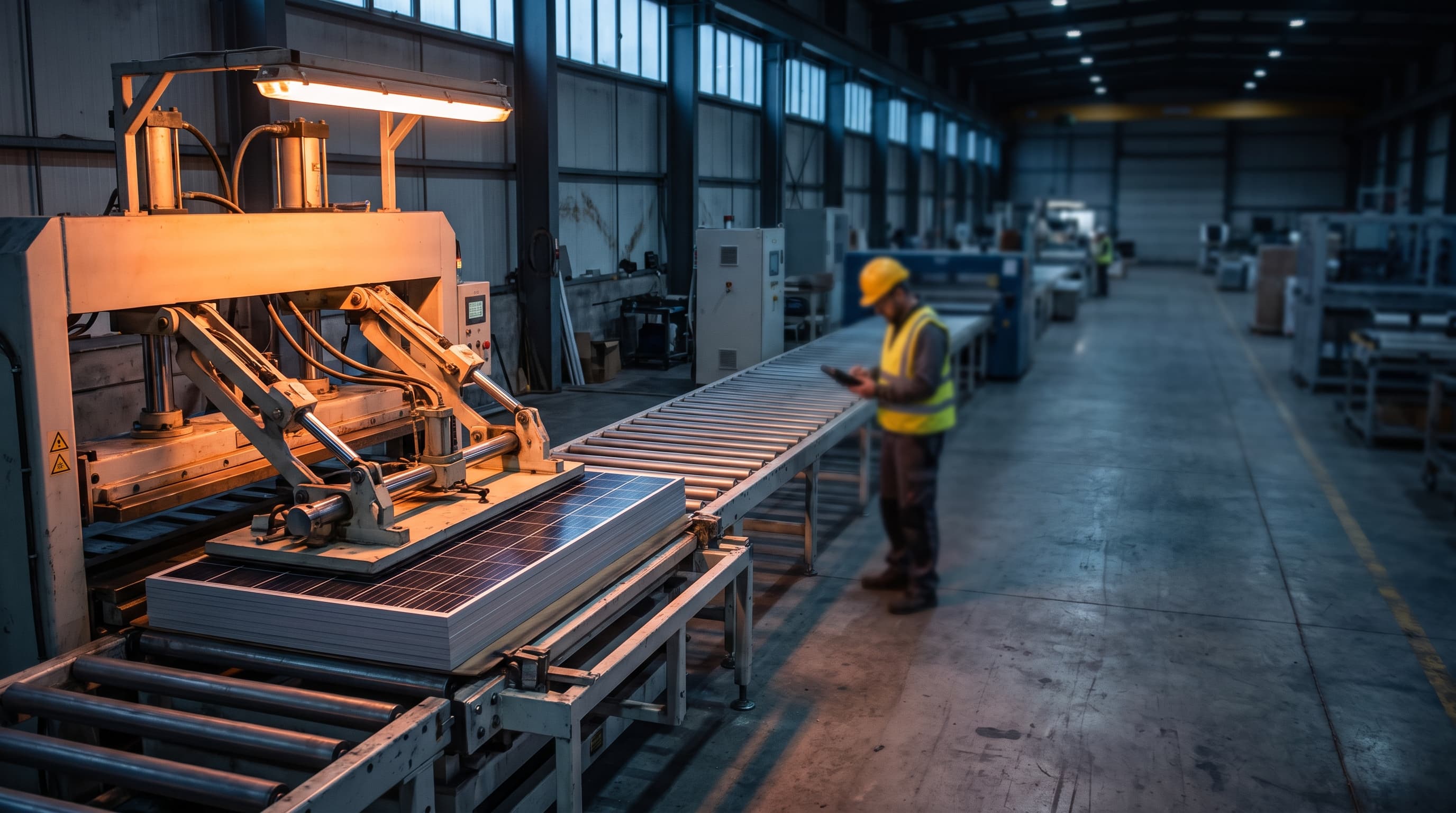
The 45X tax credit manufacturing companies claim is a federal production credit paid per unit sold, not per dollar invested. Producers of solar, wind, inverter, battery, electrode active material and critical mineral components earn it on components produced in the United States and sold to unrelated persons, then take the cash through direct pay or a transfer.
That distinction matters more than it sounds. An investment credit rewards a capital event and then sits on the balance sheet waiting for tax capacity. Section 45X accrues with throughput. Every eligible unit that ships increases the credit, which means the finance function that controls the number is production accounting, not the tax department alone. It also means the credit behaves like a per-unit price improvement rather than a one-time subsidy, and it can be modeled directly into contribution margin.
What 45X pays, by component
The statute sets most rates per physical unit, with a short list of components credited as a percentage of production cost. The rates below come from 26 U.S.C. 45X(b).
| Eligible component | Credit rate | | --- | --- | | Solar module | 7 cents per DC watt | | Photovoltaic cell | 4 cents per DC watt | | Photovoltaic wafer | $12 per square meter | | Solar grade polysilicon | $3 per kilogram | | Polymeric backsheet | 40 cents per square meter | | Torque tube | 87 cents per kilogram | | Structural fastener | $2.28 per kilogram | | Battery cell | $35 per kWh of capacity | | Battery module (with cells) | $10 per kWh of capacity | | Battery module (no cells) | $45 per kWh of capacity | | Central inverter | 0.25 cents per AC watt | | Utility inverter | 1.5 cents per AC watt | | Commercial inverter | 2 cents per AC watt | | Residential inverter | 6.5 cents per AC watt | | Microinverter, distributed wind inverter | 11 cents per AC watt | | Wind blade | 2 cents per watt of rated turbine capacity | | Wind nacelle | 5 cents per watt | | Wind tower | 3 cents per watt | | Offshore wind foundation (fixed platform) | 2 cents per watt | | Offshore wind foundation (floating platform) | 4 cents per watt | | Offshore wind vessel | 10% of sales price | | Electrode active material | 10% of production costs | | Applicable critical mineral | 10% of production costs | | Metallurgical coal | 2.5% of production costs |
Note the inverse scaling on inverters. A microinverter earns 44 times the per-watt rate of a central inverter, which is a deliberate policy tilt toward distributed product lines and a real input to product mix decisions.
The general phase-out starts with sales after Dec. 31, 2029: 75% of the rate in 2030, 50% in 2031, 25% in 2032 and nothing after that. Applicable critical minerals other than metallurgical coal run one year behind, at 75% in 2031, 50% in 2032, 25% in 2033 and zero thereafter.
The three tests that gate every claim
Per the IRS guidance on the advanced manufacturing production credit, a component qualifies only if all three of the following hold. Treat them as three independent controls, because they fail for different reasons and are documented by different people.
-
Produced by the taxpayer. The component must result from substantial transformation of constituent elements, materials or subcomponents into a complete and distinct eligible component.
-
Produced in the United States or a U.S. possession, at a facility that did not claim the Section 48C credit.
-
Sold to an unrelated person during the taxable year.
"Substantially transform," decoded
The final regulations (TD 10010, published Oct. 28, 2024) settled the question that had been keeping module assemblers awake. As Troutman Pepper Locke's analysis details, Treasury replaced the proposed "mere assembly" language with "minor assembly." The practical effect is that a producer is not disqualified simply because a third party performs a finishing step. For solar modules and battery modules, where the value added is assembly by definition, that change is the difference between a claim and no claim.
The final regulations also recognize both primary production, from non-recycled materials, and secondary production, from recycled feedstock. A recycler that transforms recovered material into a complete and distinct eligible component is producing it. The regulations apply to components produced and sold after 2022, for tax years ending on or after Oct. 28, 2024, a point corroborated in PwC's summary of the final rules.
The working test for an operations team is simple to state and hard to fake: did the inputs that entered this line leave it as a different, complete, distinct eligible component? If the answer depends on paperwork rather than on what the line physically did, the claim is weak.
The unrelated-party sale rule and its three escape hatches
Most integrated manufacturers sell first to an affiliate, which looks fatal until you read the exceptions. There are three.
-
Sale-through. If a related person sells the component onward, the taxpayer is treated as having sold to an unrelated person.
-
Deemed sale on integration. Integrating, incorporating or assembling a produced eligible component into another eligible component that is then sold to an unrelated person is treated as a sale. A cell built into a module you sell is a sale of the cell.
-
The affirmative election. Under 45X(a)(3)(B) a taxpayer may elect to treat related-party sales as unrelated-party sales, with a certification filed using Appendix B of the Form 7207 instructions.
The final regulations also softened the related-party anti-abuse rule: defects arising after the deemed sale point do not violate it, because they occur in the ordinary course of business. Contract manufacturing arrangements may allocate the credit between the parties by written agreement, which makes the tolling contract itself a tax document. Read yours before the next production year starts.
Costing discipline for the 10% credits
For electrode active materials and applicable critical minerals, the credit equals a percentage of production costs, so the cost accounting team, not the tax team, sets the size of the credit. The final regulations allow both direct and indirect material costs in the base, subject to three conditions worth building into the ERP now:
-
Costs cannot relate to materials that were already eligible components when acquired.
-
U.S. extraction costs count only if the claiming taxpayer incurred them.
-
The same costs cannot be claimed against two different eligible components.
That third condition is the one that trips vertically integrated producers. If a cost flows into both a critical mineral claim and an electrode active material claim, one of them is wrong, and reconstructing the allocation two years later from journal entries is expensive.
What the One Big Beautiful Bill Act changed
The One Big Beautiful Bill Act, enacted July 4, 2025, reshaped the back half of the credit's life:
-
Wind ends early. The credit terminates entirely for wind energy components produced and sold after Dec. 31, 2027. Wind component lines have roughly one more full production planning cycle.
-
Metallurgical coal is in, briefly. Added as an applicable critical mineral at 2.5% of production costs, with eligibility ending for coal produced after Dec. 31, 2029, per Hunton's analysis.
-
Integration gets narrower in 2027. As Kirkland & Ellis notes, from 2027 the primary component must be integrated into the secondary component at the same facility, and at least 65% of the secondary component's direct material costs must be attributable to the taxpayer's domestically produced primary components.
The 2027 integration rule is a siting decision disguised as a tax rule. If your cell plant and module plant are in different states, the deemed-sale path that works today does not work then. That is a capex conversation for this fiscal year, not for 2027.
The prohibited foreign entity problem
Prohibited foreign entity rules apply to 45X components sold after July 4, 2025, with ownership-based restrictions applying to tax years beginning after that date. A taxpayer that receives "material assistance" from a prohibited foreign entity is disqualified outright.

IRS Notice 2026-15, released Feb. 12, 2026, supplied the first workable mechanics. For eligible components the material assistance cost ratio is total direct material costs minus prohibited foreign entity direct material costs, divided by total direct material costs. As RSM US flags, the 45X version excludes direct labor from the calculation, unlike the 45Y and 48E versions. Do not reuse the same model across credits.
The notice offers three interim safe harbors: an identification safe harbor and a cost-percentage safe harbor keyed to the 2023 to 2025 Domestic Content Safe Harbor tables, plus a certification safe harbor permitting reliance on supplier certifications. Taxpayers must attach a statement identifying which one they used. The thresholds climb annually by component class. For solar energy components, 26 U.S.C. 7701(a)(51) requires 50% in 2026, 60% in 2027, 70% in 2028, 80% in 2029 and 85% after 2029.
This is now the leading cause of stalled 45X transactions. Eligibility is rarely the issue; proving the supply chain is. Build the bill-of-materials data model with supplier-level country and ownership attributes before the sale year, because reconstructing direct material cost origin at filing time is what kills deals.
Turning the credit into cash
Two monetization paths exist. Under 6417(d)(1)(D), a taxable producer may elect direct pay for 45X. The election binds for the election year plus the four succeeding taxable years ending before Jan. 1, 2033, revocable year by year but not reversible into a sale for the covered period. Otherwise the credit can be sold for cash under 6418 to an unrelated buyer that is not a specified foreign entity.
Pricing has been strong. Crux, a transfer marketplace, reports 45X paper trading at roughly $0.91 to $0.94 per dollar, with a weighted average near $0.910 in the third and fourth quarters of 2025, a high of $0.937 in the first quarter of 2026 and $0.925 in the second quarter of 2026. Trade coverage of the Crux 2025 market report put $3 to $5 billion of 2025-vintage 45X credits still available to transact entering 2026. Treat vendor-reported pricing as market color, not as a quote.
The structural reason 45X trades tighter than investment-style credits is the absence of recapture exposure. Once product eligibility and a completed sale are established, there is nothing for the IRS to claw back from a buyer. That changes what buyers diligence: they underwrite documentation of production and sale, and increasingly the foreign entity file, rather than the ongoing operation of a project.
The filing path
The mechanics are specific and the lead times are long. Per the Form 7207 instructions and the IRS guidance on registering for elective payment or transfer:
-
Pre-filing registration. Obtain a registration number per facility through IRS Energy Credits Online before making an elective payment or transfer election. Renew annually. The IRS recommends submitting at least 120 days before the return due date including extensions, and no earlier than the beginning of the tax period in which the credit is earned.
-
Form 7207, filed per facility. It reports the registration number, facility location and coordinates, whether a related-person election was made, confirmation that no 48C credit was claimed at that facility, and component-level sales volumes.
-
Form 3800. The credit flows to the general business credit.
-
Appendix B certification if you made the related-person election.
What to instrument now
A plant finance team can get ahead of all of this with four moves. First, tag eligible components at the SKU level in the ERP with the unit of measure the statute uses (DC watts, AC watts, kWh, kilograms, square meters), because shipment quantity in the wrong unit is not evidence. Second, extend the bill of materials with supplier country and ownership fields to support the material assistance cost ratio before the sale year closes. Third, map which facilities perform integration today against the 2027 same-facility and 65% direct material cost test. Fourth, start the pre-filing registration at least 120 days out, per facility, and calendar the annual renewal.
Then work the dates backward by component family: wind ends after 2027, metallurgical coal after 2029, the general phase-out begins with 2030 sales, and non-coal critical minerals run through 2033. The credit is generous, liquid and finite, and the constraint on capturing it is documentation discipline built two years before the return is due.
Related reading
Sources
-
26 U.S. Code 45X, Advanced manufacturing production credit (Cornell LII)
-
Advanced Manufacturing Production Credit, Internal Revenue Service
-
Treasury and IRS guidance on material assistance by prohibited foreign entities (Notice 2026-15)
-
26 U.S. Code 7701 (definitions, material assistance cost ratio thresholds)
-
IRS Issues Final Regulations on Section 45X Credits, Troutman Pepper Locke
-
Final regulations under Section 45X address eligible components, PwC
-
IRS issues guidance on material assistance of a prohibited foreign entity, RSM US
-
One Big Beautiful Bill Act Brings Big Changes to Green Energy Tax Credits, Kirkland & Ellis
-
Metallurgical Coal Added as Critical Mineral for Section 45X, Hunton
-
Section 45X tax credit: A 2026 guide for manufacturers, Crux
-
Crux 2025 Market Intelligence Report coverage, Renewable Energy Magazine
-
26 U.S. Code 6417, Elective payment of applicable credits (Cornell LII)