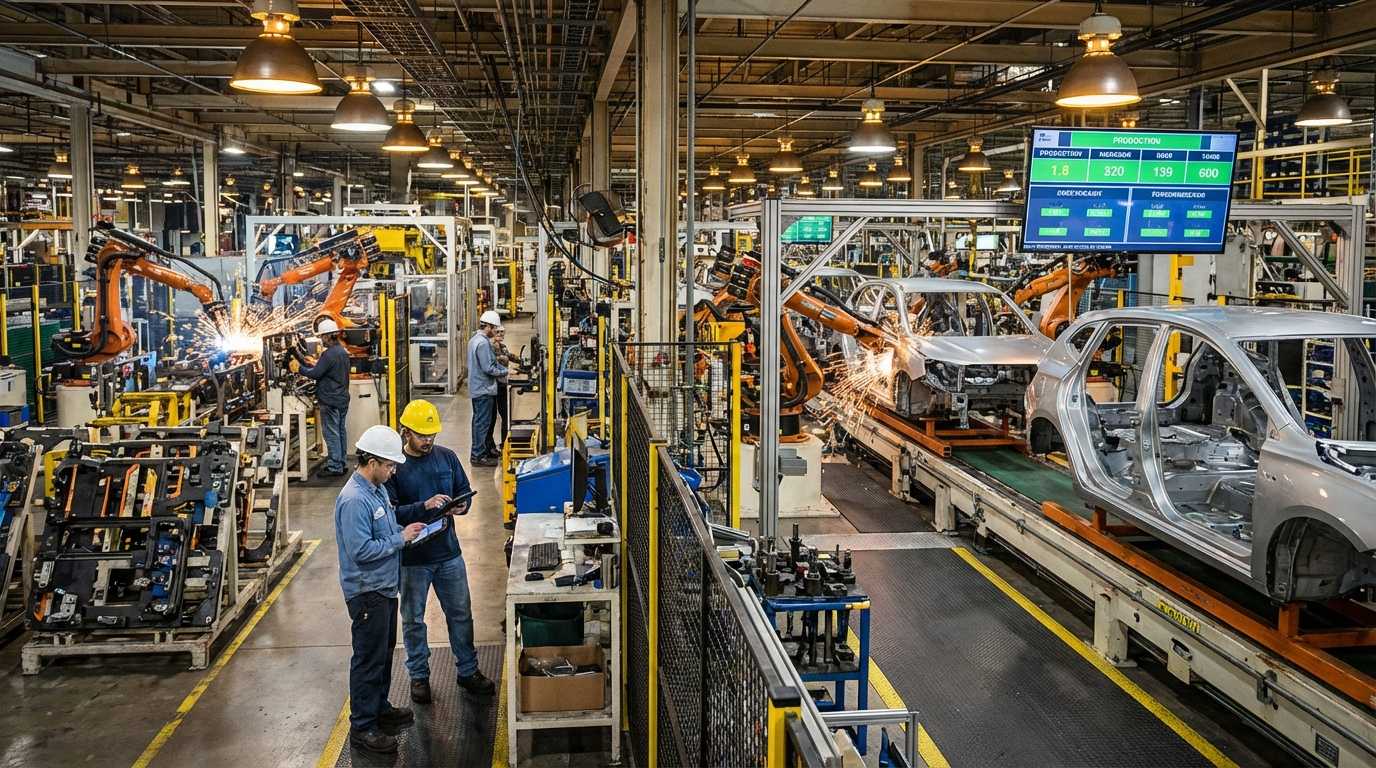
Automotive Takt Times Drop to 45 Seconds: The Hidden Cost of Retooling Legacy Lines
Forty-five seconds sounds like an operations victory. On an automotive line that had been built around a 58-second takt, it usually is not. It is a forced compression of every weak point the plant has been tolerating for years: conveyors that were fast enough but not flexible enough, fixtures designed for one vehicle architecture, torque tools that drift out of sync during launch, operators who know the legacy sequence cold and now have to relearn the job while production still has to ship.
That pressure is landing at a time when the broader factory economy is giving plant managers very little room to miss. Federal Reserve data shows U.S. industrial production edged up to 102.551 in February 2026 from 102.396 in January. Manufacturing capacity utilization also ticked higher, to 75.5088% from 75.4563%. But manufacturing employment slipped to 12.573 million from 12.585 million. Durable goods orders were effectively flat in January, $321.314 billion versus $321.342 billion in December. The signal is straightforward. Output targets are still there. Labor relief is not. And fresh demand is not strong enough to absorb a messy launch.
That is why retooling legacy automotive lines has become less of an engineering exercise and more of a margin defense project.
What a 45-second takt actually means on a legacy line
A drop from 58 seconds to 45 seconds is a 22.4% reduction in available cycle time per station. In practical terms, a line paced at roughly 62 jobs per hour now has to support about 80. That sounds manageable on a PowerPoint slide. On a 15-year-old body shop or final assembly line, it changes the economics of almost everything around the process.
Legacy lines were usually balanced around a narrow product family, a known labor mix, and a tolerable amount of manual recovery. A skipped clip install, a harness routing issue, or a seat-set mismatch could be fixed because the line still had breathing room. Remove 13 seconds and those recovery windows disappear. The line no longer absorbs variability. It amplifies it.
The first casualty is almost always station balance. The slowest operation, not the average one, starts defining throughput. Plants discover that six stations can hit 43 seconds, eight can hit 45, and one stubborn station sits at 52 because the robot reach is awkward, the presentation rack was never redesigned, or the job still depends on a two-handed manual step that engineering hoped would somehow get faster during launch. It does not.
Legacy hardware is usually the real bottleneck
Automotive retooling budgets tend to focus on the obvious hardware: new end effectors, model-specific nests, updated controls, additional vision, maybe a few cobots on subassembly. The expensive surprises sit in the infrastructure underneath. Conveyors become the problem. Lift tables become the problem. The old PLC architecture becomes the problem. And sometimes the plant learns, late and painfully, that the weld cell can make rate while the downstream marriage station cannot.
That is the hidden tax of legacy assets. They were not designed for the current product mix, the current traceability expectations, or the current tolerance for unplanned downtime. A conveyor zone that was acceptable at 58 seconds starts starving and blocking stations at 45. A fixture designed for one body style now has to support tighter variant mix with less changeover time. The old controls backbone may technically still run, but integration work balloons because every new subsystem needs translation, workarounds, and testing that nobody budgeted correctly in the first gate review.
Plants usually call this commissioning risk. Finance should call it what it is: deferred capex coming due all at once.
Scrap and launch losses eat the savings faster than most teams expect
The sales pitch for takt compression is familiar. More units through the same building. Better fixed-cost absorption. Lower labor cost per vehicle. Sometimes that math pencils out. Often it pencils out only after a launch period that is far uglier than the capital request admitted.
Consider a line moving from 58 to 45 seconds across two shifts. If planned output rises from roughly 992 units per day to 1,280, the theoretical gain is 288 units daily. But if first-pass yield falls just 2 percentage points during launch, if overtime rises to cover quality containment, and if the plant loses even 90 minutes a day to microstoppages that were not present at the old rate, the margin benefit starts leaking immediately. Add premium freight for a few constrained components and the so-called savings period stretches out by quarters.
That is where experienced launch teams focus first. Not on nameplate rate. On the cost of instability. Scrap, rework, offline repair, inspection labor, battery of temporary maintenance technicians, supplier sort crews parked near receiving. None of that shows up in the glamorous version of the retooling story. It definitely shows up in the monthly operating review.
Hybrid demand is complicating line design
The market context is not helping. Several OEMs spent the last two years recalibrating EV volume assumptions while keeping hybrid and ICE production alive longer than earlier plans suggested. That leaves many North American plants trying to do two contradictory things at once: prepare for a different propulsion mix and keep legacy lines productive enough to protect current earnings.
That usually produces compromise. Battery tray handling gets added into a building that was optimized for powertrain installation. New underbody operations are introduced without fully rebuilding material flow. Variant complexity rises because the plant has to support multiple propulsion packages, trim combinations, and software content levels on equipment that already struggled with simpler sequencing. The line becomes more configurable on paper and more fragile on the shop floor.
In that environment, a 45-second takt is not just faster. It is less forgiving of product strategy indecision.
Labor does not disappear, it shifts to harder work
There is still a bad habit in automotive capex planning, treating automation as if it removes labor instead of changing where labor sits. Legacy retools prove the opposite. When takt drops, direct touch time has to shrink, but the plant often adds labor around the line to keep it alive: launch support, maintenance, quality technicians, material handlers, controls engineers, and team leaders spending entire shifts chasing recurring faults.
The February employment print underscores the point. Manufacturing employment is no longer expanding fast enough to solve execution problems with extra hiring. Plants are being asked to launch faster with tighter staffing. That means the remaining people need more skill, not less. Controls troubleshooting, fixture validation, torque traceability, and digital work instruction adoption become frontline operational issues.
And training windows are usually too short. Legacy operators who were excellent on the previous sequence can struggle when work content is redistributed across stations or when one manual step becomes three device-dependent steps with confirmation logic. At 58 seconds, a worker can recover from hesitation. At 45, hesitation becomes backlog.
Tooling lead times still distort the schedule
Retooling calendars keep assuming the supply base can behave like it did before the pandemic. It still cannot. The worst lead times have improved, but large fixtures, custom weld tooling, specialty controls components, and validation services are not available on the kind of just-in-time schedule corporate timing charts still pretend is normal. Plants are compressing installation into shorter shutdown windows because product timing demands it. Suppliers are then forced to ship partial solutions, unfinished debug packages, or tooling that still needs significant floor-side adjustment.
The result is predictable. The plant takes its downtime, installs what it has, restarts under pressure, and uses production time to finish work that should have been closed before start of regular output. That is not launch discipline. That is borrowing from OEE to protect the milestone chart.
For legacy lines, the problem gets worse because old mounting points, utilities, and structural limitations create fit-up issues that nobody sees until the equipment is in the building. A new fixture can be perfect in the supplier run-off and still lose days once it meets old concrete, old datums, and old cable routing.
Why some plants still make the math work
The plants that manage aggressive takt reductions without blowing through margin tend to share a few habits. They do ugly prework. They map bottlenecks at the station level before approving rate targets. They budget for controls cleanup, not just shiny new automation. They validate material presentation and ergonomics early, because those are usually cheaper fixes than downstream downtime. And they protect launch staffing even when corporate asks for immediate labor savings.
They also stage the rate ramp honestly. Instead of pretending the line will jump from 58 to 45 in one clean motion, they build intermediate gates around first-pass yield, mean time between failure, and planned versus actual labor content. That sounds slower. It is usually faster in the only metric that matters, stable saleable output.
There is also a discipline issue. Good plants refuse to carry bad process forward. If a manual workaround kept the old line running, they either engineer it out or explicitly cost it into the new takt plan. The worst launches happen when plants keep tribal fixes hidden until the new cycle time exposes them.
The hidden cost is not the robot, it is the instability
Most boardroom discussions about automotive retooling still center on capital spend. How much for the fixtures. How much for the robots. How much for the controls upgrade. Those are the visible costs. The hidden cost is instability after restart, the weeks or months when the plant is technically running but not really producing at economic rate.
That instability shows up in familiar places. OEE slips because short stops multiply. Cpk falls out of the comfortable range on stations that were barely holding tolerance before the launch. Changeovers take longer than planned because part presentation was never truly debugged at target mix. Maintenance starts living in reactive mode, burning shift after shift on nuisance faults that individually look minor and collectively wreck output. None of this is dramatic enough to trigger a press release. It is dramatic enough to erase the labor savings case.
At current utilization levels, many manufacturers do not have enough slack elsewhere in the network to shrug off a bad ramp. They also do not have a labor market that will generously supply extra skilled support every time a launch goes sideways. So the old habit of accepting messy commissioning as part of the business is getting more expensive.
That is why the 45-second target deserves skepticism, not applause. On a clean-sheet line, maybe it is just engineering. On a legacy line, it is a test of whether the plant has actually paid down years of deferred operational debt. Most have not. And that gap usually gets settled in overtime, scrap, and missed schedule attainment.
What plant leaders should watch next
Three numbers matter more than the headline takt target over the next two quarters: first-pass yield after launch, minutes lost to small stops, and labor hours parked in support roles that were supposed to disappear. If those numbers move the wrong way, the throughput gain is cosmetic. If they hold, the plant probably did the hard work before restart.
The broader data says the sector still wants more output without materially more labor. That puts legacy automotive plants squarely in the crosshairs. They will keep pushing for faster takt, more flexible lines, and lower cost per unit. Fair enough. But the plants that treat retooling as a fixture swap are going to keep eating margin. The ones that treat it as a full-system redesign have a shot, especially if purchasing, maintenance, quality, and operations stay aligned through ramp.
For ManufacturingMag readers tracking launch risk, that is the real story. Not whether a line can be set to 45 seconds. Whether it can live there profitably at scale.
Get ManufacturingMag updates: Sign up for the newsletter for more reporting on automotive production, automation capex, and what the latest factory data means on the shop floor.