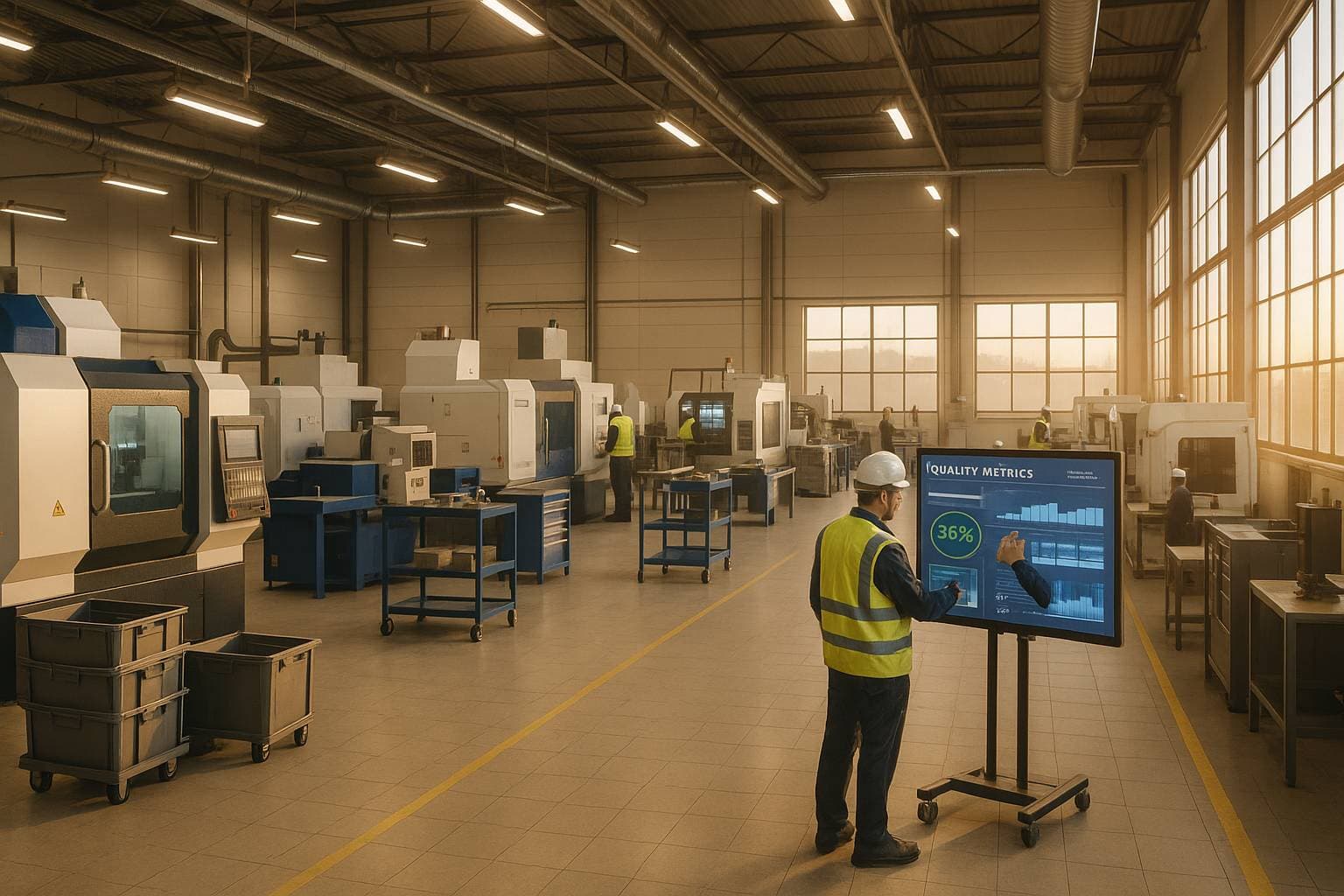
The Best Plants Deadline Is Two Weeks Out. This Year's Applications Show What Operational Excellence Costs in 2026
April 3. That is the deadline for the 2026 IndustryWeek Best Plants Awards, and the application sitting open on a plant manager's screen right now is doing something no consultant or quarterly review ever quite manages. It is forcing an honest accounting of what operational excellence actually costs to build, maintain, and prove.
The Best Plants process is not a trophy hunt. It is a structured audit of whether a facility has invested real dollars in the fundamentals that separate world-class operations from the vast middle of American manufacturing. OEE. First-pass yield. Safety. Employee engagement. Continuous improvement depth. The application demands specifics: three years of trend data, dollar figures, participation rates, project counts. Vague claims about lean culture do not survive the review. Numbers do.
And the numbers, for most plants, are uncomfortable. Average OEE across discrete manufacturing sits at 66.8 percent. World-class starts at 85 percent. Only three percent of facilities sustain that level. The gap between 66.8 and 85 is not a training problem or a motivation problem. It is a funding problem. Operational excellence costs serious money, and in 2026, with capex hesitation spreading across the sector, most plants are not spending it.
What Operational Excellence Actually Requires on the Balance Sheet
Start with the technology layer. A manufacturing execution system, the backbone of real-time production visibility, runs $500,000 to north of $2 million for a mid-size plant. The average MES project in North America lands around $800,000 in direct costs. But that number is misleading, because integration work, connecting the MES to existing PLCs, ERP, SCADA, and quality systems, adds 40 to 60 percent to the budget. A plant that budgets $800,000 and ends up spending $1.2 million is not the exception. It is the norm.
Then there is the human infrastructure. Continuous improvement staff, the people who actually run kaizen events, coach operators, facilitate DMAIC projects, and maintain the discipline that keeps gains from eroding, load at $150,000 to $250,000 per head depending on experience and geography. A plant serious about CI needs three to five of them. That is $450,000 to $1.25 million in annual personnel cost before a single project launches.
Training sits on top. Programs that build Green Belts, cross-train operators, and develop frontline problem-solving capability cost $250,000 or more per year at a plant running 200 to 500 employees. Lean Six Sigma Green Belt projects, the workhorse of structured improvement, deliver an average ROI of $68,000 in eight to 12 weeks. The math works. But only if the plant funds enough of them, and funds them consistently, year after year.
Add it up. A facility that wants to compete for Best Plants status, that wants to sustain OEE above 85 percent and first-pass yield above 98 percent, is looking at $1.5 to $2.5 million in year-one investment and $750,000 to $1.5 million annually to maintain it. That is not a line item most CFOs approve without a fight. And in 2026, the fight is harder than usual.
The Macro Environment Is Testing Every Plant's Commitment
Manufacturing capacity utilization sits at 75.5 percent. Employment has slipped to 12.573 million, down 12,000 from the prior month. Durable goods orders are effectively flat at $321.3 billion. None of these numbers scream crisis, but none of them scream confidence either. They describe an industrial economy running steady enough to avoid layoffs in most sectors, but not strong enough to make CFOs feel generous about discretionary capex.
Rockwell Automation's Q1 earnings told the story from the vendor side. Orders fell 8 percent, driven by machine builders pausing automation spending after two years of heavy post-pandemic capex. Controls hardware, MES licenses, and integration services all feel that pullback directly. Plants that were planning MES deployments or OEE monitoring upgrades are pushing timelines into Q3 or Q4, waiting for order books to firm up before committing.
That hesitation is rational in isolation. It is also precisely the behavior that keeps most plants stuck at 66.8 percent OEE.
Manufacturing capex is projected to rise just three percent in 2026. Barely ahead of inflation. The global MES market continues growing at 9.2 percent CAGR, headed toward $29.3 billion by 2031, but adoption remains concentrated among the plants that were already investing. The gap between the three percent running world-class operations and everyone else is not closing. It is widening, because the leaders keep spending through soft patches while the rest wait for conditions that never feel quite right.
What Best Plants Winners Actually Did to Get There
Hoffer Plastics, a repeat Best Plants winner out of South Bend, Indiana, runs 500-plus kaizen events every year. Not workshops. Not suggestion boxes. Structured events with defined scope, measurable targets, and follow-through audits. The company sustains 99.45 percent on-time delivery to customer request dates, a number that requires the kind of operational discipline most plants aspire to in slide decks and ignore on the floor.
That discipline did not materialize from a single initiative or a consultant engagement. Hoffer funds two or more full-time continuous improvement engineers. Every operator participates in improvement events. Daily gemba walks are standard, not ceremonial. The training budget is protected, not raided when quarterly numbers get tight. And 500 kaizen events per year compounds. Each one shaves minutes, reduces scrap, tightens a process. Multiply that by five years and the cumulative effect is a plant that operates at a fundamentally different level than its competitors.
Raymond Corporation's Greene, New York facility tells a similar story with different specifics. Raymond doubled production volume and achieved a 35 percent improvement in quality, all through Toyota Production System implementation. No massive automation build. No greenfield expansion. TPS. Standardized work. Visual management. Andon systems. Jidoka. The kind of investment that shows up less in capex reports and more in training hours, CI headcount, and the thousands of small process changes that only work when management commits to the system for years, not months.
Raymond's transformation mirrors the challenge facing automotive plants compressing takt times on legacy lines. The physics are similar: extract more throughput from existing assets without sacrificing quality. Raymond proved it works. But the enabling investment, the TPS infrastructure, the training, the cultural commitment, took years to build and costs real money to sustain.
The Application Exposes What Plants Talk About Versus What They Fund
Best Plants evaluators are experienced manufacturing professionals. They have seen hundreds of applications. They know what padding looks like. A plant that claims lean culture but reports 12 kaizen events in a year is not lean. It is dabbling. A plant that lists an MES implementation but shows OEE data only from the past six months is telling evaluators that it just started tracking. A plant that reports high employee engagement but offers no data on training hours, certification completions, or retention rates is asserting something it cannot prove.
The application demands three years of trend data across key metrics. That requirement alone eliminates most facilities, not because their numbers are bad, but because they do not have the systems in place to generate them. If a plant cannot produce three years of OEE data broken down by line, that plant does not have production monitoring infrastructure. If it cannot show first-pass yield trends by product family, it does not have quality data systems mature enough to support real improvement. The absence of data is itself the finding.
And evaluators weigh sustainability heavily. A one-year spike in performance followed by backslide tells them the gains were project-driven, not system-driven. Winners show consistent upward trends, or, even better, consistently high performance maintained across years. That is harder. It requires the boring work of standard work audits, layered process checks, and the relentless follow-through that keeps improvements from regressing the moment the project team moves on to the next problem.
Labor Investment Is the Part Nobody Wants to Talk About
Every Best Plants winner invests heavily in people. Not just headcount. Capability. The same skilled labor constraints hitting TSMC's Phoenix fab show up in different form at every manufacturing facility trying to sustain operational excellence. A plant running at 85 percent OEE needs operators who can troubleshoot, not just run parts. It needs maintenance technicians who practice predictive and preventive methods, not just reactive repair. It needs CI practitioners embedded in every shift, not siloed in an office running reports.
Training that produces these capabilities costs money. $250,000 annually is a reasonable baseline for a 300-person plant running serious development programs. Green Belt certification, problem-solving workshops, cross-training matrices, leadership development for frontline supervisors. Plants that treat training as overhead cut it first when budgets tighten. Plants that treat it as investment protect it.
And then there is retention. Manufacturing wages have climbed 4 to 5 percent annually over the past three years. Best Plants winners routinely pay 10 to 15 percent above local market rates for skilled operators and maintenance technicians. That premium is not generosity. It is math. Replacing a trained operator costs $15,000 to $25,000 in recruiting, onboarding, and lost productivity. Replacing a skilled maintenance tech costs more. Winners pay to keep people because the alternative is more expensive, and because operational excellence depends on institutional knowledge that walks out the door every time someone quits.
Why the Best Plants Deserve the Investment Anyway
None of this is cheap. But the plants running 66.8 percent OEE are not saving money by underinvesting. They are spending it differently, on expediting, on scrap, on overtime to compensate for downtime, on quality escapes that become warranty claims, on the perpetual firefighting that consumes engineering hours without ever resolving root causes.
A plant running 85 percent OEE versus one running 67 percent on the same equipment is producing roughly 27 percent more good product in the same hours. On a $40 million annual revenue operation, that delta is worth north of $10 million in throughput. Even after accounting for the $1.5 to $2 million annual investment in CI infrastructure, MES, training, and staffing, the payback is overwhelming. Green Belt projects alone, at $68,000 average ROI each, can fund a significant portion of the program if a plant runs 15 to 20 per year.
Best Plants winners understand this. Their applications do not just report metrics. They show the investment trail that produced them. They connect dollars to outcomes, training hours to yield improvements, kaizen events to OEE gains, MES deployments to downtime reductions. That connective tissue is what evaluators look for, and it is what most applicants cannot provide, because the investments were never made or were made inconsistently.
April 3 is two weeks out. For the plants that have done the work, the application is documentation. For the plants that have not, it is a mirror. Both uses are valuable. But only one produces a winner.
Frequently Asked Questions
What is the IndustryWeek Best Plants 2026 application deadline?
The deadline is April 3, 2026. Applications require detailed operational data spanning at least three years across metrics including OEE, first-pass yield, safety performance, employee engagement, and continuous improvement activity.
How much does it cost to build a Best Plants caliber operation?
Initial investment typically runs $1.5 to $2.5 million, covering MES deployment ($500,000 to $2 million), CI staffing ($450,000 to $1.25 million annually), and training programs ($250,000 plus per year). Sustaining those capabilities costs $750,000 to $1.5 million annually. Lean Six Sigma Green Belt projects deliver average ROI of $68,000 each in eight to 12 weeks, which offsets a significant portion of ongoing program costs.
What OEE level qualifies as world class in manufacturing?
World-class OEE starts at 85 percent, broken down as 90 percent availability, 95 percent performance, and 99.9 percent quality. Average discrete manufacturing OEE sits at 66.8 percent. Only three percent of manufacturing facilities sustain 85 percent or above consistently.
Should plants invest in operational excellence during a capex slowdown?
Best Plants winners consistently invest through economic soft patches. Manufacturing capacity utilization at 75.5 percent means substantial waste exists in most operations. Structured improvement programs, particularly Lean Six Sigma projects, deliver fast ROI that funds further investment. Plants that defer CI spending during slowdowns typically widen the performance gap with competitors who maintain investment.
Get ManufacturingMag in your inbox. Subscribe for weekly coverage of operational excellence, factory capex trends, automation economics, and the metrics that actually move manufacturing performance. No fluff. Just the numbers and analysis plant leaders use to make decisions.