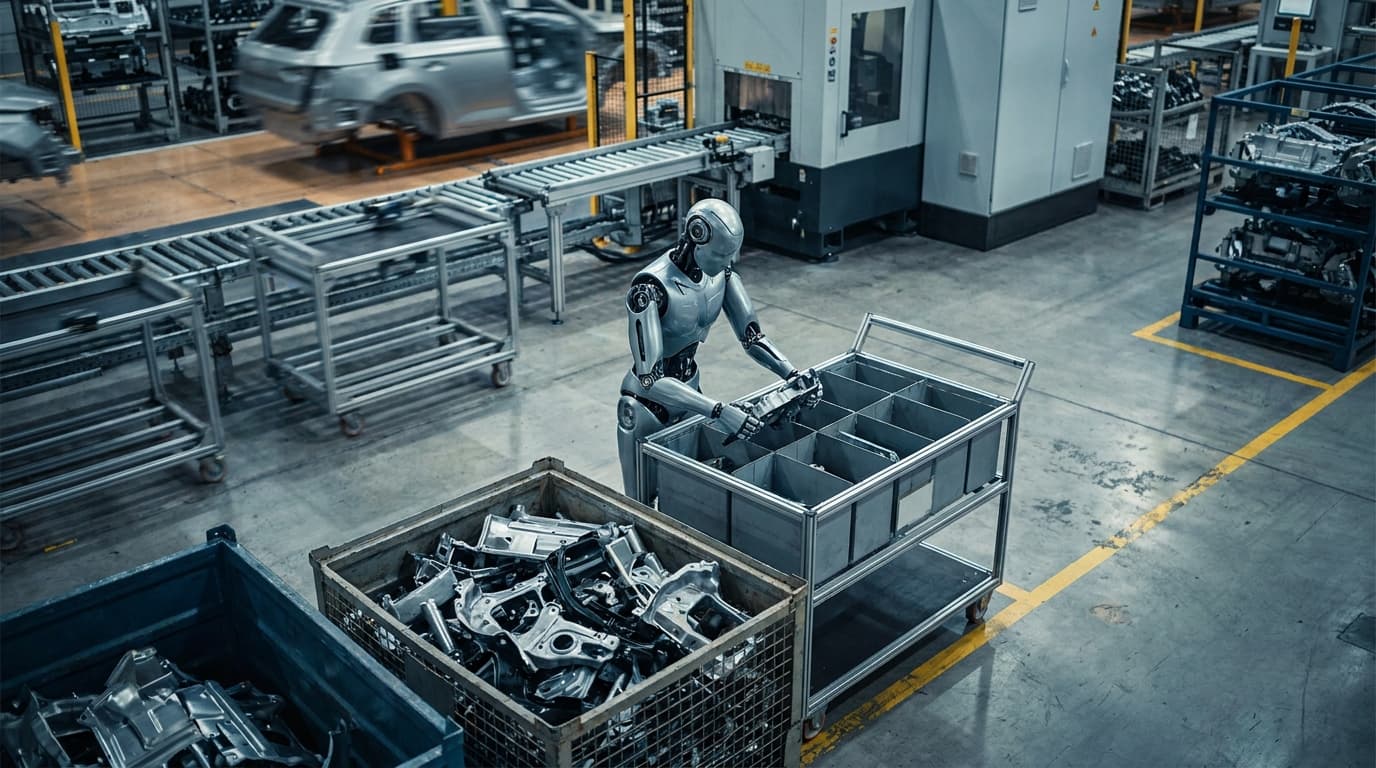
BMW Group has moved Figure AI's third-generation humanoid, the Figure 03, onto live logistics work at its Plant Spartanburg complex in South Carolina — putting a general-purpose robot inside the material flow of a running automotive plant rather than a demo cell. The task is deliberately unglamorous: the robot picks unsorted components out of bulk containers and sorts them into sequencing trolleys, the trolleys that feed BMW's just-in-sequence delivery to the line. That is exactly the kind of repetitive, ergonomically taxing handling work operators have spent decades trying to engineer away.
What makes the announcement, made in late June 2026, more than a press event is the address. Spartanburg is the same plant where an 11-month [Figure 02 pilot](https://www.figure.ai/news/production-at-bmw) loaded sheet-metal parts into welding fixtures in the body shop and, by Figure's account, contributed to the production of more than 30,000 BMW X3 vehicles. BMW vice president Ulrich Wieland has called the site "the birthplace of humanoid robotics in BMW Manufacturing's operational day-to-day activities." For a manufacturing-operations audience, that continuity is the story: this is the most production-validated third-party humanoid deployment on a U.S. automotive line to date, and it offers the clearest evidence yet of what humanoids can and cannot credibly do on the factory floor right now.
What the robot actually does
The Figure 03 job at Spartanburg is a pick-and-sort loop. It reaches into large containers of mixed, unsorted parts, identifies and grasps individual components, and places them into sequencing trolleys arranged in the specific order the assembly line will consume them — the essence of just-in-sequence supply. Once a trolley is filled, automated tugger trains and Smart Transport Robots move it to the assembly employees who need those parts, in that order, at that moment, per The Robot Report's account of the logistics flow.
The choice of task is itself the analysis. BMW did not put the humanoid on paint, final trim, or line-rate assembly. It put it on kitting and sequencing — variable-position picking from bulk into an ordered container. That is where a two-armed, human-shaped machine with dexterous hands has a real edge over fixed automation: the parts arrive unsorted and unoriented, the picking geometry changes constantly, and the surrounding infrastructure (trolleys, aisles, tugger routes) was built for humans. A humanoid slots into that human-scaled environment without re-engineering the cell. Sequencing and kitting, not the assembly line's beat, is the realistic entry point for this class of robot today.
The proof behind the milestone
The reason BMW can graduate to live logistics is that the prior generation produced a measurable operating record rather than a highlight reel. Over the 2025 pilot in the body shop, Figure reports the Figure 02 loaded more than 90,000 parts into welding fixtures across 1,250-plus hours of runtime, took roughly 1.2 million steps and walked more than 200 miles on the floor, held a 84-second total cycle time — with the load portion at about 37 seconds — and sustained better than 99% placement accuracy per shift while running 10-hour shifts, Monday through Friday. Independent trade coverage from Repairer Driven News corroborates the 11-month duration and the eventual retirement of that deployment.
Those numbers are what a "proving ground" actually validates: not that a humanoid can perform a task once, but that it can perform it thousands of times per shift, at a stable cycle time, with defect rates low enough not to poison downstream quality. A greater-than-99% placement rate still implies missed placements at scale, so the human oversight and exception-handling wrapped around the robot matter — but the record is credible evidence that the platform can hold a production cadence, which is precisely the bar most humanoid demos never clear.
What's new in Figure 03
The Figure 03 is not a spec bump; per Figure's own material, it is a redesign around the company's Helix vision-language-action AI. The headline changes are sensory and manual: improved hands with tactile sensors and palm cameras, wireless charging for higher availability, soft cover components for safety around people, and speech-to-speech audio. Figure says the F.03 carries 9% less mass and significantly less volume than the F.02 — one of the few absolute hardware comparisons the company confirms.
Those upgrades map directly onto a sequencing task. Tactile sensing and palm cameras address the hardest part of picking unsorted parts from a bin — knowing you have a secure grasp on an object whose position and orientation you did not control. Wireless charging attacks the availability problem: a logistics robot that tops up without a manual docking step loses fewer minutes per shift, and uptime is where the economics live. The soft safety covers reflect that this robot works near people in aisles rather than inside a caged body-shop station. Third-party spec databases such as Humanoid.guide estimate figures like a roughly 60 kg mass, about 20 kg payload, near 5-hour runtime with a 2 kW fast charge, and 16 degrees of freedom per hand — but Figure publishes few absolute numbers, and those should be treated as unofficial estimates, not confirmed specs.
The economics
BMW has not disclosed what it pays per unit, and Figure has not published an official Figure 03 price. What circulates in trade coverage is a roughly $130,000 early-production or deployment cost for industrial units, against Figure's long-term consumer target of around $20,000 at scale, per secondary sources including RoboZaps. Treat any per-unit figure as an estimate in the $100,000–$250,000 range, not a BMW-confirmed number.
The more important economic signal is manufacturability. Figure engineered the 03 for high-volume, low-cost production and builds it at BotQ, a facility whose first-generation line is rated for up to 12,000 units per year, with a stated goal of 100,000 units over four years. Figure has reported more than 350 Figure 03 units delivered and a production ramp from one unit per day toward roughly one per hour by mid-2026, per its production update. For a buyer, that ramp matters as much as the sticker: a humanoid is only a fleet strategy if the vendor can actually build fleets, and it only pays back if the target work — ergonomically demanding, hard-to-staff logistics labor — is expensive and persistent enough to amortize a six-figure unit over years of multi-shift runtime. The pick-from-bulk, sort-to-sequence task fits that profile better than most.
Deployment reality for operators
The honest timeline is measured in months, not weeks. On the Figure 02 pilot, the verifiable arc was roughly six months to first delivery and about ten months to full active-line deployment — a useful planning anchor for anyone modeling their own humanoid integration, and a corrective to any expectation of a multi-week drop-in. BMW also runs robot development in parallel at Spartanburg and at Figure AI, which is how the platform gets tuned to a specific plant's parts, containers, and flow rather than a generic benchmark.
The Spartanburg work sits inside BMW's iFACTORY digital-production program; Hall 52 at the plant assembles X3 variants and is slated for the future electrified iX5. Integrating a humanoid into that logistics chain meant fitting it to existing sequencing trolleys, tugger-train routes, and Smart Transport Robot handoffs — the robot is one node in an already-automated material flow, not a standalone showpiece. That is the realistic integration pattern operators should expect: the humanoid earns its place by absorbing a specific handling step within infrastructure that already exists.
Competitive context
What separates this from the rest of the humanoid field is the customer relationship. Tesla's Optimus is a captive, in-house program; Boston Dynamics' Atlas work with Hyundai is largely development-and-demonstration within an affiliated group; and traditional industrial-robot leaders like FANUC dominate fixed and articulated automation rather than legged humanoids. BMW and Figure represent something different: a third-party humanoid running inside a live, unaffiliated customer's production logistics, with a measurable prior deployment behind it. That arms-length, production-validated posture — vendor robot, customer line, real cycle-time data — is the distinction that matters for operators evaluating whether humanoids are a procurement category yet or still a research one.
Bottom line
Read soberly, the Spartanburg deployment tells operators what humanoids credibly take over in automotive today: repetitive kitting, sequencing, and pick-and-place handling in human-scaled logistics environments — not paint, not final assembly, not the line's beat. BMW frames the machines as targeting "monotonous, ergonomically demanding, or safety-critical" tasks and positions them as protecting employees rather than cutting headcount, which is both a labor-relations posture and an accurate description of where the technology's edge currently is.
The open questions are the ones worth tracking: how far task breadth expands beyond bin-picking and sequencing, whether uptime economics hold across multi-shift, multi-month operation once wireless charging and exception-handling are stress-tested, and whether BotQ's production ramp can actually deliver fleets at a unit cost that pencils against logistics labor. Spartanburg has moved humanoids from demonstration to a validated, if narrow, production role. The next test is whether that role widens — and whether the payback math survives contact with a full year of real shifts.
Related reading
-
[$1.765 Trillion Pledged, Hundreds of Thousands of Jobs Empty: The Reshoring Boom's Binding Constraint Was Never Capital](/article/reshoring-boom-labor-not-capital-binding-constraint)
-
[Tesla Retired the Model S/X Line to Build Optimus — Fremont Is Now Designed for 1 Million Robots a Year](/article/tesla-fremont-model-sx-line-optimus-1-million-units)
Sources
-
F.02 Contributed to the Production of 30,000 Cars at BMW — Figure AI
-
BMW Group deploys Figure 03 humanoid after tests with previous version — The Robot Report
-
[BotQ: A High-Volume Manufacturing Facility for Humanoid Robots — Figure AI](https://www.figure.ai/news/botq)
-
[Humanoid robots complete 11-month project at BMW plant — Repairer Driven News](https://www.repairerdrivennews.com/2025/11/25/humanoid-robots-complete-11-month-project-at-bmw-plant/)
-
Humanoid robot Figure 02 helps build over 30,000 BMW X3s — heise online
-
Figure AI Figure 03 Specs & Price — Humanoid.guide (unofficial estimates)
-
Figure 03 Price & Release Date 2026 — RoboZaps (cost context)