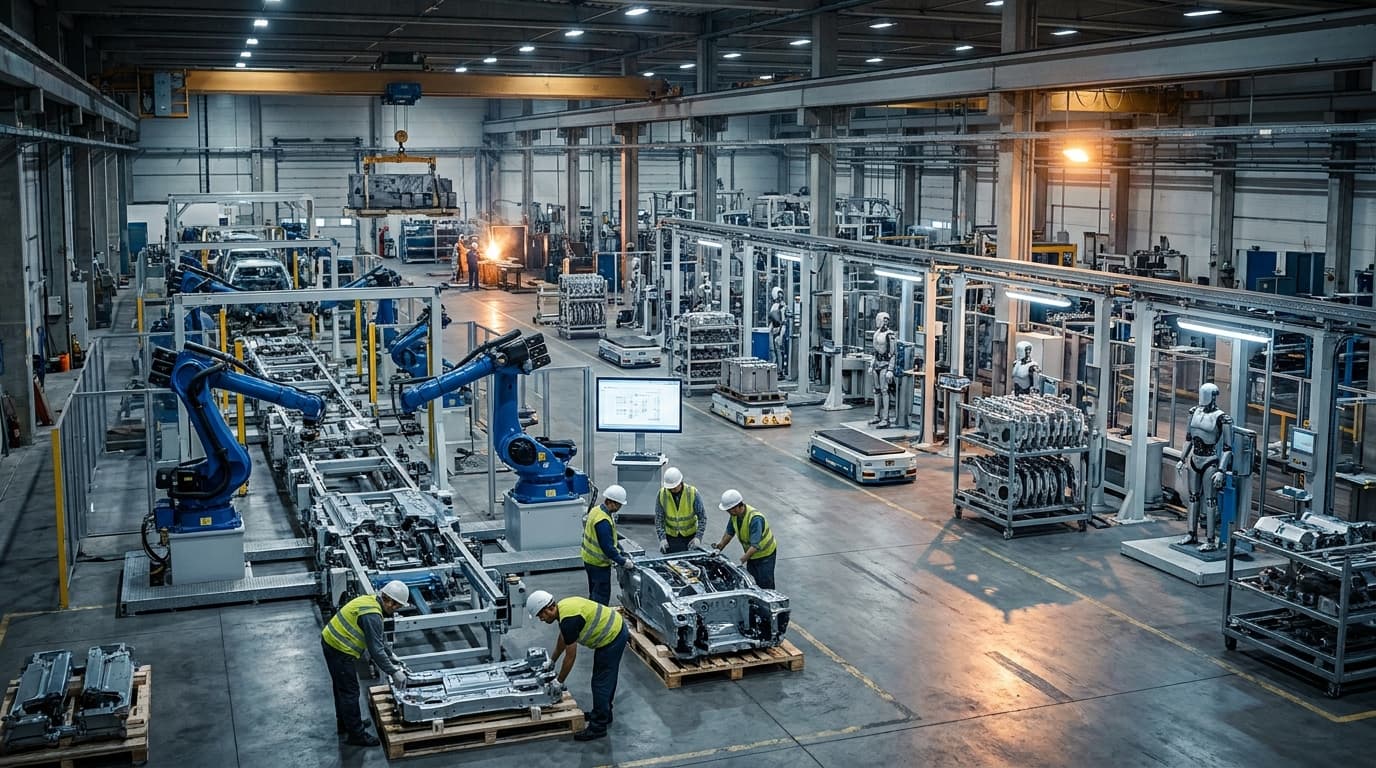
The headline is a humanoid robot. The story for manufacturing operators is a capital-allocation decision. In early May 2026, Tesla wound down production of the Model S and Model X at its Fremont, California plant — a retirement it had telegraphed on its Q4 2025 earnings call in late January 2026 — and repurposed the floor space to build its Optimus humanoid robot. On July 10, 2026, Tesla published footage showing crews had stripped the original S/X assembly line down to bare concrete in just 46 days.
Strip away the novelty and what remains is a familiar industrial question: can a company that has spent two decades learning to build cars at volume apply that discipline to a fundamentally different, 10,000-part product — and make the unit economics close? Tesla is betting yes, and it is designing the converted Fremont line for a long-term capacity of up to one million Optimus units per year.
What actually happened, and when
The sequence matters because it reveals how fast Tesla is willing to move fixed assets. The Model S and Model X — the cars that established Tesla's brand but sell in comparatively low volumes — saw their last units come off the Fremont line around May 10, 2026. Crews then dismantled the assembly line, removing concrete pits, robotic arms, and conveyors, completing the teardown in 46 days. Tesla released video of that demolition on July 10, 2026.
(One dating note for readers tracking this closely: some early coverage placed the footage on July 1, which appears to conflate a separate early-July site visit by Elon Musk with the July 10 video release.)
Low-volume Optimus production on the converted line is targeted to begin in late July or August 2026, with a third-generation (Gen 3) version of the robot slated for a mid-2026 unveiling. Musk has been explicit that early output will be modest — "quite slow," in his words — because each robot carries roughly 10,000 unique parts, a bill of materials complexity that resists a fast ramp.
Importantly, Fremont is not exiting automotive. The site continues to build the Model 3 and Model Y, Tesla's two highest-volume vehicles. Only the low-volume S/X line was retired. In practical terms, Tesla freed up its least-utilized automotive floor space and redeployed it to its newest product line — a textbook reallocation of underused capacity rather than a wholesale pivot away from cars.
The automotive-scale thesis
The most instructive part of this move is not that Tesla is building a robot; plenty of firms are. It is that Tesla is treating humanoid production as a high-volume automotive manufacturing problem rather than a robotics R&D project. Designing a line for up to one million units a year is a statement of intent about cost structure, not just output.
That intent shows up in Musk's stated long-term target: roughly $20,000 in cost of goods per unit at scale, with consumer pricing floated below about $25,000. Those numbers only become achievable through the levers automakers know well — volume, vertical integration, part-count reduction, and manufacturing learning curves. A 10,000-part product built by the tens of thousands is an expensive science experiment; the same product built by the hundreds of thousands, on a line engineered like a car plant, is where the cost curve bends.
The risk is equally automotive: ramp risk. Complex assemblies with thousands of unique parts are notoriously slow to bring to steady-state yield, and Musk's own "quite slow" caveat is a direct acknowledgment that designed capacity and realized output are two very different things in the early quarters.
Tesla as its own first customer
The economic test Tesla is running is whether the maker can also be the buyer. Optimus units have been deployed inside Tesla's own plants — reportedly handling tasks such as 4680 battery-cell sorting and parts kitting on the factory floor. If a humanoid robot can earn its keep doing real work inside the same factories that build it, Tesla captures both sides of the transaction and validates the product without waiting for an external market to form.
That is the bull case. It is also, for now, mostly a case rather than a result.
The reality check operators should not skip
On the January 2026 earnings call, Musk conceded that essentially none of the on-floor Optimus units were yet doing genuinely useful, productive work. Current in-plant deployment is largely for learning and data collection — the robots are gathering training data more than they are moving the throughput needle. The "first customer" proof point, in other words, is still early-stage.
For manufacturers evaluating humanoid robotics for their own operations, that gap between capacity design and near-term output is the number that matters. A line engineered for a million units and a fleet of robots not yet performing useful tasks are both true at the same time. The design intent tells you where Tesla wants the cost-per-unit to land; the on-floor performance tells you how far the technology is from delivering a reliable cost-per-task advantage over fixed automation that already works.
Why operators should care
A vertically integrated, self-consuming humanoid supply chain — where the same company designs, builds, and deploys the robots inside its own plants — is a structurally different proposition than buying industrial arms from a robotics vendor. It compresses the feedback loop between manufacturing and use, and it lets Tesla justify the capex partly against internal labor and productivity gains rather than solely against external sales.
Whether that model generalizes depends on questions Tesla has not yet answered at scale: reliability, uptime, and cost-per-task versus the purpose-built fixed automation that manufacturers already trust. A humanoid that is flexible but unreliable loses to a single-purpose machine that runs three shifts without complaint. The unit economics only close if the robots are both cheap enough (the ~$20,000 target) and dependable enough to displace real labor hours or capital equipment.
The forward look
Fremont is the pilot, not the endgame. Tesla is also planning a far larger Optimus line at Giga Texas, with long-term targets reported as high as 10 million units per year — an ambition that only makes sense if the Fremont line proves out the manufacturing playbook first. The iteration cadence, anchored by the mid-2026 Gen 3 reveal, suggests Tesla intends to treat the robot the way it has treated its vehicles: ship, learn, revise, and drive cost out with each generation.
For now, the honest read is that Tesla has made a bold, fast, capital-efficient bet — a 46-day teardown of a legacy line is a real signal of conviction — and has built the physical capacity ahead of the demonstrated capability. The million-unit design is a thesis about where humanoid unit economics can go. The empty-handed robots on the current factory floor are a reminder of how much still has to be proven before that thesis pays off.
Related reading
-
[Humanoids Hit Wall Street the Easy Way: Agility's $2.5B SPAC Skips the Roadshow — and Foxconn's $200M PIPE Is the Real Vote](/article/agility-robotics-churchill-spac-foxconn-pipe-humanoid-public)
-
[FANUC Just Shipped 1,000 'Physical AI' Robots — and Its Google Deal Is the Brownfield Answer to Every Humanoid Bet](/article/fanuc-google-physical-ai-brownfield-humanoid)
-
[The Humanoid Robot Cost Cliff: Why Schaeffler Just Signed for Thousands at $90K a Unit — and Bet It Hits $17K by 2030](/article/humanoid-robot-cost-cliff-schaeffler-deal)