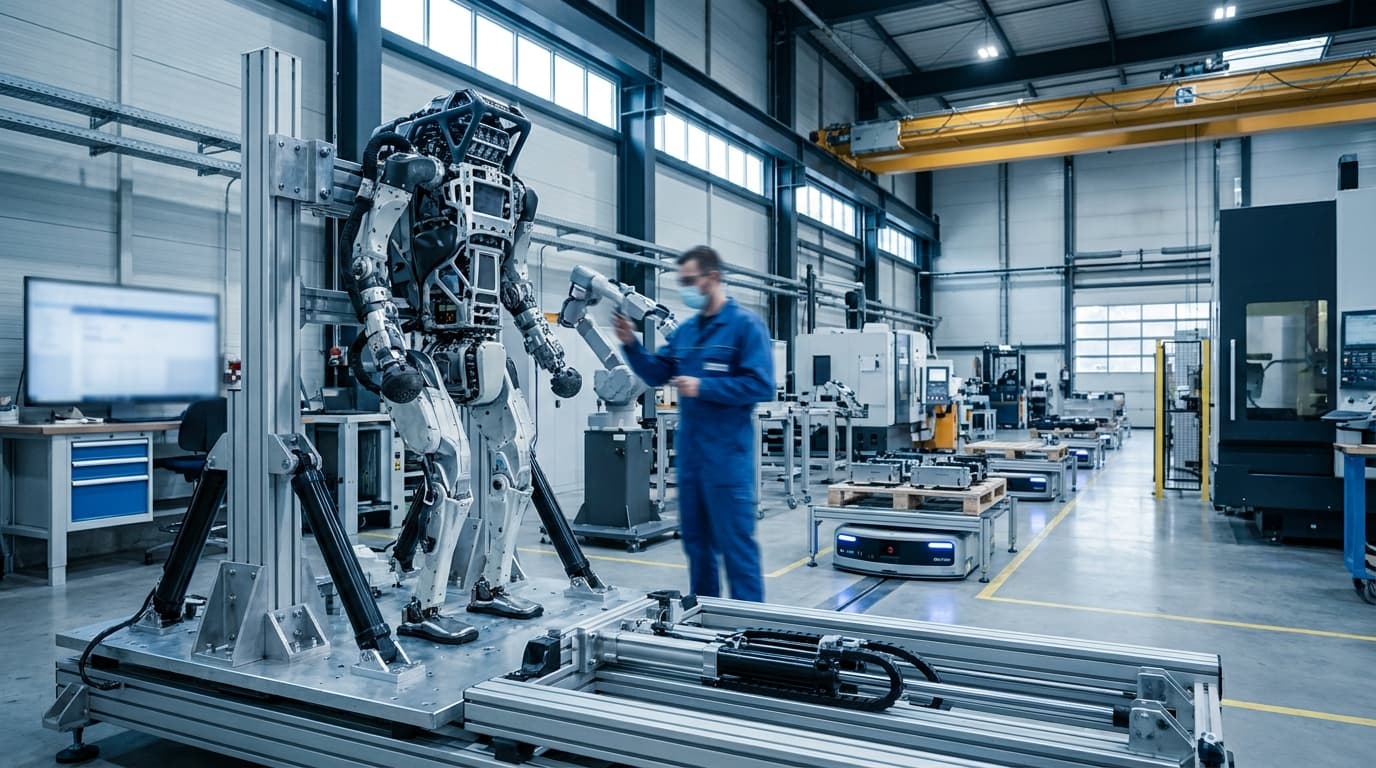
The humanoid-robot narrative has fixated on the wrong end of the factory. The pitch — robots stepping onto automotive and warehouse lines to close a structural labor gap — assumes the robots exist in volume. They don't yet. The binding question for operators and investors isn't whether a humanoid can move a tote or torque a bolt; it's who builds the robots, at what cadence, and on whose supply chain. Humanoid economics have quietly become a factory-of-factories problem, and the companies racing to solve it are now competing on throughput-per-week and first-pass yield, not demo reels.
Boston Dynamics just put a physical marker on that race.
The announcement, precisely
On June 24, 2026, Boston Dynamics announced a roughly $100 million U.S. expansion anchored by a new 323,000-square-foot advanced robotics, AI, and manufacturing center at 1601 Trapelo Road (Reservoir Place) in Waltham, Massachusetts. The site consolidates operations from three nearby facilities and, critically, co-locates manufacturing of all three of the company's platforms under one roof: Atlas, the electric humanoid; Spot, the quadruped; and Stretch, the warehouse robot.
A precise reading matters here, because the headline figures blur two different pools of money. The company's investment is the ~$100M expansion. Separately, Massachusetts is backing the project with a $25 million state Economic Development Incentive Program (EDIP) award — approved by the state's Economic Assistance Coordinating Council — tied to renovation and buildout, manufacturing, workforce training, and operations. The $25M is a state incentive, not a Boston Dynamics internal earmark. CBS Boston independently confirmed the jobs, location, and consolidation details, and the Boston Globe framed the headcount math as roughly doubling the company's local footprint.
The scale of the labor commitment: up to 1,250 new jobs by 2033, with phased move-in beginning mid-2027. Interim CEO Amanda McMaster framed the buildout as enabling the company to "launch our third robot platform this decade." For a manufacturing audience, the operative word is consolidate: putting three product lines and their production in a single facility is a bet on manufacturing efficiency and shared industrial infrastructure, not just office space.
The demand signal
The expansion lands against a demand backdrop that, on its face, looks extraordinary. Atlas's entire 2026 production run is reported fully committed to two buyers — parent Hyundai Motor Group and Google DeepMind — with additional customers expected from early 2027, according to aggregated reporting. The stated ambition is aggressive: Forbes reports a target of up to 30,000 Atlas units per year by 2028, with Hyundai Mobis having signed a framework to mass-produce Atlas hardware, backed by Hyundai's broader U.S. investment plan.
Read that "sold out" claim with discipline. Boston Dynamics has not disclosed absolute 2026 unit counts, so the phrase is relative to whatever current capacity is — being fully committed at low volume is a very different signal than being fully committed at scale. What the demand data does establish is direction: a captive first customer in Hyundai, a marquee research buyer in DeepMind, and a mass-production framework already inked. The Waltham center is the supply-side answer to that pull.
The competitive factory race
Boston Dynamics is not setting the pace on manufacturing cadence — its rivals are already ramping while Waltham comes online in phases from mid-2027.
Figure has been the most explicit about throughput. Its BotQ facility scaled manufacturing throughput 24x in under 120 days — from roughly one robot per day to roughly one robot per hour — targeting 55 Figure 03 units in a single week. The company reports 350+ units delivered, 80% first-pass yield, and more than 9,000 custom actuators produced in-house, with an eventual 50,000-per-year target. Corroborating trade coverage tracks the same cadence and the 350+ delivered figure. Those are the kinds of numbers — cadence, yield, actuator counts — that operators can actually underwrite.
Tesla reportedly began Optimus Gen 3 mass production at Fremont on January 21, 2026, converting the retired Model S/X line into an Optimus line with dedicated actuator, battery, and component sub-lines. The long-run target is 1 million units per year, with 50,000–100,000 targeted by year-end 2026. Treat those as company guidance and aspirational; they are directional intent, not shipped units.
The credibility gradient runs from disclosed operational metrics (Figure's yield and weekly cadence) to long-horizon guidance (Tesla's million-unit ceiling) to as-yet-unbuilt capacity (Boston Dynamics' mid-2027 ramp). All three are real; they are not equally verifiable.
The real constraint: a factory of factories
Here is the part the demo footage never shows. Final assembly is not the bottleneck — components are. Every serious analysis of the sector points to the same chokepoints: actuators, harmonic and strain-wave (precision) reducers, force and tactile sensors, and dexterous hands, all served by a thin global supplier base. McKinsey's analysis treats this component supply chain as the defining constraint on scaling humanoids into a billion-dollar market.
The reducer math is the tell. A single humanoid needs roughly 20 to 40 harmonic reducers to achieve human-like degrees of freedom, per supply-chain analysis. That means every weekly throughput number a manufacturer quotes is really a bet on securing tens of precision reducers per unit, times the run rate. Fifty-five robots a week is 1,100 to 2,200 reducers a week. Throughput-per-week is gated by component supply long before it's gated by how fast a line can bolt frames together.
Geopolitics of the bill of materials
This is where Boston Dynamics' U.S. consolidation play acquires strategic weight beyond a Massachusetts jobs announcement. The same analysis reports that roughly 70% of Tesla Gen 3 Optimus component value is sourced from Chinese suppliers — names like Sanhua, Tuopu, and Leaderdrive. For a program targeting a million units a year, that is a concentrated dependency on a single geography for the exact components that are already the sector's bottleneck.
Against that, Boston Dynamics building Atlas, Spot, and Stretch in one U.S. facility reads as a resilience thesis: onshoring assembly, and potentially tightening the supplier relationships around it, as a hedge against tariffs and supply disruption. Whether it also de-risks the upstream reducer and actuator supply — much of which remains China-concentrated across the industry — is the open question. Consolidating final assembly in Waltham does not, by itself, relocate the harmonic-reducer supply base.
Unit economics reality check
None of this pencils until cost comes down. Prototype-grade humanoids reportedly cost somewhere between $30,000 and $150,000 today, against a sub-$20,000 threshold generally cited for mass-market viability. Closing that gap is largely a component-cost story — which is why the reducer market itself has become an investable proxy for the whole thesis. One market-sizing estimate puts the harmonic-reducer market for humanoids at roughly $482.5 million in 2025, projected to grow at about a 58.9% CAGR through 2032. That figure is an analyst estimate, not a fact — but the growth rate implied is the market pricing in exactly the scaling that Boston Dynamics, Figure, and Tesla are all wagering on.
For humanoids to pencil on a real line, the component curve has to bend: reducer and actuator cost per unit has to fall, first-pass yield has to hold as volume climbs, and the supplier base has to widen enough that 20-to-40-reducers-per-robot stops being a scarcity constraint.
What operators should watch
The signal-to-noise filter for this sector is narrow and specific:
-
Throughput-per-week disclosures and first-pass yield — Figure has set the template; watch whether Boston Dynamics and Tesla report comparably concrete operational metrics or stick to annual-capacity aspirations.
-
Actuator and reducer supplier announcements — the real de-risking happens in the supply base. New reducer capacity, second-source actuator deals, and any onshoring of precision components matter more than assembly square footage.
-
The timeline gap — Boston Dynamics' capacity phases in from mid-2027, while Figure and Tesla are ramping now. That lead-time gap is the crux of the "who scales first" thesis.
-
Whether the labor-gap thesis survives contact with production data — the entire demand case rests on humanoids being cheaper and more available than the labor they replace. That gets tested on real lines, not in pilots.
The pacing item
The humanoid-on-the-line story has always been sold as an AI and demand story. It is, increasingly, a manufacturing and supply-chain story. Before robots can build cars, someone has to build the robots — at volume, at yield, and on a supplier base that isn't a single point of failure. Boston Dynamics' $100M Waltham bet is a credible entry into that race, but it is entering behind competitors who are already shipping, and the whole field is gated by the same thin base of reducers and actuators. The winner may well be decided in the supplier base, not the demo reel. For now, U.S. robot assembly capacity — and the resilience of the components feeding it — is the pacing item for the entire narrative.
Related reading
-
[Tesla Retired the Model S/X Line to Build Optimus — Fremont Is Now Designed for 1 Million Robots a Year](/article/tesla-fremont-model-sx-line-optimus-1-million-units)
-
[The Reshoring Boom's Mirror Image: Honda Torches $15.7B in EV Plans as GM, Ford and Samsung Idle Battery Lines](/article/reshoring-boom-mirror-image-honda-ev-writedown-battery-plants-idled)
-
TSMC Doubles Down on Arizona to $265B — Four More 2nm-and-Below Fabs, Bankrolled by a Record Quarter
Sources
-
Boston Dynamics Expands Massachusetts Footprint with New 323,000-Square-Foot Facility in Waltham — Boston Dynamics (official)
-
Boston Dynamics to build 'advanced robotics and AI center' in Massachusetts, add over 1,000 jobs — CBS Boston
-
Boston Dynamics Waltham expansion aims for big growth in MA — Boston Globe
-
Boston Dynamics Announces $100 Million U.S. Expansion Effort — Industrial Equipment News
-
[Atlas Humanoid Robots Production 'Fully Committed' For 2026, Factory Will Build 30,000 Per Year](https://www.forbes.com/sites/johnkoetsier/2026/01/06/atlas-humanoid-robots-production-fully-committed-for-2026-factory-will-build-30000-per-year/) — Forbes
-
Boston Dynamics' electric Atlas robot just sold out its entire 2026 production run — MSN (aggregated)
-
24x Throughput: Figure Scales Manufacturing to One Robot Per Hour — Humanoids Daily
-
Figure ramps humanoid robot production from one per day to one per hour — Robotics & Automation News
-
Scaling the humanoid robotics supply chain into billion-dollar wins — McKinsey
-
The Humanoid Robot's Hidden Bottleneck: It's Not the AI — It's the Supply Chain — Medium (analysis)
-
Worldwide Harmonic Reducer for Humanoid Robot Market 2026 — PW Consulting / DataM Intelligence