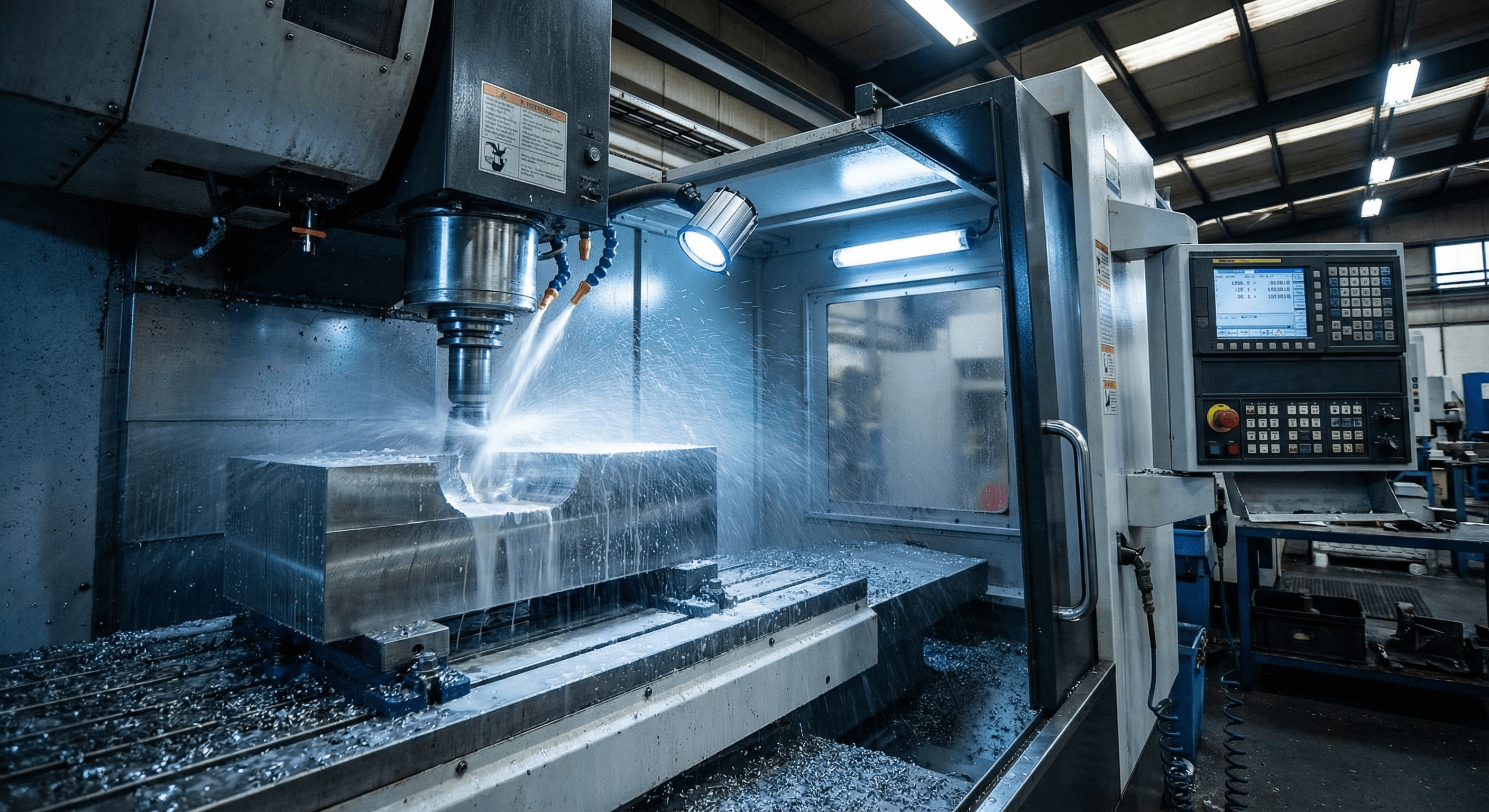
Walk through any job shop during peak hours and you'll see the reality of CNC utilization: machines sitting idle while operators search for tools, programmers debug G-code, or setups stretch into their third hour. Industry data consistently shows average spindle utilization rates between 35-45% across small to medium manufacturers, with many shops unknowingly operating closer to 25% when properly measured.
This utilization gap represents the difference between theoretical capacity and actual production output. For a shop running three Haas VF-3s on two shifts, the difference between 35% and 65% utilization translates to roughly $180,000 in additional annual capacity without buying another machine.
The Hidden Time Consumers
Setup time dominates the utilization equation in most job shops. A typical lot changeover on a vertical machining center consumes 2-4 hours, including tool changes, workholding adjustments, and first-article inspection. For shops running batch sizes under 50 pieces, setup time can exceed actual machining time by a factor of three.
Programming delays create another significant bottleneck. Many shops still program at the machine, tying up $200,000 equipment while an operator or programmer develops and proves out code. Even shops with CAM systems often lack standardized post-processors or tool libraries, leading to extensive editing and verification cycles at the machine.
Material handling presents less obvious but equally costly delays. The average operator spends 15-20 minutes per hour on non-cutting activities: loading parts, measuring dimensions, changing worn tools, and clearing chips. In high-mix environments, this figure climbs to 25-30 minutes as operators switch between different part geometries and measurement requirements.
Operator availability directly impacts utilization in shops running multiple machines per person. A single operator managing three machines creates inevitable idle time as attention shifts between setups, quality checks, and machine tending. The math works against efficiency: each machine waits an average of 10-15 minutes per hour for operator attention.
Unplanned maintenance compounds these issues. A typical 5-year-old machining center experiences 40-60 hours of unscheduled downtime annually, concentrated in 2-4 hour blocks that disrupt entire production schedules. Shops without predictive maintenance programs see higher failure rates and longer repair cycles.
Measuring True Utilization
Most shops track utilization incorrectly, measuring cycle time against available hours rather than actual spindle-cutting time. This approach inflates utilization figures by including rapid positioning, tool changes, and in-cycle inspection time as productive activity.
True utilization measurement requires tracking five distinct categories:
- Spindle cutting time (metal removal)
- Setup and changeover time
- Programming and debugging time
- Material handling and inspection time
- Maintenance and repair downtime
Modern machine monitoring systems capture this data automatically through spindle load sensors, door position switches, and cycle counters. A properly configured system distinguishes between programmed feed moves and rapid positioning, providing accurate cutting time data.
For shops without monitoring systems, manual time studies reveal utilization patterns. Track one machine for a complete week, logging all activities in 15-minute intervals. This baseline measurement often surprises management with the actual distribution of non-productive time.
The key metric becomes available spindle time rather than available machine time. If a machine operates 16 hours daily but spends 4 hours in setup, 2 hours waiting for operators, and 1 hour in material handling, only 9 hours remain available for actual cutting. A 6-hour cutting day against 9 available hours yields 67% utilization, not the 37% calculated against total machine time.
Quick-Change Tooling Systems
Implementing quick-change tooling systems reduces setup time by 40-60% in typical job shop applications. Modular tooling with pre-set tool heights eliminates individual tool measurement and adjustment during changeovers. Operators simply swap complete tool assemblies rather than breaking down and rebuilding each setup.
A shop running 10 different part families can standardize on common tooling assemblies, reducing the active tool inventory from 200+ individual pieces to 40-50 modular assemblies. This consolidation improves tool life tracking and reduces setup errors from incorrect tool selection.
Hydraulic workholding systems provide similar benefits for part loading. A pneumatic or hydraulic chuck system reduces part loading time from 3-5 minutes to under 30 seconds, while improving repeatability and reducing operator fatigue on heavy parts.
Offline Programming Implementation
Moving programming away from the machine floor increases available cutting time by 15-25% in typical environments. CAM systems with verified post-processors and standardized tool libraries enable programmers to develop proven code before machine setup begins.
Effective offline programming requires three elements: accurate machine simulation, standardized tooling databases, and systematic program verification procedures. The simulation must include actual machine kinematics and control system behavior to eliminate surprises during first-part runs.
Tool standardization proves critical for offline programming success. Shops maintaining 15-20 standard end mill sizes, drill diameters, and insert grades can program confidently without custom tool requirements. This standardization also reduces inventory costs and simplifies tool life management.
Program libraries for similar parts reduce programming time by 60-80% on repeat jobs. A well-organized CAM system maintains feature-based templates for common operations: bolt circles, pocket milling, and hole patterns transfer quickly between similar part geometries.
Pallet and Fixture Systems
Pallet systems enable setup overlapping, where one job runs while operators prepare the next setup offline. A two-pallet horizontal machining center can achieve 70-80% utilization by alternating between production and setup activities.
Even vertical machining centers benefit from standardized fixture plates and locating systems. A shop using 12-inch square fixture plates with common hole patterns can pre-setup multiple jobs, reducing in-machine setup time to fixture changes and program loading.
Dedicated fixture carts organize setup components and reduce search time during changeovers. A cart containing all fixtures, tools, and setup sheets for a specific part family enables 15-minute changeovers on jobs that previously required 2-hour setups.
Lights-Out Manufacturing
Unattended machining extends productive hours beyond normal shift operations, though implementation requires careful consideration of part mix and process stability. Simple parts with proven programs can run unmanned for 4-8 hours, effectively doubling productive capacity.
Successful lights-out operations require five elements: proven programs with adequate safety margins, reliable workholding systems, effective chip management, tool life monitoring, and emergency stop systems. Parts must run within established cutting parameters with minimal tool wear variation.
Bar feeders and pallet systems enable extended unattended runs on suitable parts. A lathe with bar feeder can produce 200+ pieces overnight, while a machining center with 4-pallet system handles multiple part types in sequence.
Remote monitoring systems alert operators to machine faults or program completion via smartphone apps. This connectivity enables rapid response to issues without continuous facility monitoring.
Realistic Target Setting
Achievable utilization targets depend on production environment and part mix. High-volume production shops with stable part families can target 65-75% utilization through dedicated fixtures and optimized processes. Job shops with frequent changeovers typically plateau at 55-65% even with excellent practices.
Shops processing 50+ different part numbers monthly face inherent utilization limitations from changeover frequency. These operations should focus on setup time reduction rather than absolute utilization percentages. Reducing average setup time from 3 hours to 90 minutes provides more benefit than marginal cutting time improvements.
Machine age and condition influence realistic targets. Newer machines with faster rapids and tool changers achieve higher utilization than older equipment. A 10-year-old machining center with 30-second tool change cycles cannot match the utilization potential of current machines with 3-second changes.
Starting with baseline measurement and targeting 10-15% improvement in the first year provides achievable goals. This improvement typically comes from addressing the largest time consumers identified in the initial utilization study.
Implementation Priorities
Focus improvement efforts on the highest-impact activities first. For most job shops, setup time reduction provides the largest utilization gain per dollar invested. Quick-change tooling and standardized workholding systems offer immediate returns with manageable implementation costs.
Operator training often yields significant improvements without capital investment. Teaching efficient setup procedures, proper tool handling, and basic preventive maintenance can improve utilization by 8-12% within 90 days.
Machine monitoring systems provide the data foundation for sustained improvement but require cultural changes to maximize effectiveness. Operators must understand that monitoring improves efficiency rather than surveillance, while management must act on the data to demonstrate system value.
The path from 35% to 60% utilization requires systematic attention to all non-productive activities, not just the obvious ones. Success comes from treating utilization improvement as an ongoing process rather than a one-time project.