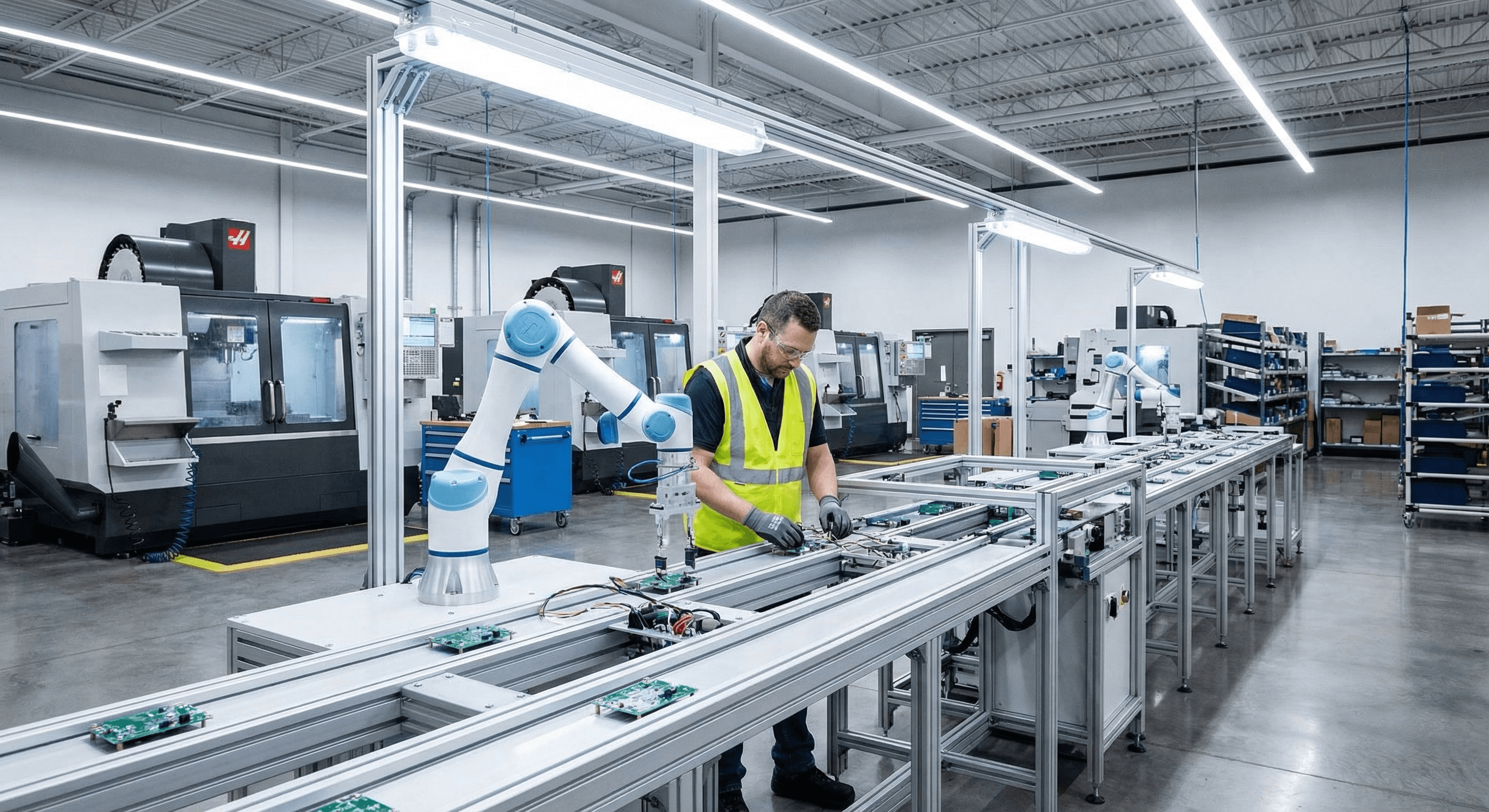
The collaborative robotics market reached a significant milestone in 2024, with global installations surpassing 2.5 million units according to data from the International Federation of Robotics. This represents a 34% increase from 2023's 1.86 million units, driven largely by manufacturing facilities that had delayed cobot deployment pending clearer safety standards and compliance frameworks.
The timing coincides with the publication of revised ISO 10218 standards in late 2023, which finally addressed critical safety assessment gaps that had emerged as cobots moved beyond their original design parameters. These updates provide manufacturing engineers with the regulatory clarity needed to justify capital expenditure and satisfy increasingly stringent audit requirements.
Safety Standards Evolution Addresses Real-World Deployment Challenges
The original ISO 10218 standard, published in 2011, established safety requirements for industrial robots but predated the widespread deployment of collaborative systems in shared workspaces. Manufacturing facilities implementing cobots between 2018 and 2022 often found themselves navigating regulatory gray areas, particularly around risk assessment methodologies and workspace design parameters.
The revised standard introduces specific protocols for dynamic risk assessment in collaborative applications. This addresses a fundamental challenge: traditional industrial robots operate in fixed, fenced environments with predictable risk profiles, while cobots function in variable human-robot interaction zones where hazard assessment must account for changing operational parameters.
Key updates in the 2023 revision include:
- Quantified force and pressure limits for different body regions during human-robot contact scenarios
- Standardized protocols for validating speed and separation monitoring systems
- Clear guidance on workspace design requirements for power and force limiting applications
- Updated electromagnetic compatibility requirements for collaborative safety systems
These changes have particular significance for regulated industries. Automotive suppliers, medical device manufacturers, and food processing facilities can now reference specific compliance pathways that were previously subject to interpretation by individual auditors and regulatory bodies.
Market Adoption Accelerates Across Manufacturing Segments
The automotive sector leads cobot adoption with approximately 680,000 units installed globally as of Q4 2024, representing 27% of total deployments. This concentration reflects the industry's early investment in collaborative assembly applications and the maturation of cobot-compatible tooling systems.
Electronics manufacturing follows with 525,000 units, driven by precision assembly requirements in semiconductor packaging and consumer electronics production. The sector's adoption rate increased 45% year-over-year, largely attributed to cobots' ability to handle delicate components without the workspace constraints of traditional automation.
Food and beverage processing installations reached 312,000 units, with notable growth in packaging and palletizing applications. The segment's growth accelerated following FDA acceptance of updated sanitary design guidelines for collaborative systems in food contact applications.
Metalworking operations deployed 298,000 units, concentrated in machine tending and finishing operations. The sector's adoption rate of 41% exceeded industry averages, driven by labor shortage pressures and the availability of cobots rated for industrial environment exposure.
ROI Metrics Drive Capital Allocation Decisions
Manufacturing executives report average payback periods of 14.2 months for cobot installations in 2024, compared to 18.6 months in 2022. This improvement reflects both declining hardware costs and increased operational efficiency as deployment practices mature.
Universal Robots, which maintains approximately 32% market share, reports that customers achieving sub-12-month payback typically implement cobots in applications with high labor content and repetitive task profiles. Material handling applications show the strongest ROI metrics, with documented productivity improvements of 23-35% and error rate reductions averaging 67%.
ABB's collaborative systems division reports similar trends, with customers in precision assembly applications documenting cycle time reductions of 15-28% while maintaining quality metrics. The company's SafeMove2 software platform, integrated with their collaborative systems, provides real-time safety monitoring that reduces the need for physical safeguarding infrastructure.
Fanuc's CR series installations in machine tending applications demonstrate average Overall Equipment Effectiveness improvements of 18%, largely attributed to reduced setup times and consistent operation during shift transitions. The company's integrated vision systems enable adaptive positioning that compensates for part variation, reducing scrap rates by an average of 43%.
Safety System Integration Becomes Standard Practice
The maturation of safety system integration represents a critical factor in cobot adoption acceleration. Modern installations routinely incorporate multiple safety technologies that work in coordination rather than as independent systems.
Pilz's PSENscan safety laser scanner, when integrated with collaborative robot controllers, provides dynamic workspace monitoring that adjusts robot behavior based on human proximity and intent. Installations using this integrated approach report 73% fewer safety-related production stops compared to installations relying solely on built-in cobot safety features.
Sick's safety light curtains and area scanners now communicate directly with major cobot platforms through standardized safety protocols. This integration enables graduated response systems where robots reduce speed, modify trajectory, or pause operation based on the specific nature of detected intrusions.
Safety-rated vision systems from Cognex and Keyence provide workspace monitoring capabilities that extend beyond basic presence detection. These systems can distinguish between authorized personnel, tools, and potential hazards, enabling more sophisticated collaborative behaviors while maintaining safety compliance.
Application-Specific Deployment Patterns Emerge
Manufacturing facilities report increasingly sophisticated cobot deployment strategies that extend beyond simple pick-and-place operations. Multi-cobot work cells, once limited to research environments, now represent 23% of new installations.
Coordinated assembly operations using multiple cobots require advanced path planning and collision avoidance capabilities. Companies like Precise Automation have developed specialized controllers that manage multiple collaborative robots within shared workspaces while maintaining safety compliance.
Mobile collaborative platforms combine traditional cobots with autonomous mobile robots to create flexible manufacturing cells. These systems can redeploy between workstations based on production requirements, providing capacity flexibility that justifies higher initial investment costs.
Quality inspection applications increasingly leverage cobots equipped with advanced vision systems and metrology tools. These installations provide consistent inspection protocols while freeing human operators for higher-value decision-making tasks.
Supply Chain and Component Availability Stabilize
Component availability constraints that limited cobot production in 2022 and early 2023 have largely resolved. Lead times for standard cobot configurations averaged 8.2 weeks in Q4 2024, compared to 16.3 weeks in Q2 2022.
The stabilization reflects both increased component production capacity and design modifications that reduce dependence on constrained semiconductor components. Major manufacturers have redesigned control systems to use more readily available processors while maintaining performance specifications.
This supply chain improvement enables manufacturing facilities to implement cobot solutions within normal capital planning cycles rather than extended procurement timelines that complicated project justification and budget allocation.
Implementation Challenges Persist Despite Standards Updates
While updated safety standards provide clearer regulatory guidance, manufacturing facilities continue to encounter implementation challenges that affect deployment timelines and costs.
Integration with existing manufacturing execution systems often requires custom software development that extends commissioning schedules. Legacy systems lack standardized interfaces for collaborative robotics, requiring middleware solutions that add complexity and potential failure points.
Workforce training requirements exceed initial estimates in many installations. While cobots are designed for intuitive operation, effective deployment requires understanding of safety protocols, basic programming concepts, and troubleshooting procedures that extend beyond traditional operator skill sets.
Facility modifications to accommodate collaborative workspaces often involve electrical, compressed air, and network infrastructure upgrades that were not included in original project budgets. These ancillary costs can increase total project investment by 15-25%.
Future Deployment Considerations
The 2.5 million unit milestone represents a foundation for continued growth, but manufacturing executives should consider several factors when evaluating cobot investments for 2025 and beyond.
Artificial intelligence integration will likely become standard in collaborative systems, enabling adaptive behavior based on production patterns and operator preferences. This capability will require updated safety assessment protocols that account for machine learning-based decision making.
Standardization efforts around cobot programming interfaces and safety protocols will continue, potentially reducing integration costs and improving interoperability between systems from different manufacturers.
As deployment volumes increase, the availability of application-specific tooling and accessories will expand, enabling more sophisticated collaborative applications while reducing custom engineering requirements.
The combination of mature safety standards, proven ROI metrics, and stable supply chains positions collaborative robotics as a viable automation solution for manufacturing facilities across multiple industry segments. Success will depend on thorough application analysis, proper safety system integration, and realistic assessment of implementation requirements beyond basic hardware procurement.