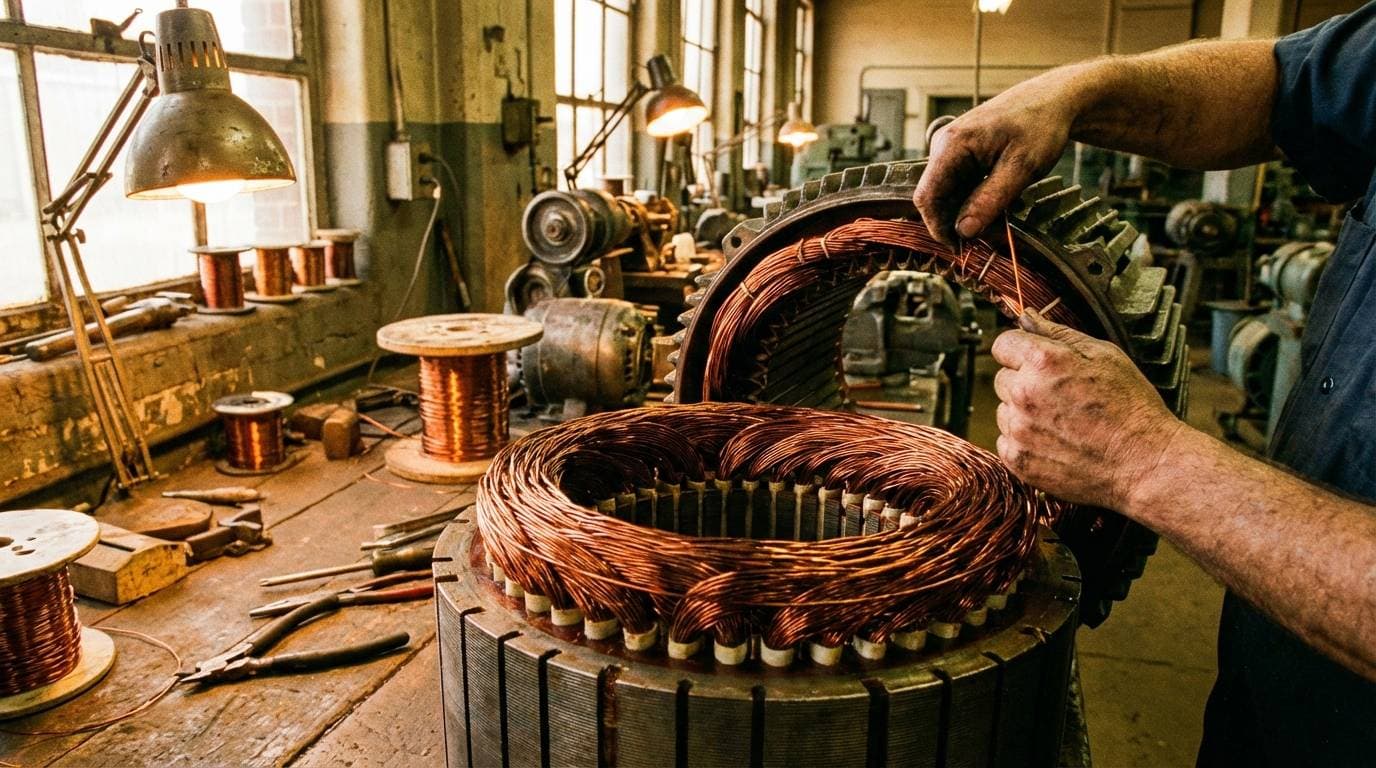
How the 15% Copper Tariff Is Wiping Out Margins for Motor Rewinders in the Midwest
Copper is not supposed to be the line item that breaks a motor rewind job. Labor usually does that. Or rush freight. Or the ugly teardown that reveals a burned stator core nobody priced in. But in March 2026, for a growing number of rewind shops across Ohio, Indiana, Michigan, and Wisconsin, copper has become the problem that sits on top of all the others.
The latest 15% tariff on imported refined copper and copper winding stock hit a trade that already runs on thin gross margins, fast turnaround promises, and customers who do not want to hear that a 250-horsepower motor rebuild now costs 12% more than it did six months ago. For a mid-size rewinder buying magnet wire every week, the tariff is not an abstract policy story. It is a direct hit to cost per job, cash flow, quote validity, and customer retention.
And the math is ugly.
Take a common 200 to 300-horsepower industrial rewind, the kind found on pumps, air handlers, compressors, conveyors, and line-side process equipment all over the Midwest. Copper content can easily run 180 to 320 pounds depending on frame size, efficiency class, and original winding design. If winding stock that cost $5.10 per pound lands closer to $5.85 after tariff, handling, and distributor markup, the copper delta alone can add $135 to $240 to a single job. On a rewind that might have carried 18% gross margin before teardown risk, that increase does not nibble at profitability. It eats it.
That timing matters because the broader input picture is not helping. Reuters' commodity market snapshot on March 18 showed the U.S. 10-year yield back above 4.2%, a sign that financing and inventory carrying costs remain elevated. Meanwhile, mortgage and bond coverage from the same week has kept inflation-sensitive commodities in focus again, and motor shops are feeling it where it hurts: working capital tied up in wire, varnish, insulation, and replacement bearings that all got more expensive before customers agreed to pay more.
The motor rewind business was never built for tariff shocks
Motor rewinders do not operate like large OEMs with annual copper contracts and procurement teams modeling geopolitical scenarios. Most are regional service businesses. Forty employees. Maybe sixty. One or two winding lines. A bake oven that has been in the building longer than half the staff. They make money on speed, relationships, and the ability to get a production motor back into service before a plant manager starts calling alternative vendors.
That business model works when input volatility stays within a band that can be covered by weekly quote updates and a little discipline on scrap recovery. It does not work well when a core material jumps fast enough to invalidate quotes before the approval email comes back.
That is what the 15% tariff has done. Shops are getting squeezed between distributors that reprice quickly and industrial customers that still expect a quote to hold long enough to clear procurement. A steel mill in northwest Indiana does not care that copper moved again on Tuesday afternoon. It cares that the 700-horsepower motor on the caster fan is down and production is already behind. The rewinder has to name a number anyway.
Where the cost increase actually lands
The headline tariff number makes the policy sound simple. The operating reality is not. Rewinders are not usually buying raw cathode directly. They are buying magnet wire, winding stock, strip, and related copper products through distributors or electrical supply channels. By the time the tariff passes through importer margin, freight, conversion cost, and distributor markup, the all-in increase can be wider than 15% on the exact material the shop uses.
That is why several Midwest rewinders are describing effective increases in the high teens on common wire sizes, especially for urgent replenishment orders and lower-volume purchases. Shops that used to keep two to three weeks of winding stock on hand are now trying to decide whether to build more inventory at higher prices or buy lean and risk getting caught short on a Friday afternoon breakdown. Neither option is attractive.
And unlike larger manufacturers that can redesign around an input problem, rewinders do not have many substitution levers. Aluminum has niche use in some applications, but not as a clean replacement in the kind of repair work that keeps heavy industrial motors running. A rewinder cannot tell a wastewater plant, a paper mill, or an automotive stamping facility that the copper problem will be solved by switching conductor materials and hoping insulation systems behave the same way. The shop has to rewind the motor to spec and return it fast.
Why Midwest shops are getting hit harder than coastal players
The Midwest still has one of the country's densest installed bases of aging industrial motors. Foundries, food processors, packaging plants, steel service centers, chemical facilities, municipal water systems, aggregate operations, and legacy automotive plants all run fleets of motors that are too important to ignore and too expensive to replace casually. That creates steady rewind demand. It also creates a customer base trained to compare repair cost against replacement cost with ruthless speed.
That replacement option has gotten more complicated. New motor lead times have improved from the worst supply chain period, but they are not normal across every size and spec. Specialty motors, older frame sizes, explosion-proof units, and certain large horsepower replacements can still push far enough out that rewinding remains the only realistic path. That should help the rewind trade. It does, up to a point.
But customers are not infinite price takers. If the rewinder pushes through a 10% to 15% price increase on a job that was already close to replacement economics, the buyer starts asking harder questions. In some cases the motor gets replaced. In some cases the plant cannibalizes a spare. And in the worst cases, maintenance defers the work entirely and runs the asset until it fails harder. None of those outcomes help the rewinder's margin mix.
There is another Midwest-specific issue: a lot of these shops serve customers with formal purchasing departments and supplier scorecards. That means quotes get reviewed, challenged, and delayed. The longer the approval cycle, the higher the odds that copper moves again before the PO lands.
Labor was already expensive. Now the material side is catching up
For years, rewinders could at least tell themselves the copper line was volatile but manageable because labor was the bigger long-term concern. Skilled winders are not easy to find. Neither are experienced teardown technicians who can diagnose whether a motor is even worth saving. Wages across industrial maintenance and repair have stayed firm, and overtime remains common in shops that promise emergency turnaround.
That labor pressure has not gone away. It has simply been joined by material inflation that the shop cannot absorb as easily.
The result is a nasty compression effect. A rewinder that used to quote a 300-horsepower rewind at $6,800 with decent confidence may now need $7,400 or $7,600 to protect the same gross margin after copper, insulation, freight, and overtime. But if the market only supports $7,100, the job still gets taken because payroll has to be covered and idle winding stations do not pay the bills. Margin disappears one quote at a time.
This is the same kind of structural squeeze that has been showing up elsewhere in manufacturing supply chains. ManufacturingMag's recent coverage of the 14-month wait for actuators in robotics showed what happens when a critical input cost or lead time stops behaving normally. The rewinder version is smaller in dollar terms, but the operating logic is the same. When a constrained input moves faster than the customer contract, the supplier in the middle gets punished first.
The tariff also changed scrap economics, but not enough
On paper, higher copper pricing should help rewinders recover some margin through scrap. Burned windings and stripped copper still have value, and shops that manage segregation well can claw back part of their input cost through scrap sales. But scrap recovery is not a clean hedge.
First, recovery yields vary by motor type and failure condition. Second, customers increasingly ask for scrap credits or expect them to be baked into the quote. Third, the timing is wrong. The shop pays elevated prices on incoming wire now, while scrap value is realized later and often inconsistently. That helps cash flow less than outsiders assume.
There is also quality risk. Shops trying to protect margin by squeezing more salvage out of teardown or by over-optimizing conductor use are playing with fire. A bad rewind is far more expensive than an expensive rewind. If slot fill, insulation integrity, or final test results get compromised because the shop tried to outsmart a tariff, the warranty cost will wipe out whatever copper was saved.
What customers are doing in response
Large industrial customers are not standing still. Some are rebidding rewind work more aggressively across multiple service shops. Some are pulling more failures toward replacement rather than repair, especially where premium-efficiency upgrades can be justified through energy savings. And some are changing maintenance strategy altogether, spending more on predictive programs and spare motor inventory to reduce emergency rewind volume.
That last point matters. Rewinders make their best money when urgency is high and competition is low. If customers respond to tariff-driven pricing by carrying more critical spares and planning maintenance windows earlier, the shop loses some of its emergency pricing power. Better planning on the plant side is rational. It is also bad news for any rewinder depending on midnight breakdown work to cover a cost structure that suddenly looks heavier.
Some customers are also challenging whether rewinding remains the right answer for older, lower-efficiency fleets. When power costs are high and reliability pressure is rising, replacing a 1990s-era motor with a new premium-efficiency unit can pencil out faster than it used to, even with replacement lead times still uneven. That does not kill rewind demand, but it pushes the trade toward the motors where repair is technically necessary and commercially messy.
How the smarter rewinders are protecting themselves
The better-run shops are responding in three ways.
First, they are shortening quote validity windows. Twenty-four hours is becoming common on larger jobs with heavy copper exposure. That is annoying for procurement teams, but it beats signing a bad PO.
Second, they are separating copper surcharges more explicitly instead of hiding everything inside one labor-and-material number. Customers may not love it, but at least the conversation becomes transparent. The shop can show where the increase came from and when it changed.
Third, they are getting more disciplined about inventory strategy. Not bigger inventory for the sake of comfort, but smarter inventory around the wire sizes and insulation systems that turn fastest. Shops that know their mix cold can still smooth some of the tariff shock. Shops that buy reactively will keep paying emergency pricing.
A few are also expanding field service and predictive maintenance offerings to reduce dependence on pure rewind margin. That shift makes sense. If copper is going to stay volatile through the rest of 2026, the service mix has to do more of the profitability work.
The next six months will tell the real story
The immediate tariff hit is already visible in March quotes. The more important question is what happens by late summer. If copper prices stay elevated and tariff policy holds, the Midwest rewind market is likely to split. Stronger shops with disciplined quoting, good distributor relationships, and enough service breadth to absorb margin swings will survive. Smaller shops that live job to job, especially the ones underpricing out of habit, are going to have a rough year.
There is a wider manufacturing implication here too. Motor rewinders sit in the background until something breaks. Then they become essential. If tariff pressure weakens that service layer, plants across the Midwest will feel it in downtime, not headlines.
That is the part policymakers rarely model. The tariff is not just raising the price of copper. It is stressing a repair ecosystem that keeps older industrial infrastructure alive. And in a region still full of aging motors, legacy equipment, and plants that cannot wait six weeks for a replacement unit, that ecosystem matters more than the headline suggests.
Get ManufacturingMag in your inbox Subscribe for weekly reporting on tariffs, capex, supply chain bottlenecks, and the cost pressures showing up first on the shop floor.