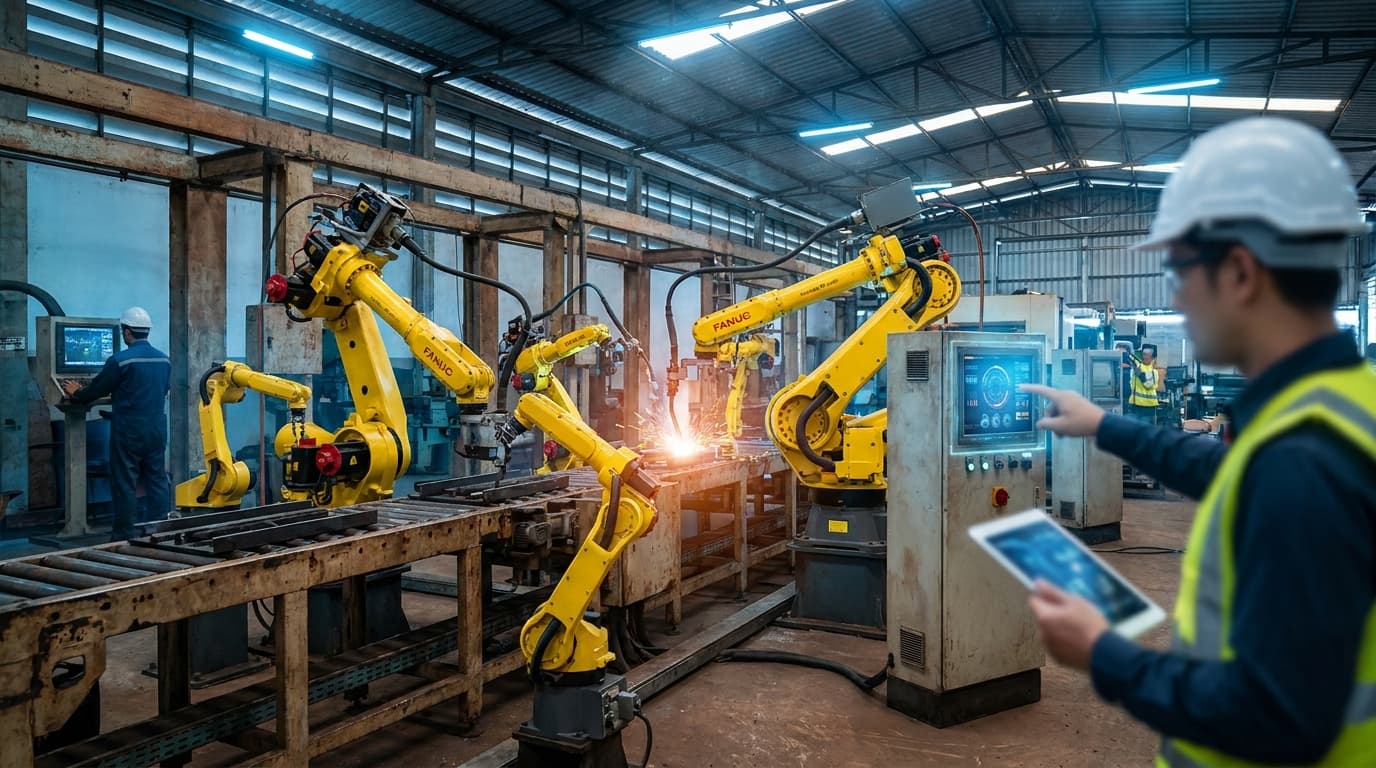
The most consequential factory-automation move of the year does not involve a walking robot. On May 19, 2026, FANUC - the world's largest industrial-robot maker, with roughly 1.1 million arms installed in factories worldwide - announced a collaboration with Google to bring physical AI to its full lineup, from 3-kilogram cobots to 2.3-ton heavy-payload machines. The pitch is not a new robot. It is a software-and-intelligence upgrade for the robots operators already own, trust, and have integrated into running lines.
That distinction is the whole story. Every quarter brings a fresh humanoid unveiling and a deployment date somewhere in the back half of the decade. FANUC's answer is quieter and, for near-term labor-gap relief, more pragmatic: don't rip and replace the installed base - retrofit intelligence onto it. The company says it has already shipped more than 1,000 robots for physical-AI applications since debuting the system at Tokyo's IREX show in December 2025, with demand accelerating. That is traction, not a demo reel.
What FANUC and Google actually announced
The May 19 collaboration stitches together three Google pieces on top of FANUC hardware. First, Google Cloud's Gemini Enterprise supplies the generative-AI agent layer - the cognitive front end that interprets instructions and makes decisions. Second, Google's Intrinsic robotics platform provides the development environment, including full compatibility with Intrinsic's web-based Flowstate visual programming tool. Third, the stack rides on ROS, the open-source robot-control standard that Google's Intrinsic group is a lead contributor to and that FANUC supports through open-source ROS drivers.
Crucially, the integration spans FANUC's entire arm catalog - the 3kg-payload machines up through the 2.3-ton heavy lifters, and explicitly including the CRX collaborative (cobot) series. In a demonstration, a Gemini-built agent understood human instructions, recognized objects, and operated FANUC robots autonomously.
Mike Cicco, president and CEO of FANUC America, framed the shift in operator terms: manufacturers are "moving beyond the question of whether to use AI and focusing on how to apply it where it matters most - on the factory floor," combining industrial-grade robotics with Google's AI while "maintaining the reliability and performance that production environments demand."
What 'physical AI' means on a real line
Strip away the branding and physical AI is the integration of cognitive intelligence with physical action: robots that perceive their environment through sensors, decide autonomously, and execute the task on hardware. The consequential word for a plant manager is autonomously. Traditional industrial robots are exquisitely precise but brittle - they repeat a programmed path and stop being useful the moment the world deviates from the program. Bolting a perception-and-reasoning layer onto that arm is what turns a fixed-motion machine into something that can adapt to variation without a re-teach.
That is the capability manufacturers have wanted for years. What is new is delivering it on machines the plant already runs, rather than on a novel form factor that has to earn its place from scratch.
The brownfield thesis: retrofit versus rip-and-replace
Here is the argument that should matter to anyone signing capex. A FANUC arm on a line has already cleared the hard gates: it is proven, reliable, integrated with the cell's safety systems, and throughput-validated in production. A bolt-on AI upgrade inherits all of that. It avoids the safety-validation burden, the throughput-proving grind, and the capital risk of introducing a brand-new class of machine.
With approximately 1.1 million FANUC robots already installed globally - a figure reported in trade coverage rather than FANUC America's press release itself - the addressable retrofit target is enormous. This reframes the automation upgrade from a hardware purchase into a software-and-integration play, which is a fundamentally lower-risk, faster-payback proposition. You are not betting on a machine class that has yet to prove it can hold a line; you are making equipment you already depend on smarter.
The counter-narrative: humanoids are a longer-horizon bet
Set that against the humanoid programs soaking up the attention. Hyundai and Boston Dynamics unveiled the new production Atlas at CES 2026, with Hyundai targeting factory deployment from 2028 - parts sequencing at its Georgia EV metaplant among the early use cases - and a stated capacity of 30,000 units a year by 2028. Impressive, and years away from committed high-volume line work.
Schaeffler is further along on the humanoid curve and still illustrates the timeline gap. The supplier has [run Agility Robotics' Digit humanoid on 8-hour shifts](https://robohorizon.com/en-us/news/2026/03/digit-humanoid-now-works-8-hour-shifts-at-schaeffler-factory/) at its Cheraw, South Carolina plant since early 2025 and took a minority stake in Agility. Separately, in May 2026 Schaeffler signed a phased supply deal with UK firm Humanoid for a four-digit number of wheeled units by 2032, with the first live in Germany in late 2026.
The pattern across both bets is the same: real capability, staged rollouts running from 2027 through 2032, and a full safety-validation and throughput-proving cycle still ahead for a new machine class. FANUC's counter is that the labor gap is a problem operators have now, and the fastest path to relief is intelligence layered onto hardware that already holds a line.
Caveats worth keeping in view
A few honest qualifications. First, the current stack is Gemini Enterprise plus Intrinsic and ROS - an agent-and-orchestration layer on industrial hardware, not a claim of unbounded, general-purpose robot autonomy. Read the demonstrations as capable task execution under instruction, not as a robot that can do anything a human can.
Second, do not conflate this with FANUC's other AI news. The company separately announced tighter integration of its ROBOGUIDE simulation with NVIDIA's Isaac Sim - a distinct physical-AI initiative, and one the trade press has been careful to hold apart from the Google deal.
Third, "1.1 million installed" is a total addressable base, not a shipped-upgrade count. How many of those arms are practical retrofit candidates - the right generation, the right controller, the right sensing - is the open question that will govern how fast the brownfield thesis actually converts into deployed intelligence.
The takeaway for manufacturers
For operators weighing where automation dollars go over the next 24 months, FANUC's message is disciplined and hard to argue with: the incumbent's bolt-on software path is the pragmatic default for near-term labor-gap relief. The 1,000-plus robots already shipped make it more than a slide. Humanoids remain a genuine, and eventually large, bet - but they are a longer-horizon one, still years from proving they can hold a production line at volume. In the meantime, the fastest return on the factory floor may come not from the newest machine, but from making the machines you already run think.
Related reading
-
[The Humanoid Robot Cost Cliff: Why Schaeffler Just Signed for Thousands at $90K a Unit — and Bet It Hits $17K by 2030](/article/humanoid-robot-cost-cliff-schaeffler-deal)
-
[Hyundai Is Building a Factory for 30,000 Humanoids a Year — Boston Dynamics' Bet That the Labor-Gap Fix Is Now a Capex Problem, Not a Software One](/article/hyundai-boston-dynamics-30000-robot-factory-capex-labor-gap)
-
[The Pentagon Guaranteed $110 a Kilo for 10 Years: Inside MP Materials' $1.25B Texas 'Magnet Independence' Bet Against China's 90% Grip](/article/mp-materials-10x-texas-magnet-plant-pentagon-price-floor-china)
Sources
-
FANUC Accelerates Physical AI Through Collaboration with Google (FANUC America)
-
FANUC Accelerates the Physical AI Through Collaboration with Google (FANUC Corporation, Japan)
-
FANUC partners with Google to advance physical AI in its robots (The Robot Report)
-
Google, Japanese firm ship 1,000 robots in automation push (Interesting Engineering)
-
[FANUC and Google Expand Physical AI in Industrial Robotics (ARC Advisory Group)](https://www.arcweb.com/blog/fanuc-google-expand-physical-ai-industrial-robotics)
-
FANUC Accelerates Physical AI in Industrial Robotics, Leveraging NVIDIA Technologies (PR Newswire)
-
[Boston Dynamics Unveils New Atlas Robot to Revolutionize Industry (Boston Dynamics)](https://bostondynamics.com/blog/boston-dynamics-unveils-new-atlas-robot-to-revolutionize-industry/)
-
[AI Humanoid Robots Central to Hyundai's Manufacturing Vision (AI Magazine)](https://aimagazine.com/news/hyundai-targets-2028-factory-rollout-for-ai-humanoid-robots)
-
Humanoid Secures Landmark Deal with Schaeffler (RoboticsTomorrow)
-
Digit Humanoid Now Works 8-Hour Shifts at Schaeffler Factory (RoboHorizon)