Intel sold common stock to the public for the first time since its 1971 IPO on August 10, 2026. The number that has stuck in headlines — $15 billion — was accurate for about eight hours. Intel announced the proposed offering at 7:45 a.m. EDT, then upsized and priced it at $20 billion the same day: 210,526,315 shares at $95.00, roughly $19.7 billion net. On August 11 the underwriters exercised the 31,578,947-share overallotment in full, taking the deal to 242,105,262 shares — approximately $23.0 billion gross and about $22.6 billion net. The offering closed August 12.
For operators and capital planners, the size revision changes the question entirely. A $15 billion raise would have covered roughly three-quarters of Intel's 2026 capital plan. A $23 billion raise exceeds it. That is not a balance-sheet repair. That is next year's tool money, raised this year, against a leading-edge node whose external demand is still a set of evaluations rather than a set of contracts.
What was actually sold
The mechanics are worth holding precisely, because most of the argument about this deal is being conducted with the pre-upsize figures.
-
Structure: underwritten common-stock offering, joint book-running managers J.P. Morgan, Goldman Sachs, Morgan Stanley and Citigroup.
-
Final size: 242,105,262 shares at $95.00 — roughly $23.0 billion gross, about $22.6 billion net after the greenshoe.
-
Dilution: against the 5.044 billion shares outstanding as of July 17, 2026 (per the deal's own disclosure baseline), the new shares are about 4.8% of the pre-deal count, roughly 4.6% of the post-deal count. The widely repeated ~3% figure holds only for the original $15 billion base at a ~$100 print.
-
Use of proceeds: deliberately unrestricted. The prospectus language is "general corporate purposes, which may include, but are not limited to, capital expenditures and working capital." There is no 14A earmark anywhere in the offering documents.
That last point deserves emphasis, because every headline tying this money to 14A — including this one — is making an inference. Intel raised unrestricted equity. The market decided what it was for. The reasoning is sound, but it is reasoning, not disclosure.
Reception was bifurcated in a way that tells you something about who was buying. The stock fell roughly 5% premarket on the announcement, while the book reportedly drew orders on the order of $100 billion. Existing holders priced the dilution; institutional buyers priced the option. Intel shares were up roughly 175% on the year going in, which is precisely the window in which a company with a capital problem should be selling equity.
The raise is bigger than the plan it is supposed to fund
On the July 23 second-quarter call, Intel raised 2026 capital expenditure guidance to more than $20 billion and said 2027 capex will run significantly above 2026, with the vast majority directed at the U.S. network. Tooling spend alone is up roughly 40% versus 2025.
Set the raise against that plan and the arithmetic is unambiguous: $23 billion gross covers 2026 with room left over. Intel did not raise to close a funding gap in the current year. It raised to pre-fund a step-up it has already told the market is coming. For anyone reading capital markets as a schedule signal — which is the correct way to read them in this industry — the message is that Intel intends to place tool orders on a timeline that requires cash on the balance sheet now, not cash generated later.
The demand backdrop makes that affordable rather than desperate. Q2 revenue was $16.1 billion, about $1.8 billion above the guidance midpoint, with non-GAAP EPS of $0.42 against $0.20 guided and gross margin of 41.8%, 280 basis points above guide. Data center and AI grew 59% year over year; AI-driven businesses grew more than 70% and now represent roughly 70% of revenue. Q3 is guided to $15.8–16.8 billion and $0.38.
The customer picture, stated accurately
The strongest version of the bear case is not that Intel has no 14A customer. It has one, publicly named. On Tesla's April 23, 2026 earnings call, Elon Musk said Tesla plans to use Intel's 14A process for its Austin "Terafab" AI-compute complex; Reuters carried the disclosure, and Lip-Bu Tan confirmed the Terafab partnership on Intel's own call, pointing to multiple 18A-P and 14A engagements. Coverage consistently characterizes it as a plan or partnership. No binding wafer volume agreement has been disclosed.
That distinction is the whole story. Terafab is an unbuilt facility targeting roughly a terawatt per year of AI compute, with cost estimates that range from about $25 billion for the initial complex to sell-side figures in the trillions for the full ambition — numbers that should be treated as speculative until concrete moves. A named customer whose anchor project is a multi-year, unfinanced megafab is a real datapoint and a thin one to install High-NA EUV against.
The only named external customer on a node that actually ships is Fortinet, announced July 21, 2026, for its next-generation Security Processor 6 including packaging — on mature Intel 4, which entered high-volume manufacturing roughly three years earlier for Meteor Lake. That is a credibility win for Intel Foundry's process discipline and customer-service motion. It is not leading-edge demand.
Apple, Nvidia, AMD and Google are all reported to be evaluating 14A, with Nvidia and AMD looking at next-generation server CPUs and GPUs, and Apple and Broadcom separately assessing Intel's EMIB packaging. None has publicly committed. The gate is the same for all of them: PDK 0.9, due to external customers in October 2026. Intel's own earlier framing — two prospective 14A customers, firm decisions in 2H 2026 into 1H 2027 — predates the Tesla disclosure and should be read as the baseline Intel set for itself, not as current status.
Sequencing: the actual tension
On the same July 23 call, CFO David Zinsner described a company that invests only where it sees returns and said Intel would be very careful around making bets ahead of customer commitments. Eighteen days later Intel raised roughly $23 billion of unrestricted equity into a node whose merchant commitments have not been announced.
Those two facts are reconcilable, but only if you accept that merchant foundry runs on a different clock than the IDM Intel used to be. Under the old model, internal products were the anchor customer by default: Intel built capacity, Intel filled it, and the demand risk was a product-forecast risk rather than a contract risk. A merchant foundry has to install tools eighteen to thirty months before a customer will tape out on the node those tools enable, because no fabless buyer commits volume to a process it cannot yet simulate. Capex before contract is not a deviation from the model. It is the model. The question is only how much of it you fund before the first signature.
Intel Foundry's current P&L makes the exposure concrete: Q2 2026 external revenue was roughly $293 million against an operating loss of about $2.1 billion. The merchant business is a rounding error relative to the capital being deployed against it.
The tool chain — and why suppliers have to commit first
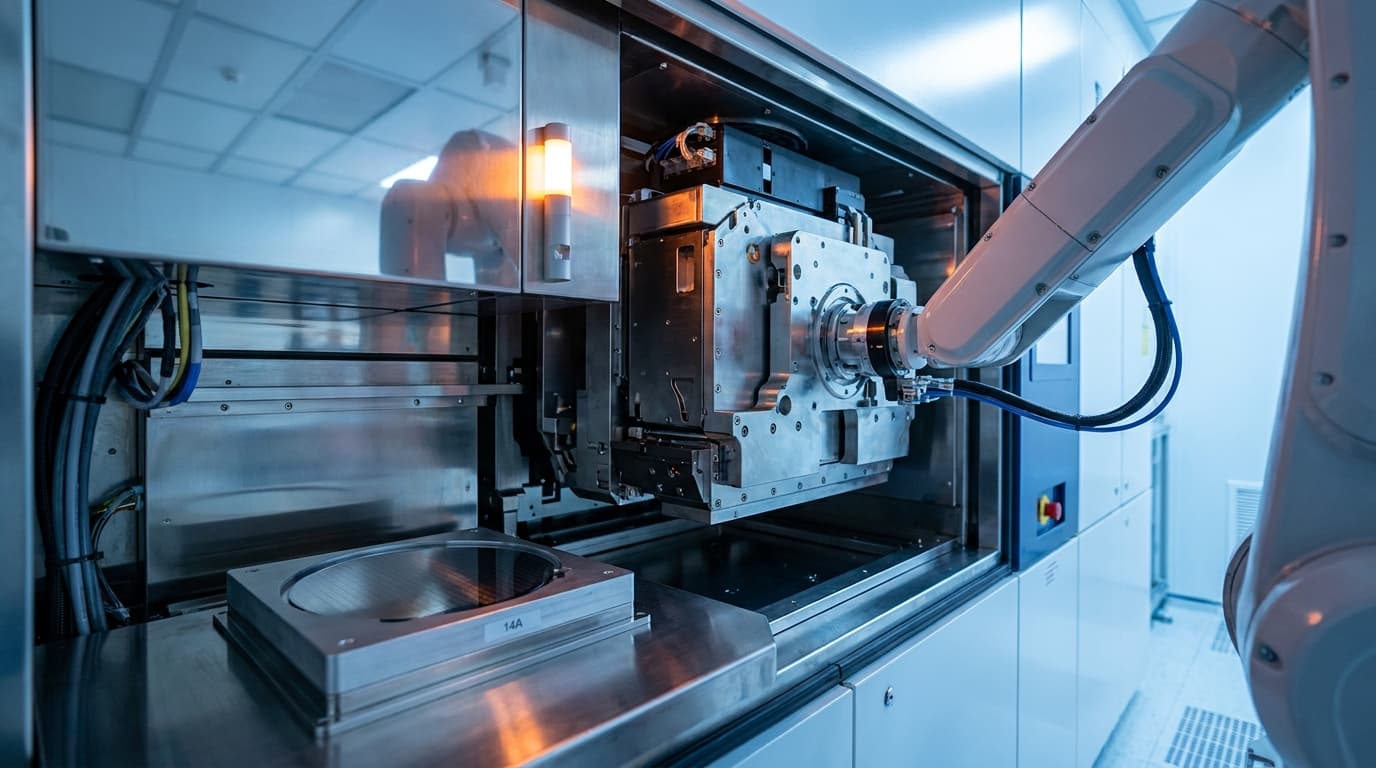
14A is the first node to take High-NA EUV into high-volume logic, paired with RibbonFET gate-all-around transistors and backside power delivery. ASML's EXE-class High-NA systems run roughly $400 million each.
Intel's High-NA position is operational, not aspirational. ASML confirmed on July 15, 2026 that Intel Foundry is running select 18A layers on the EXE platform in high-volume manufacturing for Panther Lake (Core Ultra Series 3), dual-qualified at its Oregon site — the industry's first high-volume logic on High-NA. Whatever else is uncertain about 14A, the learning curve on its defining tool is already being paid down on a shipping product.
Street models have Intel adding High-NA units for 14A, moving its CY27 count from roughly one to roughly two within an industry total shifting from about eight to ten, plus incremental low-NA EUV. Those unit figures are sell-side estimates, not disclosure from Intel or ASML — treat them as directional.
The scale math is what matters for planners. Futurum estimates that a leading-node fab at 40,000 wafer starts per month requires roughly $25 billion of equipment. Intel's U.S. tools-plus-facilities spend from 2021 through 2026 approaches $100 billion. So the $23 billion raise funds approximately one full leading-node fit-out into an existing shell. Not a greenfield site, not a network — one fab's worth of tools.
For the supply base, that is a commitment problem in its own right. High-NA lead times force ASML and its own suppliers to reserve build slots years ahead of the wafer agreements that would justify them. Equipment vendors are being asked to underwrite the same demand uncertainty Intel is, one tier upstream, with less visibility.
Where the concrete is
Construction schedules are the honest telemetry here, because Intel will not narrate demand it hasn't signed.
-
Fab 52, Arizona: the first high-volume 18A site, operational. Intel has said 18A yields reach industry-standard levels in early 2027 and is capping CPU output until then.
-
Fab 62, Arizona: expected ready around 2028, with no node assignment publicly confirmed. This is the natural 14A candidate and the single cleanest tell in the whole story. Kiryat Gat and the Ohio modules are the alternatives.
-
Ohio: the roughly $28 billion first phase has been pushed repeatedly, with first production now targeted for 2030 against an original 2025. Reporting has tied the delays directly to the shortfall in external foundry customers.
Ohio is the strongest available evidence that Tan's team does gate concrete on demand. It is also the reason the equity raise reads as a tool decision rather than a building decision: shells are cheap to defer, and Intel has demonstrated it will defer them. Tool slots are not.
The TSMC contrast, quantified
TSMC guided 2026 capex at $56 billion in January, then raised it to $60–64 billion, with management explicitly framing the increase as backed by long-term customer commitments and reserved capacity — physical capacity allocated against demand through 2028 and beyond.
That is build-to-order. Intel's $23 billion is build-to-hope, and the honest counterweight is that build-to-hope is the only way a challenger ever gets to build-to-order. But the timing does not favor Intel: TSMC's A14, its 1.4nm-class node, is also targeted near 2028. Intel's 14A buys parity on timing, not a lead. It has to win on something else — price, packaging, geography, or the willingness of buyers to fund a second leading-edge source on principle.
Three branches for U.S. advanced-logic supply
Two-plus merchant anchors sign after PDK 0.9. If commitments land by 1H 2027, Fab 62 gets a 14A assignment, Ohio's schedule tightens, and U.S. leading-edge capacity meaningfully diversifies past TSMC Arizona for the first time. In this branch the raise looks early rather than reckless.
Tesla-only. Tools get installed against internal products plus one speculative megafab. Foundry losses persist past the current ~$2.1 billion quarterly run rate, Ohio slips again, and Intel funds a second full node cycle out of the same equity. The company has already started 10A and 7A development, so the capital requirement does not pause while it waits.
18A yields slip past early 2027. This is the branch that damages 14A regardless of demand. The PDK 0.9 sales cycle runs on Intel's demonstrated execution, and every prospective customer will read the 18A yield curve as the forecast for 14A. A miss here costs Intel commitments it would otherwise have won.
What to watch, with dates
-
October 2026: 14A PDK 0.9 release to external customers. The gate on every reported evaluation.
-
Q3 2026 earnings: 2027 capex specificity, and any change in how management describes customer commitments versus engagements.
-
Fab 62 node assignment: the clearest single signal that 14A has enough demand to warrant a dedicated shell.
-
Ohio permits and construction activity: movement before 2030 means demand materialized; continued quiet means it didn't.
-
ASML order commentary: Intel-attributable High-NA units, which will show up in ASML's bookings before they show up in Intel's disclosures.
-
Tesla/Terafab: whether the arrangement is ever restated as a binding wafer agreement rather than a partnership.
Who underwrites the gap
There is a policy thread here that the market commentary has largely skipped. The U.S. government holds 9.9% of Intel, taken at $20.47 per share — roughly $8.9 billion, converted from CHIPS grants in 2025. Nvidia put in $5 billion and SoftBank $2 billion through private placements. The August raise diluted all of them, including the taxpayer position, to fund a node with no disclosed anchor contract.
On paper the federal stake is deep in the money at a $95 print, so the dilution is a rounding error against the gain. The structural point stands anyway: American leading-edge logic capacity is currently being financed by whoever is willing to fund the gap between tool install and first committed wafer. Right now that is public-market equity buyers, a government shareholder, and two strategic investors. Whoever keeps writing that check is underwriting U.S. leading-edge capacity itself — and none of them has a wafer agreement to show for it.
Related reading
-
[TSMC Doubles Down on Arizona to $265B — Four More 2nm-and-Below Fabs, Bankrolled by a Record Quarter](/article/tsmc-arizona-265-billion-four-more-2nm-fabs-record-q2-2026)
-
[The Biggest Memory Bet of the Cycle Isn't American: SK hynix Commits $38B to Korean Fabs While U.S. Manufacturers Absorb the Shortage](/article/sk-hynix-54-trillion-won-korean-fabs-memory-shortage-industrial-buyers)
Sources
-
Intel Announces Proposed $15 Billion Common Stock Offering — Intel Investor Relations, Aug 10, 2026
-
Intel Announces Upsize and Pricing of $20 Billion Common Stock Offering — Intel Newsroom, Aug 10, 2026
-
Intel Corp Form 8-K, Exhibit 99.2 and Form FWP — SEC EDGAR
-
Full overallotment exercise, 242,105,262 shares — Kalkine Media
-
$22.6B net proceeds, 4.8% share-count increase — ts2.tech
-
Wall Street sends $100 billion in orders — TechTimes, Aug 11, 2026
-
Cap table, share count and deal reception — 24/7 Wall St.
-
Is Intel's $20 Billion Stock Offering Enough to Tool a 14A Fab? — Futurum Group
-
Tesla named as first 14A customer for Terafab — TrendForce, Apr 23, 2026; Reuters via Yahoo Finance; Wccftech on Tan's confirmation
-
Intel Foundry lands Fortinet — CNBC, Jul 21, 2026; node-maturity context — Tom's Hardware
-
14A mass production committed for 2028, two prospective 14A customers, October PDK 0.9 and 10A/7A development, and Intel's fab roadmap examined — Tom's Hardware
-
Intel Q2 2026 prepared remarks (PDF) and Q2 2026 earnings call transcript; Q2 results — CNBC, Jul 23, 2026
-
2026 capex above $20B and Q3 guide — Seeking Alpha; capex raise and ~40% tooling increase — Yahoo Finance UK
-
High-NA EUV reaches first high-volume logic milestone — ASML, Jul 15, 2026; reported incremental High-NA orders — TweakTown (sell-side estimates)
-
Ohio fabs delayed to 2030 — Data Center Dynamics
-
TSMC raises 2026 capex to as much as $64B — Bits&Chips; original $56B guide — Data Center Dynamics
-
The U.S. government's Intel stake, one year on — Marketplace, Jul 24, 2026
-
Intel sells stock to fund a fab for customers who haven't signed — TechTimes, Aug 10, 2026 (reflects the pre-upsize $15B figure)