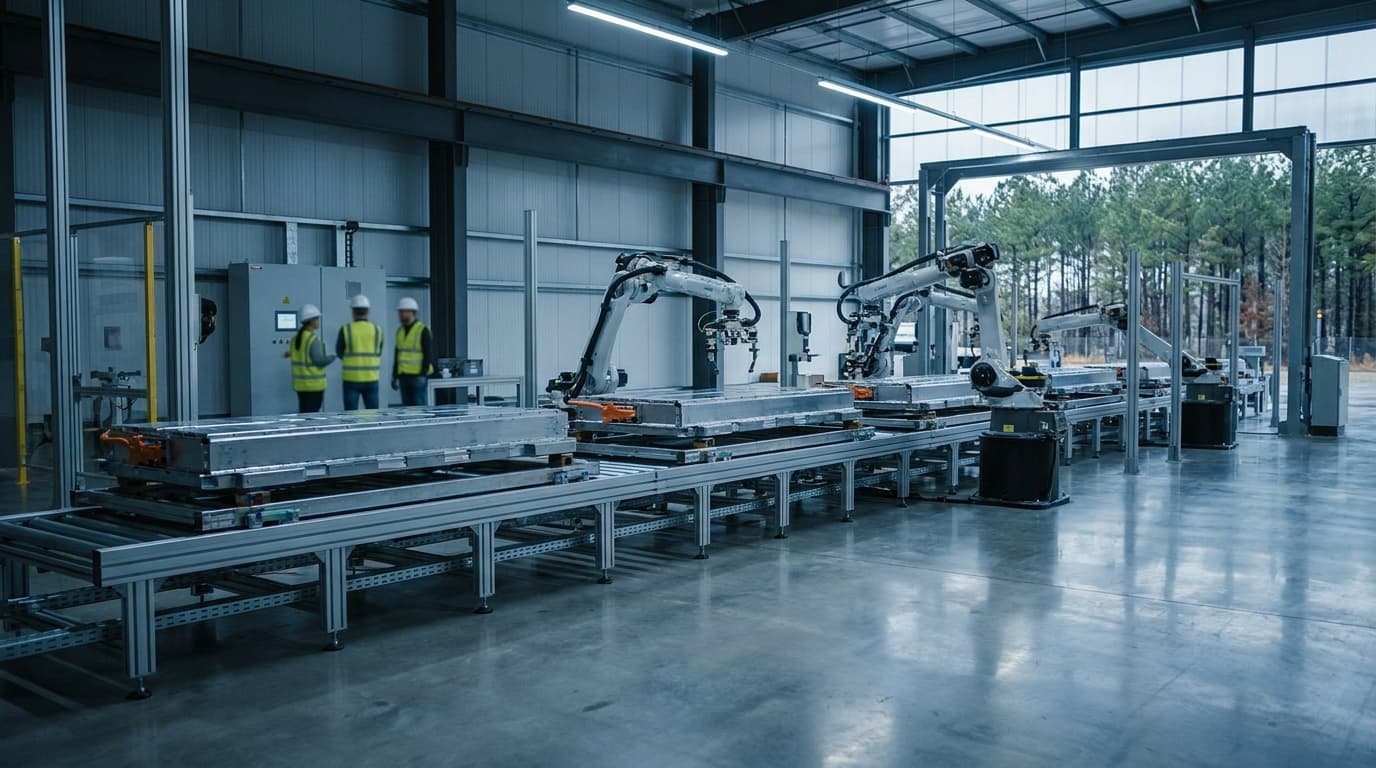
The timing looks almost contrarian. As several of America's largest battery makers slow, idle, or repurpose their electric-vehicle cell lines, Hyundai Motor Group and SK On have done the opposite: they switched on a roughly $5 billion battery plant northwest of Atlanta and started making cells. Production at the Bartow County, Georgia, facility began in June 2026 and is in an early-stage ramp, with a spokesperson saying, "We are in the early stages of battery production, and we will continue increasing our output."
That is a counter-cyclical bet in the truest sense. The rest of the U.S. battery belt is bracing for oversupply; Hyundai and SK On are pouring cells into a captive, in-house supply chain. The question for operators and investors is whether a guaranteed domestic customer makes that bet defensible — or simply concentrates the exposure.
The asset: 35 GWh, 752 acres, and a 50/50 structure
The plant is operated by Hyundai-SK Battery Manufacturing America, a 50/50 joint venture between Hyundai Motor Group and SK On that the partners formed in 2023. According to local reporting on the opening, the site spans roughly 752 acres, employs more than 3,500 people, and is designed for about 35 GWh per year of cell capacity — enough to supply roughly 300,000 electric vehicles annually at full output.
The near-term destination for those cells is not a spot market — it is Hyundai's own assembly line. Initial output is supplied to Hyundai Metaplant America near Savannah, the plant building the IONIQ 5 and IONIQ 9. That off-take relationship is the strategic core of the project: a greenfield cell plant with a demand anchor already bolted on.
The demand story: a battery belt in retreat
To understand why the ramp reads as contrarian, look at what Hyundai and SK On's peers are doing. After U.S. EV demand came in below the aggressive forecasts that justified the current wave of battery capex, makers have begun pivoting idle EV-battery lines to new markets. The macro backdrop is stark: AlixPartners projects that global EV-battery output could run roughly three times EV demand by 2030, a supply-demand mismatch that has been framed as a battery bubble.
The response has been a rush toward energy-storage systems (ESS), increasingly aimed at data-center and grid demand rather than cars:
-
LG Energy Solution is turning idled U.S. EV-battery lines toward AI data-center storage as stationary demand fills the EV gap; the Ford/LG operation in Michigan is among the sites pivoting to ESS.
-
Panasonic's plant in De Soto, Kansas, is shifting toward data-center energy storage as EV demand slows.
-
SK Battery America in Commerce, Georgia — SK's standalone plant, distinct from this JV — and Samsung SDI in Kokomo, Indiana, both plan ESS production in 2026.
In other words, much of the industry is treating EV-battery capacity as a stranded asset to be redirected. Hyundai and SK On are treating theirs as an on-ramp.
Why Hyundai is going the other way
The divergence makes more sense once you look at Hyundai's own sales trajectory, which is running against the sector's gloom. In the first half of 2026, Hyundai sold roughly 26,936 EVs — about a 5.8% share, good for third place — and closed to within about 1,331 units of Chevrolet, the current No. 2 EV brand behind Tesla. Chevrolet, for its part, saw EV sales fall roughly 40% year over year, narrowing the gap from the top down as much as Hyundai narrowed it from below.
The product mix explains the momentum. The IONIQ 5 was the best-selling non-Tesla EV in H1 2026 at about 20,730 units, up roughly 9% year over year, while the larger IONIQ 9 rose about 380% to roughly 4,858 units. Both are built at Metaplant — the same plant the new cells feed. For Hyundai, adding domestic cell capacity is not a speculative capacity play; it is vertical integration behind vehicles that are already selling.
That is the crux of the whole strategy: Hyundai is pushing to become America's No. 2 EV brand, and it is willing to build its own supply base to get there while rivals retrench.
The tariff and content-rule hedge
There is a defensive logic layered on top of the growth story. Hyundai's U.S. business is export-reliant, which makes it exposed to proposed 25% tariffs on imported cars and parts and to tightening battery raw-material origin rules that govern tax-credit eligibility. A captive domestic cell source is, in effect, tariff armor — the same framing that has followed Hyundai's Metaplant investment from the start.
The cost math points the same direction. In 2026, landed-cost data show battery packs built with imported (Korean or Japanese) cells running roughly 10-20% higher on tariff-exposed components than domestically sourced equivalents. For a manufacturer trying to hold price against competitors, moving cell production inside the U.S. border is a margin decision as much as a policy hedge — and it insulates Metaplant vehicles from the content-origin rules that determine credit eligibility.
The greenfield ramp — and the risks
None of this makes the ramp easy. Standing up a new cell plant is a yield-curve exercise: early output is slow and defect-prone, and a facility rated at 35 GWh does not hit that number on day one. The company's own language — "early stages" with output increasing over time — is a signal that the labor and yield realities of a greenfield plant will govern the next several quarters, not the nameplate capacity. The Metaplant off-take is what makes that climb tolerable: guaranteed demand smooths the ramp in a way spot-market cells never could, as independent coverage of the plant's specs and status underscores.
The macro risks are real. The federal $7,500 EV tax credit expired in September 2025, removing a demand support just as this capacity comes online — and IONIQ 5 still grew through that expiration, but the tailwind is gone. The three-times oversupply overhang means any softening in Hyundai's own EV sales would leave the plant exposed with fewer outside buyers to absorb cells, precisely because so much of the industry is chasing ESS instead. Captive supply cuts both ways: it guarantees a customer, but it ties the plant's fortunes tightly to a single brand's demand curve.
It is worth being precise about what this plant is and is not. This SK On JV is distinct from Hyundai's separate roughly $4 billion battery joint venture with LG Energy Solution in Georgia, and from SK's standalone SK Battery America plant in Commerce. Taken together, Hyundai's Georgia commitments have been cited at around $12.6 billion with some 14,000 jobs projected — a bet on the state as a manufacturing base that now spans vehicles, cells, and two separate battery partners.
The takeaway
Hyundai and SK On are ramping a $5 billion cell plant into an environment where the smart-money move has been to slow down. What separates their bet from the ones being unwound elsewhere is the demand anchor: cells that go straight into IONIQ 5 and IONIQ 9 production, for a brand still gaining EV share while rivals lose it. Whether captive domestic supply proves a durable advantage or a concentrated exposure depends on one variable the plant cannot control — whether Hyundai keeps selling the cars.
Related reading
-
[The Tariff Nobody's Tracking Swaps In on July 24: Section 122 Sunsets as a Forced-Labor 301 Duty Comes Into View](/article/section-122-sunset-july-24-forced-labor-301-duty)
-
[$1.765 Trillion Pledged, Hundreds of Thousands of Jobs Empty: The Reshoring Boom's Binding Constraint Was Never Capital](/article/reshoring-boom-labor-not-capital-binding-constraint)
Sources
-
SK and Hyundai open new $5B EV battery plant northwest of Atlanta - Atlanta Journal-Constitution
-
Hyundai-SK On battery plant begins production in Georgia - UPI
-
Hyundai opens $5 billion battery plant as it pushes to become America's #2 EV brand - Electrek
-
SK On and Hyundai start battery cell production in Georgia - Electrive
-
Hyundai's $5 Billion EV Battery Plant In Georgia Powers Up - InsideEVs
-
Hyundai sold over 20,000 IONIQ 5 EVs in H1 2026, IONIQ 9 up 380% - Electrek
-
Hyundai is closing in on Chevy as the #2 EV brand in the US - Electrek
-
Battery makers repurpose plants after EV miss - Automotive News
-
LGES turns idled US EV battery lines toward AI data centers - DigiTimes
-
Panasonic's De Soto plant shifting gears, adding data center energy storage - Lawrence Journal-World
-
Hyundai's U.S. EV Factory Is Revolutionary. Can It Also Be Tariff Armor? - InsideEVs