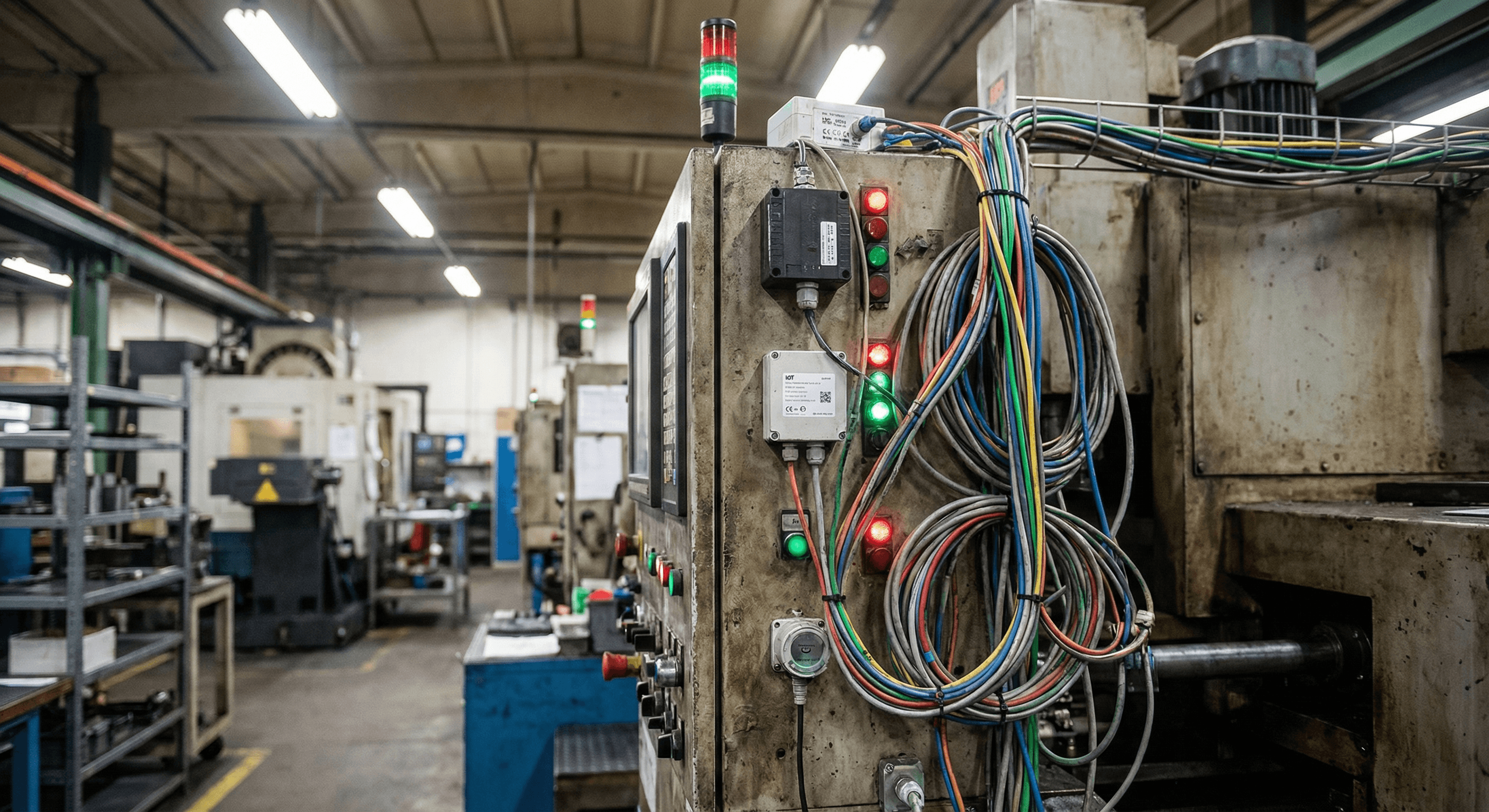
The industrial Internet of Things promised to transform manufacturing decision-making through comprehensive data visibility. Five years into widespread adoption, many plants find themselves drowning in the very data streams they invested millions to create. A typical automotive assembly plant now generates 2.3 terabytes of sensor data daily, yet production managers report making fewer data-driven decisions than before IIoT deployment.
The problem is not technological capability but operational reality. Plants that installed comprehensive sensor networks—sometimes 50,000 or more monitoring points across a facility—discover that collecting data and deriving actionable insights require fundamentally different approaches. The result is expensive infrastructure producing expensive noise.
The Alert Avalanche
Alert fatigue represents the most immediate consequence of uncontrolled data collection. A pharmaceutical manufacturing facility in New Jersey documented receiving 14,000 alerts per week from their condition monitoring system after full IIoT deployment. Maintenance technicians, initially enthusiastic about predictive capabilities, began ignoring notifications within six months.
The mathematics of alert overload work against operational teams. If each alert requires three minutes to evaluate and 95% prove non-actionable, technicians spend 40 hours weekly processing false positives for every two hours of genuine maintenance work identified. Production schedules cannot accommodate this inefficiency.
Default sensor thresholds compound the problem. Vendors typically ship vibration monitors, temperature sensors, and flow meters with conservative alarm settings designed to capture every potential anomaly. These settings may trigger alerts when bearing temperatures rise 15 degrees above baseline—appropriate for critical equipment but irrelevant for redundant systems with normal thermal cycling.
One chemical processing plant reduced alert volume by 78% through threshold optimization alone. They raised temperature alarm limits from 10-degree to 25-degree deviations for non-critical pumps, eliminated nuisance vibration alerts during startup sequences, and implemented time delays requiring sustained anomalies before triggering notifications. The remaining alerts carried significantly higher actionable probability.
The Dashboard Delusion
Executive dashboards represent another common misallocation of IIoT investment. These colorful displays present real-time metrics with impressive visual sophistication—overall equipment effectiveness trending upward in green, energy consumption per unit declining in blue charts, production rates updated every 30 seconds.
Yet dashboards fundamentally display information, not insight. Knowing that Line 3 operates at 73% efficiency provides no guidance for improvement actions. The data requires context: Is 73% normal for this product mix? How does current performance compare to similar production runs? Which specific constraints limit throughput?
Manufacturing engineers need decision support, not data visualization. A food processing plant invested $400,000 in dashboard infrastructure showing real-time moisture content, package weights, and conveyor speeds across twelve production lines. The displays looked impressive during plant tours but provided no actionable guidance for shift supervisors managing daily production targets.
Effective alternatives focus on exception reporting and predictive analytics. Rather than displaying current motor temperatures, systems should identify motors trending toward failure based on thermal patterns, operating history, and maintenance records. The goal is generating maintenance work orders, not colorful temperature graphs.
Maintenance Team Realities
Frontline maintenance perspectives often diverge sharply from management expectations around IIoT benefits. Technicians carry decades of experience recognizing equipment problems through sound, vibration, and visual inspection. Sensor systems that generate alerts for conditions technicians already monitor create perceived redundancy rather than value.
A paper mill's maintenance supervisor explained the disconnect: "The system tells me pump 47 has high vibration. I already knew that—I hear it every morning walk-through. What I need to know is whether I have two days or two weeks before replacement, and which bearing supplier has the best lead time."
Successful IIoT implementations augment rather than replace technician expertise. Predictive algorithms should quantify failure timelines, recommend specific interventions, and integrate with inventory systems to ensure parts availability. The technology serves maintenance workflows rather than generating additional monitoring tasks.
Training requirements also exceed vendor projections. Maintenance teams must understand sensor capabilities, data interpretation, and system limitations to effectively utilize monitoring tools. A steel mill discovered their technicians needed 40 hours of training to properly use vibration analysis software—four times the vendor estimate. Without adequate training investment, sophisticated sensors become expensive data collectors.
The Cost of Crying Wolf
False alarms carry quantifiable costs beyond technician time. Emergency maintenance responses triggered by sensor alerts cost $2,300 per incident when including labor premiums, equipment shutdown, and restart procedures. If 85% of urgent alerts prove non-actionable—a typical rate in poorly tuned systems—the facility spends $19,550 weekly on false emergency responses.
Production disruption represents the largest cost component. An automotive parts supplier calculated that each false vibration alarm triggering precautionary equipment shutdown cost $18,000 in lost production during the 90-minute restart sequence. With twelve false alarms monthly, the facility lost $2.6 million annually to sensor-triggered production interruptions.
Ignored alerts create liability exposure when actual failures occur. If technicians routinely dismiss monitoring system warnings due to poor signal-to-noise ratios, legitimate failure predictions may be overlooked. Legal discovery following equipment failures increasingly examines sensor data and response protocols, creating potential negligence claims when documented warnings went unheeded.
Insurance implications also require consideration. Some industrial policies now offer premium reductions for facilities with proven predictive maintenance programs. However, these benefits require demonstrable alert response protocols and documented failure prevention records. Systems generating primarily false alarms provide no insurance advantage and may increase liability exposure.
What Actually Works
Effective IIoT implementations prioritize decision outcomes over data volume. A successful deployment at a beverage manufacturer focused on three specific objectives: reduce unplanned downtime by 25%, improve changeover efficiency by 15%, and decrease energy consumption per unit by 8%. Sensor selection, analytics development, and user interfaces all aligned with these measurable goals.
Staged deployment approaches consistently outperform comprehensive installations. Rather than instrumenting entire facilities simultaneously, successful projects target 3-5 critical production lines or equipment types. This focused approach allows optimization of analytics algorithms, alert thresholds, and operator workflows before system expansion.
Integration with existing maintenance management systems proves essential. Sensors generating work orders directly in computerized maintenance management systems provide immediate workflow value. Standalone monitoring platforms requiring duplicate data entry create adoption barriers and process inefficiencies.
Human-centered design principles apply to industrial systems. Alert notifications should specify required actions, not just current conditions. Instead of "Motor temperature high," effective alerts state "Schedule bearing inspection within 48 hours—trending toward failure in 6-8 days based on thermal profile analysis."
Vendor Promises vs. Operational Reality
Marketing materials frequently present IIoT capabilities without acknowledging implementation challenges. Vendors demonstrate systems using clean datasets and optimized algorithms, but customer deployments involve noisy industrial environments, legacy equipment integration, and varying operator skill levels.
"Plug-and-play" sensor solutions rarely prove plug-and-play in practice. Vibration monitors require mounting considerations, environmental protection, and calibration specific to each machine type. Temperature sensors need proper placement, thermal isolation, and compensation for ambient conditions. Flow meters require upstream and downstream straight pipe runs often unavailable in retrofit applications.
Analytics capabilities also require realistic assessment. Machine learning algorithms excel at pattern recognition but need extensive training data and ongoing refinement. A plastic injection molding facility discovered their predictive models required 18 months of historical data before generating reliable failure predictions—significantly longer than vendor projections.
Return on investment calculations should account for full lifecycle costs: hardware procurement, installation labor, network infrastructure, software licensing, training, and ongoing maintenance. A conservative estimate for comprehensive IIoT deployment ranges from $125-200 per monitoring point when including these total costs.
The manufacturing industry benefits tremendously from sensor technology and data analytics. However, success requires disciplined focus on operational outcomes rather than technological capabilities. Plants that treat IIoT as a tool for specific decision-making improvements—rather than comprehensive data collection initiatives—consistently achieve better results with lower implementation costs and higher user adoption rates.
The goal is not monitoring everything possible, but monitoring everything necessary for improved operational decisions. This distinction separates effective IIoT deployments from expensive data collection exercises.