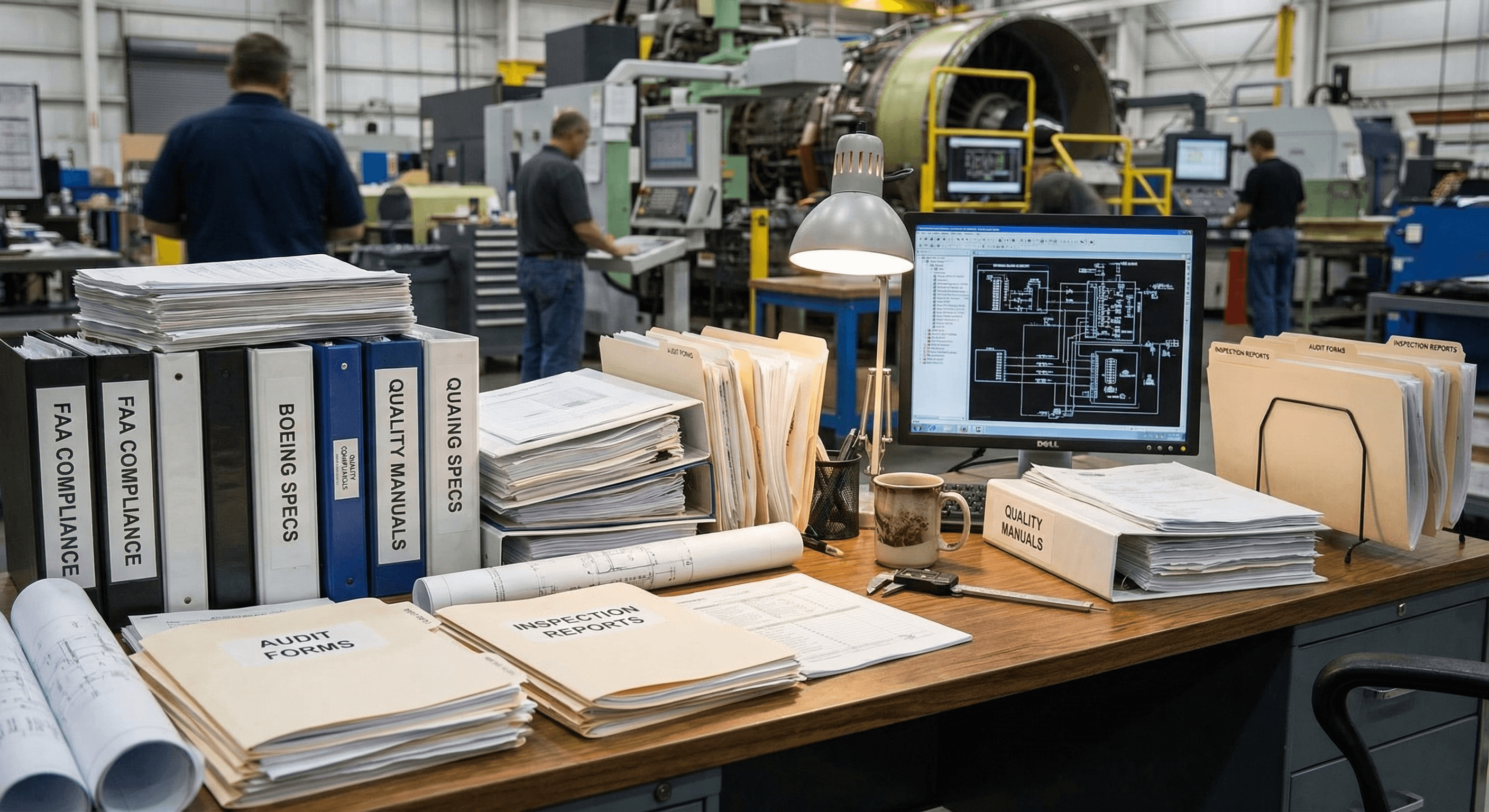
Quality engineers in aerospace and defense manufacturing face a documentation burden that would surprise executives focused on production metrics. While shop floor efficiency gains attention, the administrative overhead required to maintain AS9100 compliance and satisfy customer requirements consumes resources at an alarming rate.
A typical quality engineer spends 60-70% of their working hours on documentation tasks. In a 40-hour work week, this translates to 24-28 hours generating, reviewing, and managing paperwork rather than analyzing data or improving processes. For facilities with dedicated quality teams of 5-10 engineers, this represents 120-280 hours weekly devoted to administrative tasks.
Certificate of Conformance: The Paper Trail Bottleneck
Certificate of Conformance (CoC) preparation represents the largest single documentation burden. A standard aerospace CoC package for a complex assembly requires 12-16 hours to complete properly. This includes material certification review, dimensional inspection data compilation, process verification documentation, and final formatting for customer submission.
The error rate on manually prepared CoC packages ranges from 8-12% for simple components to 15-20% for complex assemblies with multiple sub-tiers. Common errors include missing material heat lot numbers, incorrect revision levels on drawings, and mismatched serial numbers between components and test reports. Each error triggers a correction cycle that consumes an additional 2-4 hours of engineering time and delays package submission by 1-2 days.
Consider a mid-size aerospace supplier processing 150 shipments monthly. With an average CoC preparation time of 14 hours and a 12% error rate requiring rework, the facility dedicates 2,352 hours monthly to CoC activities. At a loaded engineering rate of $85 per hour, this represents $199,920 in monthly quality documentation costs, or $2.4 million annually.
Nonconformance Reports: Downstream Impact
Nonconformance Report (NCR) documentation creates cascading delays throughout the production system. A typical NCR requires 6-8 hours to complete, including root cause analysis documentation, corrective action planning, and approval routing. Manufacturing Review Board (MRB) packages for use-as-is dispositions can extend this to 12-16 hours when engineering analysis and customer notification requirements are included.
Manual NCR processing introduces a 3-5 day delay between nonconformance identification and resolution initiation. During this period, affected work orders remain on hold, consuming floor space and tying up work-in-process inventory. For facilities processing $50 million in annual revenue, a 2% NCR rate translates to $1 million in affected work orders, with holding costs of $150-200 per day per affected lot.
The administrative burden becomes more pronounced during customer audits. AS9100 auditors expect complete NCR traceability, including evidence of effectiveness verification for corrective actions. Quality teams typically spend 40-60 hours preparing NCR documentation packages for annual surveillance audits, with an additional 20-30 hours during certification renewals.
FMEA Documentation: Analysis Paralysis
Failure Mode and Effects Analysis (FMEA) documentation requirements have expanded significantly under AS9100 Rev D. Process FMEAs for new product introductions consume 80-120 hours of engineering time, while design FMEAs can require 150-200 hours for complex assemblies.
The manual nature of FMEA documentation creates consistency problems across engineering teams. Risk Priority Number (RPN) calculations vary between engineers, and recommended actions lack standardization. Review cycles consume an additional 20-30% of the original development time as engineering managers attempt to maintain consistency across multiple simultaneous projects.
FMEA updates triggered by process changes or nonconformances represent an ongoing burden. Each revision requires 4-6 hours to complete properly, including cross-referencing with control plans and work instructions. Facilities introducing 25-30 engineering changes monthly face 100-180 hours of FMEA maintenance work, assuming all changes trigger documentation updates.
First Article Inspection Delays
First Article Inspection (FAI) documentation creates the most visible customer impact. A complete FAI package requires 16-24 hours to compile, including dimensional inspection results, material certifications, process verification data, and photographic evidence of key characteristics.
Manual FAI preparation introduces error rates of 10-15%, primarily due to data transcription mistakes and missing supplementary documentation. Each error discovered during customer review triggers a correction cycle averaging 8-12 hours, including re-inspection activities when dimensional data discrepancies are identified.
The time lag between production completion and FAI package submission averages 5-7 days for complex assemblies. This delay compounds when customers require approval before series production authorization. Programs with 30-day delivery requirements lose 15-20% of their available schedule to FAI documentation activities.
Customer rejection rates for manually prepared FAI packages range from 12-18% across the industry. Rejection drivers include incomplete delta lists, missing sub-tier certifications, and formatting inconsistencies. Each rejection cycle adds 3-5 days to program schedules and requires 6-10 hours of engineering time to resolve.
AS9100 Audit Preparation: The Annual Sprint
AS9100 audit preparation represents a concentrated documentation burden that disrupts normal operations. Quality teams spend 200-300 hours annually preparing for surveillance audits, with certification renewals requiring 400-500 hours of preparation time.
Document control verification consumes the largest portion of audit preparation time. Quality engineers must verify that all procedures, work instructions, and forms reflect current revision levels and contain proper approval signatures. For facilities maintaining 500-800 controlled documents, this verification process requires 80-100 hours annually.
Training record compilation and verification adds another 40-60 hours to audit preparation activities. AS9100 requires evidence of competency verification for all personnel performing quality-critical tasks. Manual training record systems complicate this requirement, as engineers must cross-reference employee certifications with job assignments and process qualifications.
Shipment Delays and Customer Impact
Documentation-related shipment delays occur on 8-12% of aerospace and defense deliveries. Root causes include late CoC package completion, customer rejection of submitted documentation, and internal quality holds pending paperwork resolution.
The financial impact extends beyond late delivery penalties. Customers increasingly implement supplier scorecards that include on-time delivery performance. A 5% reduction in delivery performance can influence source selection decisions for future programs worth millions in potential revenue.
Express shipping costs to recover schedule represent another hidden expense. Upgrading standard ground shipments to next-day air typically costs $200-500 per shipment. Facilities shipping 100 orders monthly and expediting 10% due to documentation delays face $24,000-60,000 in annual premium freight costs.
The Productivity Equation
Manual documentation systems create a productivity paradox in aerospace and defense manufacturing. While automation has improved machining efficiency and reduced direct labor requirements, quality documentation remains largely unchanged from practices established decades ago.
Quality engineers represent some of the highest-skilled personnel in manufacturing organizations, typically holding engineering degrees and industry certifications. Dedicating 60-70% of their time to administrative tasks represents a fundamental misallocation of human capital. The opportunity cost includes reduced time for data analysis, process improvement initiatives, and proactive problem-solving activities.
Calculating the total cost impact requires considering both direct labor expenses and productivity losses. A 20-person quality organization spending $1.7 million annually on documentation-related activities could redirect 40-50% of this effort toward value-added activities through systematic automation of routine documentation tasks.
The path forward requires acknowledging that documentation accuracy and completeness remain non-negotiable in aerospace and defense manufacturing. However, the methods used to achieve these requirements can evolve beyond manual processes that consume excessive resources and introduce unnecessary risks to program schedules and customer satisfaction.