The headline number is $250 billion. Ignore it for a second. The number an operator should actually read is one quarter.
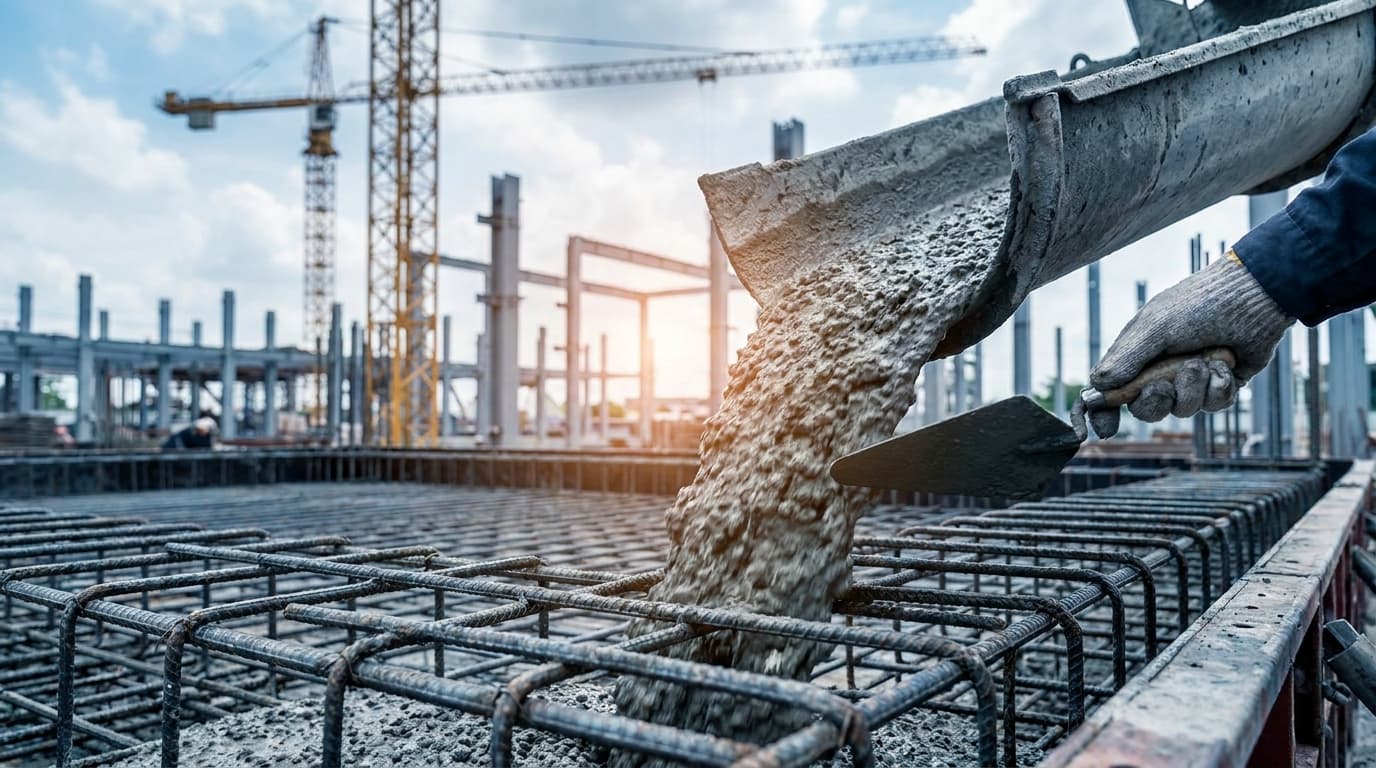
On July 9, 2026, Micron poured first concrete at its megafab campus in Clay, New York — more than a full quarter ahead of the original plan, and less than six months after breaking ground in January 2026. That milestone marks the shift from site prep to vertical construction, the point where a project stops being earthmoving and starts being a building. In an era where U.S. fab construction has become synonymous with delays and cost overruns despite tens of billions in incentives, a megaproject moving faster than plan is the anomaly worth studying. ([Micron press release, July 9, 2026](https://www.globenewswire.com/news-release/2026/07/09/3324807/14450/en/Micron-Accelerates-U-S-Investments-Pours-First-Concrete-at-New-York-Fab.html))
Micron paired the concrete pour with a bigger commitment: it raised planned U.S. investment to more than $250 billion through 2035, up from the roughly $200 billion it announced on June 12, 2025. The stated payoff for all of it is a supply thesis — produce 40% of Micron's DRAM on American soil. (Spectrum News NY1)
The number, and what actually changed
The prior baseline was about $200 billion, announced in June 2025 — roughly $150 billion in manufacturing plus about $50 billion in R&D. The new figure of more than $250 billion through 2035 represents an increment of roughly $50 billion layered onto that plan, spread across manufacturing, research and development, and high-bandwidth-memory (HBM) advanced packaging. (TrendForce, June 2025; Crypto Briefing)
What's notable is that the 40% domestic-DRAM target did not move. The target is the same one Micron set in June 2025; the capital going toward it went up. Read plainly, that's a company raising its bid to hit a goal it already committed to — a decision to pull spend forward and deepen it, not to chase a new headline.
The capacity thesis: a network, not a plant
The Clay campus is planned for up to four leading-edge, high-volume DRAM fabs. Micron cites roughly 50,000 total New York jobs tied to the project, including about 9,000 direct Micron roles, and up to $3 billion for local supply-chain ecosystem build-out. The New York project drew a $6.1 billion CHIPS Act grant. (Micron press release)
But Clay is one node in a coordinated domestic network. Micron is standing up two leading-edge fabs in Idaho — first wafers targeted for mid-2027 and late 2028 — alongside the four New York fabs, plus modernization of its existing Virginia fab, where initial 1α DDR4 production began earlier in 2026. Add HBM advanced-packaging and R&D on top. The 40% figure isn't a single flagship plant carrying the load; it's the sum of a memory manufacturing footprint spread across three states and timed to come online in sequence.
Why memory, not logic
Here's the part of the story that most reshoring coverage misses. The U.S. buildout narrative was written around logic — advanced processors, the marquee foundry projects. But the 2026 capital-spending mix has tilted toward memory at exactly the moment logic spending is contracting.
Memory is now the largest 2026 capex category at roughly 45% of industry spend. DRAM capex is projected up about 14% to around $61 billion. Meanwhile, integrated-device-manufacturer (IDM) capex is set to fall roughly 9% in 2026, after a roughly 25% drop in 2025. In other words: logic and IDM buildout is slowing while memory holds and grows. (Semiconductor Intelligence)
That divergence reframes what Micron is doing. The reshoring story is migrating from logic toward the most price-cyclical segment of the industry — memory — and Micron is the domestic company anchoring that shift. For an operator or investor, that's a meaningful change in the risk profile of "made in America" chips: memory's economics are far more boom-bust than leading-edge logic's.
The demand engine: AI and a sold-out HBM book
What makes the schedule pull-in a supply response rather than a photo op is demand. AI is the engine, and HBM is the mechanism. High-bandwidth memory has absorbed a large share of DRAM wafer capacity, tightening the broader DRAM market. DRAM prices rose about 60% across 2025, then surged roughly 90% in the first quarter of 2026 versus the fourth quarter of 2025. And Micron's entire 2026 HBM output is already committed under long-term contracts — sold out before the year is half over. (CNBC, January 2026)
That set of facts quietly dismantles the old "commoditized memory" assumption. When your forward output is contracted out and prices have nearly doubled in a quarter, capacity isn't a commodity gamble — it's a strategic-supply argument. CEO Sanjay Mehrotra framed the acceleration around data and memory being "foundational to the modern economy" and rising AI-era demand. Pulling the Clay schedule forward is what a supply response looks like when the order book is already full. (CNY Central)
The execution angle: how Clay beat the CHIPS-era track record
Plenty of U.S. fab projects have secured incentives and then slipped. Micron's Clay pull-in is the counter-example, and the execution details point to why. Micron reports roughly $675 million already directed to New York contractors and suppliers, with more than 80% of the current workforce sourced in-state. (Micron press release)
In-state workforce sourcing and early local supplier spend are the unglamorous inputs that determine whether a megaproject holds its construction sequence. A project that has to import its trades and its materials fights schedule risk on every front; one that has already wired roughly $675 million into the regional supply base and staffed 80%-plus locally has removed a large slice of that risk before pouring concrete. The pull-in from site prep to vertical construction, more than a quarter early, is the visible result of that groundwork.
The skeptic's case
None of this repeals the memory cycle. DRAM is the segment most exposed to boom-bust pricing, and the entire acceleration is underwritten by an AI demand wave and a price spike that could reverse. The honest question is whether a domestic 40% target survives the next price trough — when HBM contracts roll off, when a wave of capacity (Micron's included) lands into softer demand, and when the roughly 90% Q1 2026 price surge normalizes.
The plan also leans on sustained CHIPS support and continued AI-led memory demand. Broad industry outlooks project 2026 capex growth of roughly 20% year over year to around $200 billion on the back of AI, but the same outlooks flag CHIPS-era execution challenges as a persistent risk. (Deloitte Insights) Micron is betting that memory demand and policy support both hold long enough to fill four New York fabs, two in Idaho, and a modernized Virginia line. That's a decade-long bet against a segment famous for two-year cycles.
The takeaway
An ahead-of-schedule memory megafab is a data point about reshoring durability that most of the CHIPS narrative hasn't priced in. It says the domestic supply base can, in at least one case, move faster than plan — that local workforce and supplier depth are catching up to the ambition. It also relocates the center of gravity of U.S. reshoring from logic toward memory, the more cyclical and, right now, the more demand-constrained segment.
For operators and investors, the read is straightforward: the $250 billion is the ambition, but the quarter-early concrete pour is the evidence. Whether that evidence compounds depends on something outside Micron's control — whether AI-era memory demand stays hot enough to justify printing 40% of the world's Micron DRAM on American soil through the next down cycle.
Related reading
-
[The CHIPS Act's Quietest $50M Bet Is a Texas Indium-Phosphide Fab Feeding Nvidia's Optical Backbone](/article/chips-act-coherent-indium-phosphide-sherman-texas-nvidia-optics)
-
[America Built the Fabs and Forgot the Packaging: 74% of Chip Assembly Is Still in Asia, and Amkor's $7B Arizona Campus Won't Ship Until 2028](/article/america-built-fabs-forgot-packaging-amkor-arizona-2028)
Sources
-
Micron Accelerates U.S. Investments, Pours First Concrete at New York Fab — Micron press release (GlobeNewswire), July 9, 2026.
-
Micron pours first concrete in Town of Clay — CNY Central.
-
First concrete poured at Micron Clay facility ahead of schedule — Spectrum News NY1 / Central NY.
-
Micron to Invest $200B in U.S., Targeting 40% DRAM Made in America — TrendForce, June 2025.
-
Micron boosts US investment plan, commits $250B through 2035 — Crypto Briefing.
-
CapEx Up for Foundry, Memory — Semiconductor Intelligence.
-
AI memory is sold out, causing an unprecedented surge in prices — CNBC, January 2026.
-
2026 Semiconductor Industry Outlook — Deloitte Insights.