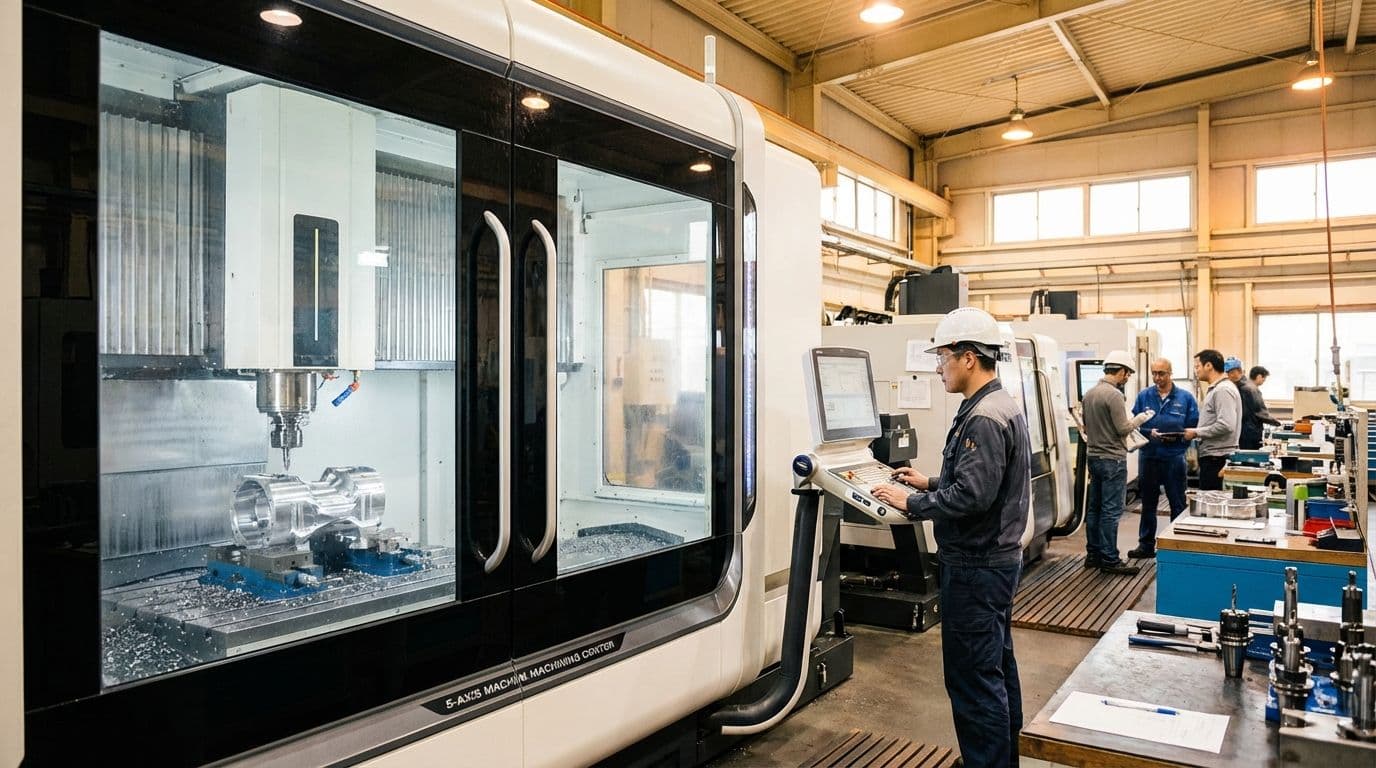
The $40 Million Gamble: Why Mid-Tier Contract Manufacturers Are Finally Buying 5-Axis Centers
March 17, 2026
The order backlog at a 220-person contract shop in Tulsa doesn't usually make headlines. But when that shop signs a $4.2 million purchase order for a pair of DMG Mori DMU 95 monoBLOCKs — and does it in the same quarter as a competitor in Wichita and another outside Nashville — something structural is happening in contract machining.
Mid-tier job shops, the backbone of aerospace and medical device supply chains, spent the better part of a decade watching 5-axis technology sit in the "aspirational capex" column. Lead times were brutal (they still are, currently running 14 to 18 months on large-format 5-axis from the major builders). The programming learning curve ate margins. And frankly, for shops running commodity aluminum brackets and steel weldments, the math never worked.
In 2026, the math is working. Not everywhere — but in enough places to constitute a genuine shift.
What Changed: Aerospace Demand and the Complexity Premium
Aerospace is the proximate cause. Boeing's 737 MAX production is targeting 42 aircraft per month by Q4 — up from roughly 24 monthly in mid-2025 — and the tier-2 and tier-3 supply chain has scrambled to keep pace. Structural components, brackets, manifold housings, actuation parts: the tolerances are tighter, the materials are harder (Inconel 718, titanium 6-4, 15-5 PH stainless), and the part geometry increasingly demands simultaneous 5-axis motion rather than 3+2 indexed setups.
The complexity premium is real. A job shop that can hold ±0.0005" on a titanium valve body with compound angles — in one setup, no refixturing — commands 18 to 25% higher margins than a shop running the same part across three 3-axis operations. That spread has widened since 2023, driven by the OEMs and tier-1 primes consolidating their approved vendor lists and paying a premium to suppliers who can reduce their own manufacturing steps.
Simplified: customers are paying more for fewer setups, and 5-axis is how you deliver fewer setups.
The Capital Math: Why $4 Million Pencils Out Now
A fully loaded horizontal 5-axis machining center — machine, tooling, fixturing, probing, CAM licenses, operator training — runs $3.8 to $5.5 million depending on work envelope and spindle configuration. For a contract shop doing $15 to $40 million in annual revenue, that's not small. That's often the largest single capex commitment the company has ever made.
But consider the operating model. A shop running three 3-axis VMCs to produce a complex aerospace housing typically burns 4 to 6 setups, 3 to 4 operators across shifts, and 9 to 14 days of flow time. The same part on a properly programmed 5-axis center: 1 setup, 1 operator, 2 to 3 days. First-pass yield goes up because there's no cumulative fixture error stacking across operations. Scrap rates on titanium drop, which matters when the material cost alone on a billet is $800.
Run the numbers at even modest volume — say, 400 of those housings per year at $1,200 average selling price — and the labor and scrap savings alone approach $280,000 annually. At a 20-year-old shop cost of capital, a $4.5 million machine starts paying for itself in year 4 or 5. That used to seem slow. Against a backdrop of 7% wage inflation for machinists over the last three years and a tightening skilled labor pool, it looks different now.
The SBA 504 loan program has also made the entry point more accessible. Fixed-rate, 10-year terms on equipment at 6.1% (as of early 2026) have pulled capital decisions forward for smaller shops that would have otherwise waited for a stronger order backlog. Several equipment dealers confirmed order acceleration tied directly to rate lock-in anxiety — shops buying in Q1 2026 to get ahead of projected rate movement.
The Workforce Problem That 5-Axis Partially Solves
Here's the counterintuitive part. Most people assume adding a $4 million 5-axis center requires more skilled labor. In some configurations, it requires less — or at least, it changes the skill profile.
A typical mid-tier shop staffing for 3-axis work needs multiple operators to manage setups, inspect parts mid-run, and shift WIP between machines. The 5-axis cell, properly configured with in-process probing and tool-length measurement, can run lights-out on second and third shift with a single operator monitoring multiple cells. One machinist managing two DMU 95s during a 10-hour overnight run — that's a labor model that didn't exist for most shops five years ago.
BLS data through January 2026 shows CNC machinist wages in aerospace manufacturing averaging $28.40/hour, up from $23.80 in 2022. In tight labor markets like the Phoenix metro and the Wichita aerospace corridor, the shortage of qualified operators has forced shops into brutal overtime cycles. Consolidating operations onto a single 5-axis platform reduces headcount exposure. It doesn't eliminate the need for skilled people — programming and setup still require genuine expertise — but it changes how many bodies per part you need on the floor.
The Builders Are Responding — With Lead Times That Will Test Your Patience
Fourteen months. That's the current lead time on a large-format 5-axis from DMG Mori's European production. Mazak is sitting at 11 to 13 months depending on configuration. Makino's A500Z, one of the more popular choices for shops targeting aerospace aluminum, is quoting 10 to 12 months for the base configuration — longer for custom workholding integration.
That lead time problem is itself a signal. Shops aren't just window-shopping anymore; they're placing orders 12 months out, which means the commit is real and the business case has been stress-tested. When a shop's ownership decides to place a deposit on a machine they won't receive until Q1 2027, they've modeled the production plan, cleared the floor space, and — usually — already had conversations with customers about the volume that will feed the cell.
The Taiwanese builders (Quaser, Tongtai, Awea) are quoting 6 to 8 months and gaining share among shops where the DMG Mori or Mazak brand premium doesn't justify the wait. Quality perception of the Taiwanese 5-axis has improved substantially — the control technology (largely Heidenhain and Fanuc, same as the European and Japanese machines) is now essentially equivalent, and for shops cutting aluminum at moderate feeds rather than pushing Inconel to its limits, the structural difference between a $2.1 million Quaser MV154 and a $3.8 million Mazak Variaxis is hard to justify on the shop floor.
Medical Device: The Other Driver Nobody Talks About Enough
Aerospace gets the attention, but the medical device sector is running parallel demand pressure — and the margins there are frankly better. Orthopedic implants, surgical instrumentation, catheter housings, spinal hardware: complex geometry, tight tolerances, biocompatible materials, and FDA audit requirements that make first-pass yield a compliance issue, not just a cost issue.
A contract manufacturer in the Chicago suburbs secured a 3-year supply agreement with a tier-2 orthopedic OEM in late 2025 that was explicitly contingent on 5-axis capability. The shop invested $7.1 million across two Makino D500 5-axis horizontal machining centers and reconfigured 12,000 square feet of floor space. The agreement covered 18 distinct part numbers — mostly cobalt-chrome and titanium spine components — at a combined annual value north of $6 million. The machine investment paid for itself in contractual revenue before a single part shipped.
That pattern — OEM qualification tied directly to 5-axis capability — is repeating across the medical device supply chain. The largest orthopedic OEMs (names any machinist would recognize) have been quietly updating their supplier qualification requirements to mandate simultaneous 5-axis capability for new complex geometry programs. Shops that haven't made the investment are getting shut out of RFQs they used to win on price alone.
The Shops That Are Still Waiting — and Why Some of Them Are Right
Not every contract shop should be writing a $4 million check right now. The business case depends heavily on work mix, customer concentration, and programming infrastructure. A shop running 70% 2D profiling on mild steel doesn't need a 5-axis center — they need a faster 3-axis with better automation and a better scheduler.
Shops that have made poor investments in 5-axis share a common failure pattern: they bought the machine without the programming talent to utilize it. CAM software for simultaneous 5-axis (Mastercam, Hypermill, NX CAM) is sophisticated and requires dedicated programming time. A shop that drops 4 million dollars on a machine and assigns programming duties to the same guy who handles fixturing design and material purchasing is going to watch that spindle sit at 28% utilization while the payment clock runs.
The successful adopters built their programming infrastructure 12 to 18 months before machine delivery — hired a dedicated 5-axis CAM programmer, ran simulation-only for months on the exact parts the machine would eventually cut, and used the lead time productively. That prep work is the difference between a cell that hits 65% spindle utilization in month three and one that struggles at 30% a year after commissioning.
Where the Capex Is Concentrating Geographically
The Wichita-to-Tulsa aerospace corridor. The Chicago-to-Milwaukee med-tech corridor. Southern California's aerospace machining cluster (still functioning, though real estate pressure continues pushing shops toward the Inland Empire). And increasingly, the Tennessee-Alabama advanced manufacturing zone that has absorbed substantial automotive and aerospace supplier investment since 2022.
State economic development incentives are accelerating timing in several cases. Tennessee's Fast Track Economic Development Fund has covered equipment costs of up to $500,000 for qualifying manufacturers expanding production capacity — a meaningful offset on a $4 million machine buy. Alabama's AIDT workforce training program, combined with equipment investment tax credits, has made the calculus favorable for shops weighing Tennessee vs. Alabama locations for new capacity.
The Broader Signal
Taken individually, each shop buying a 5-axis center is a business story. Taken collectively — and the collective here spans somewhere between 200 and 400 orders placed by mid-tier North American contract shops in 2025 alone, based on builder shipment data — it's a structural repositioning of the contract manufacturing supply chain.
The shops that survive the next decade in aerospace and medical device aren't the cheapest. They're the ones that can hold geometry on difficult materials, guarantee first-part quality on complex programs, and meet lead time requirements that assume a supplier isn't spending 9 days transferring parts between 3-axis setups. The OEMs have made this clear through their RFQ behavior, their supplier audits, and their willingness to pay the complexity premium.
The $40 million referenced in the headline isn't one machine. It's the aggregate bet a single tier-2 aerospace supplier made across a two-year capex cycle — eight machines, three facilities, full 5-axis transformation of their production floor. Whether the volume materializes to support that investment depends on Boeing hitting 42 aircraft per month and Airbus holding its A320 family ramp. Both are achievable. Neither is guaranteed.
Watch Q3 earnings from the machine tool builders. If order intake holds above 2025 levels, the mid-tier upgrade cycle still has runway. If aerospace OEM production rates slip again — and the supply chain has seen enough slippage to maintain genuine skepticism — the shops that overcommitted to 5-axis capacity will feel it in their debt service first.
The machines are on order. The floor space is cleared. Now comes the hard part.
Stay ahead of capital equipment trends and contract manufacturing market shifts — subscribe to the ManufacturingMag weekly briefing.