Reshoring's Dirty Secret: The 8-Month Wait for 480V Power Drops in South Carolina
Reshoring headlines keep coming. Battery plants. Tier 1 suppliers. Precision machining shops following aerospace work into the Upstate. Distribution-heavy industrial parks trying to backfill with actual manufacturing. On paper, South Carolina still looks like one of the cleaner bets in the Southeast, port access in Charleston, BMW and Volvo anchoring an automotive cluster, inland logistics that pencil out, and a state government that has spent two decades selling speed.
Then the utility timeline shows up.
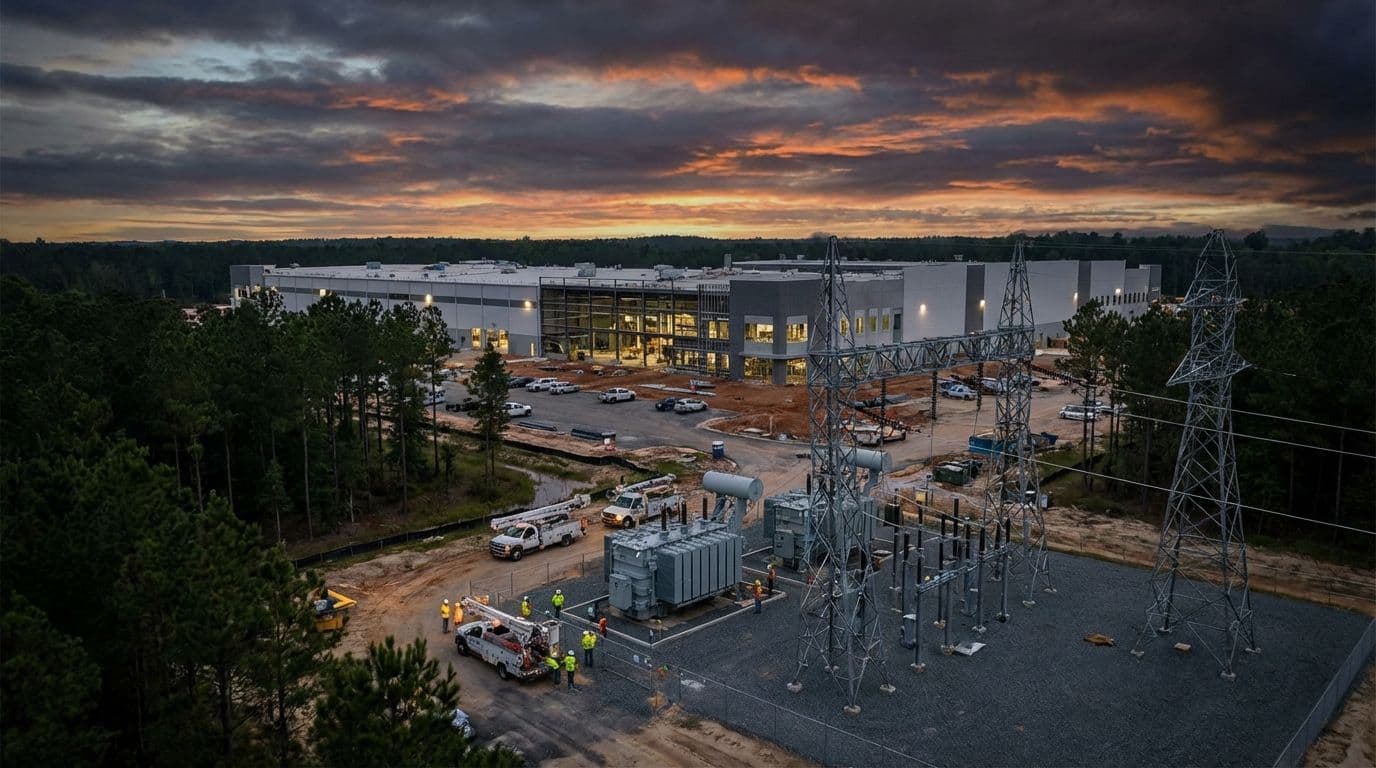
For a growing share of projects, the constraint is no longer labor first or tax incentives first. It is power, specifically how long it takes to get reliable medium-voltage service, transform it down, and energize a building on a schedule that matches modern industrial capital deployment. For smaller and mid-size projects, that bottleneck often shows up in a less glamorous phrase: the 480V drop. Not a greenfield megasite. Not a flashy transmission build. Just the basic electrical service a plant needs to commission equipment, run HVAC, light the floor, and start making parts.
The timing problem is getting harder to ignore because the broader demand picture has shifted. South Carolina utilities and lawmakers are openly debating how to handle rising power demand tied to industrial expansion, population growth, and large-load customers. Search activity and legislative discussion this month have centered on interconnection policy, qualifying industrial customers, and whether utilities should be allowed to move faster to add generation and grid capacity. That is not the kind of debate a state has when there is abundant slack on the system. It is the kind of debate a state has when growth has outrun the old playbook.
The reshoring pitch is still strong, until the power schedule hits the spreadsheet
South Carolina remains a credible reshoring destination for obvious reasons. Port of Charleston volumes support import-heavy component flows. I-85 and I-26 provide a workable logistics spine. Automotive, tire, chemicals, and advanced materials manufacturers can recruit inside an existing industrial base rather than trying to create one from scratch. And compared with parts of the Northeast or the West Coast, industrial land still looks manageable in many submarkets.
But none of that matters if the building is ready in October and the service date slips into the following spring.
That is where the 8-month number matters. It is not a universal rule, and it varies by utility territory, feeder conditions, project size, and whether the site needs off-site upgrades. But for manufacturers chasing ordinary 480V service, not hyperscale loads, not a 200-megawatt campus, plain old plant power, wait times that stretch well beyond a single quarter are now common enough to distort deal economics. The problem gets worse when the base service timeline is followed by transformer procurement delays, switchgear lead times, and final commissioning windows that collide with year-end customer commitments.
The math gets ugly fast. A $12 million to $25 million project can absorb a lot of things. It cannot easily absorb a nearly three-quarter-year delay between shell completion and revenue production. Lease carry keeps running. Equipment financed on delivery keeps depreciating. Launch teams stay on payroll. Customer programs slip. And in reshoring projects, where executives already accepted higher labor and construction costs in exchange for shorter supply chains and better control, an electrical delay can erase half the strategic rationale.
Why 480V has become a strategic bottleneck
Outside manufacturing, 480V sounds minor. On the shop floor, it is the workhorse. CNC equipment, weld cells, air compressors, ovens, chillers, conveyors, robotic cells, and plant-wide motor loads all live in that world. A manufacturer can delay office finishes. It can run temporary trailers. It can even stage some warehouse functions manually. It cannot fake plant power for long.
And the supply chain behind that power connection is under strain from multiple directions at once.
First, utilities are handling far more load studies than they were even three years ago. South Carolina's industrial recruiting machine did not slow down just because the national conversation moved from reshoring to AI. In fact, the opposite happened. Industrial recruitment stayed active while power-hungry data center proposals added noise and urgency to utility planning. One recent South Carolina policy discussion summarized the issue plainly: record population growth and major industrial expansion are pushing electricity demand higher across the state. That matters because every speculative or proposed large-load customer consumes engineering attention, queue capacity, and capital planning bandwidth, even if the project never closes.
Second, the equipment stack behind a new service connection is still not normal. Switchgear, pad-mount transformers, relays, breakers, and protection components have improved from the worst post-pandemic lead times, but many categories remain lumpy. A project can clear one hurdle and stall on another. A transformer may be available, but not the right size. The gear may arrive, but field crews are booked. The utility may be ready, but the site contractor misses trenching windows because another trade slipped.
Third, utilities are trying to reconcile economic development pressure with system reliability. A state can promise fast-track industrial growth all day. The grid still has to survive summer peaks, storm events, and reserve margin stress. That tension explains why policymakers are now discussing faster interconnection rules and broader utility flexibility. It also explains why some power plant retirements have been delayed in states including South Carolina. When utilities postpone generation retirements, that usually signals the reserve cushion is thinner than economic developers would like to admit.
This is not just a megaproject problem
The easiest mistake in this conversation is assuming power delays only hit giant battery campuses and semiconductor fabs. Those projects absolutely stress the system. But the damage often lands harder on smaller manufacturers, because they have less negotiating leverage and less room for error.
A global OEM can escalate. A 140,000-square-foot contract manufacturer usually cannot.
A large battery plant can redesign phases, pull forward temporary generation, or justify utility capital participation because the headline job count is big enough to move a governor's office. A fabricator adding a second building in Spartanburg County or a plastics processor trying to launch in Berkeley County gets treated more like a queue item than a statewide priority. And when that project slips, the company still has customer penalties and working-capital stress, just without the political muscle.
The result is a quiet sorting mechanism inside reshoring. The projects that survive are the ones with either enough scale to command attention or enough patience to absorb delay. The ones that struggle are often exactly the kind the United States claims it wants more of, mid-market industrial firms making real components, hiring 80 to 250 people, and rebuilding domestic supply chains one cell, press, or line at a time.
Site selectors are starting to price power readiness differently
Five years ago, South Carolina could win a fair number of industrial deals on labor availability, logistics, and incentive structure even if a site needed some work. Today, power-readiness screening is much harsher. Site selectors are asking earlier questions, how much capacity is actually available at the meter, what upgrades are already funded, whether the substation has room, how much redundancy exists, and what the utility will commit to in writing.
That last point matters. Manufacturers no longer want polite ranges. They want milestone dates. Design completion. equipment release. civil start. energization. They want to know whether the utility's date assumes no permitting surprises, no long-lead component misses, and no storm season disruptions. Because a "target" date without caveats is not a schedule. It is marketing.
In that environment, a shovel-ready site without power readiness is not really shovel-ready. It is just graded dirt with a brochure.
That shift changes state competition. North Carolina, Georgia, Tennessee, and Alabama all have pockets with the same problem, but the winners over the next 24 months are likely to be submarkets that can document actual electrical readiness, not just industrial zoning and road frontage. The sales pitch is moving from land cost and tax abatements to amperage and timeline certainty.
The real cost is not the utility bill, it is idle capital
Manufacturers do not relocate or expand because electricity is emotionally satisfying. They do it because the production math works. That math depends on cycle time, labor efficiency, freight savings, scrap rates, and time to stable output. A delayed 480V connection breaks the model because it turns capex into idle capital.
Consider a mid-size machining operation that signs off on a $6 million equipment package, two horizontal machining centers, automation, inspection, compressed air, fixturing, and coolant infrastructure, for a new South Carolina facility. Even a modest 6-month slip can add hundreds of thousands in non-productive cost through lease carry, duplicate overhead, installation rescheduling, contractor remobilization, and lost bookings. Stretch that to 8 months and the hit starts to look like a bad quarter, not a nuisance.
There is also a supply-chain credibility issue. OEMs that were sold on domestic sourcing do not care why a supplier's launch is late. They care that PPAP slipped, that the pilot lot is late, and that the backup source in Mexico or Asia suddenly looks rational again. Every time a reshoring project misses launch because basic utility service lags, it hands ammunition back to managers who never believed the domestic business case in the first place.
South Carolina's policy scramble tells the story
The state is not blind to the issue. Lawmakers are debating utility policy changes tied to interconnection, generation development, and treatment of large customers. Utilities are arguing for tools to move faster. Economic developers are trying to keep megaproject wins from turning into infrastructure embarrassment. Even the public conversation around data centers matters here, because it shows how contested scarce grid capacity has become.
That is the dirty secret behind the reshoring boom. The United States spent years talking about subsidies, tariffs, and national security. All important. But the plant still has to turn on. And in a lot of Southeastern markets, including parts of South Carolina, the bottleneck is no longer ideology or even financing. It is grid execution.
That reality should change how manufacturers sequence projects. Power diligence needs to happen before final site commitment, not after. Utilities need to be in the room during site selection, not just after the press release. Equipment procurement plans need to assume energization risk. And economic development offices should stop advertising timelines they cannot support with utility sign-off.
What manufacturers should watch next
Three things matter over the next two quarters.
First, whether South Carolina utility legislation actually shortens connection timelines or simply gives utilities more discretion without adding field capacity. Policy headlines are easy. Crew availability and equipment delivery are harder.
Second, whether large-load competition eases. Some utility commentary this month suggests data center proposals are already cooling in South Carolina. If that trend is real, some engineering and interconnection pressure could ease. If it is not, smaller industrial customers will keep getting squeezed behind larger, louder loads.
Third, whether manufacturers start walking away from otherwise strong sites because the power schedule no longer works. That is the signal worth tracking. Not the ribbon cuttings. The quiet cancellations. The expansions that move one state over. The second-phase buildings that never break ground.
South Carolina still has the industrial DNA to win reshoring work. But the next phase of competition will not be won with slogans about business climate. It will be won with energized buildings, documented utility timelines, and enough grid capacity to support real production. Until then, the 480V drop remains one of the least glamorous, and most consequential, constraints in American manufacturing.
Get ManufacturingMag in your inbox Sign up for weekly coverage on plant expansions, automation capex, labor economics, and the infrastructure constraints that actually move manufacturing decisions.