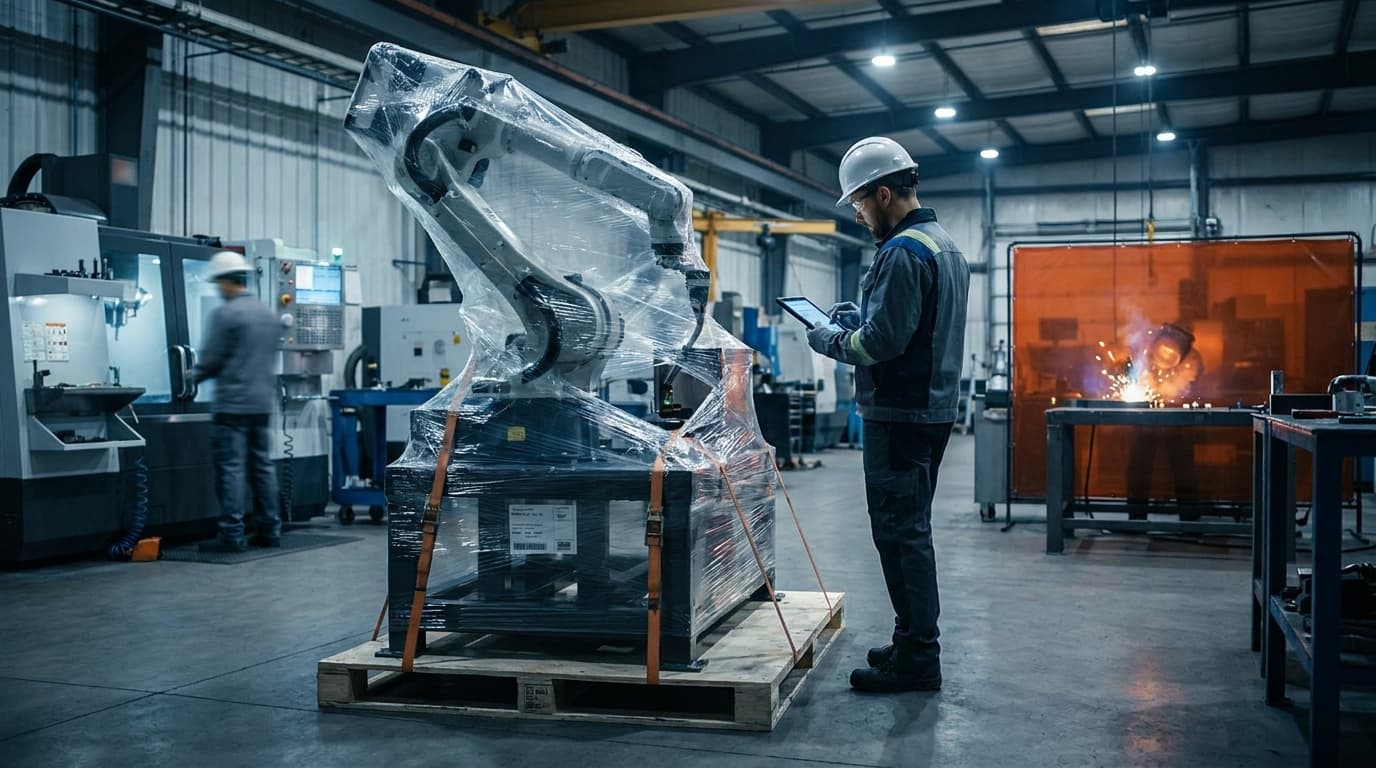
A plant manager in Ohio signs a purchase order for an imported six-axis robotic welding cell to cover a shift she cannot staff. The cell is exactly the kind of capital investment federal policy has spent two years trying to encourage on American soil. And under rules that took effect June 8, 2026, she now pays a Section 232 duty calculated on the machine's entire customs value—not because Washington passed a tax on robots, but because that cell contains covered steel and aluminum.
That is the paradox now sitting on every automation budget in American manufacturing. The tariff regime built to reshore production has begun taxing the imported machine tools and robotic systems that reshored plants depend on from day one. The popular framing—a "25% tax on robots"—is close enough to the sticker shock to stick, but it misstates the mechanism in ways that matter for anyone actually writing the check. Understanding the difference is worth real money.
What actually changed in June
On June 1, 2026, the administration issued Proclamation 11032, "Further Adjusting the Tariff Regimes for Imports of Aluminum, Steel, and Copper." It took effect at 12:01 a.m. ET on June 8, and it amends the broader restructuring set in motion by Proclamation 11021, which took effect April 6, 2026.
Two features of that framework drive the cost story. First, since April 6, Section 232 duties on covered metals and their derivative articles apply to the full customs value of the imported product rather than to the percentage of metal content inside it. As trade advisors have documented, that shift—from metal-content-based to full-value duty—is the mechanical reason a metal-intensive machine now carries a far heavier bill than the raw steel inside it would suggest.
Second, the definition of a "derivative" article has expanded to sweep in a broad set of Chapter 84, 85, and 87 classifications—well beyond bolts and pipe fittings. Coverage now reaches tractors (HTS 8701), self-propelled work trucks (8427), construction and material-handling equipment (8429), agricultural machinery (8432/8433), HVAC equipment (8415), and vehicle components (8703/8708), among others. In plain terms: capital equipment that happens to be built largely of steel and aluminum is now treated as a metal product for tariff purposes.
This is the accuracy caveat that most "robot tax" coverage skips. The machinery is dutiable because it contains covered metal—the derivative mechanism—not because the government has imposed a dedicated tariff on the machines themselves. There is no standalone 25% levy on robotics on the books today. The 25% figure people cite is the standard steel-derivative rate that would apply once temporary relief expires.
The rate math—and the cliff
Left alone, the numbers are punishing. Standard derivative rates run from 25% up to 50%, since steel, aluminum, and copper carry standard Section 232 rates as high as 50%. Layer that onto the full customs value of a multi-hundred-thousand-dollar machine tool and the tariff line item stops being a rounding error.
To blunt the impact on capital equipment, the June action created a temporary reduced ad valorem rate—widely cited at 15%, with some categories at 10%—for qualifying industrial machinery, agricultural equipment, and residential and power HVAC equipment. The carve-out is explicitly framed as protecting machinery "essential to the U.S. defense industrial base."
The catch is the calendar. That reduced rate runs only through December 31, 2027. On January 1, 2028, qualifying goods revert to the standard derivative rates of 25% to 50%. That is a deliberate buy-before-the-cliff incentive: the policy nudges plants to pull automation purchases forward into the window when duties are lightest. For a capital-planning team, the reduced rate is not relief so much as a countdown.
Several other mechanics compound the exposure:
-
Stacking. Section 232 duties stack on top of regular Column 1 duties and other trade-remedy tariffs. The reduced machinery rate is not a ceiling on total duty—it is one layer.
-
The content threshold moved. The June action lowered the U.S.-content threshold to qualify as "entirely American" and duty-exempt from 95% to 85% of the relevant metal's weight—a modest easing for goods with heavy domestic sourcing.
-
Partner-country treatment. USMCA and partner-country rules were clarified so that Canada and Mexico duties apply to non-U.S. content, with roughly a 15% minimum effective rate.
The practical upshot: depending on classification and sourcing, the same class of equipment can land anywhere across a 0/10/15/25/50% spectrum. HTS classification is no longer a compliance formality; it is a pricing variable.
The second shoe
The June metals action is not the vehicle most operators should be watching for a true tax on the machines themselves. That vehicle is a separate proceeding.
On September 2, 2025, Commerce initiated a Section 232 national-security investigation into imports of robotics and industrial machinery. Public comments were due October 17, 2025, and Commerce's report to the President was statutorily due by May 30, 2026. Its scope is aimed squarely at the machines: CNC machining centers, turning and milling machines, grinding and deburring equipment, industrial stamping and pressing machines, tool changers, and welding and cutting tools.
The scale is the story. The National Association of Manufacturers estimated the probe could touch roughly half a trillion dollars in manufacturing equipment and inputs—describing it as the largest Section 232 investigation to date—and warned it could stall U.S. investment. If that inquiry produces a direct tariff on robotics and machine tools, it would land on top of the derivative-metals duties already in force, compounding the cost of the same equipment through two distinct legal channels. Keeping the two threads separate is not pedantry; it is the difference between planning for one tariff and planning for two.
The operator's paradox
Here is why this bites reshoring specifically. Reshoring and foreign direct investment announced roughly 244,000 U.S. manufacturing jobs in 2024, and about 88% of those were in high-tech and medium-high-tech facilities—plants that rely on robotics and automation from day one. Automation and controls engineers are among the hardest reshoring roles to fill, which means the machines aren't a nice-to-have; they are how a domestic plant closes the labor gap at all.
The economics had been moving in automation's favor. Robotic-cell payback is commonly cited at roughly 8 to 18 months, with complex multi-system deployments running 24 to 36 months, and industry surveys report that about 95% of U.S. manufacturers plan new automation within three years. A full-value tariff on imported cells lengthens that payback math precisely when the window had just opened. As one industry analysis put it, automation remains key to reshoring tariffs or not—but the tariff drag directly taxes the capital that makes domestic output cost-competitive.
Counterweights and hedges
The picture is not one-directional. Several forces cut the other way, and they matter to the ROI case.
The most significant is tax. Full first-year equipment expensing under the 2025 "One Big Beautiful Bill"—available through at least 2029—lets a plant write off a robotic cell in year one, partially offsetting the tariff added to the purchase price. For a profitable operation, the immediate deduction recovers a meaningful share of the duty drag on automation capital, and it is the single most important nuance in any payback model built this year.
Beyond expensing, the levers include the temporary carve-out itself—a real, if expiring, buy-before-2028 incentive—plus USMCA and partner-country relief for qualifying content, and a likely shift toward leasing and robotics-as-a-service financing as buyers restructure how they take on tariff-laden capital.
What to watch, and what to do
For operators sizing an automation purchase this year, four practical items:
-
Nail the HTS classification. The 0/10/15/25/50% spread means the tariff outcome turns on classification and documented content. Treat it as an engineering input, not an afterthought.
-
Weigh the timing. The reduced 10–15% machinery rate expires December 31, 2027. Purchases that can be executed before the revert avoid the standard 25–50% rates that follow.
-
Track the robotics-232 report. Commerce's report was due May 30, 2026; any resulting action would be the direct machine-tool tariff the derivative rules only approximate today.
-
Build the U.S.-content file. The threshold to qualify as duty-exempt fell from 95% to 85%. Documentation of domestic metal content is now the boundary between an exemption and a full-value duty.
The bottom line
Reshoring's dependence on automation is precisely what makes this policy self-taxing. Domestic plants cannot out-compete offshore labor without robots, and the robots increasingly arrive with a Section 232 bill attached to their full value. Whether reshoring keeps its momentum comes down to a race: can full first-year expensing and the temporary machinery carve-out outrun the tariff drag before the standard rates snap back on January 1, 2028—and before a second, larger tariff aimed directly at the machines potentially arrives on top? For now, the safest read is that the "tax on robots" is real in effect, indirect in mechanism, and on a clock.
Related reading
-
[The Pentagon's Additive Budget Jumped 83% to $3.3B — and Velo3D's $9.8M DLA Contract Is the Tell](/article/pentagon-additive-budget-83-percent-velo3d-dla-contract)
-
[FANUC Just Shipped 1,000 'Physical AI' Robots — and Its Google Deal Is the Brownfield Answer to Every Humanoid Bet](/article/fanuc-google-physical-ai-brownfield-humanoid)
Sources
-
[Updates to Section 232 Tariffs on Steel, Aluminum, Copper (June 2026) — C.H. Robinson Client Advisory](https://www.chrobinson.com/en-us/resources/insights-and-advisories/client-advisories/2026q2/06-02-2026-client-advisory-updates-to-section-232-tariffs-on-steel-aluminum-copper/)
-
Trump Administration Revamps Section 232 Metal Duties — Global Trade & Sanctions Law
-
Report: 95% of U.S. Manufacturers Plan New Automation by 2028 — Supply Chain 24/7
-
Tariffs or Not, Automation Is Still Key to Reshoring Manufacturing — Manufacturing Dive
-
How the One Big Beautiful Bill Made Robotics the Hottest Investment of 2026 — Standard Bots
-
Reshoring in 2026: Why Manufacturing Jobs Are Coming Back — KORE1