The number that traveled fastest was $28,350. It is the wrong number to lead with.
On August 13, 2026, Ford said it had finished converting Louisville Assembly Plant — 3 million square feet of it — from internal-combustion production to fully electric production in under a year. Escape and Lincoln Corsair came off that plant's lines in December 2025. Prototype builds on production-qualified parts are due in the first quarter of 2027, preorders early that year, customer deliveries later in 2027. In the interval, Ford did something no American automaker has done at this scale: it took out the single moving assembly line and did not put another one back.
That is the story. The truck that comes off it — the Fathom, a five-passenger midsize electric pickup priced at $28,350 plus $1,595 destination, or $29,945 out the door — is the test case, not the thesis. The thesis is a manufacturing system, and Ford is betting roughly $5 billion on it: nearly $2 billion at Louisville and a previously announced $3 billion at BlueOval Battery Park Michigan, covering roughly 4,000 direct jobs created or secured across the two sites and 2,200 hourly jobs held at Louisville.
What an "assembly tree" actually is
The moving assembly line is a serial chain. Every station touches every unit in sequence, and the plant's output is governed by its slowest station. Ford's Universal EV Production System breaks that chain into three.
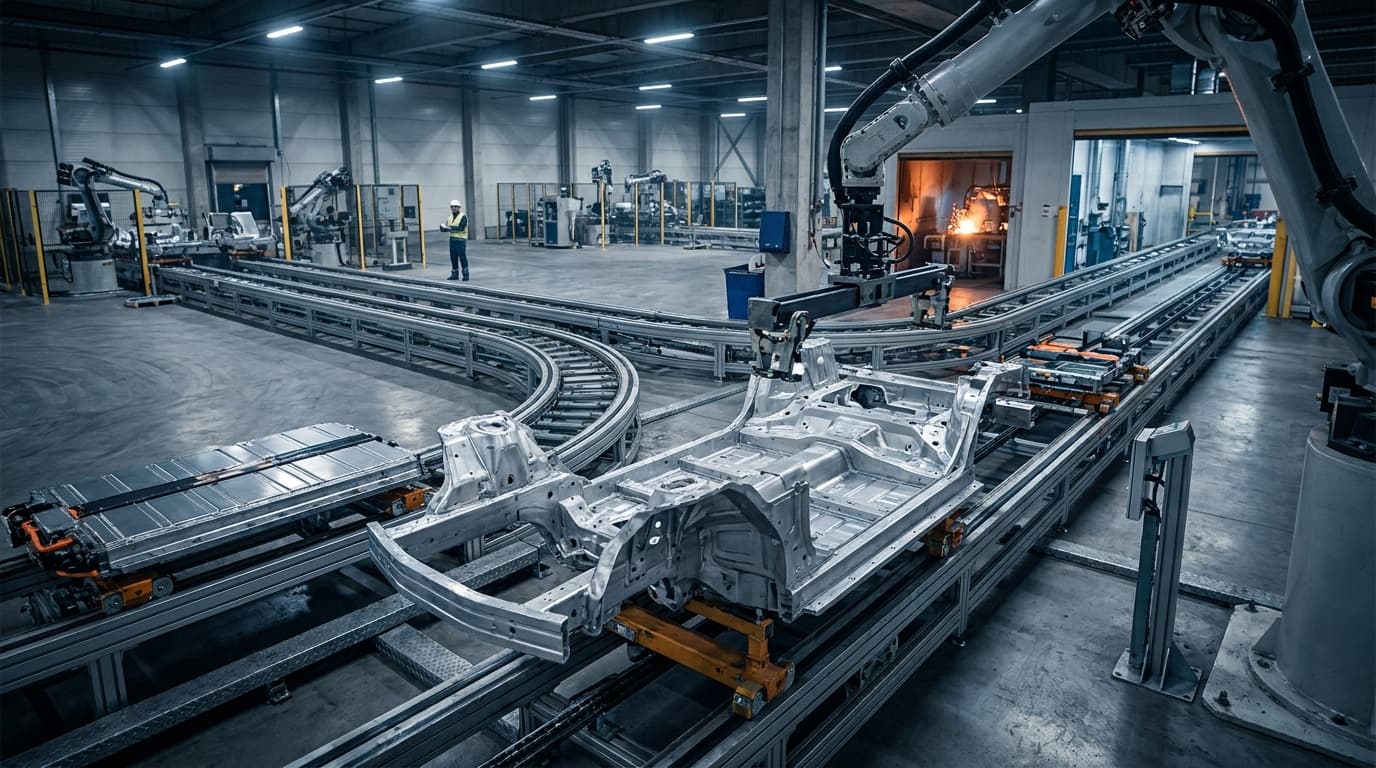
In Ford's own framing: instead of one long conveyor, three sub-assemblies run down their own lines simultaneously and then join together. Two of those branches are built around large single-piece aluminum unicastings — one front, one rear. The third is the structural battery module: a nickel- and cobalt-free prismatic LFP pack, built at BlueOval Battery Park Michigan, that forms the vehicle floor and is independently fitted with seats, consoles and carpeting before it ever meets the rest of the truck. The battery goes in from underneath at the marriage station, already trimmed.
The second design principle is kitting. Parts travel down the tree to operators in kits that contain every fastener, scanner and power tool that station requires, pre-oriented for use. That is a deliberate attack on walking distance and on the tool-search time that line-balancing studies never quite capture.
The reason all of this is possible at once is the casting. Jim Farley's claim, as reported by InsideEVs, is that the radically simplified unicastings "condense over 146 parts into 2." It is Ford's first use of large unicastings, and it is what allows a front structure and a rear structure to exist as coherent, self-supporting objects that can travel down separate branches instead of accreting station by station along one spine.
Read the productivity numbers precisely
Ford's platform-level claims, all traceable to the August 11, 2025 release: 20% fewer parts than a typical vehicle, 25% fewer fasteners, 40% fewer dock-to-dock workstations, and a wiring harness more than 4,000 feet (1.3 km) shorter and 10 kg lighter than the one in Ford's first-generation electric SUV, enabled by a new zonal electrical architecture.
Then there is the speed figure, which most coverage has gotten subtly wrong. Ford says assembly of the truck "could be up to 40% faster than Louisville Assembly" builds its outgoing products today — and that Ford intends to reinvest that recovered time into insourcing and automation to improve quality and cost, "ultimately netting a 15% speed improvement."
The 40% and the 15% are the same claim at two stages, not two independent gains. Forty percent is the gross theoretical reduction in assembly time; fifteen percent is what survives after Ford spends most of that headroom pulling work back in-house and adding automation content. Reporting them as separate wins inflates the story by a factor of about two and a half. The honest read is that Ford believes the architecture is worth 40 points of labor time and is choosing to bank a quarter of it as throughput and spend the rest on vertical integration and quality — which is a defensible strategy, and a much more interesting one than a simple speed claim.
Three takt clocks and one marriage station
Here is where the engineering gets genuinely hard, and where Ford has published the least.
A serial line has one takt time. A tree has three, and they must converge. Line balancing on the Universal EV Production System is no longer the familiar problem of smoothing work content across a long chain of stations; it is the problem of matching three branch cycle times to each other and sizing the decoupling buffers that absorb the mismatch. Get the buffers wrong in one direction and the marriage station starves. Get them wrong in the other and you have parked working capital — three partially built vehicle sections apiece — on the floor of a plant whose entire pitch is that it eliminated 40% of its workstations.
The failure mode is also different in kind. On a serial conveyor, a station stoppage halts everything downstream and, after the buffer drains, everything upstream. On a tree, a stoppage on the battery branch means the front and rear branches keep running — accumulating inventory against a marriage station that cannot consume it. Whether that is a resilience advantage or an expensive way to build WIP depends entirely on buffer sizing that Ford has not disclosed.
What Ford has disclosed about the physical conversion is impressive on its own terms and is documented in unusual detail by Work Truck Online: roughly 230,000 square feet of concrete poured, about 17,000 feet of final-assembly conveyor installed, nearly 700 miles of welding wire consumed stabilizing overhead trusses, and some 25,000 gross tons of scrap removed across 2,618 truckloads. Wi-Fi access points went from 385 to 1,080, with a private 5G network layered on for in-line quality scans. Ford calls the result the highest final-assembly automation content of any Ford plant globally.
The unicasting trade: what it removes, what it adds
"Over 146 parts into 2" is a subtraction claim, and the subtraction is real. Every part that disappears takes with it a stamping die, a die maintenance schedule, a weld gun or a rivet, a bead of structural sealer, a body-in-white fixture, an inspection point, a supplier PPAP and a line-side container.
The addition is concentration of risk. A giga press is a single point of failure with a lead time measured in quarters, not weeks. Failure modes migrate from things body shops have inspected for eighty years — weld nugget diameter, spot spacing, joint fit-up — to things far fewer plants have institutional muscle for: casting porosity, oxide inclusions, dimensional control across a large thin-wall part, thermal distortion, and the machining and CMM datum strategy that turns a raw casting into something the rest of the tree can locate against.
This is where Ford's decision to spend its recovered 25 points of assembly time on "insourcing and automation to improve quality" reads less like corporate boilerplate and more like a plan. The 1,080 access points and the private 5G exist to make scan-based, in-line quality verification cheap enough to do at every station rather than at gates. On a casting-intensive body, that is the correct place to spend the money — because a porosity defect found at final inspection is a scrapped structure, not a reworked joint.
Ford has not published press tonnage or named the casting supplier in these releases. IDRA has been reported as a Ford gigapress supplier. The more consequential unanswered question is whether the castings are produced on-site at Louisville or shipped in, because that single fact determines both the inbound logistics profile of a plant designed around kitting and the severity of the single-source exposure.
Repairability: the chapter Ford has not written
The reflexive line about large castings is that they are unrepairable and turn moderate collisions into total losses. That claim is lazier than the evidence supports.
As The Autopian documented for Tesla's castings, OEM collision manuals define repair zones by color: welding permitted up to roughly 50 mm in green zones, backing plates required in yellow and orange zones, red zones generally no-weld. Sectioning with rivets and structural adhesive is an accepted method. MIG welding cast aluminum is done in production repair. The real technical constraint is not the concept of repair — it is porosity and entrapped gas, which is precisely why the permitted weld lengths and zones exist.
So castings are repairable within OEM-defined limits. The reportable gap is that Ford has published no equivalent Fathom collision-repair procedure. And the economics of that gap bite harder here than on a Tesla. Total-loss thresholds are driven by repair cost as a ratio of vehicle value. On a $29,945 truck, a structural repair that would be routine on a $60,000 vehicle can cross the threshold. Insurers will price that ratio whether or not Ford publishes procedures — and if the procedures arrive late, they will price it conservatively. For a vehicle whose entire market position is affordability, residual value and insurance cost are not peripheral concerns.
Labor: fewer joints, more machines, and an ergonomics argument
Ford secured 2,200 hourly jobs at Louisville. It also laid off roughly 2,000 workers temporarily for the ten-month retooling, with Louisville employees working process development at Ford's New Model Programs Development Center in Allen Park, Michigan. Ford's framing, echoed in [Automotive Manufacturing Solutions](https://www.automotivemanufacturingsolutions.com/electrification/ford-reshapes-ev-manufacturing-with-new-platform/655168)' account, is reassignment to higher-value automation and data-oversight roles rather than headcount reduction.
The composition shift is the substance. A body shop that joins 146 parts needs weld technicians, fixture setters and joint inspectors. A body shop that receives two castings needs casting-process people, machinists, CMM operators and automation troubleshooters. Those are not the same jobs, they are not the same training pipelines, and the second set is scarcer in the labor market than the first.
Ford's counter-narrative is ergonomics, and it is more than PR. Chief manufacturing officer Bryce Currie cites an engineered 84% reduction in reaching over the fender — the single most reliable source of shoulder injury claims in final assembly. Kitted tools arriving pre-oriented remove wrist rotation and search time. Kevin Young, who runs advanced program manufacturing, puts it plainly: "It is simply foundationally different from how we have done things before." If the injury-rate data bears out, that is a durable cost line, not a talking point.
An aluminum bet, placed by a company with an aluminum problem
Ford's own second-quarter 2026 results attribute part of the revenue decline and Ford Pro's $600 million EBIT drop to "Novelis-related aluminum supply constraints" following the September 2025 Oswego hot mill fire.
The temptation is to draw a straight line from that to an aluminum-intensive EV architecture. Resist it. Oswego produces rolled sheet — body panels — not the casting alloy that feeds a giga press. They are different products on different supply chains with different qualification paths. The exposure worth reporting is directional, not mechanical: Ford is deepening its dependence on a light-metal supply base at a moment when it has just demonstrated, on its own income statement, how much a single upstream disruption in that base can cost. That is a risk-concentration observation, not a causal one.
The volume question, stated as arithmetic
Everything above is a bet that fixed cost converts to unit cost at sufficient volume. So here is the volume math — and to be explicit, the following is this publication's arithmetic under stated assumptions. Ford has published no Fathom breakeven figure.
Take only the $2 billion committed at Louisville — set aside the $3 billion at BlueOval Battery Park, which serves more than one program. Assume an eight-year platform life at the plant. That is $250 million a year to recover before the truck contributes anything. At a $2,500 per-unit contribution margin, recovery requires 800,000 cumulative units, or 100,000 a year. At $1,500 per unit, 1.33 million cumulative, or roughly 167,000 a year. At an optimistic $3,500 per unit, about 71,000 a year.
Now the scale check. Ford Model e wholesaled 28,000 units in Q2 2026 — down 53% year over year — on $1.0 billion of revenue, against an EBIT loss of $919 million. Annualize that quarter and Ford's entire electric vehicle business runs at roughly 112,000 units a year. In the middle of the range above, the Fathom alone would have to sell at approximately the rate of all of Ford's current EVs combined, just to amortize the plant.
The demand backdrop does not help. Per EIA data sourced from Omdia, battery-electric vehicles hit a record 12% of US light-duty sales in September 2025 — a pull-forward ahead of the $7,500 federal credit expiring September 30 — then fell to 6% of sales in Q2 2026, down from 7% in the first half a year earlier. Hybrids set a record 16% in Q2 2026. The segment Ford just rebuilt a plant for is shrinking as a share of the market, and the segment absorbing that demand is one Louisville no longer builds.
Ford is not pretending otherwise. Full-year Model e loss is guided to about $4.0 billion — improved from a prior $4.0–4.5 billion range — including roughly $1 billion of incremental Universal EV and Ford Energy investment. The $919 million quarterly loss was a $410 million year-over-year improvement and the third consecutive quarter of year-over-year gains. Segment breakeven remains targeted for 2029. Ford Blue delivered $1.1 billion of EBIT and Ford Pro $1.7 billion in the quarter — which is to say the profitable halves of the company are underwriting this.
The real test is vehicles two and three
Ford's cost argument is not confined to the factory. Doug Field's line — that a reduction of one count of drag coefficient is worth $25 of battery — captures the discipline running through the program: every gram, every foot of harness, every count of Cd is priced against cells, because cells are the bill of materials. Ford has said the Fathom targets 0-60 as quick as a Mustang EcoBoost with more passenger room than a current RAV4, plus a frunk and a bed, and pitches a five-year cost of ownership below that of a three-year-old used Model Y. EPA range, pack size and charge times were deferred at platform launch and remain unpublished.
But the tree layout and the unicastings only pay back at volume, and the strategic hedge is right there in the name: this is a Universal EV Platform, not a Fathom platform. A tree with three branches and a marriage station is far more indifferent to what body sits on top than a conveyor tuned to one product. The question that decides whether $2 billion was well spent is not how many Fathoms Ford sells in 2028. It is how quickly Ford puts a second and a third vehicle down the same tree — and whether the architecture's flexibility is real enough that adding them costs a retool rather than a rebuild.
Open questions worth putting to Ford
-
What is the press tonnage on the unicastings, and are they cast on-site at Louisville or shipped in?
-
How much buffer stock sits between each branch exit and the marriage station, and what does a single-station stoppage on one branch cost when the other two keep running?
-
What is the planned line rate and annual capacity at Louisville under the new layout?
-
What are the first-time-through and scrap targets on the castings, and how do they compare to the outgoing body shop's joint-level rates?
-
When will Fathom collision-repair procedures be published to the I-CAR and insurer channels?
Ford has answered the hard engineering questions in public and in detail — more detail than most OEMs offer about a process change of this magnitude. The remaining gaps are the operational ones, and they are the ones that will determine whether the assembly tree becomes the industry's next default or an expensive footnote in the electrification transition.
Related reading
-
[The Data Center Tax on the Rust Belt: PJM Capacity Prices Rose 1,038% and a Brick Plant's Monthly Bill Went From $1,600 to $12,000](/article/pjm-capacity-prices-data-center-tax-rust-belt-manufacturers)
-
[The Pentagon Is Printing Propellant — Just Not Where the Bottleneck Is](/article/pentagon-printing-propellant-x-bow-1100-motors-191m-solid-rocket-motor-base)
-
[Intel's First Share Sale Since 1971 Closed at $23B — Enough to Tool a 14A Fab It Has No Signed Volume For](/article/intel-23b-stock-offering-14a-capex-before-contract)
-
How to Answer a 30% Price-Down Letter Without Losing the Program
Sources
-
Work Truck Online — "Ford Fathom Production Takes Shape at Louisville Assembly Plant"
-
Fox Business — "Inside Ford's 3-million-square-foot Louisville plant transformation"
-
[Automotive Manufacturing Solutions — "Ford's Universal EV Platform: Transforming Electric Vehicle Manufacturing"](https://www.automotivemanufacturingsolutions.com/electrification/ford-reshapes-ev-manufacturing-with-new-platform/655168)
-
InsideEVs — "Ford's $30,000 EV Pickup Takes A Page From Tesla To Transform How Cars Are Built"
-
The Autopian — "How To Fix A Tesla Gigacasting After A Crash (Yes, It's Possible)"
-
Wikipedia — Ford Fathom (background corroboration of the Aug. 6, 2026 name-and-price announcement)