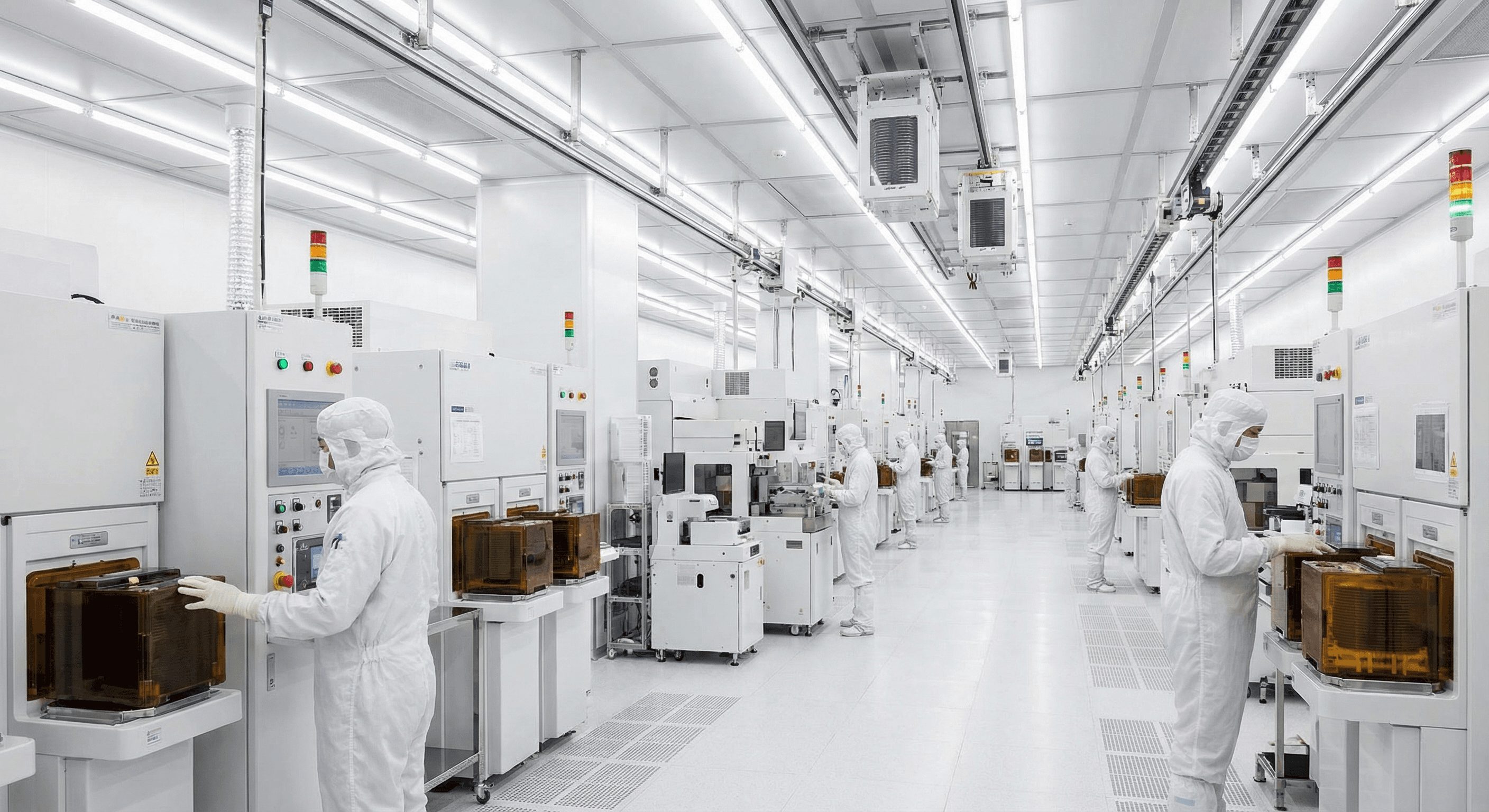
The semiconductor industry's return to American soil presents manufacturing leaders with a workforce challenge that threatens to derail the largest reshoring initiative in decades. While the CHIPS and Science Act has unlocked $230 billion in private sector commitments across 42 states, the pipeline of qualified technicians remains inadequate for the scale of planned production.
Intel's $20 billion Ohio facility will require approximately 3,000 direct manufacturing employees when fully operational. TSMC's Arizona project needs 4,500 workers across two fabs. Samsung's Texas expansion calls for 2,000 additional positions. These numbers represent just three major projects among dozens planned or under construction nationwide.
The Technical Skills Gap
Semiconductor fabrication demands precision that exceeds most manufacturing environments. Class 1 cleanrooms maintain particle counts below 10 per cubic foot, compared to typical manufacturing floors where counts reach 1 million particles per cubic foot. Process technicians must understand photolithography, chemical vapor deposition, plasma etching, and ion implantation while maintaining contamination protocols that automotive or aerospace facilities rarely require.
Current workforce data reveals the magnitude of the challenge. The Semiconductor Industry Association estimates the industry will need 300,000 additional workers by 2030, with 115,000 of those positions requiring technical training below the bachelor's degree level. Yet existing semiconductor programs at community colleges nationwide graduate fewer than 2,000 students annually.
Arizona State University's analysis of TSMC's workforce requirements illustrates the precision needed. The company's Phoenix fabs will employ approximately 500 process technicians, 200 equipment technicians, 150 metrology specialists, and 75 yield engineers per facility. Each process technician requires 18-24 months of specialized training beyond basic electronics or mechanical aptitude.
Training Infrastructure Limitations
Establishing semiconductor training programs requires capital investments that many educational institutions cannot support independently. A basic cleanroom training facility costs $2-5 million to construct and equip. Advanced process simulation equipment adds another $3-8 million. Annual operating costs reach $500,000-800,000 per program.
Portland Community College's microelectronics program, established in partnership with Intel, provides a model for effective industry collaboration. The program graduated 45 students in 2023, with 89% placement rates in semiconductor positions. However, scaling this model requires sustained industry commitment and state funding support that few regions have secured.
Equipment availability represents another constraint. Training on actual semiconductor tools requires access to systems that cost $5-15 million per unit. Most educational institutions rely on older equipment or simulators that provide adequate foundational training but cannot replicate current production environments.
Recruitment and Retention Challenges
Semiconductor manufacturing competes with other technical fields for the same talent pool. Local data from Austin, Texas shows starting salaries for fab technicians range from $45,000-55,000 annually, while experienced technicians earn $65,000-85,000. These wages compete directly with automotive manufacturing, aerospace, and oil and gas sectors that have established recruiting networks and brand recognition.
The work environment itself creates additional recruitment challenges. Twelve-hour shifts in full cleanroom suits, strict contamination protocols, and continuous process monitoring deter some candidates who might otherwise possess suitable technical aptitude. Turnover rates in new semiconductor facilities typically range from 15-25% annually during the first two years of operation.
Geographic constraints compound recruitment difficulties. Major fab projects are concentrated in specific regions: Arizona, Texas, Ohio, and New York lead in announced investments. Local labor markets cannot supply the required workforce, necessitating interstate recruiting that increases competition and salary pressures.
Industry Response Strategies
Leading semiconductor companies are implementing comprehensive workforce development initiatives that extend beyond traditional recruiting. Intel has committed $100 million to workforce development programs across Ohio, Arizona, and Oregon. The company's approach includes direct funding for community college programs, apprenticeship pathways, and partnerships with K-12 systems to build awareness of semiconductor careers.
TSMC's Arizona workforce strategy includes partnerships with Arizona State University, Maricopa Community Colleges, and Northern Arizona University. The company has established a specific curriculum pathway that begins with two-year associate degrees and provides advancement opportunities to four-year engineering programs.
Samsung's Texas facility includes an on-site training center capable of processing 200 technicians annually through 16-week intensive programs. The company recruits candidates with electronics, mechanical, or chemical backgrounds and provides full salary support during training.
Regional Workforce Development Models
Successful semiconductor workforce development requires coordination among multiple stakeholders. New York's approach to supporting Micron's $100 billion investment includes $200 million in workforce development funding distributed across SUNY institutions, community colleges, and private training providers.
The New York model emphasizes stackable credentials that allow workers to advance from basic technician roles to specialized positions without requiring complete degree programs. Students can earn certificates in cleanroom operations, process control, or equipment maintenance as standalone qualifications or components of associate degree programs.
Ohio's strategy for supporting Intel's investment includes partnerships with Columbus State Community College, Sinclair Community College, and Rhodes State College. The state has allocated $35 million for semiconductor-specific training programs and committed to establishing regional training hubs that serve multiple facilities.
Technical Training Requirements
Process technicians require competency in multiple technical areas that traditional electronics or mechanical programs do not address. Vacuum technology, plasma physics, and chemical handling protocols are fundamental requirements. Understanding of statistical process control, failure analysis, and contamination sources distinguishes qualified candidates from those with only general technical backgrounds.
Equipment technicians must diagnose and repair systems that integrate mechanical, electrical, pneumatic, and software components. Preventive maintenance schedules in semiconductor facilities operate on tolerances measured in nanometers, requiring precision that exceeds most industrial maintenance standards.
Metrology specialists work with measurement systems capable of detecting features smaller than 3 nanometers. Training requires understanding of electron beam microscopy, atomic force microscopy, and optical measurement techniques that university programs typically reserve for graduate-level coursework.
Partnership Models and Funding Mechanisms
Effective workforce development requires sustained financial commitment from industry participants. Successful programs typically involve direct equipment donations, instructional support, and guaranteed hiring commitments that justify educational institutions' capital investments.
The National Science Foundation's Advanced Technological Education program has funded semiconductor workforce initiatives at 23 community colleges nationwide, providing $45 million in grants since 2020. However, this federal support addresses only a fraction of the total need.
Private sector contributions vary significantly by company and region. Intel's workforce commitments include direct faculty salaries, equipment donations valued at $15 million per partnership, and hiring commitments for 80% of program graduates. Other companies provide internship opportunities and guest instruction but avoid capital commitments.
Implementation Timeline and Practical Steps
Manufacturing executives planning workforce strategies for new semiconductor facilities should begin recruitment and training partnerships 24-36 months before production start. This timeline allows for program development, instructor hiring, and first cohort graduation.
Regional analysis should identify existing electronics, chemical, or precision manufacturing programs that can serve as foundation for semiconductor-specific training. Community colleges with established relationships in related industries often provide more reliable partners than institutions building programs from zero.
Workforce planning must account for both direct manufacturing positions and indirect support roles. Each 100 direct manufacturing jobs typically requires 40-60 additional positions in facilities maintenance, quality assurance, materials handling, and administrative support.
The semiconductor industry's successful return to U.S. manufacturing depends on resolving workforce challenges that extend beyond traditional recruiting strategies. Companies that establish comprehensive training partnerships and commit resources to long-term workforce development will secure competitive advantages in talent acquisition and operational excellence. Those that rely on conventional hiring approaches will face continued staffing constraints that limit production capacity and operational flexibility.