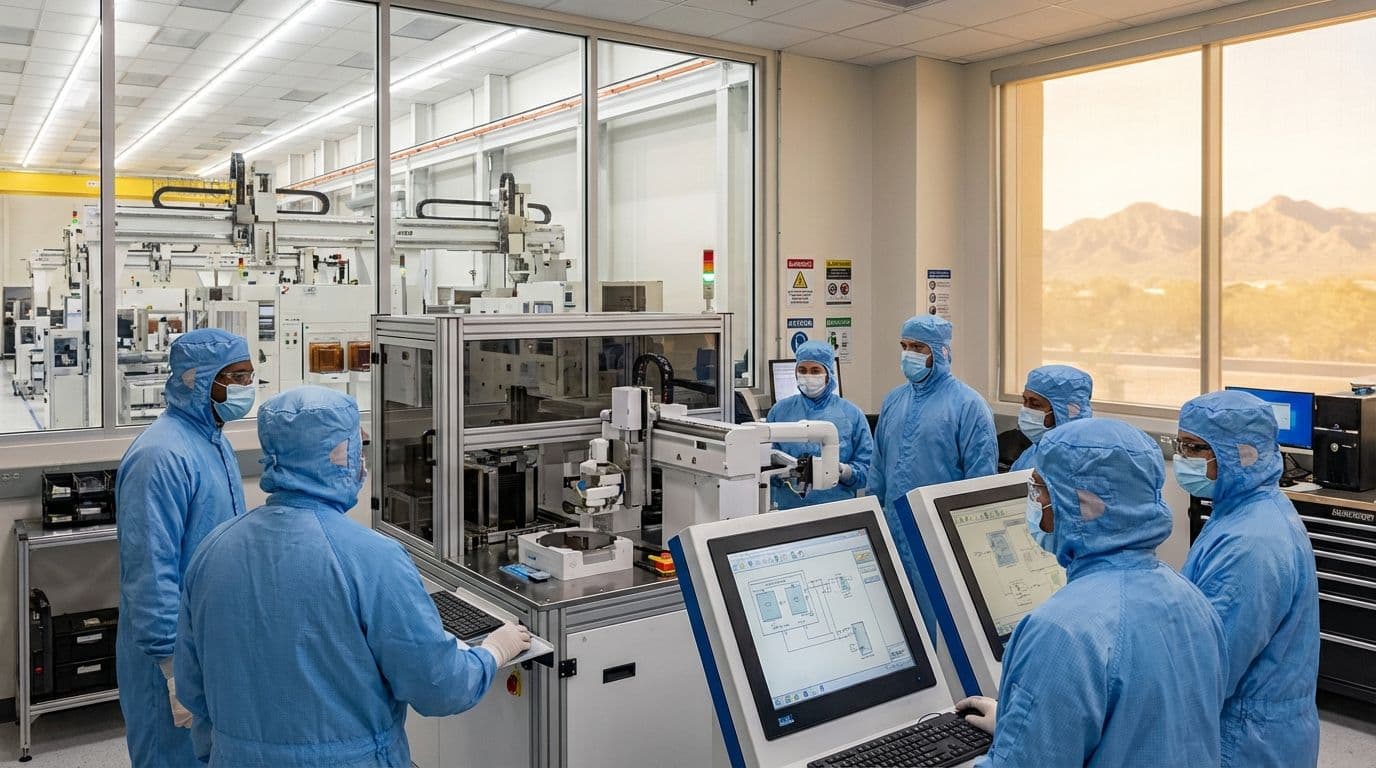
The 400-Person Labor Gap at TSMC Phoenix: Who Is Actually Training the Technicians?
TSMC is building one of the most important manufacturing campuses in the United States, and the real bottleneck in Phoenix is no longer concrete, steel, or even EUV tool delivery. It is labor. More specifically, technician labor, the kind that keeps a fab running at 2 a.m. when a vacuum system throws an error, a tool goes out of spec, or a maintenance window gets compressed because production targets moved again.
The scale of the problem is no longer theoretical. TSMC's Arizona investment has ballooned from the original $12 billion announcement to a multistage U.S. expansion measured in tens of billions, with multiple fabs planned or underway in the north Phoenix corridor. Every additional cleanroom bay, every tool install wave, every utility system handoff creates demand for equipment technicians, facilities technicians, process support staff, and maintenance specialists who are not interchangeable with general manufacturing hires. The talent gap that matters now sits around the technician layer, and in Phoenix the working estimate from recruiters, training partners, and local workforce programs is roughly 400 people short of what a smooth ramp would ideally require over the next phase of expansion.
That number matters because fabs do not fail gracefully when the technician bench is thin. They slow down. They extend training curves. They lean harder on expats. And they burn expensive engineering time on work that should be handled one layer lower in the staffing model.
The labor shortage is not about engineers first
Public coverage of semiconductor workforce problems tends to fixate on engineers, and that makes sense politically. Engineers are visible. Universities like announcing them. Governors like cutting ribbons around them. But on the shop floor, or more accurately inside the cleanroom and the support spaces around it, the technicians determine whether the fab runs with discipline or with constant friction.
TSMC Phoenix needs facilities technicians who can handle high-purity water systems, chemical delivery, gas systems, HVAC, and power support. It needs equipment technicians who can maintain and troubleshoot tools that cost more than many factories. It needs manufacturing specialists who understand contamination control, lockout procedures, shift discipline, and the difference between a training environment and a live production environment. None of this is simple, and none of it can be solved by hiring 400 people with generic manufacturing résumés and hoping the system sorts it out.
That is the hidden labor gap. Not bodies. Useful bodies with the right tolerance for procedure, the right baseline technical skill, and the willingness to work the schedule a semiconductor fab demands.
Phoenix has the building boom. It does not have infinite fab talent.
Arizona has done a credible job selling itself as the center of the American semiconductor buildout. Intel is already there. TSMC is scaling there. Suppliers have followed. Equipment vendors are adding local support. Community colleges and universities have rolled out semiconductor pathways faster than most states. On paper, that looks like a self-reinforcing labor pipeline.
In practice, Phoenix is still trying to create a mature fab labor market almost from scratch while competing for the same workers across semiconductors, aerospace, advanced manufacturing, utilities, and commercial construction. A technician who can read schematics, work on complex equipment, and survive rotating shifts is valuable in a lot of industries. Semiconductor employers are not recruiting in a vacuum.
And the timing is brutal. TSMC is not staffing one building with a leisurely three-year ramp. It is trying to stand up a multi-fab footprint while the broader U.S. semiconductor push keeps pulling on the same labor pool. That means every weak point in the local training system gets exposed quickly.
Who is actually doing the training
The short answer: not TSMC alone, and not Arizona State alone either.
The technician pipeline in Phoenix is being built through a patchwork system that includes Maricopa Community Colleges, Arizona State University, workforce boards, high schools with career-and-technical tracks, OEM training teams, staffing firms specializing in semiconductor support roles, and TSMC's own internal training operation. Some workers are getting classroom instruction locally. Some are doing lab work on training tools. Some are learning through supplier programs attached to specific equipment families. And some, still, are going overseas for direct exposure to TSMC's operating environment before coming back to Arizona.
That last part matters more than the press releases usually admit. Semiconductor manufacturing is not just a technical skill set. It is a production culture. The discipline around documentation, contamination control, escalation, and shift handoff is not intuitive for workers coming from adjacent industries. TSMC knows that. So a meaningful chunk of the real training burden still sits inside TSMC's own operating model rather than in the public workforce pipeline everyone likes to celebrate.
The community colleges are carrying more of the load than the headlines suggest
If Phoenix closes the technician gap, community colleges will deserve more credit than most of the national semiconductor coverage gives them. The reason is simple: technician labor is where two-year programs and certificate pipelines should be strongest. They can move faster than four-year universities, update curricula faster, and work more directly with employers on job-specific competencies.
That is where a lot of the actual training work is happening, in introductory semiconductor courses, mechatronics tracks, industrial maintenance pathways, and short-cycle programs designed around cleanroom basics, vacuum systems, electronics, and process discipline. The challenge is not whether these programs exist. It is whether they can scale fast enough, with instructors who have enough industry credibility, to feed a ramp this large.
And there is the catch. Technician training programs need instructors. Instructors need real industry experience. In a tight labor market, the same person qualified to teach semiconductor maintenance is often worth more on the shop floor or in field service than in a classroom. So the training system itself has a labor shortage nested inside the fab labor shortage.
TSMC is still relying on expats longer than anyone wants to say out loud
This is one of the least surprising parts of the story, and one of the most important. When a company is trying to replicate a production system that took decades to refine elsewhere, it sends experienced people from the mature sites. That is not failure. That is how manufacturing transfer works.
But it becomes a problem when the expat bridge stays in place too long because the local technician bench is not filling in underneath it. Experienced Taiwanese staff can accelerate training, stabilize startup, and transfer institutional knowledge. They cannot be the long-term answer for every shift, every maintenance function, and every tool family across a massive Arizona footprint. The economics do not work. The localization story does not work. And the resilience case for domestic semiconductor manufacturing definitely does not work.
That is why the 400-person gap matters. It is not just a headcount issue. It is the difference between a temporary transfer model and a durable domestic operating model.
The wage math is pulling against the training effort
Phoenix is not a cheap labor market anymore. Housing costs have reset upward. Competition for technical workers is real. And fabs do not just need workers, they need workers willing to stay. Training a technician into genuine semiconductor usefulness takes time, which means churn is expensive in a way a lot of public workforce narratives skip over.
A technician who leaves after nine months is not just a vacancy. That is sunk training cost, lost mentoring time, lower shift stability, and more overtime for the people who remain. In a fab, that kind of turnover shows up in productivity and maintenance discipline long before it shows up in a quarterly staffing report.
That pushes TSMC and its suppliers into a more aggressive retention fight. Better pay. Cleaner progression ladders. Tuition support. Stronger onboarding. More realistic expectations about what the job actually is. Because one reason technician pipelines leak is simple mismatch: a lot of recruits like the idea of semiconductor manufacturing more than they like the lived reality of shift work, procedure-heavy operations, and the psychological grind of high-consequence manufacturing.
The U.S. semiconductor strategy has a middle-skill problem
Washington talks about fabs in terms of national security, CHIPS Act money, and leading-edge process nodes. All fair. But the staffing problem in Phoenix is a reminder that industrial policy rises or falls on middle-skill execution. If the United States wants more wafer capacity at home, it needs thousands of technicians who can keep that capacity stable, not just scientists and design engineers.
This is where the broader manufacturing data matters. Manufacturing employment has stayed elevated, and capacity utilization remains high enough that employers across sectors are still competing for dependable technical labor. In other words, semiconductors are trying to scale inside an economy that already has plenty of claims on the same talent. The technician shortage at TSMC Phoenix is not an isolated oddity. It is a concentrated version of a wider U.S. manufacturing problem.
And semiconductors are less forgiving than most sectors. A food plant can sometimes carry a maintenance vacancy longer than it should. A fab running advanced tools has less room for that kind of slippage.
Why technician training in semiconductors takes longer than other factory ramps
A lot of advanced manufacturing employers can hire a mechanically solid worker, give them a few weeks of structured training, and get useful output reasonably fast. Semiconductor fabs do not work like that. The technical stack is denser, the error tolerance is lower, and the documentation burden is much heavier. A technician is not just learning how to turn a wrench or replace a module. They are learning contamination discipline, alarm hierarchies, escalation paths, preventive maintenance routines, and what counts as an acceptable deviation in a process environment where tiny mistakes can ripple into yield loss.
That extended learning curve changes the economics of every workforce promise tied to domestic fabs. It means a public training program can produce candidates, but it cannot fully produce fab-ready technicians on its own. It means employers need mentoring bandwidth from experienced staff at the exact moment those staff members are already overloaded. And it means the difference between a 6-month staffing miss and a 12-month staffing miss is bigger than it sounds, because the replacement worker still has to climb the same long training ramp after they arrive.
This is one reason TSMC Phoenix has become such an important case study for the rest of the U.S. semiconductor buildout. The company is not just testing whether America can finance a leading-edge fab. It is testing whether local institutions and private employers can build the slower, less glamorous technician pipeline that advanced manufacturing depends on after the groundbreaking ceremony is over.
What happens if the gap does not close
The most likely outcome is not catastrophe. It is drag.
Tool qualification takes longer. Training cohorts get stretched. More responsibilities stay with engineers and senior specialists than should. Ramp timelines look technically on track while operational efficiency lags underneath. The fab runs, but with more friction than the investment case assumes. That is usually how labor shortages show up in advanced manufacturing, not as a dramatic stop, but as a chronic tax on yield, uptime, and managerial attention.
There is also a supplier-layer effect. If TSMC cannot localize technician capability fast enough, equipment vendors and service partners get pulled deeper into daily operating support. That may help in the short term. It also pushes more cost into the ecosystem and makes the local supply chain more dependent on a handful of specialized outside teams.
The next 18 months tell the real story
The ribbon-cutting phase of TSMC Phoenix has already happened. The harder phase is underway now, turning a massive capital project into a repeatable labor system that can support multiple fabs at U.S. wage levels with U.S.-trained technicians. That is the part investors, policymakers, and plant leaders should watch.
If local training programs start graduating workers who stick, if expat dependence begins to ease, and if technician retention stabilizes, Phoenix becomes the real template for U.S. semiconductor workforce development. If not, the industry will keep talking about domestic fab capacity while quietly importing more of the operating know-how than the political story implies.
That is why the 400-person gap matters. It is not a recruiting problem. It is a test of whether the United States can rebuild advanced manufacturing at scale, all the way down to the shift technician who keeps the line alive when nobody is watching.
Get ManufacturingMag in your inbox Subscribe for weekly reporting on semiconductor fabs, labor bottlenecks, automation spending, and the numbers that actually move manufacturing decisions.