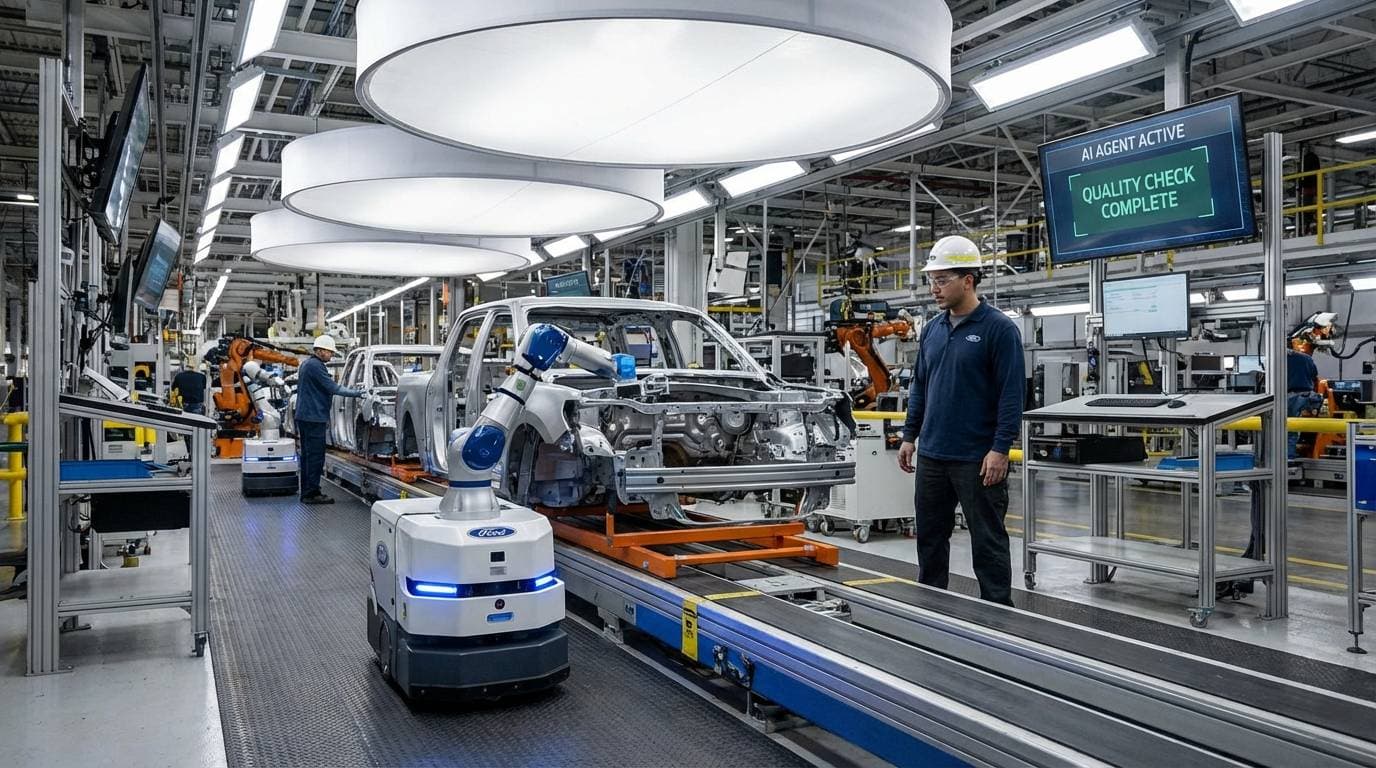
Why Ford's Shop-Floor AI Agents Mark the End of Traditional Quality Inspection
Published March 13, 2026 | ManufacturingMag
Ford's Dearborn Truck Plant ran its last traditional end-of-line visual inspection station in February. Not because management decided to cut corners. Because the AI agents that replaced those stations are catching defects the human inspectors were structurally incapable of finding — at 2.3 seconds per vehicle versus the 47-second manual check that had been standard since 2019.
That's not a productivity improvement. That's a process replacement.
The broader rollout — covering seven North American assembly facilities by Q4 2026, with a combined capital commitment Ford has pegged at $185 million — represents the most aggressive deployment of autonomous quality agents in automotive manufacturing since Tesla's vision-based inspection system came online at Fremont in 2022. But what makes Ford's approach structurally different, and potentially more significant for the industry, isn't the computer vision. It's what sits underneath it: AI agents that don't just flag defects but autonomously reroute vehicles, adjust upstream process parameters, and escalate tooling wear alerts to maintenance — without a quality engineer in the loop.
That's the part worth paying attention to.
What "Agentic" Actually Means on the Assembly Line
The word "agent" is getting thrown around in industrial AI circles the way "smart" got thrown around in 2015 — attached to everything, meaningful in almost nothing. So let's be specific about what Ford has actually deployed.
The system, built on a platform developed jointly with Siemens Digital Industries and an undisclosed LLM infrastructure provider, consists of layered AI agents assigned discrete decision authorities. A vision agent handles surface defect detection — paint fisheyes, panel gaps outside spec, misaligned trim — using a network of 34 high-resolution cameras at each inspection gate. A process agent monitors upstream variables from welding, stamping, and body shop operations and correlates them with inspection outcomes in real time. A maintenance agent tracks tool wear patterns and generates work orders autonomously when Cpk values begin degrading below threshold.
Each agent operates within a defined decision boundary. The vision agent can flag and reroute. The process agent can adjust weld parameters within a pre-approved range. The maintenance agent can generate but not execute work orders — a human still approves the job before the tool gets pulled. Ford's quality engineering team spent 14 months mapping those boundaries before a single agent went live.
That hierarchy matters. This isn't a lights-out operation. It's a human-supervised autonomous system — a distinction Ford's manufacturing leadership has been careful to emphasize, probably because the UAW contract language around automation-triggered job displacement is still being negotiated.
First-Pass Yield Numbers That Make the Business Case
Ford ran a 90-day pilot at its Kansas City Assembly Complex, which builds the F-150 and Transit, before committing to the broader rollout. The results were specific enough to move the capital allocation conversation quickly.
First-pass yield on F-150 bodies improved from 94.1% to 97.6% over the pilot period. Warranty claim rates for paint and exterior fit issues — a category that had been running Ford approximately $340 per vehicle in warranty costs over a 36-month window — dropped 31%. Defect escape rate, meaning defects that made it past inspection to the customer, fell from 0.8 per thousand vehicles to 0.09.
The 0.09 figure is the one that ends the debate about whether to scale.
At F-150 production volumes — roughly 700,000 units annually across Kansas City and Dearborn — a 0.71 improvement in defect escape rate translates to approximately 497,000 fewer defective vehicles reaching customers per year. Even at a conservative $800 average warranty repair cost, that's nearly $400 million in annual warranty liability removal. The $185 million capex pencils out before you account for the labor redeployment savings.
The Human Inspection Problem Nobody Wants to Talk About
Traditional end-of-line visual inspection has a dirty secret: it's remarkably ineffective. Studies from the automotive quality community — including a 2024 analysis published by the Automotive Industry Action Group covering 23 assembly plants — found that experienced human inspectors detect roughly 78% of visual defects under standard line conditions. On second and third shift, that number drops to 71%.
Twenty-nine percent escape rate on third shift. That's the baseline the industry has been operating against for decades.
The reasons are straightforward. Inspection fatigue compounds over a shift. Lighting variability across a 400,000-square-foot body shop is impossible to fully standardize. Human eyes can't maintain consistent threshold sensitivity across a full eight-hour inspection window, and the defects that are hardest to spot — micro-waviness in painted surfaces, 2mm gap variations in door-to-fender fitment — require the kind of sustained attention that human neurology doesn't sustain reliably past hour four.
Ford's vision system detects surface irregularities down to 0.3mm and maintains that threshold at the same accuracy level on vehicle one as on vehicle eight hundred. It doesn't get tired. It doesn't adjust its standards based on what the line supervisor said about output targets. And it generates a complete digital inspection record for every vehicle — a data asset that traditional inspection simply couldn't produce at scale.
That inspection record is becoming its own strategic asset. Ford is using it to feed process models that predict which upstream conditions are most likely to generate which defect types — essentially building a causal map between process variables and quality outcomes that no manual inspection program ever could have created.
What This Does to Staffing — and Why the UAW Math Is Complicated
Ford currently employs approximately 1,200 quality inspection technicians across its North American assembly operations. That number will be materially different by 2028.
Ford hasn't published a specific displacement figure, and given the current UAW relationship — particularly after the 2023 contract battles — it's unlikely to do so voluntarily. What Ford has said is that affected technicians will be "prioritized for redeployment into AI operations, maintenance, and data quality roles." The company has allocated $22 million for retraining through its existing partnership with community colleges in Michigan and Missouri.
The math on that redeployment story is harder than it sounds. A quality inspection technician who's been doing visual checks on F-150 bodies for 11 years is not a natural fit for calibrating machine learning models or managing AI agent decision logs. The skills gap is real, the retraining timeline is 18-24 months minimum for meaningful technical proficiency, and the number of new roles Ford actually needs is a fraction of the number of roles being eliminated.
The UAW's position — that automation-driven displacement requires negotiated transition packages, not just retraining promises — isn't going to get weaker as deployments like this one become more visible. The next contract negotiation starts in 2027. Ford's AI quality rollout will be fully operational by then, which means the displacement numbers will be concrete rather than projected. That's a harder bargaining position for management.
Tier 1 Suppliers Are Watching — and Some Are Already Moving
Ford's quality specification requirements flow downstream. When Ford tightens its incoming parts acceptance criteria — which this AI system enables it to do, since it can now catch supplier-introduced defects at a granularity it couldn't before — Tier 1 suppliers feel it immediately.
Magna International confirmed in its Q4 2025 earnings call that it's accelerating deployment of its own AI-assisted inspection systems across three stamping facilities, with capital commitments totaling $67 million through 2027. The stated driver: meeting tighter OEM quality gates. Lear Corporation made similar remarks about seating assembly inspection in January. Neither company framed this as discretionary investment. Both framed it as staying qualified.
That's how quality standards propagate through a supply chain. Ford sets a defect escape threshold the old inspection technology can't reliably meet. Suppliers either adopt comparable technology or they lose source approvals. The technology cost becomes a cost of doing business, not a competitive advantage — and it migrates down to Tier 2 and Tier 3 suppliers faster than most of them are prepared for.
A mid-size stamping supplier running three 600-ton lines in Ohio doesn't have $67 million to spend on AI inspection infrastructure. It probably has $800,000 to $1.2 million in annual capex flexibility. The mismatch between what OEM quality gates will require and what mid-market suppliers can afford to deploy is going to be a supply chain stress point by 2028. The consolidation implications are worth watching.
The Process Feedback Loop Is the Long-Term Story
Six months from now, the conversation about Ford's AI inspection deployment will move past defect detection rates. The real story is what happens when 18 months of inspection data — catalogued at the individual vehicle level, correlated with upstream process variables — starts generating actionable process intelligence.
Ford's process agent is already running correlation analyses between welding parameter drift and subsequent paint adhesion failures. Early results suggest that a 4% increase in weld current variance in the body shop predicts a measurable uptick in paint fisheye defects approximately 90 minutes later at the paint shop exit — a relationship that took seven months of data to surface and that no human quality team had ever identified, partly because the data to find it never existed before.
Knowing that relationship exists allows Ford to intervene at the weld cell before the defect ever reaches the paint shop. That's a different category of quality management than inspection — it's defect prevention rather than defect detection. The OEE implications are significant: you're not just catching bad parts later, you're making fewer bad parts earlier.
Traditional quality inspection was always a lagging indicator. You found the defect after it was already built into the vehicle. AI-driven process feedback converts quality data into a leading indicator — a signal that something upstream is drifting before the defect cost is locked in. That's the end of traditional quality inspection not just as a practice, but as a philosophy.
The Next 18 Months
Ford's full seven-plant deployment reaches completion in Q4 2026, assuming the current integration timeline holds — which is ambitious given the complexity of harmonizing AI agent decision authorities across facilities with different line configurations and legacy PLC infrastructure. Two of the seven plants are running on control systems that predate the current industrial Ethernet standards Ford's platform requires. The middleware problem there is not trivial.
GM has a comparable program in early pilot at its Lansing Delta Township facility, targeting full deployment by mid-2027. Stellantis has been quieter but filed 14 patents related to autonomous inspection agent architecture in the past 18 months. The competitive pressure to match Ford's defect escape numbers is going to accelerate all of it.
For plant managers outside automotive who think this story doesn't apply to them: medical device and aerospace manufacturers are already in conversations with the same platform vendors Ford used. The FAA's draft guidance on AI-assisted inspection for structural aerospace components, expected in late 2026, will either accelerate that or complicate it significantly.
Ford's pilot numbers were convincing enough to commit $185 million. The question now is whether the economics hold at full scale — across seven plants, three shifts, and a UAW workforce watching every job reclassification closely. The answer comes in Q1 2027, when Ford will have its first full year of post-deployment warranty data. That's when the business case either becomes the industry playbook or becomes a cautionary case study about what the numbers looked like in a 90-day pilot versus what they looked like when the whole system had to work every day.
Watch the warranty line item in Ford's Q1 2027 earnings release. That's the number that tells the real story.
Stay current on automation, AI deployment, and quality systems in North American manufacturing. Subscribe to the ManufacturingMag weekly briefing — no fluff, just the developments that matter on the floor.