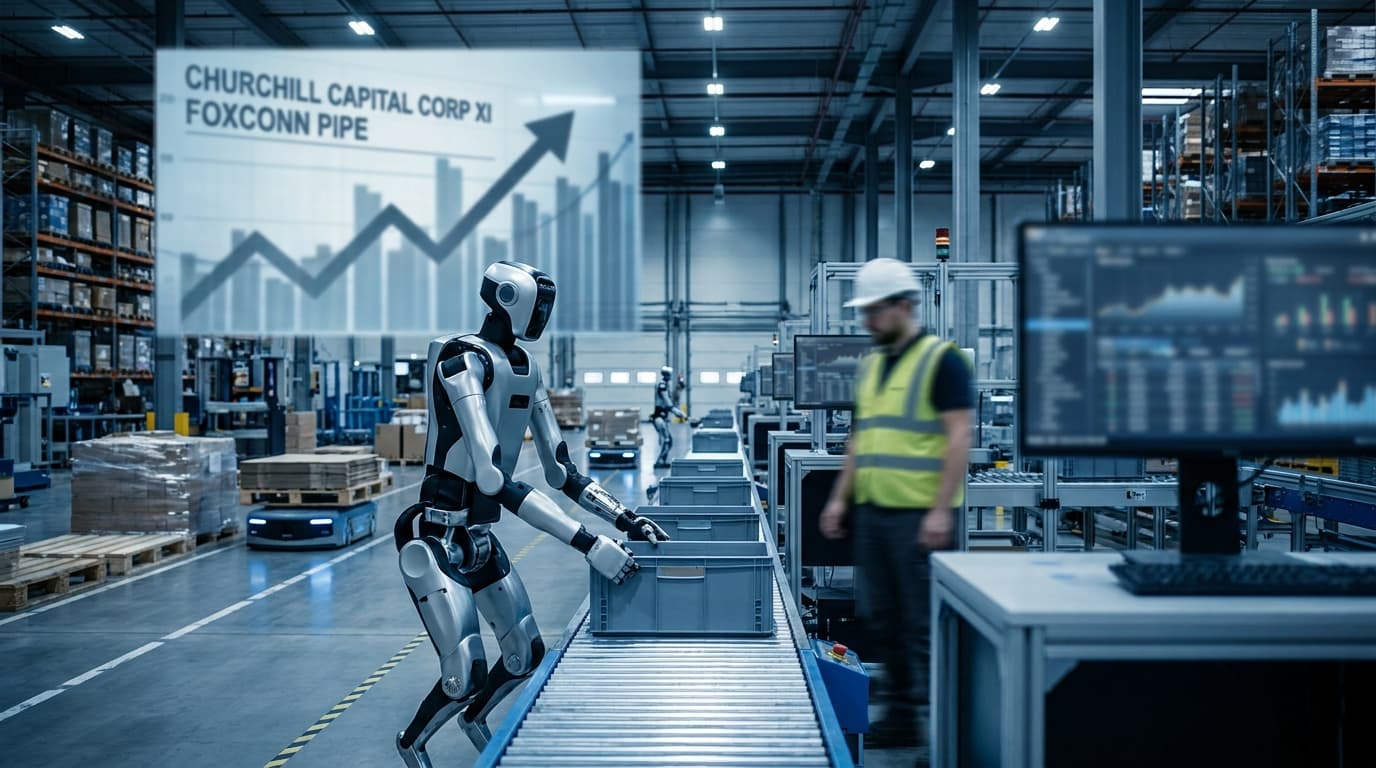
The eye-catching number is the valuation: roughly $2.5 billion for a company that makes a bipedal warehouse robot. But for anyone who runs a distribution center, buys capital equipment, or underwrites automation projects, the valuation is the least interesting part of the deal Agility Robotics announced in late June. The interesting part is the structure — and who signed the check.
Agility Robotics, maker of the Digit humanoid, has agreed to merge with Churchill Capital Corp XI (Nasdaq: CCXI), the latest special-purpose acquisition company from financier Michael Klein. The combined business is expected to trade on Nasdaq under the ticker AGLT, making Agility the first pure-play humanoid robotics company on U.S. public markets. That firstness is a competitive claim as much as a financial one: CEO Peggy Johnson has framed the move as a first-mover advantage over rival humanoid firms still stuck in private funding rounds.
A de-SPAC lets a company reach public markets without running the traditional IPO gauntlet — no bookbuilding roadshow, no underwriter pricing discovery, and, critically, the latitude to market forward-looking projections. That matters right now, because the humanoid sector is long on demos and short on audited unit economics. The question operators should hold onto through every press release: is the public market financing durable warehouse revenue, or underwriting a labor-gap narrative ahead of proven payback?
The deal in numbers
Per the Form 425 business-combination communication filed with the SEC, the transaction values Agility at approximately $2.5 billion and is structured to deliver more than $620 million in gross proceeds. That breaks into two buckets: roughly $420 million sitting in Churchill's trust account, plus a private placement (PIPE) of more than $200 million. The company describes it as the largest capital raise in humanoid robotics to date.
The pieces to keep straight:
-
Counterparty: Churchill Capital Corp XI (CCXI), a Michael Klein–sponsored SPAC. Klein's Churchill series has taken companies public before — most visibly the Lucid Motors deal.
-
Ticker transition: CCXI → AGLT on Nasdaq.
-
Timing: close expected in 2026, conditional on SEC review and shareholder votes.
-
Status: this is a forward-looking business-combination communication with a conditional close — not a completed financing, and not accompanied by audited revenue figures.
Why the PIPE is the real vote
Trust cash is essentially neutral capital — it was raised to chase some deal, and redemptions can shrink it. The PIPE is where conviction shows up, because PIPE investors are choosing this specific company at this specific price. And the lead PIPE investor here is Foxconn (Hon Hai), as confirmed in the SEC filing and corroborated by trade coverage.
That is not a generic crossover fund reaching for a robotics theme. Foxconn is the world's largest contract electronics manufacturer — a company that built its scale entirely on supply chains, throughput, and production economics. When a manufacturer of that kind anchors the raise for a humanoid maker, it is putting strategic capital, not just financial capital, behind the machine. Foxconn is a plausible deployer of the very robot it is helping to fund, and it can read a bill of materials better than almost any investor on the cap table. Strategic money from an operator signals that humanoids are moving from R&D curiosity toward industrialization — or at least that a serious manufacturer is willing to bet they are.
Why a SPAC, not an IPO
The mechanics matter for how you read the story. In a conventional IPO, underwriters price the offering against live investor demand, and forward-looking financial projections are heavily constrained. A de-SPAC inverts that: the valuation is negotiated privately between the target and the sponsor, the pricing-discovery step is effectively skipped, and management is permitted to publish forward projections to sell the combination to shareholders.
For a pre-scale hardware company, that is a feature — it lets Agility tell a growth story unencumbered by an IPO book. For an operations buyer evaluating whether to put Digit in a facility, it is a caution flag. The route to public markets that most flatters a projection is also the one that subjects those projections to the least external scrutiny before the stock starts trading. None of that makes the underlying business weak; it just means the burden of proof shifts onto the deployment data rather than the deal terms.
The traction rivals can't match
Where Agility separates from the humanoid pack is commercial mileage. According to the deal materials and reporting on the transaction, Digit is deployed across nine customer sites with more than 65,000 hours of commercial operation, and nearly 100 units are running in real-world settings. The named customer list is what gives the number weight: GXO Logistics, Schaeffler, Toyota Motor Manufacturing Canada, Amazon, and Mercado Libre, with the company citing a pipeline of 30-plus prospective customers.
The backlog claim is the one to watch: more than $300 million in multi-year orders for the Digit v5 generation. Orders are not recognized revenue, and multi-year commitments can be restructured — but a committed backlog from logistics and automotive names is a materially different signal than a stage demo. In a field crowded with impressive videos and thin deployment records, operating hours and repeat industrial customers are the scarcest asset, and Agility has more of both than its peers.
The manufacturing angle
Building humanoids is itself a manufacturing problem, and Agility's answer is RoboFab, its factory in Salem, Oregon, designed to eventually produce up to 10,000 robots per year. The company also says roughly 75% of Digit's components are sourced domestically — a claim that matters both for tariff and policy exposure and for the resilience narrative that sits well with a U.S. industrial audience.
Capacity is not the same as economics, though. Proving out a 10,000-unit line requires yield, uptime, and a per-unit cost curve that bends downward as volume climbs — the same discipline Foxconn's presence implicitly promises to bring. The relevant question for the industrialization thesis isn't whether RoboFab can build 10,000 Digits; it's whether the tenth thousand costs meaningfully less than the first, and whether customers will absorb that volume at a price that clears a margin.
The skeptic's case
Set against the traction is a genuine list of unknowns. The announcement disclosed no audited revenue. The de-SPAC structure, by design, foregrounds projections over historicals. And the demand framing leans on the labor gap: Johnson describes customers as "seeking to fill the labor gap" — a real operational pressure, but a narrative that can outrun demonstrated payback.
The SPAC era left operators with a healthy reflex here: a large raise and a headline valuation are inputs, not results. There is a widely circulated figure of 100,000-plus totes moved at GXO during 2025 pilot work; it is consistent with the Agility/GXO relationship but was not confirmed in the deal-announcement sources reviewed for this article, so we're flagging rather than repeating it. That is exactly the kind of stat a buyer should trace to a primary GXO or Agility release before letting it anchor an investment case.
Bottom line for operators
Agility is doing the hard part that most of its rivals haven't — putting robots on real floors, logging real hours, and booking real orders. But going public through a SPAC converts an engineering-and-deployment story into a market-expectations story, and the two are scored differently. The deal finances the next phase; it does not, by itself, prove the unit economics.
Post-close, the metrics that separate durable warehouse revenue from a financed narrative are straightforward to name and harder to fake: deployment growth (does the site count climb well past nine?), operating hours and reliability per unit (does uptime hold as the fleet scales?), and — the one that ultimately settles the argument — gross margin on Digit units as RoboFab volume ramps. Foxconn's vote is the strongest early signal that a serious manufacturer thinks those numbers can work. Whether they do is a question the public market is now paying to find out.
Related reading
-
[The Humanoid Robot Cost Cliff: Why Schaeffler Just Signed for Thousands at $90K a Unit — and Bet It Hits $17K by 2030](/article/humanoid-robot-cost-cliff-schaeffler-deal)
-
[FANUC Just Shipped 1,000 'Physical AI' Robots — and Its Google Deal Is the Brownfield Answer to Every Humanoid Bet](/article/fanuc-google-physical-ai-brownfield-humanoid)
-
[The '25% Tax on Robots': How Section 232's June Machinery Rules Hit the Imported Machine Tools Factories Need to Automate](/article/section-232-june-2026-machinery-tariffs-imported-automation-reshoring-paradox)
Sources
-
Churchill Capital Corp XI — Form 425 Business Combination Communication (SEC filing, via StockTitan)
-
[Agility Robotics goes public at a $2.5B valuation, and its humanoid robots are already working in warehouses (Tech Funding News)](https://techfundingnews.com/agility-robotics-goes-public-at-a-2-5b-valuation-and-its-humanoid-robots-are-already-working-in-warehouses/)
-
Humanoid Robot Stock: Agility Robotics Eyes Nasdaq Debut With $2.5B SPAC Deal (Tech Times)