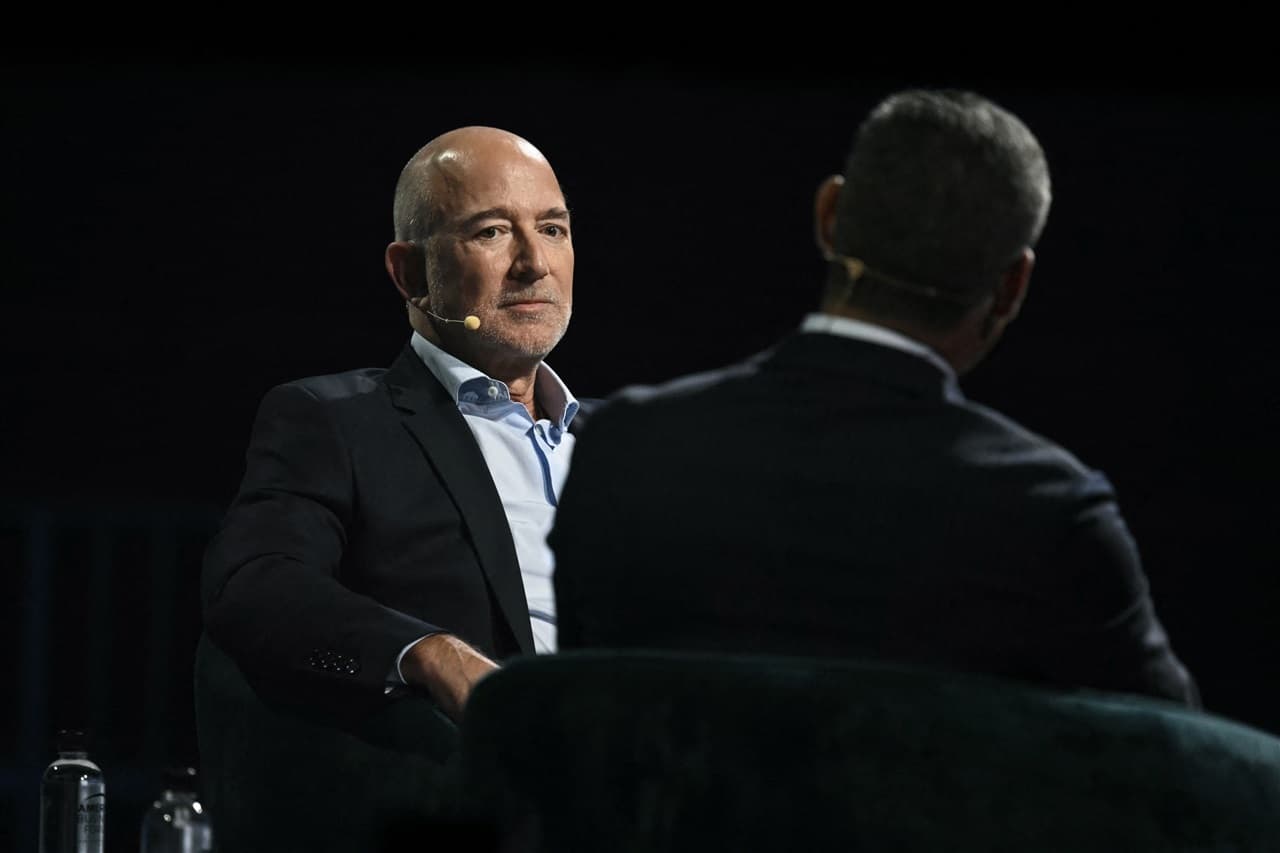
When the founder of the world's largest logistics operation starts raising $100 billion to acquire manufacturers, the shop floor should pay attention. Jeff Bezos is in early-stage discussions to assemble what documents describe as a "manufacturing transformation vehicle" -- a fund that would buy companies in semiconductors, aerospace, and defense, then overhaul their operations using AI developed by his startup, Project Prometheus.
If the fund closes at anything near that figure, it would rank among the largest buyout vehicles ever assembled. But the dollar amount is not what matters most to the people running production lines. What matters is the thesis behind it: that AI simulation can compress design-test-build cycles from months to minutes, and that the companies slow to adopt it will become acquisition targets.
What Project Prometheus Actually Does
Project Prometheus is not building another chatbot. The startup, where Bezos serves as co-founder and co-CEO alongside Vik Bajaj -- a Stanford School of Medicine professor who previously co-founded Google's life science division, Verily -- is developing AI systems that simulate and predict physical-world behavior.
Think computational fluid dynamics and finite element analysis, but orders of magnitude faster. Prometheus' models can simulate how air flows around an airplane wing geometry or predict the failure point of a metal component under cyclic stress loading -- the kind of work that traditionally requires weeks of compute time on dedicated HPC clusters, followed by physical prototype validation.
The company has raised $6.2 billion to date. It has recruited senior AI researchers away from OpenAI and DeepMind. David Limp, CEO of Blue Origin, sits on its board. None of this is accidental. Bezos is assembling the technical infrastructure to make physics-based AI simulation a commercial product, and the $100 billion fund is the distribution channel: buy the factories, install the technology.
The $17 Trillion Opportunity Gap
The investment thesis rests on a straightforward asymmetry. Software-driven industries represent roughly $1 trillion in global economic activity. Manufacturing accounts for closer to $17 trillion. Yet the vast majority of AI investment and talent has concentrated in the software economy -- large language models, code generation, digital advertising optimization.
Physical manufacturing has been slower to adopt AI for structural reasons. Factory environments generate messy, unlabeled sensor data. Legacy MES and ERP systems were not built with machine learning pipelines in mind. The consequences of a bad prediction in a semiconductor fab or an aerospace assembly are measured in scrapped wafers and grounded aircraft, not a degraded user experience.
Bezos appears to be betting that industrial AI simulation -- trained on the output of thousands of existing physics simulations -- can bridge this gap. Instead of validating one design iteration at a time through physical testing, engineers could explore thousands of configurations digitally before cutting metal.
"For decades, manufacturing innovation has been constrained by how long it takes to test physical ideas," said Pete Schlampp, CEO of Luminary, an AI startup focused on physics-based simulation for engineering. "AI is changing that by allowing engineers to predict real-world performance much earlier in the design process."
What This Means on the Factory Floor
For manufacturers watching this unfold, the practical implications break into three categories.
Design Cycle Compression
AI simulation does not eliminate the need for physical validation, but it dramatically reduces the number of iterations required to reach a viable design. Schlampp estimates that teams using AI-driven simulation can explore "thousands of options digitally before building anything." For shops running FMEA processes, that means catching failure modes earlier and reducing the engineering change orders that disrupt production scheduling.
Digital Twin Adoption
Nvidia already offers tools for manufacturers to create digital twins -- virtual replicas of live factories or warehouses used to plan layouts, optimize flow, and flag anomalies. Mercedes-Benz uses digital twins of its assembly lines to reduce unplanned downtime and to validate autonomous driving software before real-world deployment. If Prometheus acquires manufacturers and deploys its simulation stack at scale, it will accelerate the timeline for digital twin adoption across the sectors it touches. For context on how major industrial automation players are navigating this shift, Rockwell Automation's Q1 earnings showed orders down 8% as machine builders pause capex -- a signal that some manufacturers are waiting to see which digital platforms win before committing.
Supply Chain Reconfiguration
A $100 billion fund targeting semiconductor, aerospace, and defense manufacturers is also a supply chain play. Bezos has traveled to Singapore and the Middle East to court investors -- regions with deep strategic interest in manufacturing capacity. The fund is widely seen as part of a broader push to reindustrialize the United States at a time when China's manufacturing dominance is a central concern for defense planners and trade policymakers. Bezos is not alone in betting big on U.S. chip manufacturing -- Elon Musk's TERAFAB proposal targets a 100-million-square-foot chip foundry, signaling that multiple billionaire-backed megaprojects are converging on the same industrial thesis.
The Workforce Question Nobody Can Dodge
A fund of this scale dedicated to AI-driven manufacturing automation has predictably sharpened the debate about industrial jobs. Senator Bernie Sanders framed it bluntly on X: Bezos, he wrote, "plans to replace 600,000 Amazon workers with robots. Now, he wants to spend $100 billion to fully automate not just his warehouses, but factories in the U.S & other countries."
Amazon's own trajectory lends weight to the concern. The company's distribution network already operates at a scale where robots may outnumber human workers by some measures. Bezos has separately invested in Physical Intelligence, a company applying AI to general-purpose robotics.
The counterargument, advanced by AI companies and some economists, is that simulation-driven design lowers the cost of bringing new products to market, which in turn expands manufacturing industries and creates new roles. Schlampp predicts AI "will not replace engineering, but will change where engineers and technicians spend the majority of their time, shifting their focus from repetitive validation tasks to higher-level system design and innovation."
That argument has merit in theory. In practice, the transition will depend on whether reskilling programs scale at the same rate as automation deployment. The 400-person labor gap at TSMC's Phoenix fab offers a real-time case study of what happens when advanced manufacturing moves faster than workforce readiness. History suggests they rarely stay in sync.
What Manufacturers Should Do Now
Whether or not the Bezos fund reaches its $100 billion target -- and early-stage fundraising discussions frequently result in smaller closes -- the signal is clear. Capital is moving toward AI-driven manufacturing automation at a pace that will reshape competitive dynamics within the next five years.
Manufacturers who have not yet invested in digital infrastructure -- sensor networks, clean data pipelines, modern MES integration -- will find themselves on the wrong side of an acquisition calculus. Companies that have already begun experimenting with industrial AI simulation, digital twins, or AI-assisted quality inspection will be better positioned to compete with, or partner alongside, the Prometheus-backed operations that are likely coming.
The $100 billion is a headline. The real story is that physics-based AI simulation is moving from research labs into production environments, and the capital to make it happen is now being assembled at an unprecedented scale. For manufacturers, the question is not whether this transition is coming. It is whether you will be the one driving it or the one being acquired.
Key Facts at a Glance
-
Fund size: $100 billion (early-stage discussions)
-
Vehicle: "Manufacturing transformation vehicle" targeting acquisitions
-
Sectors: Semiconductors, aerospace, defense
-
Technology: Project Prometheus -- physics-based AI simulation
-
Prometheus funding: $6.2 billion raised to date
-
Leadership: Jeff Bezos (co-CEO) and Vik Bajaj (co-CEO, ex-Google/Verily)
-
Board: David Limp, CEO of Blue Origin
-
AI talent: Researchers recruited from OpenAI and DeepMind
-
Market gap: Software economy ~$1T vs. manufacturing ~$17T globally
-
Investor outreach: Singapore and Middle East
Frequently Asked Questions
What is Project Prometheus?
Project Prometheus is an AI startup co-founded and co-led by Jeff Bezos and Vik Bajaj. It builds AI systems that simulate and predict physical-world behavior -- think computational fluid dynamics and finite element analysis at dramatically faster speeds. The company has raised $6.2 billion and recruited researchers from OpenAI and DeepMind.
How much is Jeff Bezos raising for the manufacturing fund?
Bezos is in early-stage discussions to raise approximately $100 billion for what internal documents describe as a "manufacturing transformation vehicle." If it closes at that scale, it would be one of the largest buyout funds ever assembled.
Which industries would the fund target?
The fund would acquire companies in semiconductors, aerospace, and defense manufacturing, then modernize their operations using AI simulation technology developed by Project Prometheus.
Will this replace manufacturing jobs?
The fund has intensified the debate about industrial automation and jobs. Critics like Senator Bernie Sanders argue it will accelerate displacement. Proponents counter that AI simulation lowers product development costs, expands industries, and shifts engineers from repetitive validation tasks to higher-level design work. The actual impact will depend on whether reskilling programs scale alongside automation deployment.
What should manufacturers do to prepare?
Manufacturers should invest in digital infrastructure -- sensor networks, clean data pipelines, and modern MES integration. Companies already experimenting with simulation, digital twins, or AI-assisted quality inspection will be better positioned to compete with or partner alongside Prometheus-backed operations.