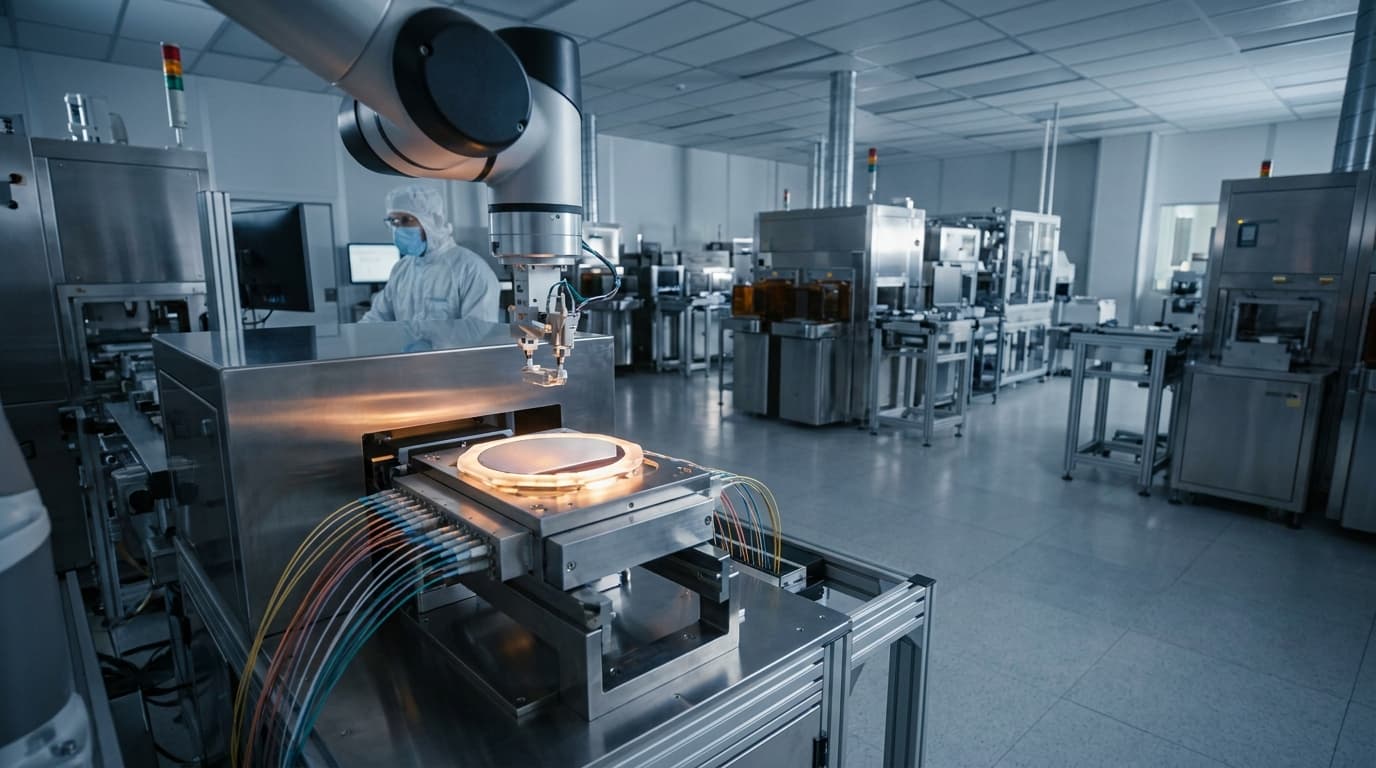
Most of the money and most of the headlines in America's semiconductor reshoring push have gone to two things: silicon logic — the transistors that compute — and high-bandwidth memory. On June 16, 2026, the Commerce Department's CHIPS Program Office signed a letter of intent that points somewhere else entirely. The award is small by CHIPS standards — up to $50 million in direct funding to Coherent Corp. — but its target is unusual: a compound-semiconductor photonics fab in Sherman, Texas that makes none of the chips that do the math, and all of the parts that move the data.
The facility is, by Coherent's and the government's own description, the first and largest high-volume 150mm (6-inch) indium phosphide (InP) semiconductor manufacturing plant in the world. That is a mouthful, and it is also the point. In a reshoring narrative tuned almost entirely to logic and memory, this is a comparatively rare federal bet on the optical layer of the AI stack — and it lands on a segment that has drawn far less public capital than the parts of the supply chain that get the magazine covers.
What indium phosphide actually does
Silicon is the material of computation. Indium phosphide is the material of communication. InP photonic devices — the lasers, modulators, and optical transceivers built on these wafers — are what convert electrical signals into light and back again, and light is how high-speed data moves between processors, memory, and systems inside a modern AI data center.
That distinction matters more than it used to. As AI clusters scale, the bottleneck increasingly isn't raw compute on any single chip; it's data movement — getting bits between GPUs, between GPUs and memory, and between racks fast enough and at a low enough energy cost to keep the expensive silicon fed. InP photonics sit directly on that problem. As Bill Frauenhofer, Commerce's Executive Director for Semiconductor Investment and Innovation, put it, "Indium phosphide photonics are essential for enabling high speed data transmission within AI systems, telecommunications, and advanced networks." The government's primary announcement frames the award almost entirely around that interconnect and energy-efficiency rationale rather than around chips that compute.
The facility: doubling space, quadrupling wafers
The CHIPS letter of intent attaches to a much larger private project. Coherent's Sherman expansion is a $650 million build-out that will roughly double the site's manufacturing and cleanroom footprint and quadruple wafer production capacity. Independent trade coverage has centered on that same headline number — a roughly 4x increase in wafer output aimed squarely at AI interconnect demand.
For an operator, the capacity math is the story. Quadrupling wafer starts at the world's largest 6-inch InP line is a step-change in available supply for a component class that has been capacity-constrained relative to where AI optics demand is heading. At completion, Coherent expects the Sherman site to support more than 1,000 total jobs, including 550-plus direct advanced manufacturing, engineering, and technical roles — the kind of high-skill industrial workforce that compound-semiconductor fabs require and that is genuinely hard to stand up at scale. Trade press corroborates the funding figures, the 6-inch InP fab description, and the capacity expansion.
The funding stack: public seed, private engine
The $50 million is best understood not as the project's funding but as the smallest visible layer of it. It stacks on roughly $20 million previously provided through the Texas Semiconductor Innovation Fund and the Sherman Economic Development Corporation — state and local money that documented the groundbreaking and the incentive context around it.
The much larger private layer arrived earlier and from a different direction. On March 2, 2026, Nvidia announced a $2 billion strategic investment in Coherent, paired with a multibillion-dollar purchase commitment and future capacity and access rights, explicitly focused on co-packaged optics for next-generation data center architecture. Independent coverage corroborated both the dollar figure and the optics rationale. Set side by side, the picture is clear: $50 million in federal money and roughly $20 million in state and local incentives sit alongside a $2 billion private investment and a purchase commitment measured in the billions. Public capital here is catalytic and confirmatory, not primary — a way of de-risking and signaling around a chokepoint that private demand had already identified.
The Nvidia angle: co-packaged optics and the data-movement wall
Why is Nvidia putting $2 billion and a multiyear purchase commitment behind an optics supplier? Because co-packaged optics — bringing the optical engine physically next to the switch or compute silicon — is one of the leading answers to the data-movement wall that constrains large AI systems. Moving data optically instead of electrically over longer distances cuts both latency and energy per bit, and at data-center scale energy per bit is a capex and opex line item, not a footnote.
Coherent's role in that architecture was underscored about as plainly as these things get: Nvidia CEO Jensen Huang attended the Sherman groundbreaking. A chief executive showing up in person at a supplier's fab opening is a signal about where that supplier sits in the roadmap — Coherent is being positioned as a key optics source feeding Nvidia-class AI systems.
The strategic takeaway: small dollars, outsized leverage
For operators and investors, the useful frame is leverage per dollar. Fifty million dollars is a rounding error against the hundreds of billions flowing into AI compute, logic fabs, and memory. But it is aimed at a narrow, underfunded segment — compound-semiconductor photonics — that disproportionately gates how well the rest of the buildout performs. Every GPU added to a cluster increases the burden on the interconnect fabric that ties it to the others. Capacity in InP lasers, modulators, and transceivers is, in that sense, a quiet multiplier on the value of the silicon everyone else is racing to build.
The award is also a tell about how the CHIPS Program is reading the supply chain. Spreading even a small amount of money into photonics, rather than concentrating everything in logic and memory, suggests an explicit recognition that the AI bottleneck is increasingly about moving data, not just producing it.
Risks and caveats worth flagging
Three caveats deserve to stay in view. First, a letter of intent is not a binding award. The funding is "up to" $50 million and, like other CHIPS commitments, is structured around milestones — the dollars follow execution, they don't precede it. Second, building and ramping the world's largest 6-inch InP line on a doubled footprint is a hard manufacturing problem; quadrupling wafer capacity is a target, not a delivered result, and ramp timelines in compound-semiconductor fabs are unforgiving. Third, there is real concentration risk in the structure itself: a single anchor supplier (Coherent) tied tightly to a single anchor customer (Nvidia) is efficient when demand holds and fragile if either the roadmap or the demand curve shifts.
None of that undercuts the core read. The loudest CHIPS dollars are still going to logic and memory. This one — quiet, small, and aimed at the optical backbone of the AI data center — may end up being one of the better-placed bets in the program, precisely because it targets the part of the stack that everyone needs and almost no one is funding.
Related reading
-
[America Built the Fabs and Forgot the Packaging: 74% of Chip Assembly Is Still in Asia, and Amkor's $7B Arizona Campus Won't Ship Until 2028](/article/america-built-fabs-forgot-packaging-amkor-arizona-2028)
-
[The 48D Cliff: Why Chipmakers Are Racing to Pour Concrete Before Dec. 31, 2026](/article/48d-cliff-chipmakers-racing-pour-concrete-december-2026)
-
[Texas Instruments' $11B Lehi Fab Ramps in 2026 — Straight Into a Mature-Node Glut It Can't Out-Run](/article/texas-instruments-lehi-fab-2026-mature-node-glut)
Sources
-
Department of Commerce's CHIPS Program Announces a Letter of Intent with Coherent for up to $50 Million to Expand Indium Phosphide Production — NIST/Commerce
-
[Coherent to receive $50m US CHIPS Act funding to expand Sherman 6-inch InP fab](https://www.semiconductor-today.com/news_items/2026/jun/coherent-170626.shtml) — Semiconductor Today
-
Coherent Breaks Ground on Expanded Texas Facility, Scaling AI's Optical Backbone — Nvidia
-
Nvidia-backed optics vendor to boost wafer output by 4x to meet AI interconnect demand — The Register
-
NVIDIA and Coherent Announce Strategic Partnership to Develop Optics Technology to Scale Next-Generation Data Center Architecture — NVIDIA Newsroom
-
Nvidia invests $2bn in optics solutions supplier Coherent — Data Center Dynamics
-
Coherent Breaks Ground on Sherman expansion with Nvidia, announces $50M federal funding — Sherman EDC