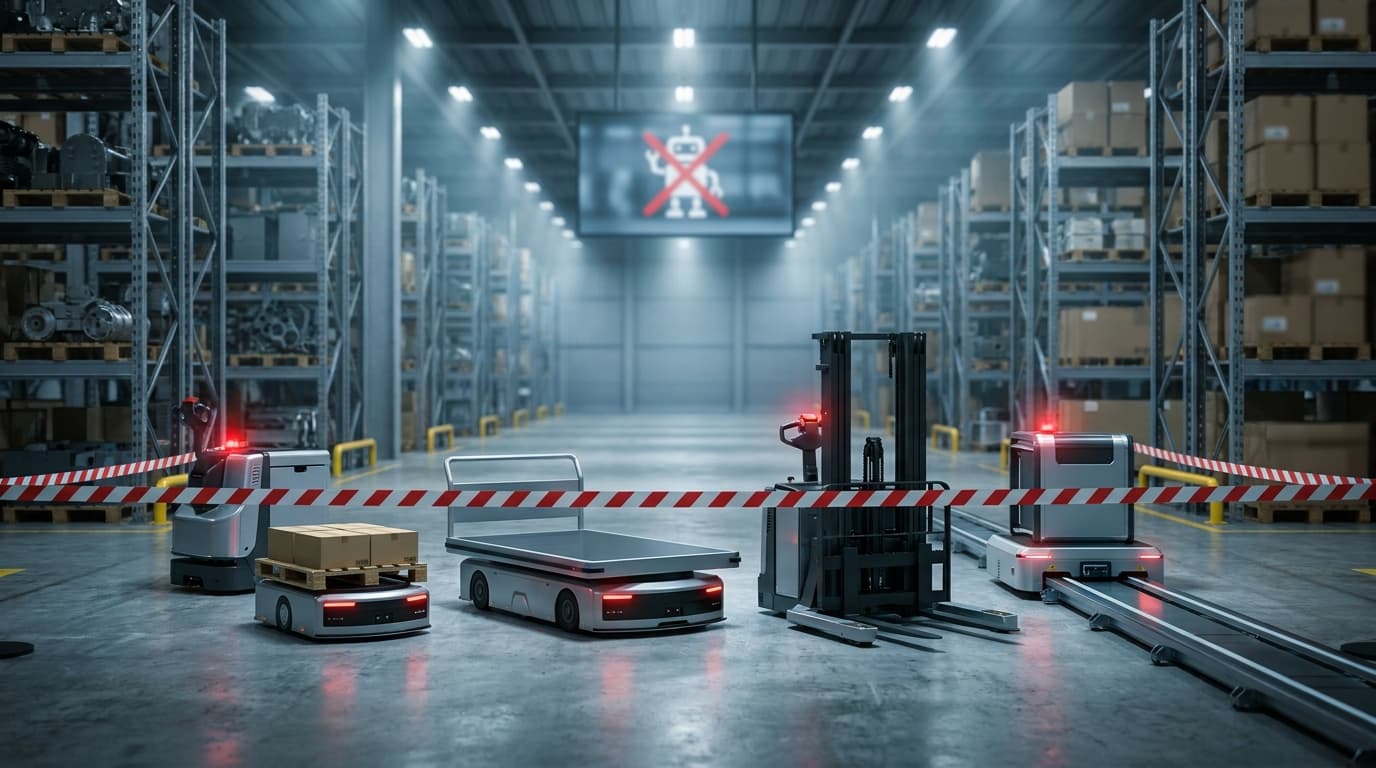
The headlines called it a humanoid ban. Read the Public Notice and it is something considerably more consequential for anyone who runs a distribution center: a definition. On July 28, 2026 the FCC released Public Notice DA 26-786 in WC Docket No. 18-89, adding two categories to the Covered List — foreign-produced connected power inverters and foreign-produced "advanced robotic devices." Nothing in the operative text mentions humanoids or quadrupeds. What it describes instead is a ground-mobile machine, weighing more than 4.4 pounds with its dock, that carries a sensor, talks on a network, and runs software that navigates or takes remote commands.
That is a description of a warehouse floor. Every autonomous mobile robot moving totes, every autonomous forklift, every goods-to-person bot and sortation shuttle and inventory scanner in a modern facility satisfies all four elements without effort. The rule is prospective — it blocks new equipment authorizations rather than unplugging installed fleets — but equipment authorization is the gate through which a device must pass to be imported, marketed, or sold in the United States. For material-handling teams with three-year capital plans built around next-generation hardware from offshore factories, the gate just closed.
What the rule actually says
The underlying national security determinations were issued on July 27, 2026 by an executive-branch interagency body. As Wiley Rein notes in its client alert, the Commission's role here is ministerial: it lists what the interagency process determines, rather than making an independent risk finding. The listing was effective immediately on release, with no phase-in.
A device is covered if it meets all four of the following:
- Locomotion. A mechanical mobile device capable of locomotion, obstacle avoidance, navigation, or movement on the ground.
- Distance operation. It operates at a distance from a human operator or supervisor, acting on commands or on sensor data.
- Weight. The combined weight of the device plus its ground or docking station exceeds 4.4 pounds (2 kg).
- Connected autonomy. It contains an environmental sensor, network connectivity of at least 200 kbps, and software, firmware, or AI controlling autonomous navigation or remote operation.
Two thresholds deserve correction from how they are being repeated in the trade press. The weight test is not a 2 kg robot test — it is a 2 kg system test that counts the charging dock or ground station. A light inspection bot with a substantial charging base is in scope. And 200 kbps is not a meaningful ceiling in 2026; it is roughly the floor of anything that reports telemetry. Neither threshold is doing exclusionary work.
The express carve-outs are narrow and specific: connected vehicles at any gross weight, vehicles operating exclusively on rails, uncrewed aircraft and drones, underwater vehicles, FDA-regulated medical devices, and fixed industrial robots — articulated, SCARA, delta, Cartesian, and gantry. As K&L Gates reads the same list, a bolted-down welding cell is untouched. Put that same manipulator on a mobile base and it is covered.
The clearest evidence that the FCC wrote to the definition rather than to a threat picture is at the consumer end: the Commission's own FAQ confirms robot vacuums and robotic lawn mowers are covered when they meet the test. If a Roomba is in scope, a 1,200-pound autonomous pallet truck was never going to be out of it.
Why the warehouse is the epicenter
Trade analysis by Warehouse Automation works through the equipment list, and it is comprehensive: AMRs for transport, AGVs, goods-to-person robots, sortation and picking robots, autonomous forklifts and pallet jacks, mobile manipulators pairing an arm with a mobile base, inventory-scanning and facility-monitoring robots, AMR-based ASRS installations running hundreds to thousands of bots inside proprietary rack structures, and grid-based 3D cube-storage systems.
One classification question is genuinely unresolved and materially expensive: how the rail-only exclusion applies to grid-based storage robots and shuttle systems that traverse fixed tracks. A cube-storage bot running on a rigid aluminum grid has a colorable argument that it operates exclusively on rails. It also navigates, avoids conflicts, and takes remote commands. Nobody has adjudicated it. If your 2027 capital plan includes an AutoStore-style or shuttle-based ASRS from an offshore factory, that ambiguity is the single line item most worth a legal opinion before the purchase order.
What is grandfathered — and what is not
The distinction that matters operationally: models that obtained authorization before July 28, 2026 keep those authorizations. They may continue to be produced, imported, marketed, sold, and operated absent further Commission action, and federal agencies may keep buying previously authorized units. Nobody is coming for the installed base.
The Office of Engineering and Technology paired the listing with blanket waiver DA 26-789, which permits certain Class I and Class II software and firmware permissive changes to previously authorized robots and inverters — security patches included — at least until January 1, 2029. That waiver is the reason your existing fleet does not become an unpatched liability in eighteen months. Intertek confirms the same horizon from the compliance-lab side.
What does not survive: hardware permissive changes, which remain barred without separate waiver relief, and anything that counts as a new generation requiring fresh authorization. Warehouse fleets are specified for 10-to-20-year service lives. The binding constraint is therefore not legality of what is installed — it is spares, fleet expansion, and hardware refresh on a platform whose manufacturer can no longer authorize a successor.
The country-neutral point operators keep missing
"Foreign-produced" in this rule does not mean Chinese. It means failing the Buy American "domestic end product" test at 48 C.F.R. § 25.101(a). The International Federation of Robotics states the point plainly: the restrictions depend on manufacturing location, not company nationality. A U.S.-headquartered vendor building in Southeast Asia is caught. A European, Japanese, Korean, or Norwegian system is caught. Vendor nationality is not the variable in the equation. Factory location is.
Buyers who responded to the July 28 notice by asking their AMR vendor "are you Chinese?" asked the wrong question. The right question is where the finished device is assembled and what fraction of its component cost is domestic.
The Conditional Approval path runs through the Department of War
There is an escape hatch, and it is unusually narrow. For robotic devices, the Department of War is the sole granting authority for Conditional Approval — unlike power inverters and other Covered List entries, where authority is shared with DHS. Applications require corporate-structure disclosure, manufacturing-pipeline documentation, global supply-chain mapping, and a detailed, time-bound plan to establish or expand U.S. manufacturing. Intertek estimates up to 18 months for a decision.
The filing deadline is January 1, 2028, with no categorical safe harbor after it. Run the arithmetic against an 18-month review: a vendor that files in mid-2027 may not have an answer until late 2028. A buyer specifying that vendor's next-generation platform for a 2028 go-live is underwriting a regulatory outcome, not a delivery date.
The alternative to Conditional Approval is meeting the domestic-content threshold — roughly 65% U.S. component cost for items delivered through 2028, stepping up in 2029. Here the secondary sources conflict: Sidley reports 75% for 2029 while K&L Gates reports 70%. We are not printing a 2029 figure until it is checked against the primary Public Notice, and neither should your procurement team. One point both firms agree on: allied and qualifying-country content does not count toward the domestic percentage.
The 2027-28 roadmap problem, quantified
Interact Analysis sizes the exposure. Chinese vendors' share of mobile robots deployed in the United States went from 1% in 2018 to 36% in 2025. Over the same period U.S. annual mobile robot shipments rose from roughly 30,000 units to more than 200,000 — about a 32% CAGR — with roughly 500,000 forecast for 2030. Chinese manufacturers shipped 91% of their output domestically in 2018; by 2025 that had fallen to 64%, which is precisely the export push the rule now interrupts.
More than a third of recent U.S. deployments came from vendors whose next model cannot be authorized. Interact Analysis expects buyer conversations to shift "from price, performance, and service coverage toward regulatory resilience," alongside a near-term investment pause while the market waits out the uncertainty. A pause is rational. It is also expensive in a market compounding at 32%.
What changes in procurement, concretely
This is the operational core. Warehouse-automation analysts recommend a due-diligence sequence that belongs in the RFP template, not in a legal memo:
- Confirm FCC authorization status and the FCC ID for the exact model quoted, and verify the authorization predates July 28, 2026.
- Confirm country of production under the Buy American domestic-end-product test — final assembly location and component cost origin, not corporate headquarters.
- Confirm the authorization covers the exact communications configuration quoted. A different radio module or frequency plan can put the quoted unit outside the authorization on file.
- Flag whether the quoted unit is a new generation requiring fresh authorization. Vendors mid-refresh have every incentive to quote the new platform.
- Check Conditional Approval status with the Department of War — filed, pending, granted, or not attempted — and get the filing date.
- Obtain supplier warranties on regulatory compliance that survive delivery.
- Add contract terms for the three failure modes: authorization delay, inability to expand the fleet, and inability to supply replacement robots.
That last cluster is the one buyers under-price. A fleet-expansion clause is worth more than a discount when the alternative is a half-automated facility with no path to the second phase.
Pre-authorization inventory is now a hoardable asset
An already-authorized SKU has acquired option value it did not have in June. Buying ahead on a grandfathered model — spares, expansion units, whole additional cells — is a legitimate hedge against a 2028 in which the vendor's successor platform has no authorization path.
The offsetting risks are real and should be priced. Hardware permissive changes are barred, so the spec is frozen at whatever shipped. Firmware improvements have a stated horizon of January 1, 2029. And a 10-to-20-year service life on a platform that will never receive a hardware revision means you are buying into a dead-end architecture on purpose. That can still be the right call. It should be an explicit call.
The domestic demand shock and its component-supply catch
U.S. builders inherit the order flow. They do not inherit a domestic supply chain. China's dominance in robot component production — actuators, reducers, sensors, batteries — means American integrators absorbing this demand still depend on Chinese subassemblies, which is exactly the dependency the Conditional Approval framework asks applicants to unwind with a time-bound onshoring plan. That is a multi-year capital commitment, not a 2027 delivery slot.
Industry reaction reported by IEEE Spectrum reads accordingly. Boston Dynamics VP of policy and government relations Brendan Schulman called the action "just the first round in a series of policies." ANYbotics VP Philipp Frey argued that enterprise buyers already prioritize long-term reliability, cybersecurity, and software capability over unit cost — a claim the rule now tests directly. Ghost Robotics CEO Gavin Kenneally asserted that spyware is deployed inside the United States on Chinese robots.
The security predicate, reported straight
The Department of War cited IEEE Spectrum's reporting on Unitree vulnerabilities in justifying the action. The September 2025 disclosure known as UniPwn covered the Go2 and B2 quadrupeds and the G1 and H1 humanoids: hardcoded cryptographic keys and an authentication bypass in the Bluetooth Low Energy Wi-Fi provisioning interface, giving an attacker within wireless range root-level control — and wormable between units. Separately, researchers at Alias Robotics documented G1 and H1 telemetry transmitted to China-based servers at roughly five-minute intervals with no user notification and no opt-out; the finding is corroborated in independent technical coverage.
Translate an equivalent exposure into a distribution center and the concern is not the robot. It is what the robot knows: the facility layout it maps continuously, the presence patterns of workers it routes around, the throughput and dwell data it generates by the shift. A wormable, proximity-range root exploit across a fleet is an operational-technology incident with a physical-safety edge, not a data-privacy footnote. Whether that risk profile justifies a rule reaching robot vacuums is a policy judgment. The technical predicate is documented.
Geopolitics and the open questions
China's Ministry of Commerce objected formally, saying the measures "fly the banner of non-discrimination but in substance discriminate against and suppress Chinese enterprises," accusing Washington of overstretching national security and of unilateral bullying, and warning of countermeasures. Both things are true at once: the text is country-neutral by construction, and the national security record points at one country.
Two pending items should be on every operator's watch list. A July 22, 2026 Third Report and Order closes the "component part" loophole, effective 30 days after Federal Register publication and applying to new applications only. And a pending Third Further NPRM proposes extending the domestic-end-product standard to all Covered List entries while cutting the unauthorized-device import allowance from 4,000 units to 40. If that second proposal is adopted, the small-volume import path that some integrators are quietly counting on for spares disappears.
Five things to do before the next capital request
- Inventory your fleet by FCC ID and authorization date. You need to know which models are grandfathered and which are one refresh away from a wall.
- Ask every vendor where the device is built, not where the company is headquartered, and get the domestic component-cost percentage in writing.
- Get a legal read on grid and shuttle ASRS against the rail-only exclusion before signing anything with an offshore-built cube-storage system.
- Rewrite the contract template to cover authorization delay, fleet-expansion failure, and spares supply — with remedies, not just representations.
- Verify the domestic-content figures against the primary Public Notice before they enter a board deck. The 2029 threshold is reported inconsistently by credible firms, and the number drives the make-versus-buy math.
The installed base is safe. The roadmap is not. That is the whole rule in two sentences, and it is enough to reopen every 2027 automation plan in the country.
Related reading
-
[Humanoids Hit Wall Street the Easy Way: Agility's $2.5B SPAC Skips the Roadshow — and Foxconn's $200M PIPE Is the Real Vote](/article/agility-robotics-churchill-spac-foxconn-pipe-humanoid-public)
Sources
- FCC Public Notice DA 26-786 — Foreign-Produced Power Inverters and Robots Added to Covered List
- FCC FAQs on Recent Updates to the Covered List
- FCC Fact Sheet (PDF)
- Wiley Rein — FCC Adds Foreign-Produced Power Inverters and Advanced Robotic Devices to the Covered List
- Sidley Austin — FCC Adds All Foreign-Produced Advanced Robotic Devices to the Covered List
- K&L Gates — Five Things to Know
- Warehouse Automation — What Does the US Ban on Foreign Robotics Mean for Warehouse Automation?
- Interact Analysis — What the FCC Ruling Means for the US Mobile Robot Market
- IEEE Spectrum — FCC Covered List Bans New Foreign Mobile Robots in US
- International Federation of Robotics — FCC Restrictions on Foreign-Produced Advanced Robotic Devices
- Intertek — U.S. FCC Expands the Covered List
- Help Net Security — Unitree G1 Bluetooth vulnerability and telemetry findings