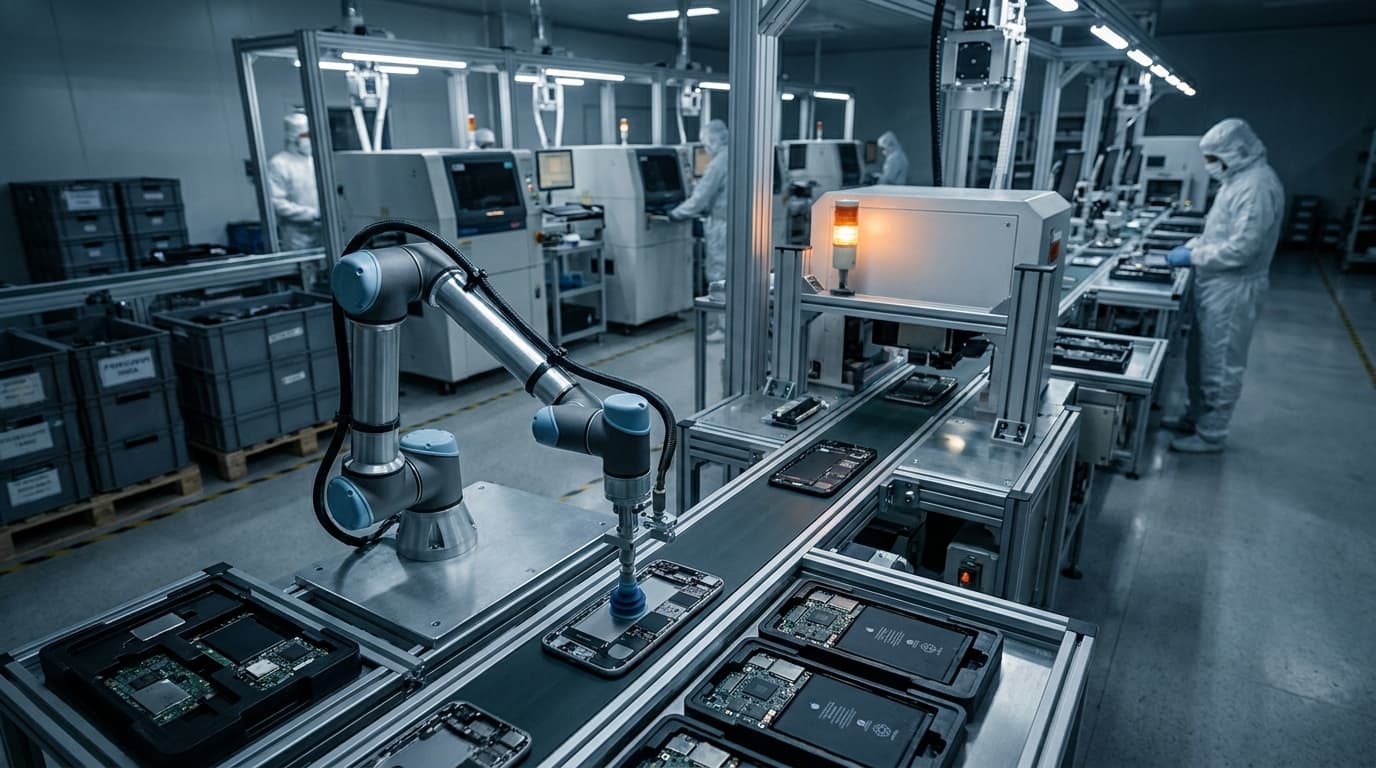
India built roughly 25% of the world's iPhones in the first quarter of 2026, the country's assembly base having jumped 53% to about 55 million units in 2025 from 36 million the year prior, according to Bloomberg. That single data point reframes a five-year-old narrative: Apple's diversification out of China is no longer a hedge being slowly priced in by Wall Street. It is a cash-flowing primary node, with the operator economics and supplier ecosystem to match. For US manufacturers reading Apple as a leading indicator on Asia exposure, the question has shifted from whether the China alternative works to how fast the rest of the BoM follows the assembly footprint.
Foxconn alone supplies more than 80% of India-assembled iPhones, per Digitimes, which puts the contract assembler's India network — anchored by its legacy Sriperumbudur base in Tamil Nadu and the new Devanahalli campus near Bengaluru — at roughly one in five iPhones globally on its own. Add Tata Electronics' three-site footprint, and a country that produced under 5% of iPhones at the start of the decade now functionally rivals Zhengzhou as a center of gravity.
The capacity stack: four sites doing the work
The 25% figure resolves into four operational facilities running concurrently, not a single hero plant.
Foxconn Sriperumbudur (Tamil Nadu) is the legacy base — the line that absorbed the initial Chinese assembly transfer and proved out the model. Foxconn Devanahalli (Karnataka) is the more telling story. The plant is targeting about 20 million units per year at full ramp, and per Business Standard, hired roughly 30,000 workers in eight to nine months on its way to a planned 50,000 headcount across 12 assembly lines. A workforce ramp at that velocity in a greenfield site has historically been the binding constraint on India electronics — Foxconn appears to have solved it.
Tata Electronics is the second pillar. The group acquired a 60% stake in Pegatron's India operation in early 2025, taking over a Tamil Nadu site running roughly 10,000 staff and 5 million iPhones per year, per Business Standard. That deal followed Tata's earlier absorption of Wistron's Karnataka facility, and the through-line is a Tata roll-up of Apple's secondary Chinese sub-suppliers under one Indian operator. Separately, Tata's enclosure plant at Hosur (Tamil Nadu) is doubling output toward 100,000 enclosures per day, with about 28,000 additional hires queued, taking site headcount toward 40,000, per Channel iAm. Tata's combined production-value share is now trending toward 44%, narrowing the gap with Foxconn meaningfully.
The operator playbook: enclosure → assembly → PCBA → fab
Strip away the geopolitics and the sequencing reads like a textbook capex ladder. India started with low-complexity enclosures and final assembly. Industry analysis notes the supplier ecosystem around Apple in India has grown to roughly 45 companies, with PCBA (printed circuit board assembly) capacity stacking next — India's PCBA market crossed $16 billion as early as 2020 and has continued building. The order matters: each tier de-risks the next, and each new tier shifts more value-add onshore.
What's distinctive about the Indian build-out compared to Vietnam or Mexico is the Tata consolidation model. Rather than letting Pegatron, Wistron, and Foxconn run as parallel Chinese-headquartered subcontractors, India effectively created a domestic champion that absorbs the sub-suppliers as they de-risk out of mainland China. The Pegatron and Wistron acquisitions don't add net global capacity — they redistribute existing Apple-qualified capacity onto an Indian operator's books. For Apple that means dual-sourcing without the regulatory and political overhead of running two foreign nationals' lines side-by-side.
Upstream: the Dholera bridge to silicon
The next tier — silicon — is where the timeline gets honest. The Tata–PSMC Dholera fab in Gujarat is the bridge from assembly to upstream wafer fabrication. The plant is planned at 50,000 wafers per month across 28, 40, 55, and 110nm nodes, with first commercial chips targeted for December 2026, per Digitimes, which also reported the project secured roughly $735 million in lender financing in 2026 under strict conditions.
Execution is uneven. Independent reporting from Domain-B has flagged soil and engineering challenges at the site, and Digitimes documented leadership churn alongside continuing but uneven progress. The nodes themselves — 28nm and trailing-edge — won't print iPhone application processors. But they're the right floor: power management, display drivers, and analog parts that today route through Taiwan and China are exactly the parts a domestic foundry can credibly take on first. Display and glass remain stubbornly China-locked, and nothing in the current build-out changes that on a 24-month horizon.
Tariff math: noise on top of a durable signal
The tariff environment around the India shift has been violent and largely irrelevant to the underlying capex decisions. The Trump administration raised India tariffs to 50% in August 2025 — a 25% base layered with a 25% Russia-oil penalty — which on paper threatened to make the India arbitrage uneconomic overnight. In February 2026, the Supreme Court struck down the IEEPA reciprocal tariff regime, which was replaced with a 10% Section 122 blanket carrying no product exemptions. Apple has booked roughly $3.3 billion in cumulative tariff costs since 2025, with analysts modeling $100 to $350 in added cost per iPhone 17 unit depending on routing.
What's telling is what Apple did not do. Through the 50% spike, Apple did not slow the India ramp, did not pull forward Vietnamese or Brazilian alternatives at scale, and continued to publicly target moving the majority of US-bound iPhones to India by the end of 2026 and roughly 32% of global volume / 26% of value to India by 2026–27. The persistence through tariff volatility is the durability signal — the India bet is being made on five-year operator economics, not on quarter-to-quarter landed cost.
What it means for US manufacturers reading Apple as a tell
Three things, concretely.
First, the workforce ramp is no longer the long pole. Foxconn pulling 30,000 hires into a single greenfield site in nine months collapses the conventional wisdom that India couldn't field assembly labor at Chinese velocity. For US operators sizing offshore moves, the assumption that India needs a five-year staffing runway is now stale. The hard part has shifted upstream — to engineering talent for fabs and tier-2 process control, not to assembly-line headcount.
Second, the sub-supplier consolidation play is replicable. The Tata model — buy out the Chinese-headquartered Apple-qualified subcontractors as they look to de-risk — is a template any large industrial group sitting next to a US OEM's diversification target could run. The capital required is modest relative to the strategic position it creates.
Third, the cost of waiting compounds. Apple started seriously building India capacity around 2021. Five years later, it has ~25% of global volume in country and a credible path to ~32%. Operators who started later — or who paused on tariff noise — are now competing for capacity, talent, and supplier slots inside an ecosystem that already has anchor tenants. The window for cheap entry has visibly narrowed.
Open questions
The 32% target by 2026–27 is plausible on the announced capacity, but the upper-bound 35% scenarios cited in trade press assume Dholera ships on time, Hosur hits 100K enclosures/day cleanly, and Devanahalli's 12-line full ramp doesn't slip. Any one of those slipping six months pulls the number back toward the high 20s. More importantly, the capabilities that remain China-locked — high-end packaging, advanced-node logic, OLED panels, cover glass — are exactly the parts where US importers still face concentrated single-country risk regardless of where final assembly happens. The headline 25% figure is real. The decoupling underneath it is partial, and the next four quarters of fab and display localization news will determine whether the trajectory holds or plateaus.
Related reading
Sources
-
Bloomberg — Apple Now Makes About 25% of iPhones in India After China Pivot
-
TechWire Asia — Apple iPhone production in India hits 25% of global output
-
The Week — Tata and Foxconn power India's electronics revolution
-
Business Standard — Tata Electronics acquires 60% in Pegatron India
-
Channel iAm — Tata Electronics Leads Apple Production in India
-
Digitimes — Tata Semiconductor secures $735M for Dholera fab
-
Digitimes — Tata India chip fab leadership and engineering hurdles