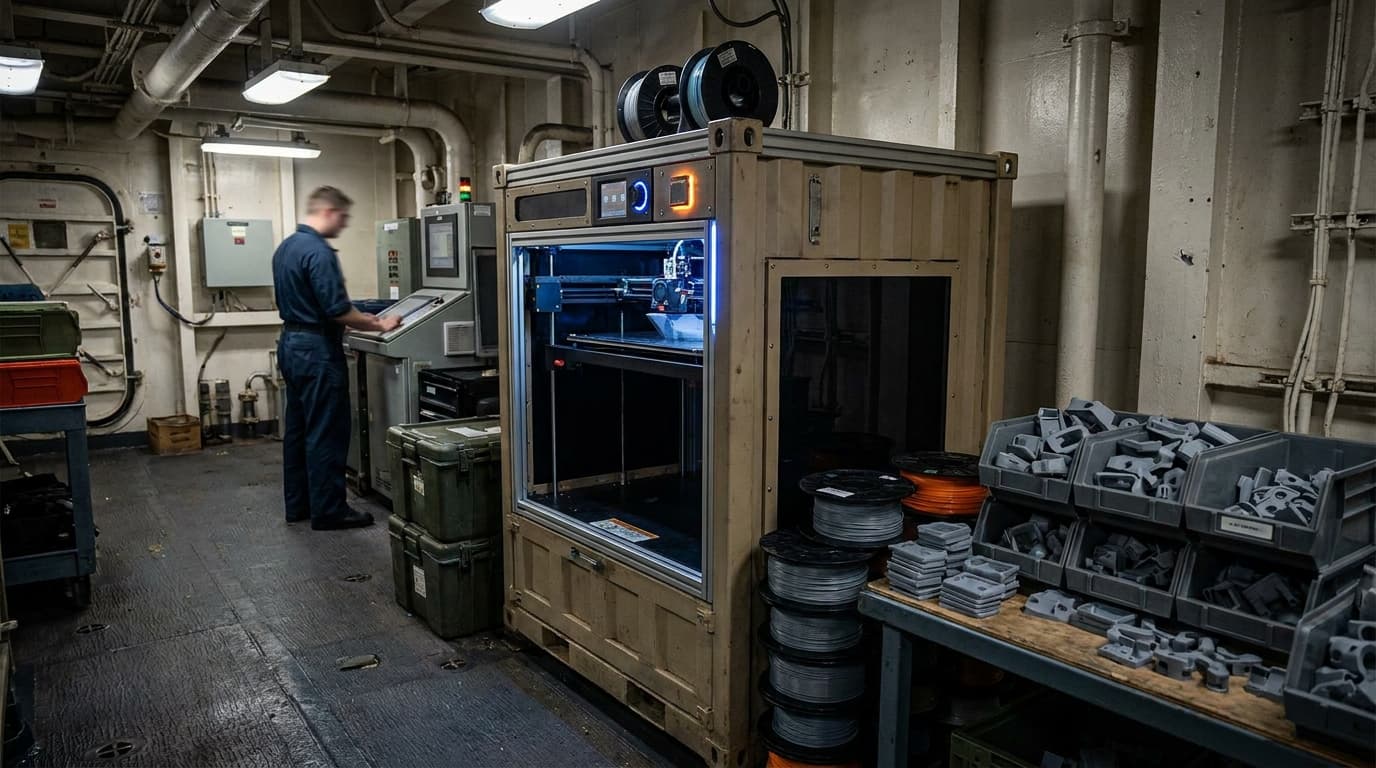
For six weeks this summer, the amphibious assault ship USS Essex (LHD-2) operated as something the U.S. Navy has been talking about for a decade but rarely fielded at scale: a floating factory. During RIMPAC 2026 — the 30th Rim of the Pacific exercise, running June 24 to July 31 in and around the Hawaiian Islands — the Wasp-class ship anchored what the Navy and Department of War describe as the largest advanced-manufacturing demonstration in Department of War history.
The number doing the rounds in coverage — more than 1,000 parts produced while underway — is real. But it is worth getting precise about what produced them, because the headline conflates two distinct systems that happened to deploy under the same experiment. The 1,000-plus figure belongs to Firestorm Labs' containerized xCell platform, a polymer 3D-printing system, not to the metal hybrid cell it is frequently lumped in with. For a publication whose readers buy machines, feedstock, and software, that distinction is the whole story.
What RIMPAC 26 actually was
RIMPAC is the world's largest international maritime exercise. The 2026 iteration drew figures on the order of 35 nations, roughly 40 surface ships, five submarines, more than 140 aircraft, and about 25,000 personnel, per the Naval Postgraduate School (some sources cite larger totals). What made this year different for manufacturing readers was the manufacturing itself.
The advanced-manufacturing effort was led by the Naval Postgraduate School's Consortium for Advanced Manufacturing Research and Education (CAMRE), working through the partnership intermediary FLEETWERX under the Navy's Fleet Experimentation Program (FLEX) — one of roughly 40 experimentation projects folded into the exercise. According to NPS, RIMPAC 26 marked the first time CAMRE integrated advanced manufacturing, artificial intelligence, and unmanned/autonomous delivery (including drone parts delivery) into a single operational demonstration. USS Essex served as the centerpiece platform, supported by Combat Logistics Battalion 13 of the 13th Marine Expeditionary Unit, per Army Recognition.
The framing matters: this was not a Pentagon budget line or a single procurement award. It was a live operational trial, at sea, in real sea states — the kind of demonstration that tells you whether a capability survives contact with an actual ship.
The systems, disaggregated
Three vendors carried the technical load, and they did different jobs.
Firestorm Labs (San Diego) — polymer, and the 1,000-part number. Firestorm's containerized xCell 3D-printing platform produced more than a thousand parts for the Navy, Marines, Coast Guard, and Army while underway aboard Essex — including in seas up to 12 feet — according to field operations manager Duane Blank. This is a polymer system. Printing dimensionally acceptable parts on a moving deck in 12-foot seas is the operationally interesting milestone here, and it belongs to Firestorm.
Phillips Federal — the metal hybrid cell. Separately, Phillips Federal deployed a containerized hybrid manufacturing cell pairing a Haas TM-1P CNC mill with Meltio Blue wire-laser metal deposition — a directed-energy-deposition process. The pairing lets a single container do both additive and subtractive work: build up metal features, then machine them to tolerance, and repair or restore critical metal components near the point of need. No verified source credits this metal cell with the 1,000-part total; that figure is polymer.
"When critical parts are unavailable through traditional supply channels, the ability to manufacture or repair components closer to the point of need can help improve readiness," said Brian Kristaponis, president of Phillips Additive Manufacturing Solutions.
3YOURMIND — the digital thread. The software layer came from 3YOURMIND, whose commercial off-the-shelf tools handled part identification, order management, and production planning — managing the distributed "digital thread" across participating units in the NPS experiment. This is the unglamorous piece that turns a box of printers into a supply system: knowing what to make, where, and whether it is qualified to install.
The supply-chain thesis
The strategic argument behind all of this is well-sourced and, for once, not hype. Additive manufacturing is being reframed from a prototyping tool into a readiness and sustainment capability — a hedge against contested logistics, obsolete or discontinued parts (the DMSMS problem: diminishing manufacturing sources and material shortages), and punishing lead times. It maps directly onto the Navy's Distributed Maritime Operations and the Marines' Expeditionary Advanced Base Operations, both of which assume the supply chain will be stressed or cut.
The evidence cited in coverage is concrete. One illustrative example: a bracket for the destroyer USS Halsey carried a roughly 40-week traditional lead time; via 3D printing it was produced in about two weeks, ahead of a 30-day deployment window. Aboard Essex, the crew made the same case in plainer terms. Gunnery Sgt. Samuel Margarini, the ship's 3D-printing team lead, framed the goal as the ability to "manufacture parts on site at the point of need," noting that many shipboard parts are "no longer manufactured" at all. Cmdr. Jason Pirrallo, the supply officer, said the process cuts administrative processing and procurement cost. Capt. David Foster, senior medical officer, pointed to a future goal of printing medical equipment — aspirational, but on the roadmap. (Naval-affairs outlet USNI News established Essex as the trial's centerpiece.)
Operational reality check
What clearly worked: polymer parts, in volume, underway, in rough seas, benefiting four services. That is a genuine step past the lab.
What remains experimental: printed medical equipment is a stated goal, not a fielded capability. Metal qualification — proving a DED-built-then-machined component is airworthy or hull-worthy — is the hard, unfinished work that stands between a container full of hardware and a signed-off installable part. And there is a factual ambiguity worth flagging: Phillips' own announcements place its hybrid-metal cell aboard USS Essex, while Stars and Stripes reporting describes a containerized hybrid-metal printer aboard the aircraft carrier USS Theodore Roosevelt as a first-of-kind carrier deployment. Until a single authoritative source reconciles them, treat the metal cell's exact ship assignment as unsettled. The polymer 1,000-part milestone aboard Essex is not in dispute.
The read-through for the additive supply base
For ManufacturingMag readers, the signal is where the demand concentrates if this becomes doctrine rather than a demonstration:
-
Hybrid machine builders. The Haas TM-1P + Meltio Blue pairing is a template: mate a proven CNC platform with a wire-laser DED head in a ruggedized container. Expect more additive/subtractive integration aimed at repair-and-restore, not just net-shape building.
-
Feedstock. Wire-laser DED consumes metal wire, not powder — a different, generally cheaper and more logistics-friendly feedstock than powder-bed fusion. Polymer platforms drive filament/pellet demand. Sustainment volumes, if they materialize, are recurring rather than one-off.
-
MES and digital-thread software. 3YOURMIND's role underlines that the constraint is rarely the printer — it is part identification, order management, and qualification workflow. That is a software and data problem, and a durable one.
-
Defense-adjacent primes and intermediaries. FLEETWERX-style partnership intermediaries are how commercial off-the-shelf vendors reach the deck. The channel, not just the box, is part of the addressable opportunity.
The most important budget nuance: if additive is scored as a sustainment line — reducing readiness downtime, shrinking spares inventory, cutting 40-week waits to two — it is evaluated very differently than a one-off procurement number like a headline machine contract. Sustainment budgets are recurring and defended on availability metrics, which is a friendlier home for additive than capital-procurement math has historically been.
How this differs from prior additive coverage
Most defense-additive news is a budget line or a single procurement — a contract for X machines, or a Pentagon program element. RIMPAC 26 is different in kind: a live, multi-service, at-sea operational demonstration at scale, stress-tested in 12-foot seas, with a working software layer and named crew making the readiness case. The question it answers is not "will the Pentagon fund this?" but "does it survive a real ship?" On the polymer side, at least, the early answer is yes.
Related reading
-
[The Pentagon's Additive Budget Jumped 83% to $3.3B — and Velo3D's $9.8M DLA Contract Is the Tell](/article/pentagon-additive-budget-83-percent-velo3d-dla-contract)
-
[A Korean-Owned Yard Wants to Go From 2 Ships a Year to 20 — and It Just Won Another $1.5B in Federal Ship Orders](/article/hanwha-philly-shipyard-throughput-bet-15b-nsmv-marad)
Sources
-
RIMPAC makes largest-ever DOD show of 3D printing and autonomous delivery — Stars and Stripes
-
USS Essex at the Center of Additive Manufacturing Trials During RIMPAC 26 — USNI News
-
Phillips to deploy containerised hybrid AM at RIMPAC 2026 — Metal AM
-
USS Essex uses embarked 3D printers to cut supply chain delays — VoxelMatters
-
Military scales up 3D printing, drones and AI to supply RIMPAC forces — Honolulu Star-Advertiser