The headline number is easy to say and hard to spend. The FY2026 Shipbuilding and Conversion (SCN) account carries roughly $47.4 billion — what Navy officials describe as the largest single-year U.S. shipbuilding investment since the Cold War. But the topline is not the story. The story is a structural bet on who builds the ships, and whether an industrial base concentrated in a few enormous yards can be re-architected into a distributed national supply chain fast enough to matter.
Put plainly: the Navy wants to grow from a battle force of roughly 291 ships toward 450-plus vessels by the early 2030s, and it has concluded it cannot get there by pouring more money into the same handful of prime yards. So the operational question moving through the industrial base right now is deceptively simple — how do you turn 291 hulls into a problem that thousands of fabrication shops, module suppliers, and regional workforce pipelines get to help solve?
The appropriation: $47.4B, and where it comes from
The FY2026 SCN total of ~$47.4 billion funds 19 ships. It is not clean single-year money. Roughly 56% ($26.5 billion) was drawn from the FY2025 reconciliation act — covering 16 of the 19 ships — with the remaining 44% ($20.8 billion) in new FY2026 appropriations funding three. The split matters because it signals that a meaningful share of this record was pre-loaded through reconciliation rather than a durable base-budget commitment, a nuance the Congressional Research Service tracks in its running analysis of Navy force structure and shipbuilding plans.
Behind the appropriation sits the Navy's May 2026 Shipbuilding Plan, which frames the 450-plus fleet — a count that spans manned, auxiliary, and unmanned vessels — as an "early 2030s" ambition. It's worth being precise here: the tidy "450 by 2031" framing that circulates in coverage is tighter than the plan's own language. The gap between ~291 today and 450-plus in roughly half a decade is the entire reason the industrial-base conversation exists.
What "distributed shipbuilding" actually means
Today, distributed shipbuilding — building ship sections and modules at smaller or commercial yards and suppliers, then bringing them to a primary yard for final assembly — accounts for only about 10% of Navy shipbuilding work. The stated goal is to push that to 50%.
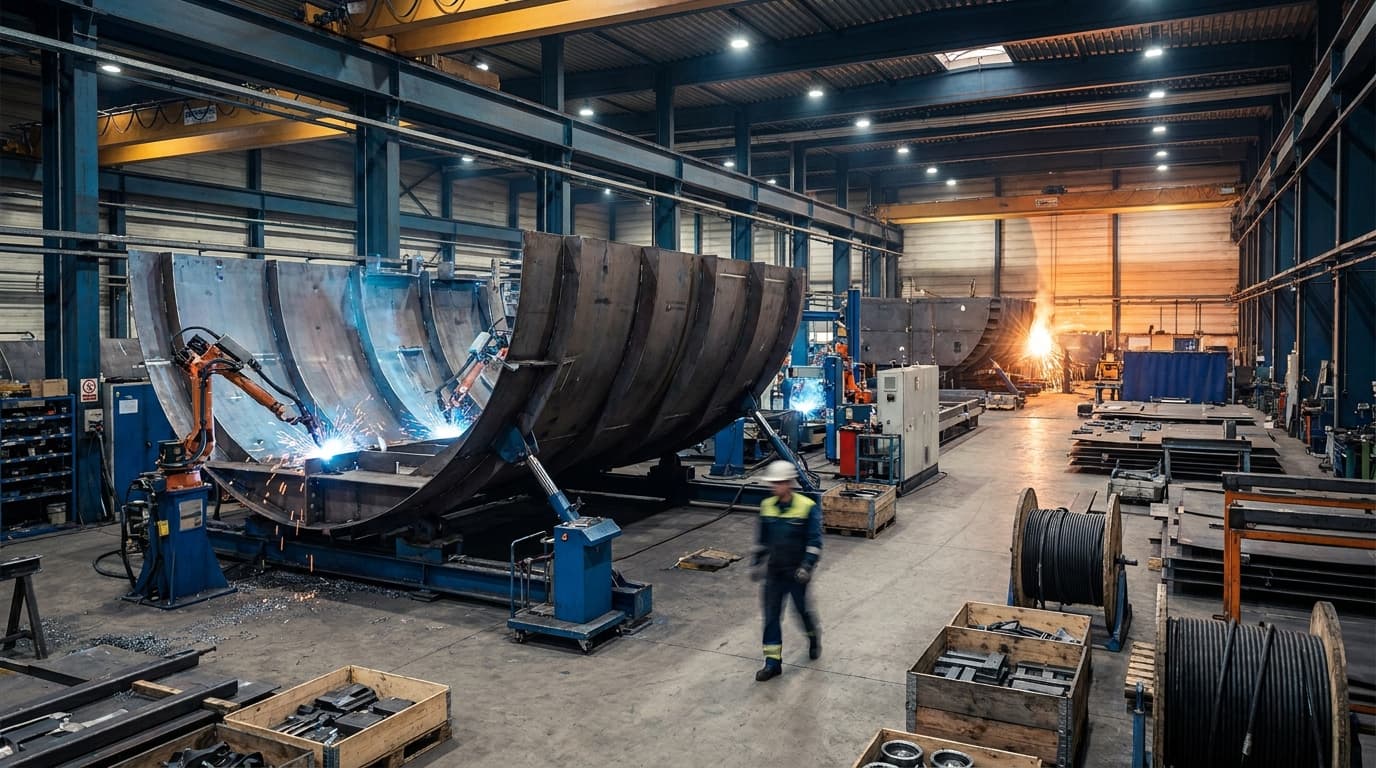
The logic is part capacity, part risk. When nearly all construction on a class runs through a single prime yard, that yard becomes a structural chokepoint: a labor shortage, a delivery slip, or a physical constraint at one facility ripples across the entire program. Modular, distributed construction spreads the work — hull modules, deckhouse units, and outfitted sections built in parallel across many locations — so that throughput is no longer gated by one site's welding bays and one region's labor pool. As National Defense Magazine reported, the Navy is explicitly targeting that 10%-to-50% shift as a core execution strategy for the larger fleet.
HII as the proof of concept
The clearest live example is HII (Huntington Ingalls), the country's largest military shipbuilder. At Sea-Air-Space in April 2026, HII said it plans to outsource 2.5 million-plus hours of shipbuilding work in 2026 — a roughly 30% increase over 2025 — spread across 25 locations in 11 states. In practical terms, that's on the order of 1,000-plus additional distributed jobs pulled into the naval supply chain.
The partner network shows what distributed construction looks like on the shop floor. Per HII's own disclosure and trade-press analysis, it includes Trident Maritime Systems building Ford-class carrier units, Gulf Copper in Texas producing Ingalls destroyer hull modules, and Keel fabricating submarine modules and carrier units in Michigan and South Carolina. HII also acquired and repurposed the former W International plant in Charleston, South Carolina, folding an existing fabricator directly into its throughput. The company credited this expanding model with a 14% output increase in 2025 — the first hard evidence that distributing the work moves the delivery needle rather than just the org chart.
Wall Street starts writing checks
The newer development — and the one that reframes this from a defense-budget story into an industrial-finance story — is private capital plugging into a public buildout. On July 15, 2026, JPMorganChase committed $24 million to strengthen shipbuilding in Philadelphia and the broader defense industrial base: $18 million in loans and investments plus $6 million in grants.
The anchor is a $13 million New Markets Tax Credit equity investment in Rhoads Industries, an Electric Boat supplier, to stand up a 95,000-square-foot high-bay facility projected to create roughly 450 permanent jobs. The package also includes a $5 million loan to PIDC Community Capital and about $6 million in workforce and supplier-development grants. Read structurally, this is private capital de-risking the ramp — using tax-credit equity and community lending to make the physical expansion of a submarine supplier bankable before the full order flow arrives. Both JPMorganChase's release and independent trade coverage lay out the components.
The supplier and submarine layer
That Rhoads facility does not stand alone. It sits atop a 10-year (2026–2035) strategic agreement between Rhoads Industries and General Dynamics Electric Boat, with an estimated program value around $2.5 billion supporting the submarine industrial base. The labor math is the point: the agreement averages roughly 1.4 million workforce hours per year, and Rhoads' workforce is expected to grow toward 1,500. As Rhoads' announcement makes clear, this is a supplier-to-prime relationship — the kind of durable, multi-year commitment that lets a mid-sized fabricator justify hiring and capital expansion.
Alongside it, Hanwha Philly Shipyard won an additional roughly $1.5 billion National Security Multi-Mission Vessel (NSMV) order from MARAD (within the Department of Transportation), announced in mid-July 2026 and projected to create 2,000-plus jobs. Hanwha — the South Korean industrial group that acquired Philly Shipyard in December 2024 — has delivered three of the five original NSMVs, including the State of Maine in March 2026. The foreign-ownership angle is part of the narrative: the deal is frequently framed under the "MASGA" (Make American Shipbuilding Great Again) banner, a recognition that rebuilding U.S. yard capacity is drawing in overseas capital and operators. USNI News and Seoul Economic Daily both cover the expanding order book.
This activity is regionally concentrated for a reason. Sen. Dave McCormick's July 15, 2026 Pennsylvania Defense and Innovation Summit at the U.S. Army War College spotlighted more than $4 billion in Pennsylvania shipbuilding and maritime investments — part of a broader package the state pegs at roughly $10 billion.
The forward pressure: FY2027
If FY2026 is a record, FY2027 is a step-change. The FY2027 shipbuilding request rises about 46% to $65.8 billion ($60.2 billion base plus $5.6 billion reconciliation), funding 34 vessels — 18 battle-force ships and 16 auxiliaries — a record request by count and dollars, as detailed by Naval News and corroborated by Defense One.
Here is the operator's read on that number: appropriations are no longer the binding constraint. If Congress is prepared to authorize a ~46% year-over-year jump, the gating factor becomes whether the industrial base can absorb the money — whether there are enough qualified suppliers, enough certified module shops, and above all enough skilled hands to convert dollars into delivered hulls.
The binding constraint: welders, machinists, suppliers
Every source in this story circles back to the same bottleneck: skilled labor — welders and machinists — and qualified module and component suppliers. It is the identical reshoring constraint dogging semiconductors, batteries, and heavy industry generally. You can appropriate $47 billion, or $65 billion, but you cannot appropriate a journeyman welder into existence on the budget cycle's timeline.
This is why distributed shipbuilding is best understood as a workforce-geography strategy as much as a capacity strategy. Pushing modular work out to 25 sites in 11 states is a way to tap regional labor pools that would never relocate to a coastal mega-yard — the machinists in Michigan, the fabricators in Texas, the metal shops in the industrial Midwest. The distributed model doesn't just spread the risk; it widens the hiring funnel.
The open risks are real. Spreading work across dozens of suppliers introduces coordination overhead, quality-assurance complexity, and margin pressure on primes like HII that must manage a sprawling subcontractor base. Delivery delays and cost overruns have dogged Navy shipbuilding for years, and distribution is a bet that parallelization outruns integration risk — not a guarantee that it will.
The manufacturing-mag angle
For the broader industrial base, the signal is unambiguous: naval shipbuilding is being deliberately re-plumbed to run through the same fabrication shops, module suppliers, and regional workforce pipelines that make up general American heavy manufacturing. A high-bay in Philadelphia, a hull-module line in Texas, a submarine-component shop in Michigan — these are becoming defense supply-chain nodes, backed by multi-year prime agreements and, increasingly, private capital willing to finance the physical expansion in front of the orders.
The 450-ship goal will ultimately be decided not in the SCN topline but in whether that distributed base can be built, staffed, and qualified. The money has arrived. The question the next five years will answer is whether the welders, the shops, and the suppliers can too.
Related reading
-
[The November Snap-Back: China's Gallium Reprieve Expires in Weeks, and Trump's $10B 'Project Vault' Won't Refine a Gram in Time](/article/china-gallium-suspension-snapback-project-vault)
-
The Pentagon's Additive Budget Jumped 83% to $3.3B — and Velo3D's $9.8M DLA Contract Is the Tell
-
[The Pentagon Guaranteed $110 a Kilo for 10 Years: Inside MP Materials' $1.25B Texas 'Magnet Independence' Bet Against China's 90% Grip](/article/mp-materials-10x-texas-magnet-plant-pentagon-price-floor-china)
Sources
-
Navy Force Structure and Shipbuilding Plans: Background and Issues for Congress (CRS RL32665)
-
HII Increases Throughput, Expands Industrial Base through Distributed Shipbuilding (HII Newsroom)
-
To Speed Up Warship Deliveries, HII Leans Into Distributed Shipbuilding (The Maritime Executive)
-
Navy Looks at Home, Abroad to Execute Shipbuilding Plan (National Defense Magazine)
-
JPMorganChase announces $24 million to help strengthen shipbuilding in Philadelphia (press release)
-
JPMorganChase Provides $24M to Strengthen Philadelphia's Naval Shipbuilding (The Maritime Executive)
-
Landmark U.S. budget request includes $65.8 Billion for Navy shipbuilding (Naval News)
-
Navy shipbuilding request rises nearly 50% in 2027 proposal (Defense One)
-
Hanwha Wins Additional $1.5 Billion US Navy Ship Order (Seoul Economic Daily)