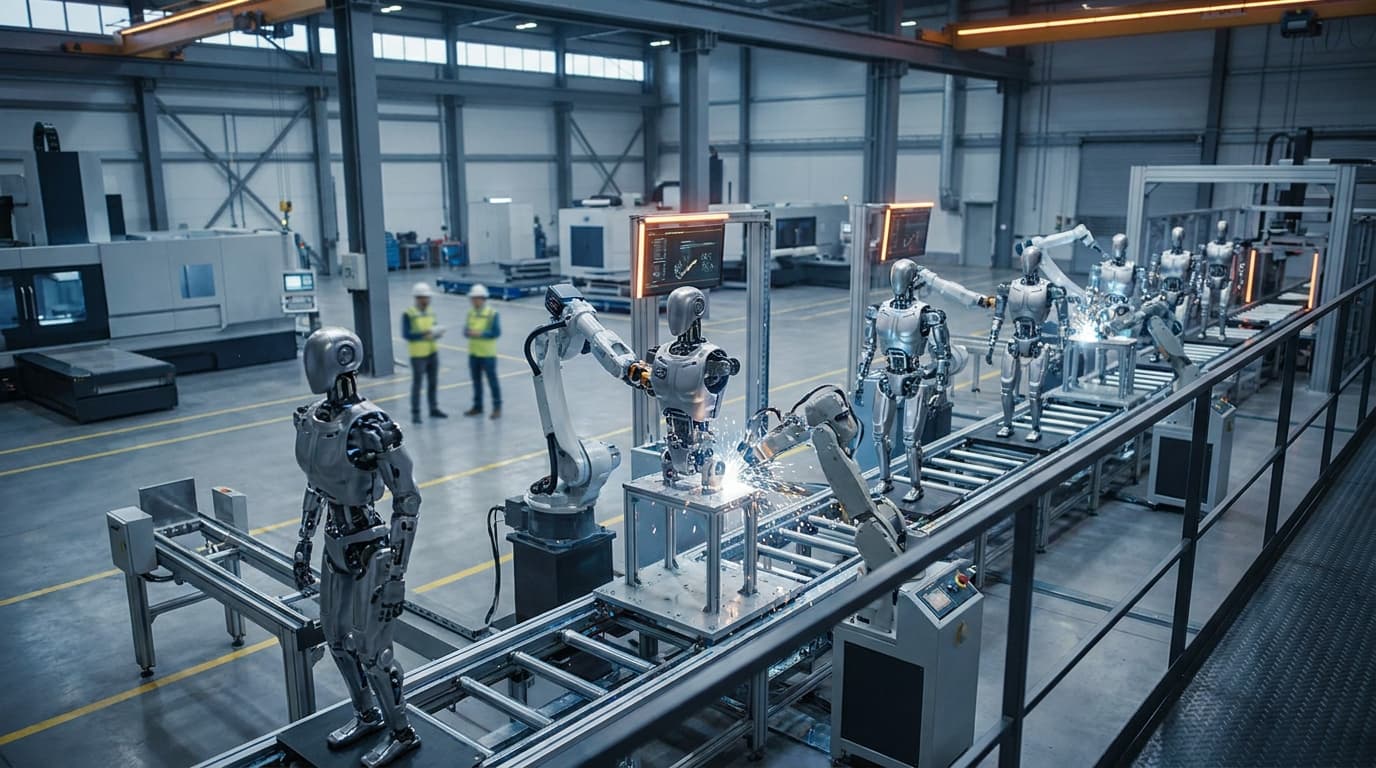
The headline out of CES 2026 was easy to misread: a factory built to produce 30,000 humanoid robots a year. The number is real, and so is the ambition behind it — but the attribution and the timeline both need correcting before operators build a plan around them. The commitment belongs to Hyundai Motor Group, which is raising its total U.S. investment to $26 billion across 2025–2028, and the robotics plant is one line item inside that package. Hyundai owns roughly 80% of Boston Dynamics; the 30,000-unit factory is a group-level bet, not standalone Boston Dynamics capex. And 30,000 a year is a future capacity target — reporting points toward 2028, with full scale-out language extending toward 2030 — not 2026 output.
Strip away the misattribution and the more durable story is still there, and it is arguably more interesting for anyone running a plant. A humanoid-robot supplier is verticalizing into high-volume manufacturing. That move reframes the entire humanoid question. For a decade the gating constraint was capability — could the machine walk, grasp, balance, recover. Building a 30,000-unit plant is a statement that the vendor believes capability is largely solved and the remaining problem is industrial: unit cost, duty-cycle reliability, and total cost of ownership at fleet scale. In short, the bet is that fixing the labor gap with humanoids is now a capex problem, not a software one.
What was actually announced — and what is aspirational
Two things are happening now, and they should not be conflated with the 30,000 figure. Per [Boston Dynamics' own announcement](https://bostondynamics.com/blog/boston-dynamics-unveils-new-atlas-robot-to-revolutionize-industry/), production of the redesigned, fully electric Atlas began immediately at the company's Boston headquarters, and the entire 2026 production run is already "fully committed." That is the near-term reality: a limited run, out of Boston, already spoken for.
The 30,000-per-year plant is the aspirational layer. It is the capacity Hyundai and its Boston Dynamics unit are building toward, not the volume shipping this year. Axios framed the timeline plainly — pilots now, factory scale by roughly 2028 — and that gap between a committed 2026 run measured in a small number of units and a plant sized for tens of thousands is the single most important thing for operators to hold onto. The announcement is a capacity commitment, not a delivery schedule.
Who gets the first units
The 2026 Atlas run is not going onto the open market. According to Boston Dynamics, the first units are committed to two internal and partner channels: Hyundai's Robotics Metaplant Application Center (RMAC), where the robots will be validated inside Hyundai's own manufacturing environment, and Google DeepMind, as part of a robot-learning partnership. Broader early-adopter orders are expected to open in 2027.
That sequencing matters because it tells you what stage this technology is actually at. These are pilots and partner deployments — the vendor proving the machine inside controlled environments it either owns or co-develops with — not proven fleet economics sold to third-party plants. The 2027 order window is the first moment outside operators will get a real price and a real product to evaluate. Until then, everything is a demonstration of intent.
The new Atlas, by the numbers
The hardware itself is built for industrial duty rather than stage demos. The redesigned Atlas is fully electric with 56 degrees of freedom, a payload of roughly 50 kg (110 lb), 2.3 m of reach, water resistance, an operating range of −20°C to 40°C, and autonomous battery swapping. The last spec is the one operators should read twice: autonomous battery swapping is a duty-cycle feature, not a party trick. A humanoid that can keep itself running across shifts without a human tending its charge cycle is a prerequisite for the fleet economics the 30,000-unit plant is premised on. The spec sheet is, in effect, an argument that the machine is being engineered for uptime.
Why the capex signal matters more than the capability one
When a supplier commits to a 30,000-unit plant, it is making a claim about where the constraint has moved. You do not build volume manufacturing capacity for a product whose fundamental capability is still in doubt; you build it when you believe the remaining problem is driving cost down the learning curve and proving reliability at scale. That is why the factory, not the robot's degrees of freedom, is the real news.
For operators, this shifts the evaluation questions. The interesting question is no longer "can a humanoid do this task," but "at what per-unit cost, what uptime, and what total cost of ownership does deploying one beat the alternative." Those are procurement and finance questions, not robotics questions — and they are exactly the questions a plant built for 30,000 units a year is designed to answer, eventually, by manufacturing the cost down. The bet is that scale manufacturing turns a bespoke research platform into a line item on a capex plan.
The labor math — and where it doesn't yet add up
The demand backdrop is the reason any of this pencils out as a market rather than a science project. Deloitte and The Manufacturing Institute project that up to 2.1 million U.S. manufacturing jobs could go unfilled by 2030, with a potential economic cost of roughly $1 trillion in 2030 alone. That is the gap humanoid vendors are pitching against, and it is substantial enough to make automation demand a structural story rather than a cyclical one.
But the arithmetic deserves an honest look. Even at full build-out, 30,000 units a year is a rounding error against a 2.1-million-job shortfall — and that assumes one humanoid cleanly replaces one unfilled role, which it does not. Humanoids today handle bounded, repetitive tasks; the labor gap spans skilled trades, technicians, and roles no current humanoid can fill. The correct read is not that a 30,000-unit plant closes the gap, but that it is a first credible increment of supply against a demand curve large enough to absorb far more. The labor shortage is why the capacity gets built; it is not evidence that the capacity is sufficient.
Right-sizing the $26 billion
It is worth being precise about the headline number, because the temptation is to read "$26 billion" as a robotics bet. It is not. The $26 billion (2025–2028) spans vehicle production, a Louisiana steel plant sized for 2.7 million metric tons a year with operations slated for 2029, and roughly 25,000 direct jobs by 2028. The robotics hub is one component of a diversified industrial package, not the centerpiece. Hyundai's official CES 2026 AI robotics strategy release confirms the 30,000-unit annual capacity target and the intent to deploy Atlas in U.S. factories, but the robotics allocation is a slice of the whole. Operators reading the announcement should not over-index on the headline number as a proxy for humanoid spending.
The questions operators are actually underwriting
Everything above resolves to a short list of open questions that Hyundai and Boston Dynamics have not publicly quantified — and until they do, any deployment case rests on assumptions rather than data:
-
Per-unit cost. No public price. The entire economic argument for humanoids-versus-labor depends on it, and it is precisely what a 30,000-unit plant is meant to eventually drive down — but there is no published figure to underwrite against today.
-
Duty-cycle and uptime reliability. Autonomous battery swapping signals intent, but sustained multi-shift reliability in a real plant is unproven outside pilots.
-
Total cost of ownership. Maintenance, integration, downtime, and support costs are the difference between a compelling demo and a defensible capex case. None are published.
-
Fleet economics. Every deployment to date is a pilot at RMAC or a research partnership with Google DeepMind. There is no proven at-scale fleet economics yet — that is what 2027 orders and beyond will test.
Bottom line for operators
The accurate version of the CES 2026 story is less dramatic than "Boston Dynamics builds 30,000-robot factory" and more useful. Hyundai Motor Group is anchoring a $26 billion U.S. investment that includes robotics capacity built for up to 30,000 humanoids a year, Atlas production has started in Boston with the 2026 run fully committed to internal and partner pilots, and the market itself opens in 2027. The strategic signal — a humanoid vendor verticalizing into volume manufacturing — is the part worth acting on, because it tells you the industry believes the constraint is now cost and reliability, not capability.
The proof points to watch are concrete: the pilot-to-fleet transition, the first published per-unit cost and uptime data, and the shape of the 2027 order book. Until those arrive, the right posture is to treat humanoids as a capacity bet being placed on your behalf by suppliers — one worth tracking closely and worth piloting selectively, but not yet one to build a labor plan around. The factory is a statement of conviction about where the problem now lives. Whether the unit economics vindicate it is the question the next two years will answer.
Related reading
-
[The Pentagon Guaranteed $110 a Kilo for 10 Years: Inside MP Materials' $1.25B Texas 'Magnet Independence' Bet Against China's 90% Grip](/article/mp-materials-10x-texas-magnet-plant-pentagon-price-floor-china)
-
[The CHIPS Act's Quietest $50M Bet Is a Texas Indium-Phosphide Fab Feeding Nvidia's Optical Backbone](/article/chips-act-coherent-indium-phosphide-sherman-texas-nvidia-optics)
Sources
-
Boston Dynamics Unveils New Atlas Robot to Revolutionize Industry — Boston Dynamics
-
Hyundai boosts US investments to $26B through 2028 — Manufacturing Dive
-
Hyundai Motor Group Announces AI Robotics Strategy at CES 2026 — Hyundai Newsroom
-
Hyundai plans to deploy thousands of humanoid factory robots — Axios
-
[Atlas Humanoid Robots Production 'Fully Committed' For 2026, Factory Will Build 30,000 Per Year — Forbes](https://www.forbes.com/sites/johnkoetsier/2026/01/06/atlas-humanoid-robots-production-fully-committed-for-2026-factory-will-build-30000-per-year/)
-
2.1 Million Manufacturing Jobs Could Go Unfilled by 2030 — The Manufacturing Institute