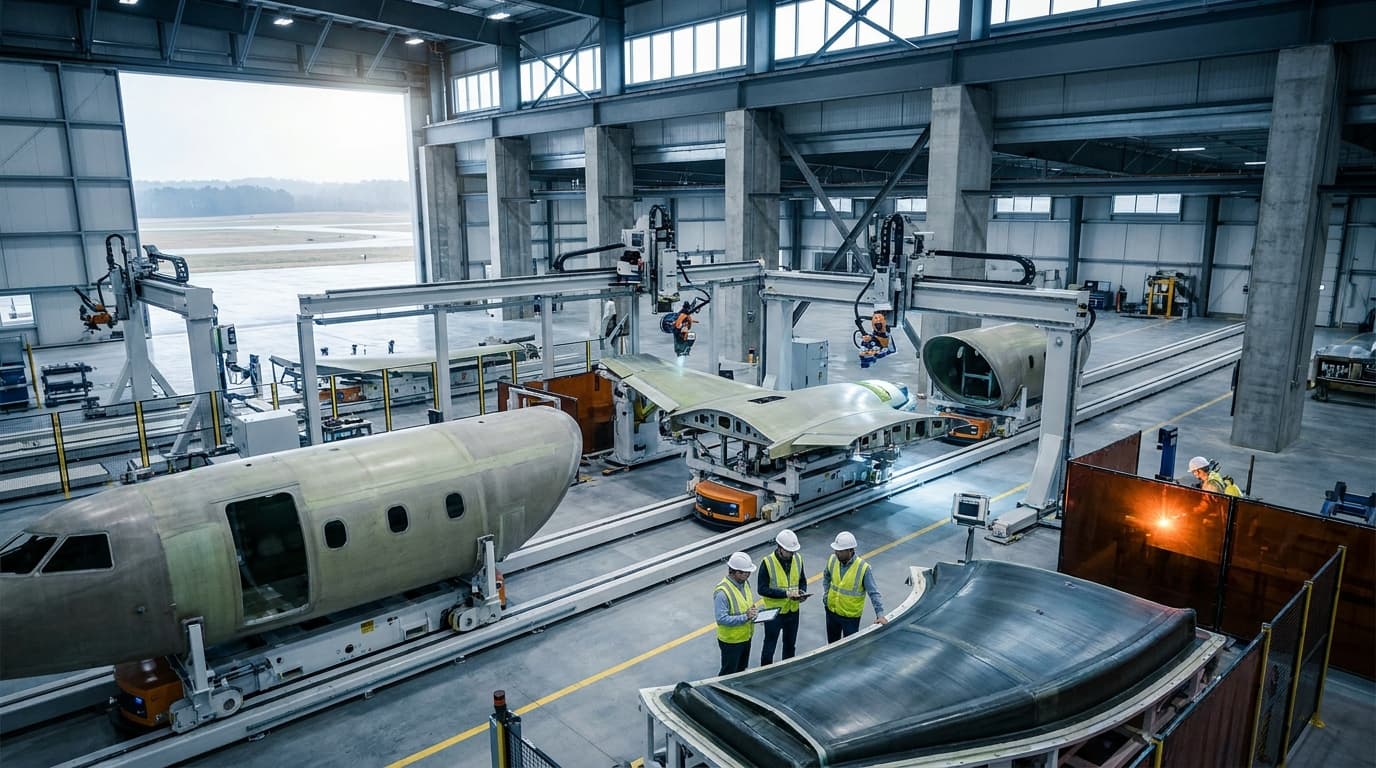
On June 15, 2026, JetZero broke ground at Piedmont Triad International Airport in Greensboro, North Carolina on a final-assembly plant of roughly 8 million square feet — about twice the footprint of Boeing's 4.28-million-sq-ft widebody plant in Everett, Washington. The numbers attached to the announcement are the kind states put on highway signs: a $4.7 billion investment and 14,564 jobs in Guilford County over the next decade, the largest job announcement in North Carolina history, underwritten by the largest state incentive package ever offered to a startup.
Strip away the aerodynamics and this is a manufacturing-industrialization story. A company that has not yet delivered a single revenue aircraft is committing to a plant larger than the building Boeing needed to build 747s and 777s, sized to turn out up to 20 of its Z4 airliners a month at full rate by the late 2030s. The bet is not whether the airplane can fly. It is whether JetZero can build the system that builds it.
The airplane: a shape the industry shelved
The Z4 is a 250-seat jet with a range of up to roughly 5,000 nautical miles, built around a blended-wing-body — an "all-wing" geometry in which the fuselage and wing merge into a single lifting surface. JetZero claims the configuration cuts fuel burn by up to 50% versus a conventional tube-and-wing aircraft of comparable mission. The promise is old: flying-wing concepts date to the 1950s and 60s, and the commercial industry repeatedly studied and shelved them. The reason was rarely aerodynamic. It was structural and economic — the configuration is hard to pressurize, hard to certify, and hard to build at rate.
Why the geometry is hard to build
A conventional airliner fuselage is a cylinder for a reason. A round pressure vessel carries cabin pressure as hoop stress, distributed evenly through the skin. A blended-wing body is not round, and that is the crux of the problem. As technical analysis of the configuration lays out, when a pressure vessel is box-like rather than cylindrical, hoop stresses become bending loads — and a NASA study found that effect can raise material stress by more than tenfold. The structure has to be engineered to absorb loads a tube simply does not see.
JetZero's answer is composites — specifically stitched, resin-infused composite structures rather than the fastener-drilled metal or laminate skins of legacy airframes. That is the right tool for a non-cylindrical pressure vessel, but it is also the part of the program with the least industrial precedent at this scale. Rate tooling, cure cycles, inspection, and repeatability for a structure this large and this geometrically unusual are exactly the variables that separate a flying demonstrator from a factory turning out 20 aircraft a month — and they feed directly into the certification basis.
The de-risking playbook
JetZero is not trying to reinvent everything at once, and its strategy reads as a deliberate effort to narrow the unknowns to the airframe itself. On the systems side, the company designs around certified, off-the-shelf engines and systems already in service, leaning on established aerospace suppliers so the program can stay inside today's certification and operating frameworks rather than blazing new regulatory trails for every component.
On the factory side, the plant is being built as a complete Siemens/Deloitte AI-driven digital twin before concrete is poured — a simulation of people, machine, and material flow intended to wring out production-line problems in software before they are cast in steel and rebar. For a company industrializing an unfamiliar airframe, modeling the line before building it is a hedge against the most expensive class of mistakes: the ones you discover after the building is up.
The execution risk
The schedule is where ambition meets the calendar. JetZero is targeting a full-scale demonstrator flight in 2027 — that aircraft is being built by Northrop Grumman's Scaled Composites and cleared a critical design review in May 2025 — followed by certification as early as 2029 and service entry in the early 2030s. Against that timeline sits the harder problem: a pre-revenue startup has to stand up a clean-sheet widebody supply chain and the rate-tooling to feed an 8-million-sq-ft line, from essentially zero, while ramping toward a 20-aircraft-per-month ambition.
That is the gap operators and investors should watch. Boeing and Airbus took decades and accumulated institutional muscle to reach widebody rate production. The demonstrator answers whether the airplane flies. It does not, by itself, prove the industrial system behind a 20-per-month run rate — supplier qualification, composite production repeatability, workforce, and the certification of a structure with no commercial predecessor.
Capital and demand backing
The program is not running on incentives alone. United Airlines has taken an equity stake in JetZero — a meaningful demand-side and credibility signal from a customer that would ultimately fly the aircraft. The company has also raised $175 million to push the demonstrator toward its 2027 first flight. North Carolina, for its part, projects the project will generate more than $250 billion in lift to the state economy over time.
Even so, the credibility questions are structural, not rhetorical. Equity from an airline and a record incentive package reduce financing risk; they do not retire industrialization risk. The capital buys time and runway. It does not compress the learning curve of building a non-cylindrical composite pressure vessel at rate.
The Triad labor question
For the Piedmont Triad, the immediate story is labor. Folding 14,500-plus aerospace jobs into a regional workforce over a decade is a large absorption under any conditions, and it lands on top of demand for skilled composites and aerospace manufacturing talent that the broader industry is already competing hard for. Alongside the assembly plant, JetZero is renovating a 108,000-sq-ft Greensboro building known as "The Hub" as its headquarters — work led by local firm Cline and targeted for early 2027 — even though the company is currently headquartered in Long Beach, California. The hiring ramp will test how quickly a regional pipeline can produce composites technicians and aerospace assemblers at volume.
Bottom line
The Z4's physics are, at this point, the settled part of the story. The open question for operators and investors is the industrialization timeline and the rate ramp: whether a pre-revenue company can build the supply chain, the tooling, and the workforce to fill 8 million square feet on schedule — and whether a non-cylindrical composite airframe can be certified and produced at the rate the business case requires. The groundbreaking proved JetZero can pour a foundation. The next several years will prove whether it can build a manufacturer. As the manufacturing-industrialization framing makes clear, that is the bet — not the airplane.
Related reading
-
[The Navy's Biggest Shipbuilder Is Now Printing Hull Parts: Newport News Commissions Wire-Arc Metal AM and Orders Four More Machines](/article/newport-news-shipbuilding-aml3d-arcemy-wire-arc-additive-manufacturing-fleet)
-
[Ultium's Recall Date Just Slipped to August: The EV Battery Layoff Wave Is the Reshoring Boom Running in Reverse](/article/ultium-recall-slips-august-ev-battery-layoff-wave-reshoring-reverse)
-
[The July 31 Pharma Tariff Cliff: $480B in Reshoring Pledges Can't Beat a Deadline That Hits Before a Single Plant Opens](/article/july-31-pharma-tariff-cliff-reshoring-deadline)
Sources
-
JetZero Breaks Ground on Z4 Factory in North Carolina — Aviation International News
-
JetZero breaks ground on factory 2X the size of Boeing Everett — Leeham News and Analysis
-
Governor Stein Celebrates JetZero Groundbreaking — NC Governor's Office
-
JetZero plans 14,500 jobs in Greensboro; $4.7B investment — Business North Carolina
-
JetZero breaks ground on Greensboro factory, reveals HQ plans — CompositesWorld
-
Bjorn's Corner: Blended Wing Body Airliners, Part 9 — Leeham News and Analysis
-
Startup JetZero to build $4.7B factory in North Carolina — Manufacturing Dive