Robot as a service cost usually runs about $8-15 per robot-hour in indicative third-party figures. Owning a $120k CNC tending cell costs roughly $3.0k-$3.5k a month over five years, counting financing and maintenance. That puts the break-even near $8.50-$10 an hour on two shifts and $17-$20 on one. Single-shift or uncertain work favors RaaS. Steady two-shift work favors owning.
Plant managers got two signals in the same week. At IMTS 2026, which ran Sept. 14-19 at McCormick Place in Chicago, exhibitors pitched preengineered machine-tending cells next to a robots-as-a-service (RaaS) demonstration. On Sept. 16 the Federal Open Market Committee voted 12-0 to raise the federal funds target range by a quarter point to 3.75-4.00%, and major banks lifted prime from 6.75% to 7.00% the next day. The question for anyone with a tending cell in next year's capex plan: does the rate hike tip the decision from buy to subscribe?
Our math says it barely matters. What decides it is how many hours the cell runs.
What exhibitors put on the floor at IMTS
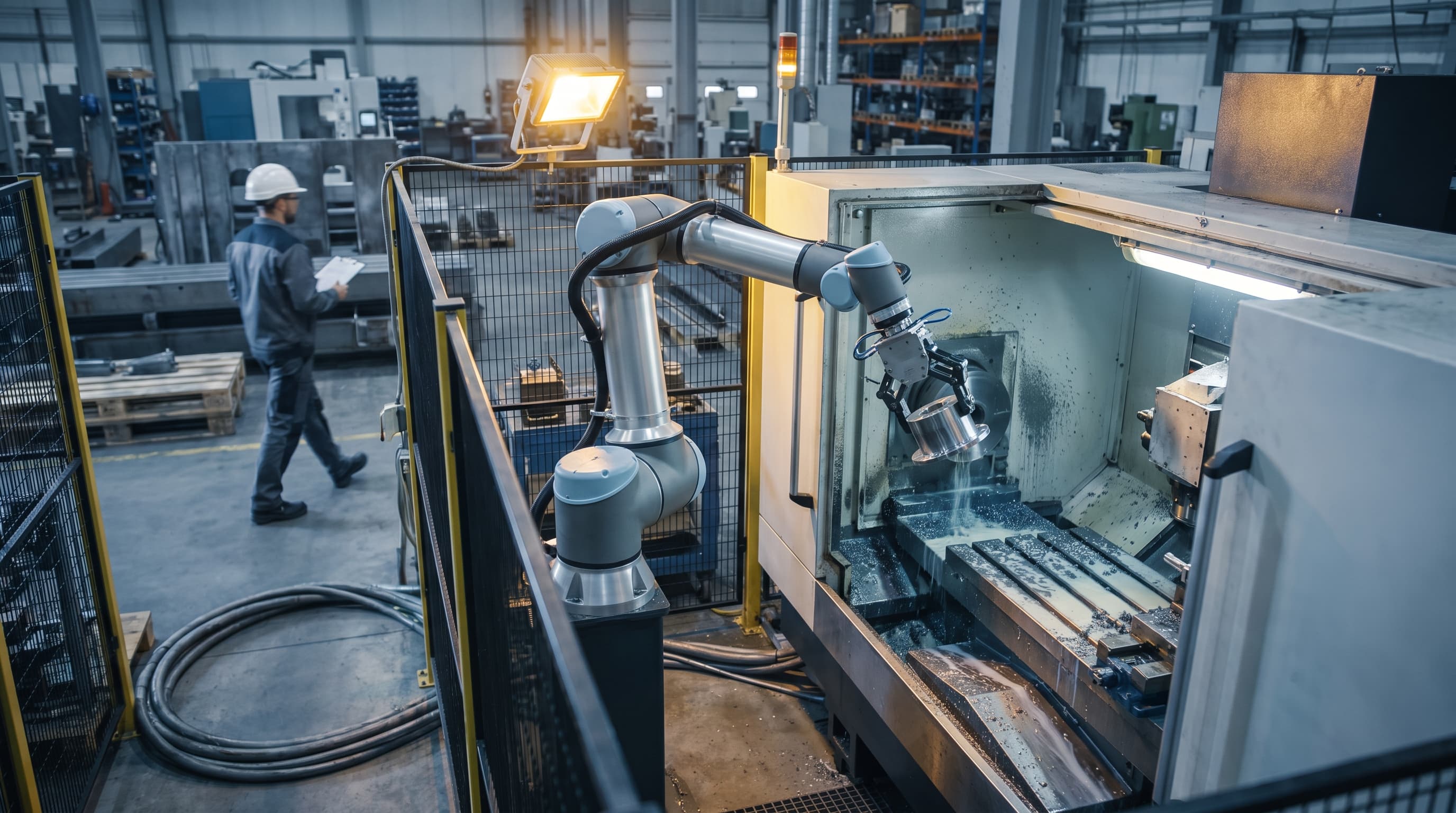
The automation story at this year's show was about deployment, not robot specs. Modern Machine Shop's IMTS automation guide listed several preengineered tending systems:
-
Mitsubishi Electric Automation showed LoadMate Plus, a single-machine cell aimed at long-term deployment, and ARIA, a compact, configurable system for mill and lathe tending.
-
KUKA showed tending cells paired with EMAG, Matsuura and Syil machines.
-
Fastems showed its modular FPS-S pallet system, which starts at one or two machines and expands into a linear flexible manufacturing system.
The financing angle came from KUKA and integrator Formic Automation. According to KUKA's show announcement, the two companies demonstrated a KR CYBERTECH robot tending an EMAG WPG 7 cylindrical grinder under Formic's RaaS model. KUKA pitched it as automation "without significant capital expenditure." These are exhibitor descriptions. ManufacturingMag did not test the systems.
What you pay for in each model
Owning the cell
AMD Machines, an integrator, puts an installed cobot tending cell at $90k-$150k, with typical payback of 14-22 months. Its figures assume 0.75-1.5 FTE displaced across shifts at a fully burdened $55k-$65k per operator per year, and put the robot arm at about 25-40% of total cell cost. AMD sells cells, so treat those payback figures as a vendor's best case.
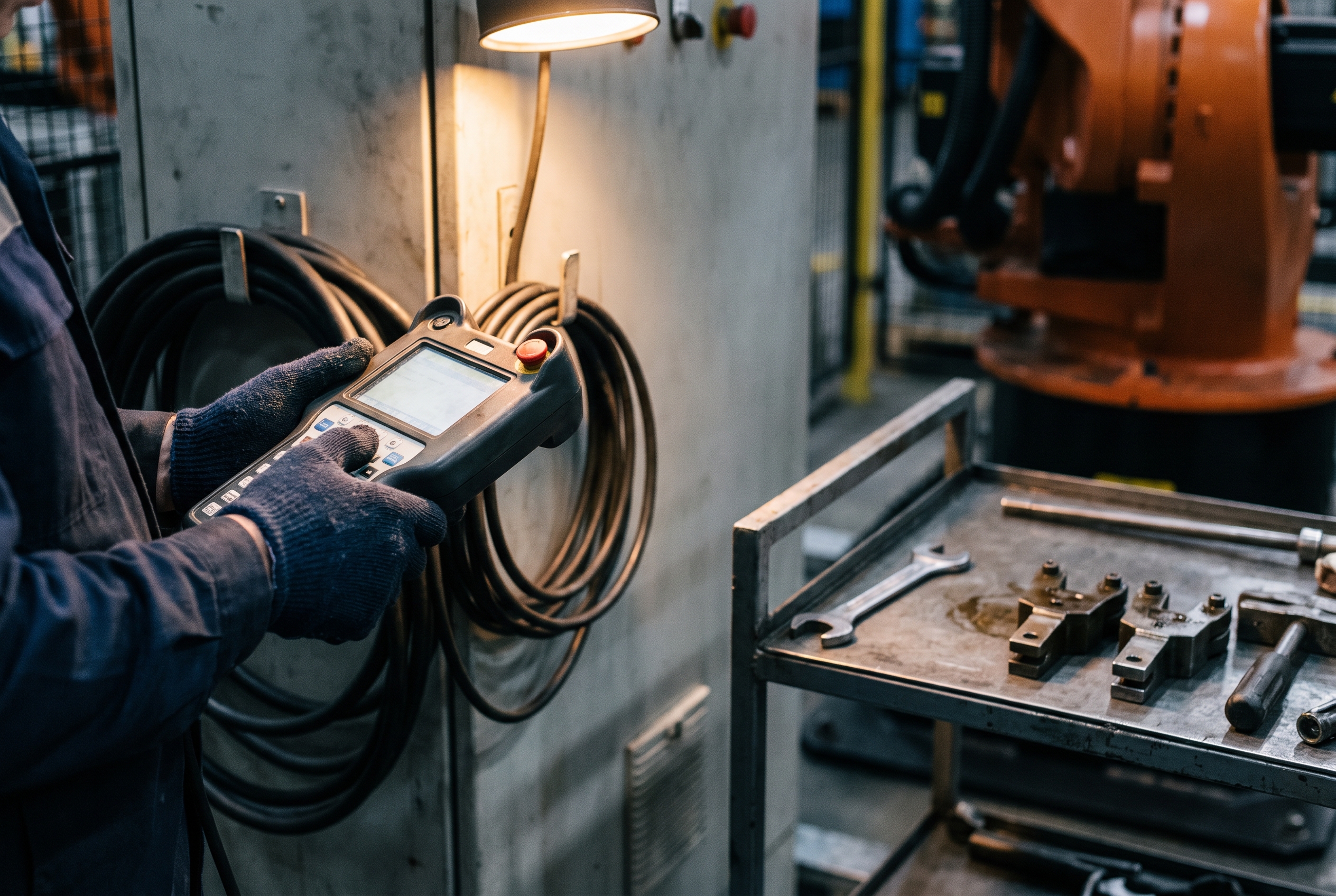
The purchase price is only the first cost. Formic, which sells the subscription alternative, lists the cost lines owners take on:
-
Safety analysis: up to $10k
-
Installation: $5k-$25k
-
Project management: $7.5k-$30k
-
Maintenance: 5-10% of project cost per year
-
Replacement parts: $2k-$20k per occurrence
-
Reprogramming: $5k-$25k per change
Formic's example workcell costs $150k. The company also says buying makes sense for highly customized systems that will be used 10 years or more, or where the manufacturer has in-house engineering. That is a fair concession from a company that makes money when customers do not buy.
Subscribing
Under RaaS, the provider owns the equipment and charges a recurring fee. Formic says its model bundles equipment, engineering, maintenance and 24/7 monitoring. When Formic launched in 2021, Robotics 24/7 reported that it charged an hourly rate with performance SLAs, backed by a $100M debt facility, with Formic carrying the financing risk.
That financing risk is the key point. Under RaaS the rate hike lands on the provider's balance sheet first. Whether it reaches your hourly rate depends on your contract's escalation terms.
A pricing caveat. Formic's own pages publish no rates. The figures that circulate, $8-15 or $8-24 per robot-hour, come from third-party aggregators that cite no source. The only other published tending price point we found is old: in 2021 Rapid Robotics priced its machine-tending subscription at "less than $2,100 per month." Treat every subscription figure in this article as an indicative range and get quotes before you model your own cell.
The five-year model
We built a simple comparison on the numbers above. These are our calculations, not vendor quotes.
| Assumption | Value | | --- | --- | | Installed cell cost | $120k (mid-range of AMD's $90k-$150k) | | Financing | 60-month equipment loan at prime + 2 points | | Rate before Sept. 17 | 8.75% (6.75% prime + 2) | | Rate after Sept. 17 | 9.00% (7.00% prime + 2) | | Maintenance | 5-10% of project cost per year (Formic's range) | | Two shifts | 16 hours x 22 days = 352 robot-hours per month | | One shift | 8 hours x 22 days = 176 robot-hours per month | | RaaS rate | $8-15 per robot-hour (indicative, unverified) |
The owned case leaves out residual value, tax effects and reprogramming. Labor savings are the same in both cases because the robot does the same work either way, so they drop out of a buy-versus-subscribe comparison. They still matter for whether to automate at all.
Result 1: the rate hike is a rounding error
| Loan rate | Monthly payment | Five-year total | Change vs. 8.75% | | --- | --- | --- | --- | | 8.75% (old prime + 2) | about $2,477 | about $148.6k | n/a | | 9.00% (new prime + 2) | about $2,491 | about $149.5k | about +$860 | | 9.75% (a further 75 bp) | about $2,535 | about $152.1k | about +$3.5k |
The Sept. 16 hike adds about $15 a month to a $120k tending cell loan, or about $860 over five years. Even a full percentage point adds only about $3.5k over the term. One unplanned spindle crash can cost more.
The Fed's forecast matters more than the hike itself, because it tells you not to count on a cheap refinancing. The September Summary of Economic Projections puts the median fed funds rate at 4.1% at the end of 2026 and 2027 and 3.9% in 2028, with a longer-run median of 3.2%. It projects PCE inflation at 3.7% in 2026, falling to 2.3% in 2027. Secondary coverage calls this the first hike since 2023. For a five-year equipment loan, assume roughly today's rate for most of the term.
Result 2: utilization decides it
Add $30k-$60k of maintenance over five years to about $149.5k of financed payments and the owned cell costs about $180k-$210k, or $3.0k-$3.5k a month. That cost is fixed whether the cell runs one shift or three.
The RaaS bill scales with hours:
| Scenario | Owned cell per month | RaaS at $8/hr | RaaS at $15/hr | Break-even RaaS rate | | --- | --- | --- | --- | --- | | One shift (176 hrs) | $3.0k-$3.5k | about $1.4k | about $2.6k | about $17-$20/hr | | Two shifts (352 hrs) | $3.0k-$3.5k | about $2.8k | about $5.3k | about $8.50-$10/hr |
At one shift, the whole indicative RaaS range comes in under the cost of ownership. At two shifts, the answer depends on the quote: a rate near $8 still beats owning, while a rate near $15 costs about $1.8k-$2.3k a month more. Going from one shift to two swings the subscription bill by thousands of dollars a month. The rate hike moved the owned cell by $15.
That also assumes the cell actually runs two full shifts, 22 days a month, for five years. If your volume forecast is shaky, the owned cell's fixed cost is what exposes you.
What else moves the break-even
-
Residual and redeploy value. An owned robot can be moved to another machine or sold after five years. The model gives it zero value, which understates the owner's case. Under RaaS, nothing comes back to you when the contract ends.
-
Tax timing. The One Big Beautiful Bill Act made 100% bonus depreciation permanent for qualified property acquired after Jan. 19, 2025. A CPA firm reports the 2026 Section 179 limit at $2.56M, with phaseout starting at $4.09M; confirm that with the IRS or your tax adviser. Either way, this is mostly a timing benefit. Subscription fees are deductible operating expenses too, so the owner gets the deduction sooner, not a larger one.
-
Changeover frequency. At $5k-$25k per reprogramming change, a high-mix shop that retools a cell several times a year can wipe out the owner's advantage. Find out whether your RaaS contract covers redeployment or bills it separately.
-
Downtime exposure. An owner carries the full cost of a failed cell. A RaaS contract with a real uptime SLA moves some of that risk to the provider. To put a number on the risk, use our downtime cost calculator, which separates lost contribution from recovery costs.
-
Contract minimums and exit terms. An hourly rate with a monthly minimum at two-shift volume is effectively a fixed cost, which erases RaaS's main advantage on uncertain work.
Decision rules
Subscribe when:
-
The cell will run one shift, or volume is uncertain.
-
You have no in-house robot programming or maintenance skills.
-
You want to prove out a part family before committing capex.
-
The job mix changes often enough that reprogramming costs add up.
Buy when:
-
The work is stable and runs two or more shifts, or lights-out.
-
You have internal engineering to program and maintain the cell.
-
Your planning horizon is five years or longer (Formic itself points to 10 or more years for customized systems).
-
You can capture residual or redeploy value at the end.
Consider a hybrid: run a pilot on RaaS, and buy once hours and cycle times are proven, provided the contract includes a buyout option that credits some of the fees you have already paid.
Questions to ask a RaaS vendor
-
What does "uptime guarantee" mean in the contract? Measured how, over what period, and with what credit if they miss it?
-
Who pays for reprogramming when a part or machine changes?
-
Is there an escalation clause tied to interest rates, inflation or labor costs?
-
Is there a buyout option, and how is the price calculated?
-
What is the minimum term, and what does early exit cost?
-
How are hours metered? Spindle time, robot power-on time or scheduled shift time? Is there a monthly minimum?
Get quotes from at least two providers and plug them into the model above against your real shift pattern. The hourly rate matters, but the minimum and metering terms often decide which option costs less.
Related reading
-
Why Did Factory Output Slip in August After Seven Straight Gains?
-
Lease or Buy the Next CNC Machine After the Fed's Rate Hike?
Sources
-
Federal Reserve: Summary of Economic Projections, Sept. 16, 2026
-
RoboticsTomorrow: KUKA showcases scalable machine tending robotics at IMTS 2026
-
Modern Machine Shop: IMTS 2026 automation and robotics guide
-
IRS: Guidance on additional first-year depreciation under OBBB
-
Reed Corporation CPA: 2026 Section 179 and bonus depreciation