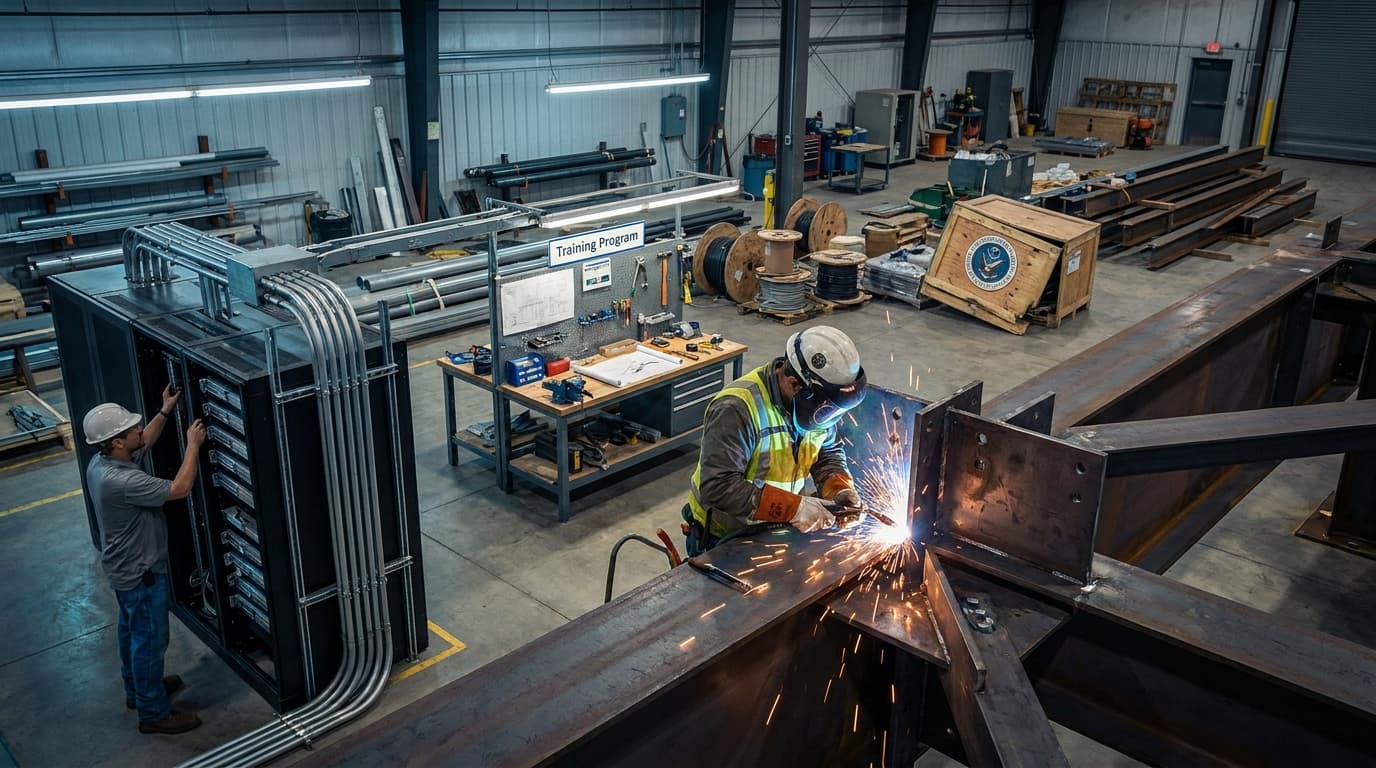
In June 2026, Meta did something no manufacturer, utility, or construction firm has done at this scale: it put $115 million behind the electricians, welders, and pipefitters it needs, and attached a job guarantee to the offer. The company calls its new America's Workforce Academy (AWA) the largest private-sector commitment to the skilled trades with a guaranteed job in U.S. history. The claim is defensible. The timing is the story.
AWA launched the same quarter federal workforce money is being pulled in two directions at once — a new Pell Grant channel opening to short-term training programs on July 1, even as advocates warn that a broader budget consolidation would strip roughly $1.64 billion out of core training funding. The result is a split screen that should concentrate the mind of any operator who staffs a plant: the single richest private bet on the trades in memory, landing precisely as the public pipeline that supplies everyone else's floor wobbles.
What Meta actually launched
The mechanics are aggressive. AWA is free to participants and covers tuition, airfare, lodging, and a daily stipend across a training program that runs roughly five weeks. Every graduate is guaranteed a job. Entrants need no prior experience, and the program is open to applicants from all 50 states, per Meta's launch details.
The credential design is the part operators should read closely. Graduates earn an industry-recognized NCCER credential — from the National Center for Construction Education and Research — plus an "America's Workforce Certificate," both engineered to travel across employers rather than lock a worker to Meta. On paper, that makes AWA a supply-side investment in the labor pool broadly, not just a captive hiring funnel.
AWA is not a cold start. It scales Meta's earlier LevelUp fiber-technician pipeline, which drew 35,000 applications in seven days — a demand signal strong enough to justify widening the aperture from a single trade to welders, electricians, plumbers, mechanics, and others. The pilot runs in four states: Louisiana, Ohio, Indiana, and Texas.
The geography tell
Those four states are not a random footprint. They map onto Meta's data-center and AI-infrastructure capex. As Fortune reported, the academy is explicitly tied to the labor bottleneck stalling Meta's AI build-out — the company needs the tradespeople to pour the concrete, pull the wire, and run the mechanical systems for facilities that don't get built without them.
Read plainly, this is a hyperscaler financing the trades its own construction pipeline consumes. When a data center's critical path runs through a shortage of licensed electricians, training electricians stops being philanthropy and becomes procurement. The job guarantee is credible in part because the demand is Meta's own.
The structural gap that made this rational
The numbers behind the decision are stark. Roughly 600,000 skilled-trade jobs were posted while only about 150,000 new workers entered through apprenticeship programs — a four-to-one gap between openings and fresh supply, according to data compiled on the 2026 outlook. The U.S. Department of Education cites a 5-to-2 retirement-to-replacement ratio for construction and manufacturing trades: for every five workers aging out, roughly two enter.
The Bureau of Labor Statistics puts total annual openings across construction and extraction occupations at about 649,300 per year. And JLL estimates the trades shortage threatens up to roughly $1 trillion in economic losses. For a company whose AI ambitions are gated by how fast it can physically build, those figures reframe $115 million as a rounding error against the cost of a stalled buildout.
Washington's split screen
Here is where the private bet and the public policy diverge inside a single month. On one side, the federal government just widened access to exactly the kind of short, fast training AWA represents. Workforce Pell Grants took effect July 1, 2026 (with the final rule effective July 20 and early implementation permitted from July 1), extending Pell eligibility to short-term programs. Per the Congressional Research Service, those programs run 150 to 599 clock hours, completable in 8 to 15 weeks, and must clear 70% completion and 70% job-placement thresholds to qualify. That is a direct federal subsidy for the compressed, outcomes-tested model Meta is now running privately.
On the other side, the National Skills Coalition warns the FY2026 budget cuts the ground out from under the broader system. In its analysis, "Cuts Disguised as Reform," the NSC argues the "Make America Skilled Again" (MASA) block grant would consolidate 11 workforce programs while cutting overall funding by roughly $1.64 billion — about 29% of WIOA Title I — and would eliminate Job Corps, the Senior Community Service Employment Program, and WIOA Title II adult education. The underlying budget figures trace to the Department of Labor's FY2026 Budget in Brief.
There is a public counterweight, but it is modest against the scale of the gap. In January 2026, the Department of Labor announced a $145 million pay-for-performance apprenticeship investment aimed at reaching one million active apprentices. Set beside a 600,000-versus-150,000 shortfall, $145 million is a down payment, not a fix.
The operator angle
Strip away the announcement gloss and a harder question surfaces. When a single company can out-fund the marginal public training dollar — offering free tuition, paid housing, a stipend, and a guaranteed job — who staffs the plants that aren't building AI data centers?
The trades labor pool is not infinite. Every welder AWA trains and hires is a welder a food-processing line, a shipyard, or a regional HVAC contractor did not get. That is fine, even good, if AWA's portable NCCER credentials genuinely expand the total supply rather than reshuffle it toward the highest bidder. It is a problem if the public pipeline that feeds the non-hyperscaler economy is thinning at the same moment the richest private buyer enters the market. The MASA cuts, if enacted, would thin exactly that pipeline — the training infrastructure that serves employers without a $115 million line item.
Open questions
Several caveats deserve to stay on the table. First, guarantee durability: a job guarantee is only as strong as its wage floor and its horizon, neither of which the launch materials fully specify. Second, portability: NCCER credentials are genuinely recognized across the construction industry, but whether the "America's Workforce Certificate" travels as advertised is an empirical question that graduates will answer over the next few years. Third, MASA's status: budget proposals are not appropriations law, and the $1.64 billion cut the NSC describes is a warning about a proposal, not a settled outcome. Fourth, scale: the DOL's $145 million apprenticeship push and Meta's $115 million academy are meaningful signals, but both are small against a posted-openings gap measured in the hundreds of thousands.
What is not in doubt is the direction of the money. A hyperscaler is now financing the electricians and pipefitters its AI factories depend on, with the largest private trades commitment on record. The open question for the rest of American manufacturing is whether the public system will still be there to staff the plants that aren't Meta's.
Related reading
-
[Humanoids Hit Wall Street the Easy Way: Agility's $2.5B SPAC Skips the Roadshow — and Foxconn's $200M PIPE Is the Real Vote](/article/agility-robotics-churchill-spac-foxconn-pipe-humanoid-public)
-
[The '25% Tax on Robots': How Section 232's June Machinery Rules Hit the Imported Machine Tools Factories Need to Automate](/article/section-232-june-2026-machinery-tariffs-imported-automation-reshoring-paradox)
-
[The Pentagon's Additive Budget Jumped 83% to $3.3B — and Velo3D's $9.8M DLA Contract Is the Tell](/article/pentagon-additive-budget-83-percent-velo3d-dla-contract)
Sources
-
America's Workforce Academy: The Future Is for Everyone (Meta)
-
Meta commits $115 million to solve the skilled-trades shortage stalling its AI build-out (Fortune)
-
Meta launches $115M skilled trades academy with guaranteed jobs (Fox Business)
-
U.S. Department of Education Final Rule on Workforce Pell Grants
-
Workforce Pell Grants (Congressional Research Service, IF13253)
-
Critical skilled trades shortage threatens $1T in economic losses (JLL)
-
Skilled Trades Shortage 2026: BLS Data and Openings Outlook (TradeColleges.org)