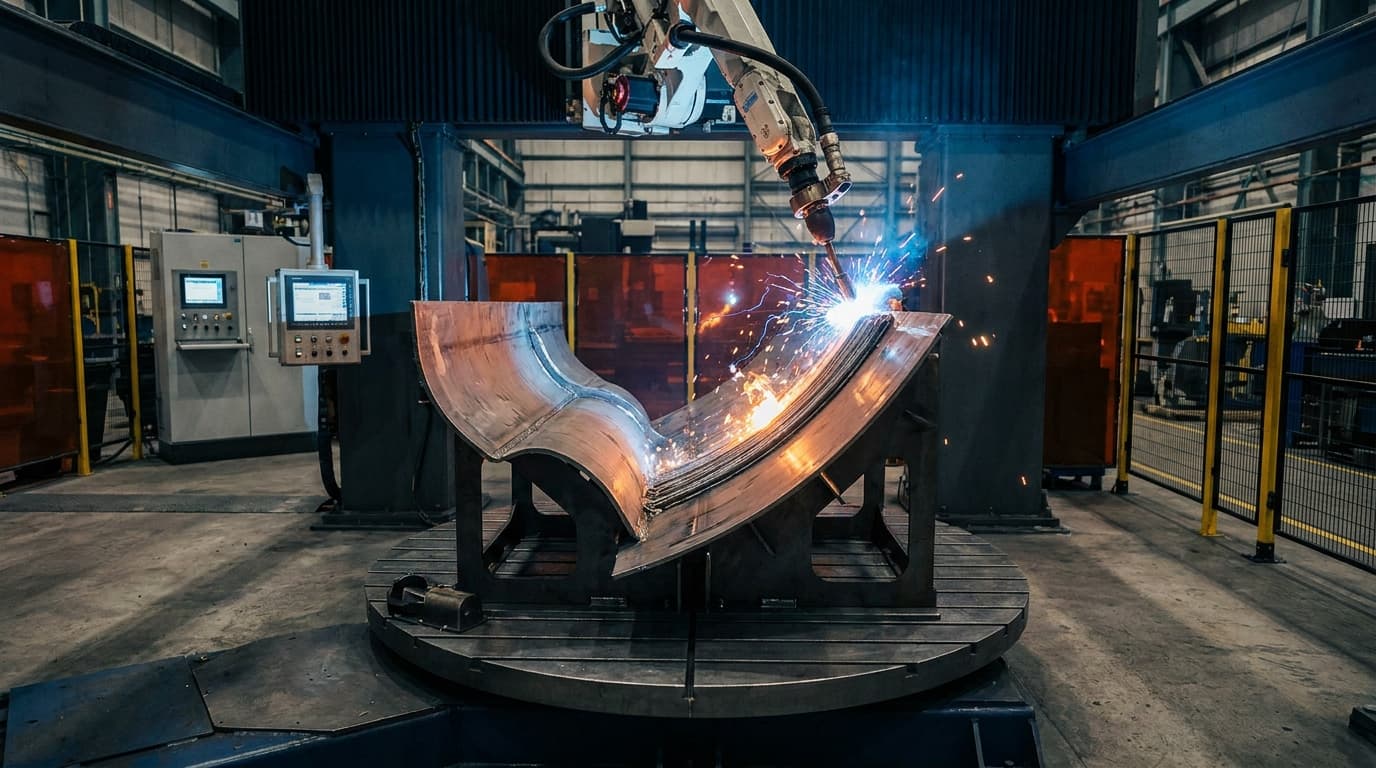
The sole U.S. builder of nuclear aircraft carriers is now making ship parts the same way a desktop printer lays down plastic — except in steel, copper and titanium, one weld bead at a time. Newport News Shipbuilding (NNS), the HII division that constructs the Navy's carriers and roughly half its submarines, has commissioned its first two custom [ARCEMY X wire-arc metal additive manufacturing systems](https://www.voxelmatters.com/aml3d-delivers-two-arcemy-x-printers-to-newport-news-shipbuilding/) from Australian supplier AML3D (ASX:AL3), and has placed a follow-on order for four more. The plan is a six-machine in-house fleet for, in NNS's framing, "ship component fabrication and replacement."
For a yard that sits at the most exacting end of the U.S. maritime industrial base, that is a meaningful signal: large-scale metal additive manufacturing is moving from prototype curiosity toward production tooling inside the Navy's supply chain. But the detail underneath the headline matters — including the dollar figures, which are easy to read wrong.
The deal, precisely
This is two orders, not one. The initial purchase — two custom ARCEMY X systems — was announced around 20 October 2025 at roughly A$4.5 million (about US$2.9 million). Those two machines have now been commissioned and completed, a milestone that triggered a final payment of about A$0.89 million (~US$0.9 million).
The follow-on, announced around 17 March 2026, covers four additional ARCEMY X 6700 systems for approximately A$9.9 million (~US$7.0 million), expected installed and operational in Q3 of FY2027. Combined, the six-machine fleet runs to roughly A$14.4 million.
A currency caveat operators should not gloss over: the eye-catching "$9.9M order" and "$14.4M fleet" figures are Australian dollars. AML3D's own coverage and parts of the press use both A$ and US$ symbols, and the A$9.9M and US$9.9M numbers are trivially easy to conflate. In U.S. dollars, the four-machine follow-on is about US$7.0 million, and the full six-machine fleet totals roughly US$9.9 million. So the "$9.9M" you may see attached to a single order and the "$9.9M" attached to the whole fleet are not the same number in the same currency — one is AUD for four machines, the other is USD for six.
What the machine actually is
ARCEMY is AML3D's robotic wire-arc additive manufacturing platform — wire-arc AM, also called wire-DED (directed energy deposition). Instead of fusing powder in a sealed chamber, it runs in open air, feeding metal wire into an arc and depositing it bead by bead under robotic control. The platform prints aluminum, copper, stainless steel, nickel and titanium alloys, which is most of the alloy menu a shipyard cares about.
The NNS units are customized for heavy work. The first pair carries a roughly 10,886 kg positioner; the four follow-on ARCEMY X 6700 systems are cited with an approximately 11,000 kg positioner — the rotating fixture that holds and manipulates the part during the build. That capacity is the tell: these are sized for large, heavy near-net-shape components, not bench-scale demonstrators. The systems are sourced from AML3D's technology centre in Stow, Ohio.
Why a shipyard wants open-air metal printing
Wire-arc AM's economic argument is about the critical path, not surface finish. Its natural targets are large near-net-shape parts and long-lead replacement components — the kind of items conventionally sand-cast or forged, where the bottleneck is foundry queue time and tooling rather than machining hours. AML3D's stated value proposition is reducing lead times and material waste and offering an alternative to conventional casting and forging, with parts it claims "meet or exceed traditional manufacturing standards."
What it plausibly displaces: heavy, geometrically simple-to-moderate components where buying a casting means waiting in a constrained supplier's line. What it does not displace: high-precision machined parts, anything requiring tight metallurgical pedigree that AM has not yet qualified for, and small-batch items where conventional methods are already fast and cheap. Wire-arc deposition produces a rough preform that still needs machining to final tolerance — it shortens the front of the supply chain, not the whole of it.
The qualification reality
Here is the line operators and investors should hold onto: capability installed is not the same as qualified parts in hulls. For Navy and defense work, part qualification is the gating hurdle for additive manufacturing — the engineering, testing and certification path that lets an AM component carry the same trust as a forged or cast one. The NNS announcements describe a broad application — "a variety of shipbuilding applications, including ship component fabrication and replacement" — but do not publicly disclose specific qualified parts, named submarine or carrier programs, or the qualification specifics behind the "meet or exceed" claim.
So the honest read of this deal is that NNS is buying production capacity and the option to qualify parts on it over time — a deliberate, multi-machine bet — rather than announcing a catalog of additively printed components already going into ships. The fleet is the infrastructure; the qualified parts are the work still ahead.
Backlog context — and a separate data point
The strategic logic only makes sense against the strain in the submarine and carrier component supply chain, where multi-year lead times for large castings and forgings are a recurring theme in Navy and oversight reporting. That "years-long lead time" framing is genuine industry context, but it is not a figure stated in these AML3D or NNS announcements — readers should treat lead-time numbers as independently sourced industrial-base context, not as a claim made by either company here.
One concrete, if separate, indicator of momentum: AML3D is also producing five replacement components for U.S. submarine trials under a roughly US$1.8 million contract with BlueForge Alliance, the nonprofit stood up to strengthen the submarine industrial base. That is a distinct contract from the NNS machine orders, but it shows the same wire-arc technology already moving toward trial parts in the submarine pipeline.
Scale and signal
By AML3D's accounting, the two commissioned NNS units were the 9th and 10th ARCEMY systems deployed in support of the U.S. Navy maritime industrial base, and the 2nd and 3rd heavy-capacity units. The company operates its Stow, Ohio technology centre and has signaled roughly US$12 million of investment to expand U.S. production capacity — a domestic-footprint move that matters for a defense customer wary of foreign-sourced industrial tooling.
A six-machine fleet concentrated at a single yard is a different statement than a one-off pilot. It implies NNS expects enough recurring demand — replacement parts, near-net-shape preforms, obsolescence fills — to keep multiple printers utilized, and that additive is crossing from the prototype shop into something closer to a standing production line.
Bottom line — what to watch
The capability is real and the commitment is non-trivial, but the payoff metrics are still ahead. Three things will tell you whether this is a genuine supply-chain unlock or an expensive option: first, the arrival of named, qualified production parts going into actual hulls; second, throughput — whether six machines can produce at a rate that matters against component demand; and third, whether print-on-demand measurably dents the casting and forging backlog rather than nibbling at its edges. Until then, the accurate headline is the modest one: the Navy's biggest shipbuilder has installed serious metal-AM capacity and is betting it can qualify its way into the critical path.
Related reading
-
[Ultium's Recall Date Just Slipped to August: The EV Battery Layoff Wave Is the Reshoring Boom Running in Reverse](/article/ultium-recall-slips-august-ev-battery-layoff-wave-reshoring-reverse)
-
[The July 31 Pharma Tariff Cliff: $480B in Reshoring Pledges Can't Beat a Deadline That Hits Before a Single Plant Opens](/article/july-31-pharma-tariff-cliff-reshoring-deadline)
-
[Agentic AI's 6%-to-24% Jump on the Factory Floor: Terex's 40 Plants Are the Yield Proof Operators Are Watching in 2026](/article/agentic-ai-factory-floor-terex-yield-proof-2026)
Sources
-
AML3D delivers two ARCEMY X printers to Newport News Shipbuilding — VoxelMatters
-
AML3D receives ARCEMY X order from HII / NNS — AML3D (official announcement)
-
AML3D receives $7 million ARCEMY X order from HII's Newport News Shipbuilding — VoxelMatters
-
Newport News orders two 3D printing systems from AML3D — WorkBoat
-
HII's Newport News Shipbuilding Buys 3D Printing from AML3D — The Maritime Executive
This article contains AI-assisted content and has been reviewed in our editorial workflow.