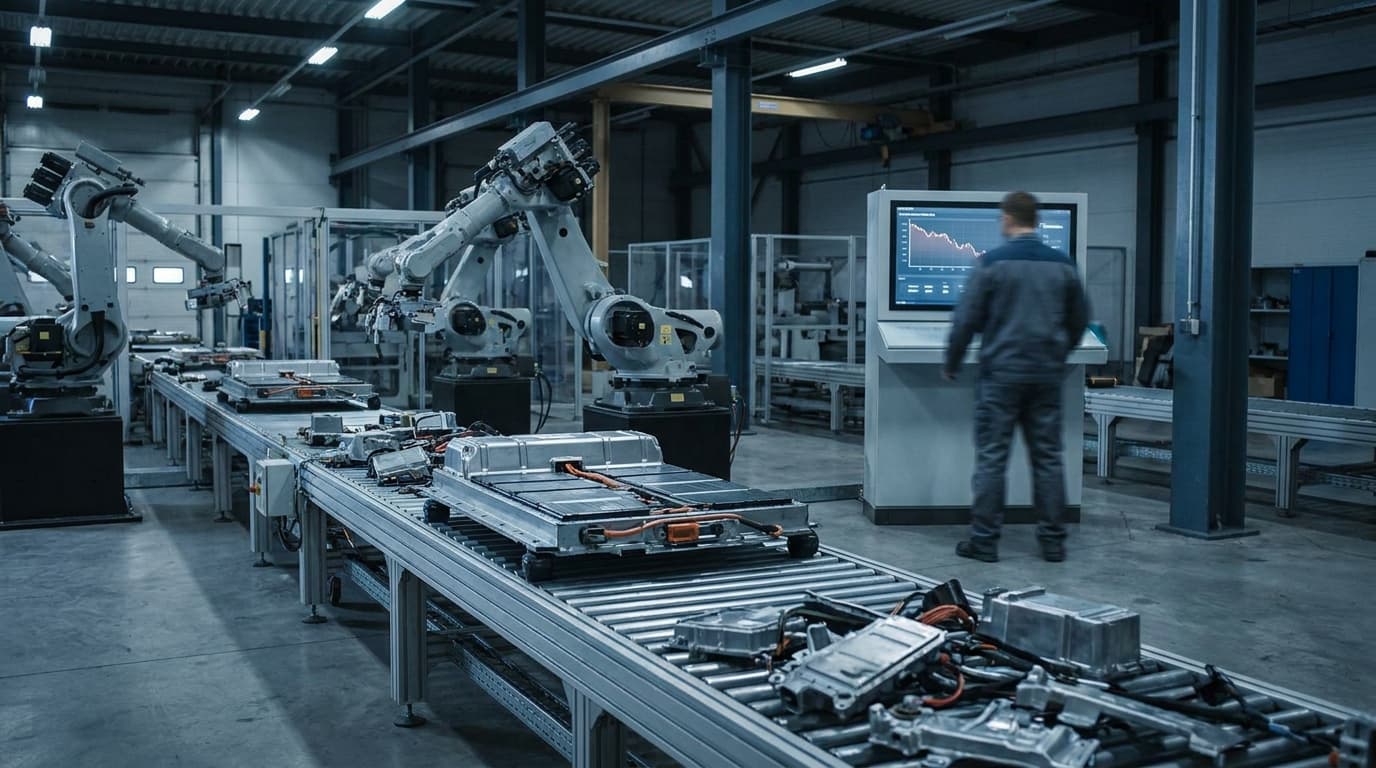
Read the U.S. industrial investment map two ways and you get two opposite stories. In one, roughly $1.765 trillion in announced private manufacturing investment — led by about $1.2 trillion in semiconductors and advanced tech — is landing on American soil, with TSMC alone raising its U.S. commitment to $265 billion. In the other, the same automakers who three years ago were racing to build electric-vehicle capacity are now writing it down by the tens of billions. Same map, opposite direction.
By early 2026, the industry had absorbed at least $65 billion in combined EV losses and writedowns — a partial unwind of the more than $330 billion in EV and battery investment announced between 2021 and 2024. For operators, the reshoring narrative and the EV retreat are not contradictions. They are the same story about aligning capacity to demand, told on two different products.
Honda's $15.7 billion reversal
The headline number belongs to Honda. The company cancelled its entire North American battery-electric program — the Honda 0 SUV, the Honda 0 Saloon, and the Acura RSX — and now expects losses of up to ¥2.5 trillion, roughly $15.7 billion. That charge is heavy enough to push Honda to its first net loss since it went public in 1957, with weak U.S. demand and tariff pressure cited as the drivers.
Honda is not exiting electrification so much as re-sequencing it. Capacity earmarked for its Ohio EV push is being redirected toward gasoline and hybrid production, and the company is pointing at 15 new hybrid models worldwide by 2030. The bet is that a hybrid buildout monetizes existing powertrain investment on a demand curve that actually exists today, while the pure-EV program waited on one that has receded.
The domino chain
Honda's retreat is the loudest, but it is not isolated. In December 2025, Ford disclosed a $19.5 billion special charge — including an approximately $8.5 billion write-down of Model E assets — cancelled three planned EVs, and ended production of the current all-electric F-150 Lightning. Ford's forward plan reframes the Lightning as a second-generation extended-range electric vehicle (EREV) with a gasoline range-extender, and targets 50% hybrid and EREV of global sales by 2030. The rationalization charges are detailed in the company's FY2025 Form 10-K.
Upstream, the cell-manufacturing footprint is contracting in step with the vehicles. GM and Samsung SDI paused construction of their $3.5 billion joint-venture battery cell plant in New Carlisle, Indiana — a 36 GWh facility slated for roughly 1,600 jobs — explicitly to "align production capacity with current demand." Construction layoffs at the site began in October 2025.
The charges scale accordingly. GM recorded roughly $7.9 billion in total GMNA charges for FY2025 tied to its EV pullback and warned of additional charges in 2026. Stellantis booked a still larger EV-related writedown of roughly $27 billion. Add Honda and Ford, and the industry-wide total clears $65 billion. By one count, more U.S. EV plants were cancelled in the first quarter of 2025 than in 2023 and 2024 combined.
The demand cliff
The proximate cause is not a technology failure. It is a demand cliff engineered by policy. U.S. retail EV share is on track for about 6.6% of December 2025 sales, down from 11.2% a year earlier — a roughly 4.6-point drop in twelve months. Independent tracking from Cox Automotive corroborates the post-credit-expiration collapse.
The mechanism was a pull-ahead spike followed by a hangover. The $7,500 federal clean-vehicle credit expired on September 30, 2025, so buyers who wanted the subsidy compressed their purchases into the third quarter. When the credit lapsed, the demand that had been borrowed from the future simply did not show up. Automakers who had sized plants against a subsidized adoption curve were left holding capacity against an unsubsidized one.
Policy mechanics: 30D repeal versus 45X restriction
The relevant statute is the One Big Beautiful Bill Act, the FY2025 reconciliation law. Per the Congressional Research Service, it repealed the 30D, 25E, and 45W clean-vehicle credits for vehicles acquired after September 30, 2025 — roughly seven years ahead of the schedule set under the Inflation Reduction Act.
The distinction that matters for manufacturers is that the law hit the demand side harder than the supply side. As the Center for Climate and Energy Solutions explains, the consumer-facing 30D credit was repealed outright, while the 45X advanced-manufacturing production credit for battery cells was restricted rather than fully eliminated. In other words: the incentive to buy an EV largely vanished, but the incentive to build cells domestically was trimmed, not erased. That asymmetry is the whole operator problem. You can still earn a production credit on cells you can no longer sell into vehicles at the prior volume.
The operator story: stranded gigafactories look for a new offtake
Faced with cell lines sized for vehicle demand that evaporated, the operator playbook is repurposing rather than mothballing. Ford launched Ford Energy to build U.S.-made grid-scale battery energy storage systems (BESS) at a repurposed Kentucky plant, targeting 20 GWh per year by 2027. It is not alone: analysts at S&P Global Mobility describe LG Energy Solution, SK On, and Samsung SDI reallocating stranded EV-cell capacity toward stationary energy storage.
The logic is that a cell is a cell. Lines built for automotive packs can, with rework, feed grid-scale storage — and grid storage has a fast-growing new customer in AI data centers, whose power demand is arriving faster than new generation. Whether that offtake fully absorbs the stranded automotive footprint is the open question, but it converts an idled asset into a served market instead of a write-down.
The counterweight
Not every battery line is going dark. In July 2026, Hyundai Motor Group and SK On began production at their $5 billion, 35 GWh battery plant in Bartow County, Georgia — Hyundai-SK Battery Manufacturing America — supplying the Hyundai Metaplant in Savannah. One plant switching on while others idle is not a contradiction; it is what capacity discipline looks like in practice. Vertically integrated capacity feeding a specific, committed vehicle program comes online, while speculative capacity built against a broad subsidized curve waits or repurposes.
That is the reconciliation with the reshoring boom. The $1.765 trillion in tracked commitments — concentrated in semiconductors and advanced tech — is flowing toward products with durable, policy-backed demand. The EV powertrain buildout is contracting because its demand signal was rewritten mid-construction. Both are the same discipline: build where the offtake is real.
Outlook
The near-term picture is overcapacity in automotive cells, a wave of consolidation, and a scramble to redirect gigafactory output toward grid storage before idle lines become permanent write-offs. The tell to watch is whether BESS and data-center demand grow fast enough to absorb the stranded EV battery footprint — and whether hybrid and EREV programs give automakers a bridge that pays for the powertrain investment they cannot yet monetize as pure EVs. The reshoring story and the EV retreat will keep sharing the same industrial map. The question for 2026 is how much of the idled battery capacity finds a second life pointed at the grid.
Related reading
-
TSMC Doubles Down on Arizona to $265B — Four More 2nm-and-Below Fabs, Bankrolled by a Record Quarter
-
Hyundai and SK Just Switched On a $5B Battery Plant in Georgia — as Rivals Mothball Theirs
-
How to Answer a 30% Price-Down Letter Without Losing the Program
Sources
-
[Honda scraps $15.7bn EV future: Ohio smart-factory pivot — Automotive Manufacturing Solutions](https://www.automotivemanufacturingsolutions.com/strategy/honda-scraps-its-ev-future-in-157bn-retreat/2630846)
-
Honda halts North American EV plans amid weak demand and US tariff pressures — Fastmarkets
-
Ford to record $19.5 billion in special charges as it pulls back on EV plans — CNBC
-
Ford stops production of the all-electric F-150 Lightning, turns to hybrids — NPR
-
GM pauses $3.5B Indiana EV battery plant in latest electrification pullback — DealershipGuy
-
Construction layoffs hit GM-Samsung EV battery project in Indiana — Detroit News
-
What is Behind the $65bn Slump in the Global EV Market? — EV Magazine
-
EV, Battery Plants Being Canceled — National Association of Manufacturers
-
IRA Tax Credit Repeal in the FY2025 Reconciliation Law: Part 2 — Congressional Research Service
-
The 30D & 45X Tax Credits Explained — Center for Climate and Energy Solutions
-
[Ford Energy launches US-made grid-scale battery storage from repurposed Kentucky plant — Automotive Manufacturing Solutions](https://www.automotivemanufacturingsolutions.com/electrification/ford-launches-ford-energy-for-gridscale-bess/2662378)
-
EV Slowdown Drives Shift to Energy Storage Systems — S&P Global Mobility