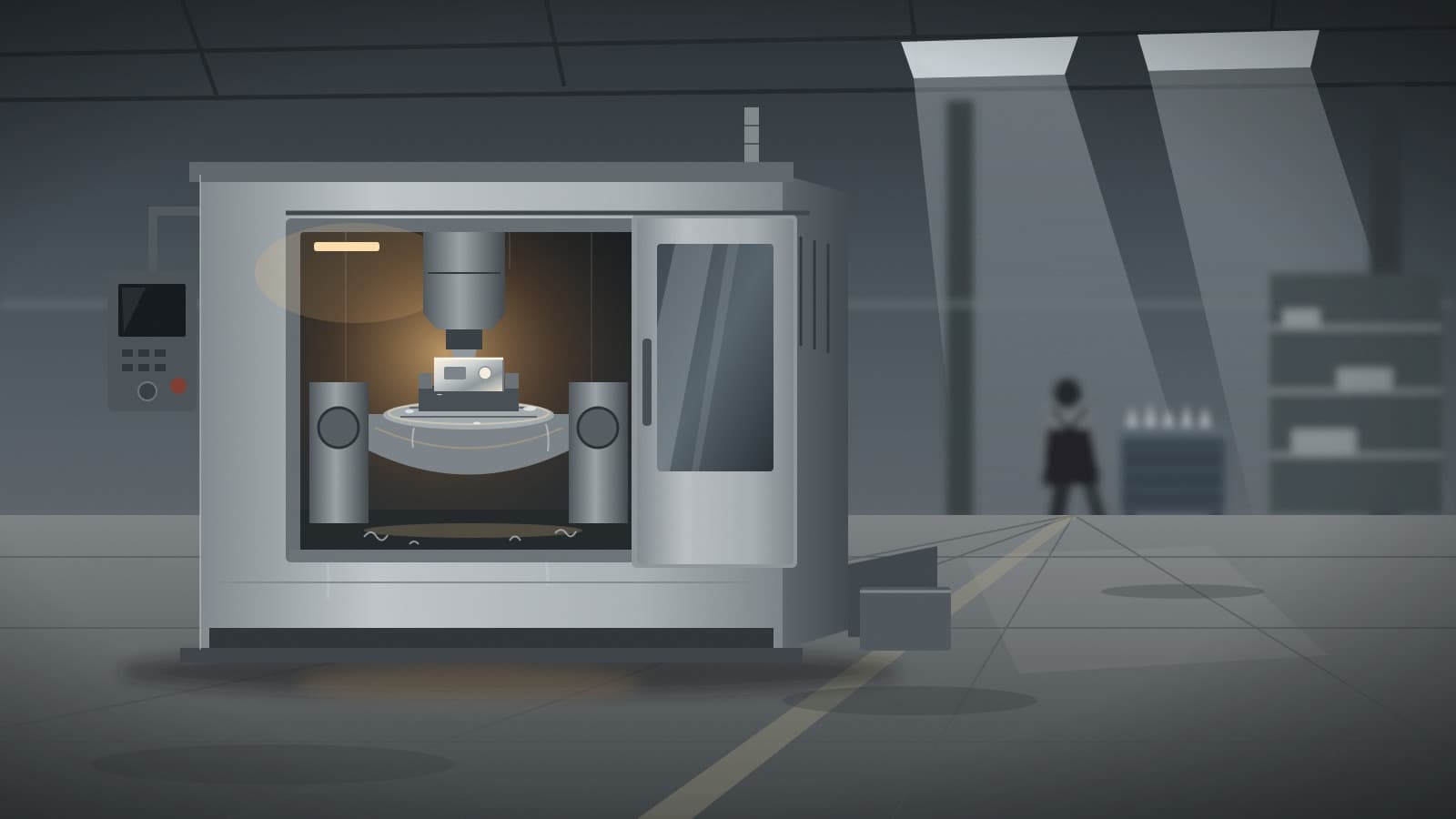
In the lease vs buy machine tool decision for 2026, buying (or using a $1-buyout lease) usually wins if the shop has enough taxable income to use Section 179 or 100% bonus depreciation and steady five-axis work to keep the spindle busy. A fair-market-value lease fits better when hours are uncertain or the shop wants the lessor to carry resale risk.
The old shortcut was "lease to save cash, buy to get the tax break." For a job shop pricing a five-axis cell this year, that is too simple. Federal tax law now lets most purchases be written off in the first year, and lease accounting rules put nearly every lease on the balance sheet anyway. What matters now is how many spindle hours the machine will run, how the deal looks to the shop's lender, and who carries the risk on resale value.
Demand makes the timing relevant. AMT reported U.S. machine-tool orders of $732.9 million in August 2026, up 21.0% from July and 36.3% from August 2025, with year-to-date orders of $4.76 billion, up 36.9%, according to American Machinist's report on the USMTO data. AMT said contract-shop demand growth "bested overall market growth" in August. It also noted that since the current expansion began in September 2024, order values have grown nearly three times faster than units, which AMT ties to more automation being packaged into each machine. In practice, the machines on the quote are getting more expensive.
Financing is available. The ELFA CapEx Finance Index showed $11.8 billion in seasonally adjusted new business volume for August 2026. That was down 17.3% from July's $14.3 billion but up 19.1% from a year earlier, with year-to-date volume up 17.3% and a credit approval rate of 75.4%. "Cooler demand in August was unsurprising given the strength of demand in July," said James Cress, ELFA's acting president and CEO. "July's volume was nearly 25% above the previous all-time monthly high due to a surge in AI spending."
Three ways to put the machine on the floor
There are three ways to acquire a machine, and the tax treatment depends on the structure of the deal, not on whether the paperwork calls it a lease.
-
Cash or loan purchase. The shop owns the machine, depreciates it, and deducts interest on any loan.
-
$1-buyout lease (a capital or finance lease). Crest Capital, an equipment lessor, says the IRS treats this as a conditional sale: "You are treated as the buyer from the start. You recover the cost through depreciation, which is where the Section 179 deduction and bonus depreciation come in, and you deduct the interest part of each payment." For tax purposes, this works like a financed purchase.
-
Fair-market-value (FMV) lease, also called a true or operating lease. Crest Capital explains: "On a true lease the lessor owns the equipment and takes the tax benefits of ownership, including depreciation. You deduct the lease payments as rent, an ordinary business expense, in the year you pay them." Section 179 does not apply. This matches IRS Publication 946, which says a lessee "generally cannot depreciate its cost because you do not retain the incidents of ownership."
On terminology: "capital lease" is the older accounting name. Under ASC 842 it is called a finance lease, according to FinQuery's summary of the standard. Tax law and book accounting use separate tests, so a lease can be classified one way for the IRS and another way for the financial statements.
What changed in the tax math for 2026
Section 179 limits are much higher
The One Big Beautiful Bill Act raised Section 179 expensing to a $2.5 million base. IRS Publication 946 (2025 edition) puts the 2025 maximum deduction at $2,500,000, reduced by the amount that Section 179 property placed in service during the year exceeds $4,000,000. For tax years beginning in 2026, Pease Bell CPAs reports that businesses can expense "up to $2,560,000 of qualifying equipment." The deduction drops dollar for dollar once Section 179 property placed in service exceeds $4,090,000 and is gone at $6,650,000. Pease Bell attributes these figures to Rev. Proc. 2025-32.
For a single five-axis machine, the dollar cap will not be the limit. The income cap may be. Publication 946 says the Section 179 deduction "cannot exceed the taxable income from the active conduct of any trade or business during the year." Pease Bell notes that any excess carries forward to later years.
Bonus depreciation at 100% is now permanent
The IRS announced Notice 2026-11 in news release IR-2026-06 on January 14, 2026. The notice gives interim guidance on the "permanent 100-percent additional first year depreciation deduction" for eligible property acquired after January 19, 2025. For qualified property placed in service in the first tax year ending after that date, taxpayers may elect to deduct 40% (60% for certain property with longer production periods or certain aircraft) instead of 100%.
Bonus depreciation differs from Section 179 in one way that matters to job shops. Pease Bell notes that bonus depreciation has no business-income limit and can create a net operating loss. Pease Bell also says manufacturers typically apply Section 179 first, then take bonus depreciation on the remaining basis.
State taxes may not follow
Pease Bell warns that "Many states do not conform to federal bonus depreciation, and some cap or decouple from Section 179." A shop could take the full federal deduction in year one and still depreciate the machine over several years on its state return. The worksheet should therefore use separate federal and state tax rates and separate deduction schedules.
Result: a cash purchase or a $1-buyout lease can usually be written off in year one at the federal level. Rent on a true lease is deducted as it is paid, over the term. When the shop has the income to use it, the purchase gets a large tax deduction early, and money saved early is worth more than money saved later.
Balance-sheet effects under ASC 842
Under the old accounting rules, an operating lease often kept equipment off the balance sheet. That reason for leasing is mostly gone. According to FinQuery, ASC 842 requires both finance and operating leases to appear on the balance sheet as a right-of-use asset and a lease liability. The exception is short-term leases: "Leases with a total term, including renewal options reasonably certain to be exercised, of 12 months or less are exempt from capitalization."
FinQuery summarizes five tests. A lease is a finance lease if it meets any one of them:
-
Ownership transfers to the lessee by the end of the term.
-
The lease has a purchase option the lessee is reasonably certain to exercise.
-
The term covers the major part of the asset's economic life.
-
The present value of payments equals or exceeds substantially all of the asset's fair value.
-
The asset is so specialized that the lessor has no alternative use for it.
A $1-buyout lease will normally meet the purchase-option test. The main difference between the two lease types is on the income statement. A finance lease shows interest on the lease liability plus amortization of the right-of-use asset, similar to depreciation. An operating lease shows one even expense over the term.
Whether either structure affects a bank covenant depends on how the shop's loan agreement defines debt, EBITDA and fixed charges. Do not assume. Ask the lender and the CPA directly: Does the covenant count operating lease liabilities as debt? Is lease expense added back in the EBITDA calculation? Would a finance lease or a term loan use up more of the shop's borrowing capacity?
The worksheet: inputs and outputs
Build one spreadsheet with three columns (buy, $1-buyout lease, FMV lease) and use the same inputs for each. Interest rates and lease rate factors were not researched for this article and change from quote to quote, so enter the figures from your actual quotes.
| Input | Notes |
|---|---|
| Machine price | cncmachines.com estimates a new Haas UMC-500 at about $150,000 base, $175,000 with some options and $200,000 fully loaded. Treat this as a third-party estimate and use your own quote. |
| Tooling, workholding, installation | Often financed with the machine. Check whether the lessor will include them. |
| Down payment | Applies to the loan and to some leases. |
| Loan rate | From the lender's quote. |
| Lease rate factor and term | From the lessor's quote, for both $1-buyout and FMV structures. |
| Buyout type | $1, fixed percentage, or fair market value. This decides whether the shop is the tax owner. |
| Marginal federal and state tax rates | Keep them separate because of state non-conformity. |
| Taxable business income available | Decides whether Section 179 can be used this year or carries forward. |
| Expected spindle hours per year | Base it on quoted and won work, not on hoped-for work. |
| Contribution margin per spindle hour | Revenue minus variable costs (material, consumables, variable labor, power) per hour of cutting. |
| Expected resale value at end of term | Applies to buy and $1-buyout. For an FMV lease, enter the price to buy the machine at end of term if you might keep it. |
| Discount rate | The shop's cost of capital or borrowing rate. |
Outputs for each column:
-
After-tax present-value cost. For buy and $1-buyout: up-front cash and payments, minus the present value of the tax savings from depreciation and interest, minus the present value of after-tax resale proceeds. For an FMV lease: the present value of after-tax rent, plus any end-of-term costs.
-
Cost per spindle hour. Annualized after-tax cost divided by expected spindle hours.
-
Breakeven utilization. The number of hours the machine must run before its contribution covers its cost.
Utilization breakeven: the input that decides most cases
The formula is simple:
Breakeven spindle hours per year = annual after-tax ownership (or lease) cost ÷ contribution margin per spindle hour
Hypothetical example, for illustration only: if the annualized after-tax cost of a machine is $45,000 and each spindle hour contributes $75, the machine has to cut 600 hours a year to cover its cost. Divide that by the hours the shop actually schedules (shifts times days) to get a breakeven utilization percentage. Then compare that percentage with the utilization you can realistically expect.
For a reference range, Modern Machine Shop's Top Shops benchmarking (Derek Korn, August 2015, based on 2014 performance) found median spindle utilization of 75% at Top Shops versus 65% at other shops. The same survey found that 44% of Top Shops used five-axis contouring, compared with 22% of other shops. The 2015 survey results (Korn, September 2016) showed median spindle uptime of 72% at Top Shops versus 60% at others. This data is about a decade old, so treat it as a rough check on your planning assumptions rather than a current benchmark. If your plan needs better utilization than the leading shops achieved, revisit the plan.
How to use the result:
-
Breakeven well below steady, contracted hours: owning usually wins. The shop gets the year-one tax deduction and keeps the resale value.
-
Breakeven close to expected hours, or hours depend on one new customer: an FMV lease or a shorter term limits the downside if the work does not materialize.
-
Every hour the machine is down counts against breakeven. Use the ManufacturingMag downtime cost calculator to separate lost contribution from incremental recovery costs, then set the expected-hours input to account for realistic maintenance and changeover time.
Residual value: who carries resale risk
An FMV lease transfers resale risk to the lessor. If five-axis machines lose value faster than expected, that is the lessor's problem. When you buy, or use a $1-buyout lease, the shop keeps whatever the machine is worth at the end, whether that is more or less than expected.
As one example, Surplus Record lists a 2023 Haas UMC-500 with a 50-tool changer at an asking price of $129,500. Machine hours are not stated, and an asking price is not a realized sale, so this is one data point and not market evidence. Still, compared with the $150,000 to $200,000 new-price estimate, it shows why the resale input matters to the result.
One more point to raise with your tax adviser: if a machine was fully expensed through Section 179 or bonus depreciation, selling it later can produce a taxable gain. Enter after-tax resale proceeds in the worksheet, not the gross sale price.
Which option fits which shop
-
Profitable shop, enough taxable income, steady five-axis work: buy outright or use a $1-buyout lease. Either one gets the year-one federal deduction. Pick between them on financing cost and cash on hand.
-
Shop with losses or thin income: Section 179 is capped at active business income, though the excess carries forward. Bonus depreciation has no income cap and can create a net operating loss. Ask the CPA which approach fits your tax position. An FMV lease, which spreads deductions over the term, may compare better here than it would for a profitable shop.
-
First five-axis machine, or work tied to one uncertain program: an FMV lease, or a shorter term, limits exposure if utilization falls short and puts resale risk on the lessor.
-
Shop with tight bank covenants: before signing, model all three paths under ASC 842 and have the lender confirm how each is treated in the covenant calculation.
Checklist before you sign
Ask the lessor:
-
Is the buyout $1, a fixed percentage, or fair market value? Who decides fair market value, and how?
-
What are the end-of-term options: return, renew or purchase? What are the notice periods and return-condition standards?
-
Who handles maintenance, and how are wear and hours treated at return?
-
Can tooling, workholding and installation be included in the lease?
Settle with your CPA:
-
Will the shop be the tax owner under this structure?
-
Federal treatment: Section 179, bonus depreciation, or both, and in what order?
-
Does the shop have enough active business income for Section 179 this year?
-
How does your state treat Section 179 and bonus depreciation?
-
What is the tax on resale at the end of the planned holding period?
-
How will each option appear under ASC 842, and what does that do to your covenants?
Related reading
Sources
-
IRS, IR-2026-06: Guidance on the additional first year depreciation deduction (Notice 2026-11)
-
Pease Bell CPAs, Section 179 Manufacturing Equipment: 2026 Limits and Bonus Depreciation
-
Crest Capital, Equipment Lease Accounting and Tax Treatment Explained
-
FinQuery, Capital/Finance Lease vs. Operating Lease Explained (ASC 842)
-
Modern Machine Shop, Best Practices of Top U.S. Shops (Derek Korn, Aug. 2015)
-
American Machinist, Machine Tool Demand Continues to Grow (USMTO August 2026)