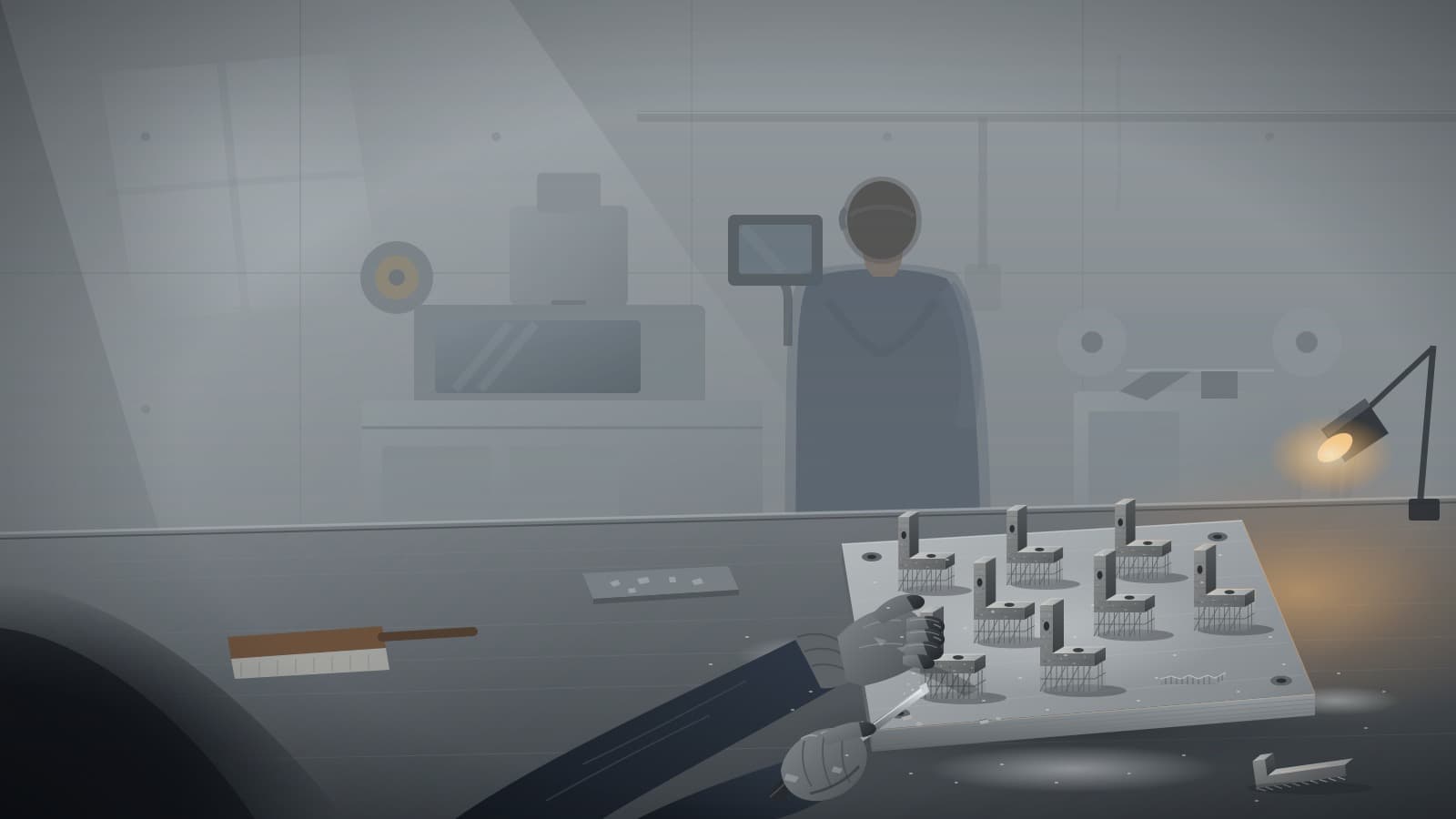
Buyers usually compare metal additive manufacturing quotes on the build: machine hours, powder and build height. The comparison stops being like-for-like once the plate comes out of the machine. Metal 3D printing post processing cost is a big enough share of part cost that a vague line, or a missing one, can change which supplier should win the part. This guide breaks a metal powder bed fusion (PBF) quote into the steps that follow the build. For each step, buyers can check whether the supplier included it, excluded it, priced it per batch or sent it out, and how that cost is split across parts.
How much does metal 3D printing post-processing cost?
The best-documented benchmark puts post-processing at roughly a quarter of AM part cost. Wohlers Associates' October 2021 special report, Post-Processing of AM and 3D-Printed Parts, found that nearly 27% of the cost of producing AM parts comes from post-processing. The figure draws on research for Wohlers Report 2021, with input from 124 service providers in 27 countries (SME; Laser Focus World).
Keep two caveats in mind. First, the 27% is an average across all AM, not metal alone. Second, the number has held steady. Wohlers Report 2019, based on input from 127 service providers, found that companies offering both metal and polymer AM put post-processing at more than 26% of a part's cost (Digital Engineering 24/7).
Single-vendor claims run higher. Metal AM vendor 3DEO says on its part cost breakdown page that "50% of the cost comes from post-processing," but it gives no method and does not define post-processing. A U.S. Bureau of Reclamation research project page says support removal alone "accounts for approximately 46 percent of the total cost of metals AM." That page cites no source, and its figure is well above the Wohlers survey number. Use the Wohlers figure as the planning anchor. Treat the higher figures as a reminder that complex, support-heavy metal parts can land far above the average.
The SME coverage of the Wohlers report also points to a schedule risk: "Bottlenecks are a challenge, especially when scaling into production quantities." Post-processing adds lead time as well as cost, and a quote can hide either one.
What post-processing steps do metal powder bed fusion parts need?
Most metal PBF parts go through a standard sequence, and some need extra steps depending on the application. Wohlers lists the standard sequence as powder removal, thermal stress relief, separating parts and supports from the build plate, removing supports from parts, media blasting, and machining and grinding. Per Laser Focus World's summary, some parts also need hot isostatic pressing (HIP), additional heat treatment, anodizing and inspection.
That list makes a good scope definition for a request for quote. If a bidder's quote doesn't say where each step happens, who does it and how it's priced, the buyer can't compare it with the others.
Why do metal AM quotes for the same part differ so much?
Bidders draw the scope boundary in different places. One supplier bundles stress relief and plate removal into the build price. Another lists them separately. A third leaves out machining and inspection because the buyer's machine shop is assumed to handle them. Several of the most common steps are also priced per batch or per plate, not per part, so the cost per part depends on how many parts the supplier assumed would share the plate.
Practitioner price points from Timothy W. Simpson of The Barnes Global Advisors, writing in Additive Manufacturing Media, show how batch-based these costs are. Simpson's article was first published in 2018 and republished in 2023, so treat his figures as 2018-era prices and use them to gauge order of magnitude, not as current quotes.
Line item 1: Powder removal and build plate separation
Parts have to be depowdered and cut off the plate before anything else can happen. Simpson writes that "we spend about $200 to $300 per plate for wire EDM, which can take a few hours depending on the number and size of the parts." He notes that a bandsaw can do the job in minutes.
The quoting question is allocation. As a simple illustration using Simpson's range, a $250 wire EDM charge works out to $12.50 per part on a plate holding 20 parts, but $125 per part on a plate holding two. A bidder who assumes a dense plate will look cheaper per part than one who assumes a sparse plate, even with identical rates.
Ask: How many parts per plate does the quote assume? Wire EDM or saw? If your order quantity doesn't fill a plate, are the parts nested with other customers' work or run alone?
Line item 2: Thermal stress relief
In Wohlers' sequence, stress relief comes before parts are separated from the plate. Simpson puts it at about $500 to $600 per batch, plus shipping. That "plus shipping" matters: when the supplier sends stress relief out to a heat treater, the quote picks up freight and the schedule picks up transit time in both directions.
Ask: Is stress relief done in-house or outsourced? Is freight in the price? What furnace atmosphere and cycle does this alloy need, and is that cycle defined by a standard or by the supplier's own procedure?
Line item 3: Support removal, the most variable labor line
Support removal varies more from part to part than any other line in the quote, and the documented examples cover a wide range. In 2017, ASME reported that Owen Hildreth, then an assistant professor at Arizona State University, "got a quote from a machine shop of the cost of machining away the supports: $4,000 and five days" for a single part.
The Bureau of Reclamation's FY2020 project, "Optimizing feasibility of using Additive Manufacturing to print 3D metal parts," says that "manual removal of the structural supports needed to print an AM part can cost upwards of $100/hour." Its comparison models "40 hours of machining time per part at $100/hr = $320,000 per 80 parts traditionally post-processed," and credits the cost and time inputs to machinists at the Colorado School of Mines. Those numbers are modeled assumptions, not an invoice. Still, they show how far support labor can move total cost on a part family.
Labor rates also differ widely. A January 2019 Tech Briefs article, written by Todd Grimm on behalf of printer vendor RIZE and based on six unnamed, mostly polymer-focused companies, put burdened post-processing labor at $30 to $100 per hour. That works out to roughly $25,000 to $50,000 a year of direct post-processing labor per printer. Those companies reported that post-processing added 17% to 100% to printing time, depending on the batch. The sample is small and vendor-sponsored, but the spread is a warning against assuming every bidder uses the same labor rate.
Ask: What are the estimated hours per part for support removal, and at what rate? Who designed the supports: the supplier, or you through the build file? If support strategy is the supplier's job, does the quote commit to it, or can the hours be revised after the first build?
Line item 4: HIP and heat treatment
HIP is applied to close internal defects. Magnus Ahlfors of Quintus Technologies, a HIP equipment maker, wrote in a 2018 AeroMat conference abstract that HIP "is widely used today to eliminate internal defects in additive manufactured material" and "will improve the ductility and especially the fatigue properties." That is a vendor's view, but it explains why fatigue-critical parts so often carry a HIP line.
Simpson writes that heat treatment "can easily cost $500 to $2,000 depending on the material and how many parts are being treated," and that "like heat treatment, HIP costs $500 to $2,000, but you often do not need to heat treat the part if you HIP it." Ahlfors makes a related point: with rapid cooling, "conventional heat treatment steps" can be folded "into the HIP cycle to make a more cost-effective process."
For buyers, the practical check is double charging. If a quote shows both HIP and a separate heat treat, ask whether the HIP cycle can cover the heat treatment for this alloy and requirement.
Specs can settle part of this argument. ASTM F3301-18a, "Standard Specification for Thermal Post-Processing Metal Parts Made Via Powder Bed Fusion," is listed as active. It covers titanium alloys, CoCr28Mo6, UNS N07718, UNS N06625, UNS S31603 and AlSi10Mg. If your part uses one of those alloys, ask whether the thermal post-processing is written to F3301-18a or to a proprietary cycle.
Ask: Is HIP in-house or outsourced, and how many parts share the HIP batch? Is the separate heat treat necessary, or can the HIP cycle replace it? Which specification governs the thermal cycles?
Line item 5: Machining and datums
Machining an AM part reverses the usual order. Marc Saunders of Renishaw, writing in Additive Manufacturing Media in 2017, notes that with AM, "precision datums have to be added in a final machining operation after all the other surfaces have been generated." In conventional machining, datums come first. Saunders also points out that lightweighting reduces part stiffness, and that complex AM forms are "hard to grip securely without causing damage." His proposed fix is 3D-printed encapsulating jaws.
Simpson writes that "machining of mating interfaces, surfaces, threads, support structures and more likely will be required," and that "registering parts and establishing datums for machining can be tricky." He says the cost is "highly dependent on the material and the job as well as the fixturing needed to hold the part."
In practice, the machining line on an AM quote covers more than spindle time. It also carries fixture design and build, probing and alignment to a part with no conventional datum surface, CAM programming and first-article setup. Those are mostly one-time costs. Whether they are amortized over the order or charged up front changes the per-part comparison between bidders.
Ask: Does the quote include fixture design and build, CAM programming and first-article setup? Are those amortized or billed as non-recurring? How much extra stock does the build file leave on machined surfaces, and who set that allowance?
Line item 6: Surface finishing
Media blasting is part of the standard sequence. Getting beyond it costs more. Simpson writes that treatments to reduce roughness, clean internal channels or remove partly melted particles can "easily run in the hundreds if not thousands of dollars." Internal channels matter most: if a quote says only "blast," it probably doesn't cover internal passages.
Ask: What is the target surface roughness (Ra) for each surface, and which surfaces does it apply to? Are internal channels finished, and how is their condition verified?
Line item 7: Inspection and documentation
Simpson lists inspection methods for metal AM as white- or blue-light scanning, dye-penetrant testing, ultrasonic testing and CT scanning. CT is the expensive one: "A CT scanner will easily cost $1 million to buy, install and operate," he writes.
Most suppliers who don't own a scanner send CT out. Keyence, which sells CT systems, says in an undated blog post that outsourced scanning "runs approximately USD 519 per scan," while running an in-house system at high utilization "brings that cost down to USD 141-285 per scan." These are a vendor's figures with no source given, and they are per scan, not per part. Whether one scan covers one part or several changes the math.
Customer specifications often decide inspection scope. NASA-STD-6030, "Additive Manufacturing Requirements for Spaceflight Systems," is listed as an active, NASA-endorsed (not mandatory) standard with a baseline document date of April 21, 2021. It covers all crewed spaceflight hardware, including vendor-furnished items, and gives tailoring guidance for non-crewed missions. NASA also lists MSFC-STD-3716, for laser powder bed fusion spaceflight hardware (released October 18, 2017), as active. A quote written to one of these, or to a customer's own AM spec, will carry process-control and inspection work that a commercial quote may leave out.
Ask: Which specification is the quote written to? Which inspection methods are included, on what sampling plan, and how many parts per CT scan? Are certifications and inspection reports included in the price?
Should you outsource post-processing or keep it with the print supplier?
There's no general answer, but splitting steps across vendors adds cost that quotes rarely show. In the Tech Briefs article, a consumer-products engineering manager said that "outsourcing increases the part cost by three or four times." That was one company in a polymer-leaning sample. The mechanism applies to metal too: every handoff adds freight, queue time and a margin. Before awarding the print and the machining to different vendors, add the logistics between them to the comparison.
A worksheet for comparing metal AM post-processing quotes
Put every bid on one sheet with one row per step. Fill in the columns for each bidder. Then convert every per-batch and per-plate charge into a per-part number at the build density that bidder assumed, and again at the density your order quantity will really support.
| Step | Included / excluded / outsourced | Priced per part, per batch or per plate | Parts per batch or plate assumed | Lead time added | Cost per part at expected density | Who owns scrap if the part fails after this step |
|---|---|---|---|---|---|---|
| Powder removal | ||||||
| Stress relief (incl. freight) | ||||||
| Plate separation (wire EDM or saw) | ||||||
| Support removal (hours x rate) | ||||||
| HIP | ||||||
| Additional heat treatment | ||||||
| Machining (incl. fixtures, CAM, first article) | ||||||
| Media blasting and surface finishing | ||||||
| Anodizing or other coatings | ||||||
| Inspection (method, sampling, parts per scan) | ||||||
| Documentation and certification |
The scrap column is the one buyers most often skip. A part that fails inspection after HIP and machining has absorbed almost all of its cost. The quote should say who pays for it and whether the replacement is rebuilt at the quoted price.
Questions to send every bidder before awarding a part family
-
List every post-processing step in your price, and mark each one as in-house or outsourced.
-
For every per-batch or per-plate charge, state the number of parts the price assumes.
-
Give estimated support removal hours per part and the labor rate behind them.
-
Confirm whether HIP replaces the separate heat treatment for this alloy. If both are quoted, explain why.
-
State which specifications govern thermal processing and inspection (for example ASTM F3301-18a, NASA-STD-6030 or our own spec).
-
Separate non-recurring machining costs (fixtures, programming, first article) from recurring per-part costs.
-
State the surface finish target for each surface, including internal channels.
-
Give the lead time each step adds, including freight to and from outside processors.
-
State who bears the cost of parts scrapped after post-processing.
The number to compare
Cost per build is the number that's easiest to compare and the least useful. The number that should decide the award is total landed cost per good part: build, every post-processing step at realistic batch density, freight between processors, inspection, and expected scrap. With nearly 27% of AM part cost sitting after the build in the Wohlers survey, a quote that is vague about that portion is incomplete.
Related reading
Sources
-
SME: Wohlers Associates Publishes Report on Post-Processing (Oct. 18, 2021)
-
ASME: Game-Changing Technology for 3D Printing Metal (June 6, 2017)
-
AeroMat 2018 abstract: Cost effective Hot Isostatic Pressing (Magnus Ahlfors, Quintus Technologies)
-
Tech Briefs: 3D Printing: The Impact of Post-Processing (Jan. 2019)
-
ASTM F3301-18a: Thermal Post-Processing Metal Parts Made Via Powder Bed Fusion
-
NASA-STD-6030: Additive Manufacturing Requirements for Spaceflight Systems