MasterBrand Cabinets will end all Value Semi-Custom operations at its plant at 651 Collier-Loftin Road in Kinston, N.C. From then on the plant will make only frameless cabinetry and components. The MasterBrand Kinston layoffs affect up to 391 workers. A state WARN notice dated Sept. 28, 2026 says those employees "will permanently lose their current positions," according to WCTI News 12. The notice says the first separations will begin Nov. 27, 2026, or within 14 days after that date.
A company spokesperson told Neuse News that about 390 employees are affected and about 180 will stay at Kinston. Non-frameless production is moving to MasterBrand plants in Indiana, Illinois and Oregon by late November 2026.
This article draws on the WARN notice as reported, company statements, public filings and state records. ManufacturingMag did not visit the plant or interview anyone at MasterBrand. Where we discuss changeovers, freight and labor, that is our analysis built on those facts. It is not reported data.
What changes at Kinston
The Kinston site is moving from a mixed plant to a single-construction plant. According to the company spokesperson, it will focus only on frameless cabinetry and components. That includes Ultracraft frameless production, which recently moved to the site. Value Semi-Custom work is leaving.
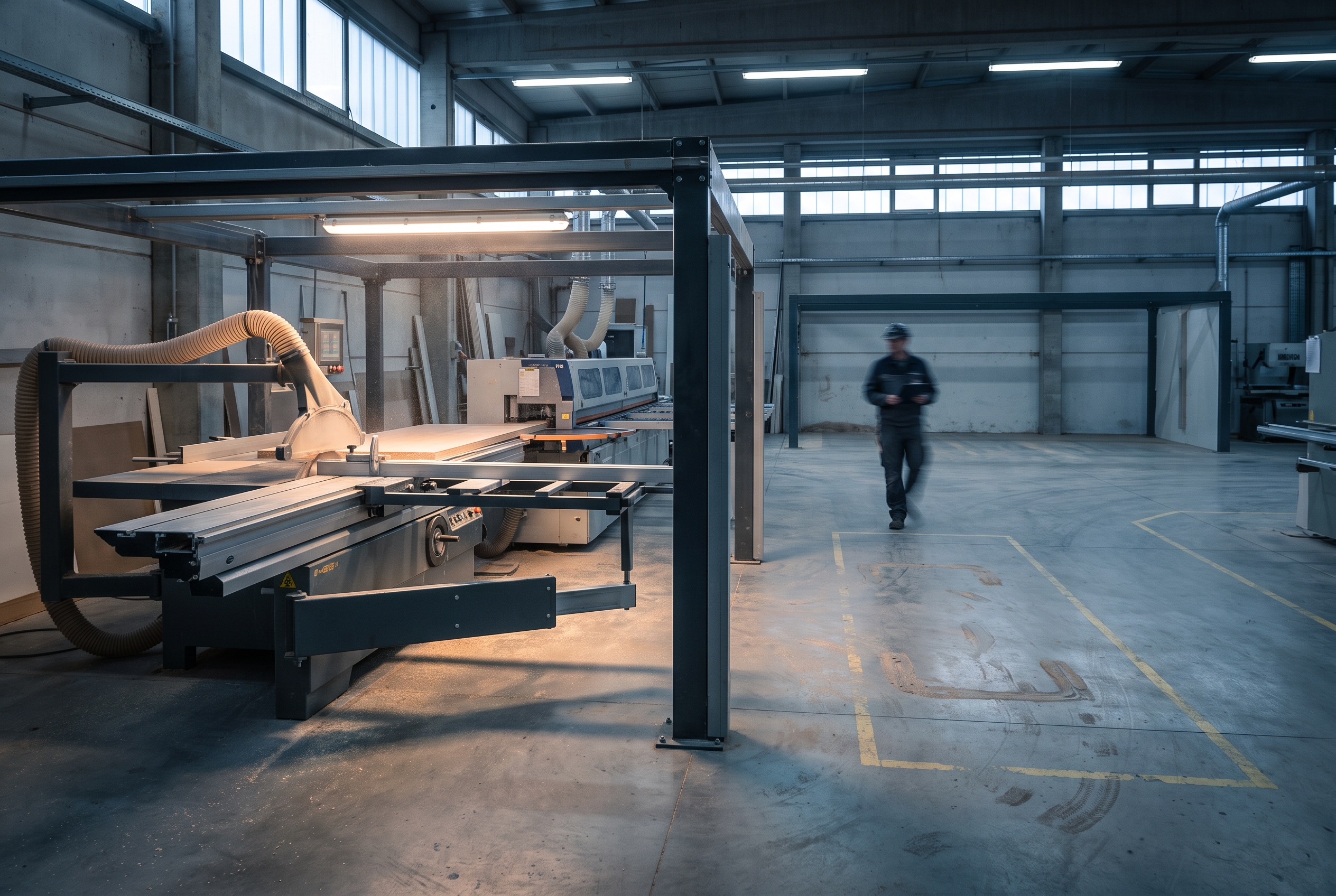
For readers outside the cabinet trade: a frameless (European-style) cabinet is a box with no face frame on the front, and the doors usually cover the whole box edge. A framed cabinet has a hardwood face frame attached to the front of the box. The two are built differently and use different parts and assembly steps. A plant set up for one is not automatically efficient at the other.
On the people side, the spokesperson said affected workers will get "enhanced severance packages with pay and benefits continuation, outplacement support and connections to workforce resources." They can also apply for other MasterBrand jobs, and some of those jobs come with relocation help. The company did not say how many of the affected workers it expects to transfer and how many will leave. Neuse News also reported that when it published, the notice was not yet on North Carolina's public WARN listings. The company said it had notified the relevant agencies.
Why now: the American Woodmark merger math
MasterBrand says the Kinston decision came out of an ongoing review of its manufacturing network following its merger with American Woodmark. That all-stock deal closed May 28, 2026, according to the company's second-quarter 2026 earnings release.
The same release sets the financial goal behind the review:
-
MasterBrand raised its long-term target to more than $100 million in annual run-rate cost synergies by the end of year three after close.
-
About $30 million in annualized synergy actions were already done by late July.
-
Net sales for the quarter ended June 28, 2026 were $815.2 million, including $125.5 million from American Woodmark.
-
Legacy MasterBrand sales fell 5.6% year over year.
-
Restructuring charges were $9.2 million, mainly for corporate workforce cuts. The release also lists American Woodmark's closure of its Monterrey, Mexico facility as a cost action.
"With integration ahead of schedule, we remain confident that this combination positions MasterBrand to streamline our cost structure," CEO Dave Banyard said in the release.
Put plainly, the first visible cost actions after the merger were corporate headcount and one Mexican plant. Kinston is the first big production move announced since the release. When legacy sales are falling and the company has publicly committed to more than $100 million in savings, plant-level consolidation is the obvious next step. Merging two cabinet networks leaves overlapping capacity, and specialization is one way to remove it without closing a building.
How Kinston got here
Kinston has taken on and lost product lines several times over the past 15 years:
-
April 2010: MasterBrand announced 334 Kinston jobs and a $3.75 million investment in a new cabinetry line. The project was backed by a $200,000 One North Carolina Fund grant (NC Department of Commerce).
-
2011: MasterBrand said it would lay off more than 150 Kinston workers as it moved Aristokraft production to Indiana. Headcount was expected to drop to about 370, compared with about 900 at the peak of the housing boom (WCTI).
-
Nov. 23, 2021: The state announced that MasterBrand would add more than 450 jobs (464 tied to the incentive) over five years and invest more than $13.5 million to expand capacity. Average wages for the new jobs were to exceed the Lenoir County average of $39,839. A Job Development Investment Grant (JDIG) authorized reimbursements of up to $3,878,000 over 12 years, paid only if job targets were met (NC Department of Commerce). At the time, MasterBrand already employed about 800 people in Kinston and planned to reach the new total by adding a shift (Neuse News). "We are proud to expand our operations in Kinston, which allows us to better meet the demand of our customers while providing new jobs," Banyard, then MasterBrand president, said in the 2021 release.
-
December 2024: MasterBrand said it would close the Ultracraft Cabinetry plant in Liberty, N.C., in 2025. That plant had 200 employees and had built cabinets since 1986. The Statesville plant would close too. "The production in North Carolina will funnel to the Kinston site, where the plant has enough room to accommodate an increase in operations," the Randolph Record reported.
-
September 2026: The WARN notice ends Value Semi-Custom work. Kinston becomes the frameless site.
The pattern matters for anyone running a multi-plant network. Kinston was first the collection point for North Carolina production. Once the network roughly doubled through the merger, the plant was narrowed to a single construction method. The decision that made it the collection point (floor space and an existing workforce) is the same one that made it the natural home for one product family.
The operator's case for a single-construction plant
MasterBrand has not released changeover, throughput or cost figures for Kinston, so what follows is reasoning, not reported results.
Fewer product-family switches. A mixed plant changes over more than equipment. Material flow, parts kitting, assembly sequencing, quality checkpoints and operator skills all shift between framed and frameless work. If a plant builds only frameless boxes and components, the hardest of those changes disappear. Remaining changeovers are within one family (sizes, finishes, door styles), and those are usually shorter and easier to standardize.
Concentrated volume. Ultracraft frameless work is already at Kinston. Putting the rest of the frameless volume on the same lines spreads fixed costs (equipment, engineering support, supervision) over more units of a similar product. It also lets the plant set capex, maintenance schedules and preventive-maintenance intervals around one process instead of two.
Simpler staffing and training. One construction method means a narrower set of skills to train and certify. That may be part of why the retained workforce is about 180. In general, a plant can run with fewer indirect roles once the product mix gets simpler. MasterBrand has not explained how it arrived at the retained headcount.
The cost: less flexibility. A specialized plant is efficient only while its product sells. If frameless demand softens, Kinston has no other product family to fill the gap, and the network has no second frameless site to share the risk. The company is betting on a steady frameless mix. The 2011 Aristokraft move shows this plant has gone through demand-driven cuts before.
If you are modeling a similar line transfer, count the ramp-up losses at the receiving plant and the wind-down at the sending plant separately from the steady-state savings. Our downtime cost calculator separates lost contribution from incremental recovery costs. That is the split you need to see whether a transfer pays back within the synergy window.
Freight, lead times and the network tradeoff
After the move, MasterBrand's network looks like this: non-frameless product ships from plants in Indiana, Illinois and Oregon, and frameless product comes from one site in eastern North Carolina. No freight or lead-time figures have been published, so these tradeoffs are qualitative.
-
Frameless lanes get longer for some customers. With one frameless plant, every frameless order ships from Kinston no matter where the customer is. Cabinets are bulky and light for their size, so freight costs are driven by cube, and longer lanes cost more per unit than they would for dense goods.
-
Framed lanes may get shorter for some customers. Moving framed work to three plants in the Midwest and West could bring it closer to customers in those regions and farther from Southeast customers who used to be served from Kinston.
-
Mixed orders get harder. A dealer or builder ordering both framed and frameless products may now get them from different plants on different schedules. That can complicate consolidation and jobsite timing.
Whether the manufacturing savings outweigh the freight and service costs depends on order mix and customer locations, and MasterBrand has not disclosed those.
The labor pool question
About 390 affected workers in Lenoir County is a large number for one employer's single announcement. The company's package (severance, continued pay and benefits, outplacement, internal job postings, some relocation help) is standard for a large reduction. The open question is how many workers take a transfer. The receiving plants are in Indiana, Illinois and Oregon, and many hourly workers will not move across the country for their current wage. Neuse News's note that the notice was not on the state's public WARN list at first publication matters mainly to local workforce agencies planning rapid-response services.
For MasterBrand's own operations, there is a less visible risk. The workers who stay at Kinston have just watched most of their colleagues leave, and some of them may leave too. A specialized plant depends on experienced operators on fewer lines, so retaining the 180 is part of making the plan work.
The incentive question
The 2021 JDIG was performance-based: the state reimburses only when the company meets its job targets. That structure exists for situations like this one, where a company's plans change before the incentive period ends.
Critics of state incentives see a different lesson. "This is yet another reminder that announced jobs are not actual jobs," Brian Balfour, senior vice president of research at the John Locke Foundation, told Carolina Journal. Balfour also said a Locke analysis found more than 80% of completed JDIG projects failed to create the promised number of jobs.
Both points can be true. Performance-based grants limit taxpayer losses when jobs don't appear. But the headline job number in an announcement, whether in 2010 or 2021, shows what a company plans, not what it is committed to. Coverage of the 2021 investment varies: WITN reported $13.7 million, while the state's release says more than $13.5 million. We use the state's figure.
What plant managers and ops VPs should take from Kinston
If your company has just closed a merger and announced a synergy target, expect a network review to reach the plant floor. Kinston suggests what to watch for and what to ask.
-
Which product families stay, and why? Specialization usually follows whatever the site already does at the most volume or does better than other plants. Kinston kept the family it had just taken in from Liberty. Know which of your product families is your plant's strongest claim.
-
How much real spare capacity do the receiving plants have? A move that looks good on paper can fail if receiving plants run short on labor, tooling or floor space during ramp-up. Ask for the receiving plants' staffing plans, not only their square footage.
-
How was retained headcount set? Ask whether the number comes from a line-by-line staffing model for the new mix or from a top-down cost target. The answer shows how much margin the plant has when demand shifts.
-
What is the freight and service cost? Make sure the network model includes outbound lanes, mixed-order consolidation and lead times, not just conversion cost per unit.
-
What incentive obligations come with the site? If the plant has a performance-based state grant, operations and finance should know the job targets and how a reduction affects them before the WARN notice goes out.
Kinston has taken in production and lost it before. This time the plant will make only frameless cabinetry and components, which ties its future to one product family and one integration plan.
Related reading
Sources
-
WCTI News 12: MasterBrand to cut up to 391 jobs at Kinston facility (Sept. 30, 2026)
-
Neuse News: MasterBrand changes to affect 390 workers at Kinston facility (Sept. 30, 2026)
-
Carolina Journal: Cabinet manufacturer slashes jobs at Kinston location (Oct. 2, 2026)
-
MasterBrand: Second Quarter 2026 Financial Results, SEC 8-K exhibit (Aug. 4, 2026)
-
NC Department of Commerce: MasterBrand Cabinets will expand in Lenoir County (Nov. 23, 2021)
-
Neuse News: MasterBrand Cabinets to expand and add 464 new jobs (Nov. 23, 2021)
-
NC Department of Commerce: Cabinet manufacturer to bring 334 jobs to Lenoir County (April 22, 2010)
-
Randolph Record: Liberty cabinet plant to close in 2025, with 200 jobs lost (Dec. 9, 2024)