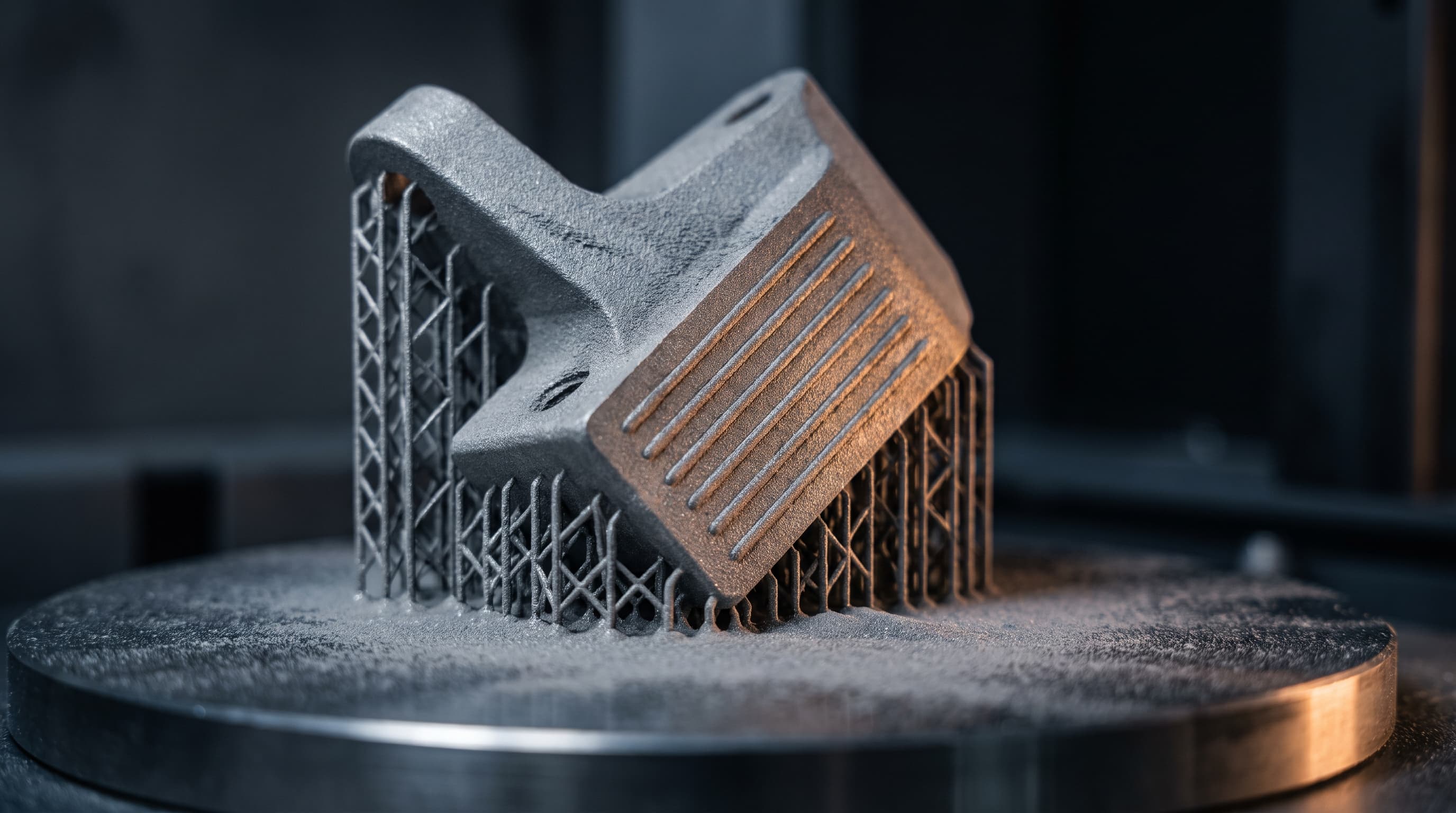
In metal 3D printing vs investment casting, multi-laser powder bed fusion wins on time to first part and on low-volume, complex or supply-constrained parts. It rarely beats mature, tooled, high-volume castings on unit cost. For flight-critical parts, the cost of qualification usually decides the case more than machine speed does.
That is the short answer. This article explains how we got there, starting with the machine that put the question back on the table this month.
What EOS brought to Chicago
EOS showed its M4 Onyx laser powder bed fusion (LPBF) system in North America for the first time at IMTS 2026, held September 14-19 at McCormick Place in Chicago, VoxelMatters reported. EOS launched the machine at Formnext in November 2025, and its launch release put commercial availability in Q1 2026. The system uses six 400 W lasers. EOS aims it at serial production in aerospace, defense, energy and semiconductor.
Modern Machine Shop's IMTS coverage names the EOS M 400-4 as its predecessor and says the new build volume is 25% larger. EOS's spec page gives the build volume as 450 x 450 x 400 mm and notes that the figure includes the build platform. Materials listed in the release are titanium, nickel and stainless steel, with other options on request. Validated processes on the spec page include Ti64 at 60 µm and IN718 at 40 and 80 µm layers.
EOS makes three headline claims. The six lasers "provide 50% higher throughput and reduce part costs by 30%," and the system offers "up to 97% system availability (OEE) with full-service contracts." Patrick Boyd, EOS marketing director, told VoxelMatters the company is "working closely with customers and partners across the defense and aerospace supply chain to help address the growing need for faster, more resilient production." Sebastian Becker, EOS head of product management for metal, called it "our most productive metal AM system to date."
Missing from all of this: a baseline, a price and a customer. The release does not say what system the 50% and 30% figures are measured against. TCT Magazine's launch coverage, VoxelMatters and MMS do not disclose a price or name a buyer either.
How an operator should read the claims
The 30% part-cost figure. A cost reduction with no stated baseline and no published cost model can't go into a business case. It could be measured against an older EOS machine, a different part or a different utilization rate. Treat it as a question for the sales engineer, not an input. Ask which machine it is compared against, which part and material, what layer thickness, what utilization, and whether powder, gas, labor and post-processing are included.
The 97% figure. Three qualifiers matter. It is "up to." It depends on a full-service contract, which is its own line item. And it is labeled OEE when it describes availability. OEE multiplies availability by performance (speed against the ideal rate) and by quality (good parts as a share of total). A machine that is up 97% of the time but runs slow jobs or scraps builds will post an OEE well below 97%. Plant managers should model availability at a realistic level for their shop and then apply their own performance and quality rates.
The gap between a vendor ceiling and your actual uptime has a price. If you're sizing one printer against casting capacity, run the difference through our downtime cost calculator. It separates lost contribution margin from incremental recovery costs such as expediting and overtime. On a single machine with no backup, that difference can be the whole business case.
Other vendor figures. EOS also claims job changeovers "in less than 30 minutes," "more than 90% powder material recovery," and integrated error detection that "reduces quality assurance expenses by up to 50%." All three come from the vendor. The QA claim matters most for the comparison with casting, because inspection and qualification are where AM costs tend to pile up. Ask for the data behind it before counting on it.
Why laser count drives cost per part
The logic behind multi-laser machines is sound even if EOS's specific numbers can't be checked. On industrial metal printers, machine time is the largest cost line. John Borrego, writing in War on the Rocks, puts it at over half of per-piece cost. More lasers spread the hourly cost of the machine over more parts.
The best independent model of that effect comes from John E. Barnes of The Barnes Global Advisors, published in Additive Manufacturing Media in 2021. In a modeled control-arm case, a 12-laser system produced 36 times the annual parts of a single-laser machine, and "we see the cost of producing our TBGA control arm fall by 87%." Barnes wrote that this "now puts it in the competitive space of casting and machining solutions in terms of $/kg."
Two caveats. First, this is a model of a 12-laser machine, not a production result and not a study of the M4 Onyx. Second, Barnes attached a condition: "Having the operational tempo to bring on a multi-laser machine is necessary, otherwise your productivity will suffer." A six-laser machine that sits idle half the week carries its full depreciation on half the parts.
The starting point matters too. NIST's 2014 cost study (SP 1176, by Douglas Thomas and Stanley Gilbert) found that "in many instances, the cost of producing a product using additive manufacturing processes exceeds that of traditional methods." Multi-laser systems narrow that gap. They don't erase it for every part.
Where casting is weakest: lead time and capacity
In aerospace, the case for printing rests less on unit cost than on the calendar. BCG's July 2024 report, Fixing Aerospace's Supply Chain: Casting and Forging, found that "the manufacturing process can take 6 to 18-plus months, depending on the part, size, metal, process, and level of vertical integration." BCG also reported:
-
Titanium lead times of about nine months.
-
One high-demand steel alloy from a single supplier with "a lead time of 70 to 80 weeks."
-
"Many US foundries and forges had to lay off half or more of their workforce during COVID."
-
"Most contracts are for five to seven years," which locks in capacity and makes it hard to switch sources.
Two years later the constraint is still there. Deloitte's midyear 2026 A&D outlook lists "engines, electronics, castings, forgings, titanium, high-temperature alloy, and energetics" as factors limiting the ramp in aircraft, missiles, munitions, drones, satellites and naval platforms. It adds that contractors "are increasingly exploring additive manufacturing and digital production tools to augment constrained casting and forging supply chains, accelerate qualification of replacement parts."
Note the word "augment." Deloitte doesn't describe AM replacing casting.
Commercial casting is a different market. Niagara Investment Castings, a commercial foundry rather than an aerospace superalloy house, says most of its investment casting tooling falls between $1,000 and $10,000, with a typical tool life of 50,000 pieces. It quotes samples 3-5 weeks after tooling, an 8-week production lead time once a part is approved, and rapid-prototype castings in under three weeks. Those figures belong to one foundry and are a lower bound, not an aerospace benchmark. They still make the point: for commodity castings in common alloys, a printer has little lead-time advantage to sell. The lead-time case is strongest for aerospace and superalloy parts stuck in long queues.
Qualification often decides the cost
For regulated parts, qualification can cost more than every other difference between the two processes. NIST's AM Part Qualification program states that "extensive empirical testing consisting of thousands of individual tests, costing millions of dollars and necessitating several years to complete, is required to qualify parts." It also says minor process changes require complete re-qualification.
That has a direct consequence for anyone looking at the M4 Onyx or any new platform. A different laser count, build volume and gas flow is a process change. Parts qualified on an older machine, even one from the same vendor, don't carry over automatically. The speed gain has to cover a new qualification campaign before it starts saving money.
BCG limits AM substitution to a narrow set: "advanced machining and additive manufacturing is a viable alternative for some select parts that may have lower strength or less difficult shape requirements." On material properties, War on the Rocks quotes a naval materials expert who says printed parts can "meet or exceed the properties of a cast product," while matching wrought properties is impractical for now. Borrego also notes that "quality assurance is still a significant challenge in larger adoption." For a part that is cast today, the property bar is reachable. For a forged part, AM is generally not the answer.
A break-even worksheet, not a crossover number
Any single "print below X units, cast above X" figure hides the inputs that matter. The better approach is to build the comparison per part number. The table below lists the cost lines to fill in with your own quotes and plant data.
| Cost line | Investment casting | Multi-laser LPBF | | --- | --- | --- | | Up-front tooling | Wax-die tooling cost divided by tool life or program volume, whichever is lower | None, but build plates and fixtures still apply | | Lead-time penalty | Safety stock, expediting, line-down risk while waiting for a casting slot | Machine lead time, install and ramp; lower once running | | Unit processing | Foundry piece price plus finish machining | Machine-hour cost divided by parts per build, adjusted for real utilization | | Material | Alloy price and yield | Powder price, recovery rate and inert gas | | Post-processing | Gating removal, machining, inspection | Support removal, heat treatment, HIP if required, machining, inspection | | Qualification | Often already done on legacy parts | Full campaign, amortized over program volume and repeated after process changes |
Two effects work against each other. Casting tooling is a fixed cost, so it favors printing at low volumes. AM qualification is also a fixed cost, and a large one for regulated parts, so it pushes the break-even volume the other way. A part with long program life and stable demand can absorb qualification. A part needed in small quantities for a short program often can't, unless the casting alternative means a year-long wait.
Utilization runs through every line. Barnes' warning applies here: the machine-hour cost in this table only holds if the plant has enough qualified part numbers to keep the machine busy.
For investors: incumbents are growing, not shrinking
If multi-laser printing were displacing castings at scale, it would show up in incumbent results. It doesn't. Howmet Aerospace reported Q2 2026 Engine Products revenue of $1.37 billion, up 32% year over year, and said the segment "absorbed approximately 485 net headcount in the quarter in support of expected revenue increases." Total revenue was $2.55 billion, up 24%. CEO John Plant said "demand in the gas turbines market is extraordinary with customers already revisiting and adding to their demand outlooks."
Casting capacity is being added. The realistic role for AM in the near term is to relieve pressure on specific parts, not to take share from casting across the board.
Facility check before the capex request
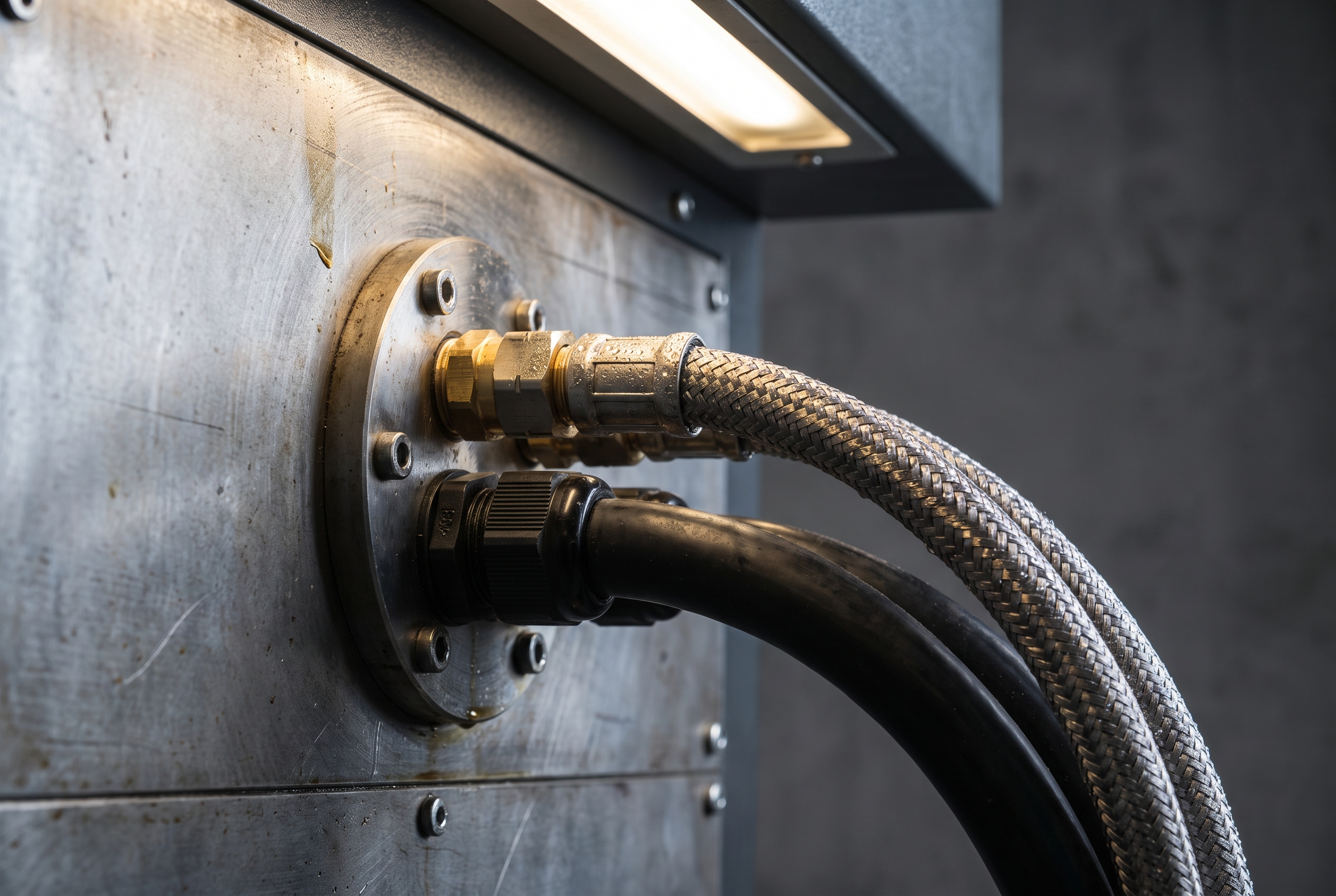
A six-laser production machine is a facilities project as much as an equipment purchase. From EOS's spec page:
-
Weight: approximately 5,700 kg. Check floor loading.
-
Machine footprint: 5500 x 2370 x 2730 mm. Minimum installation space: 7100 x 6000 x 3300 mm.
-
Power: 45.0 kW maximum, 29.0 kW typical, on a 3 x 54 A supply.
-
Compressed air: 7 bar, 20 m³/h.
Budget for powder handling and storage, inert gas supply and whatever post-processing capacity you don't already have, such as heat treatment and support removal. The machine price, which EOS hasn't published, is only one part of the total cost.
Verdict: when to print and when to keep casting
We did not visit an M4 Onyx installation or test the machine. This assessment is based on published vendor specifications and independent research cited below.
Print when:
-
Volumes are low and the tooling cost can't be spread across enough parts.
-
The part has complex internal features that are hard or impossible to cast.
-
The casting slot is more than 12 months out and a line-down or delivery penalty is costly.
-
You need spare parts for legacy platforms whose tooling is gone or worn out.
-
You can qualify the part once and run it for years on a stable process.
-
You have enough qualified work to keep a multi-laser machine busy.
Keep casting when:
-
The part belongs to a mature, tooled family with qualification already done.
-
Volumes are high and steady, and tooling life is far from used up.
-
A commercial foundry can deliver on a normal schedule.
-
Your qualification path would restart with each machine or process change.
Parts that need wrought properties fall outside both options, since neither casting nor printing is the usual answer there.
Multi-laser printing has moved the cost line. For the right parts, especially in supply-constrained aerospace and defense programs, it can undercut a casting that won't arrive for a year. For mature, high-volume cast part families, it doesn't beat casting on cost, and vendor throughput claims without a baseline don't change that.
Related reading
-
What Tier-3 Foundries Should Expect From the GE Castings Deal
-
Will Boeing's Engineer Offer Reset Pay at Aerospace Suppliers?
Sources
-
EOS: Industrial Scale: Introducing the EOS M4 ONYX (press release, Nov 18, 2025)
-
VoxelMatters: IMTS 2026 brings the North American debut of EOS's six-laser M4 Onyx
-
Modern Machine Shop: EOS Showcases AM's Shift From Prototyping to Production
-
Additive Manufacturing Media: Making a Slow Decision on a Fast Technology (John E. Barnes)
-
NIST SP 1176: Costs and Cost Effectiveness of Additive Manufacturing
-
BCG: Fixing Aerospace's Supply Chain: Casting and Forging (July 17, 2024)
-
Deloitte Insights: Midyear update, 2026 Aerospace and Defense Industry Outlook
-
War on the Rocks: The Additive Manufacturing Mirage in Defense (John Borrego)