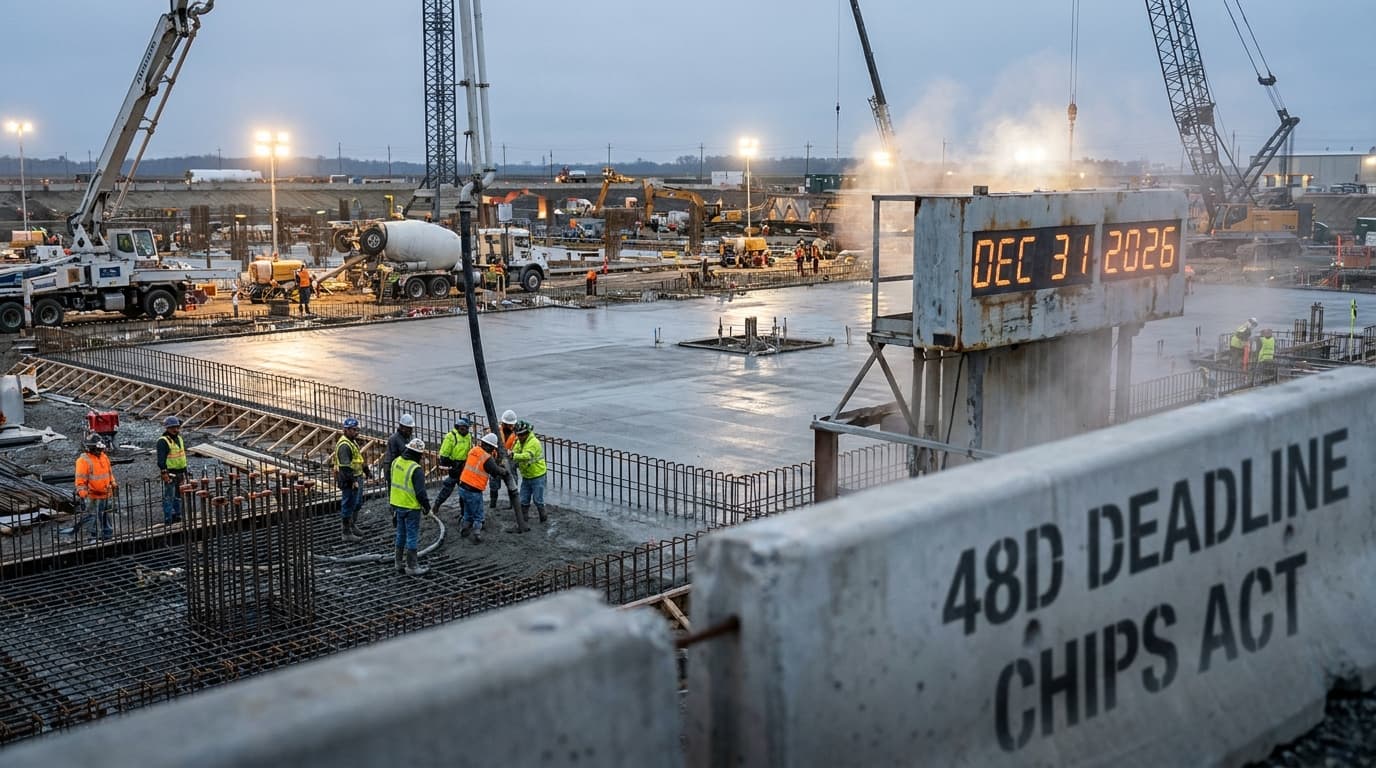
For the financial and operations teams steering America's semiconductor build-out, the most consequential number in the next 18 months isn't a wafer price or a capacity forecast. It's a date: December 31, 2026. Miss it, and a federal subsidy worth more than a third of a fab's qualified capital cost disappears.
Under Section 48D of the tax code—the Advanced Manufacturing Investment Credit created by the 2022 CHIPS Act—a chipmaker can claim a credit against the cost of building and equipping an advanced manufacturing facility. The 2025 budget law informally known as the One Big Beautiful Bill Act (OBBBA) made that credit substantially richer, raising the rate from 25% to 35% for qualified property placed in service after December 31, 2025. But OBBBA left the credit's expiration untouched. The statute is blunt: the credit shall not apply to property the construction of which begins after December 31, 2026. In plain terms, construction has to begin on or before that date—before January 1, 2027—or there is no credit at all.
That combination—a sweeter rate and a fixed sunset—creates a hard, dateable cliff. Begin construction by year-end 2026 and lock in a 35% subsidy on the full qualified investment. Begin a day late and the number is zero. The practical contest now underway is over a deceptively technical question with billions of dollars riding on it: what, exactly, counts as the beginning of construction?
What 48D actually subsidizes
Section 48D was the CHIPS Act's tax-side complement to the law's direct grant program. Where the grants steer appropriated dollars to specific projects, 48D is an investment credit available to taxpayers that build facilities for manufacturing semiconductors or the equipment used to manufacture semiconductors.
Crucially for capital planning, the credit reaches more than just tools. Qualified property is tangible, depreciable property that is integral to an advanced manufacturing facility—and the final regulations confirm that this includes buildings and their structural components, alongside the machinery and equipment used in semiconductor or semiconductor-equipment manufacturing. For a megafab, where the shell, cleanroom structure, and utilities represent an enormous share of total cost, sweeping the building itself into the credit base is what makes 48D move investment decisions rather than merely trim them.
The credit is also direct-pay eligible through an elective payment mechanism, meaning a qualifying entity can monetize it even without a large tax liability to absorb it. That elective-payment feature widens the universe of beneficiaries—and raises the stakes on clearing the qualification bar before the cliff, because for many builders the credit functions like cash.
One older boundary still matters for long-gestating projects: for property whose construction began before January 1, 2023, only the basis attributable to work performed after August 9, 2022 qualifies. Pre-CHIPS construction is carved out.
Two moving numbers, pulling in opposite directions
The current scramble is best understood as the interaction of two figures that OBBBA treated very differently.
The first is the rate. OBBBA substituted "35 percent" for "25 percent," a 10-point increase that applies to qualified property placed in service after December 31, 2025. On a multibillion-dollar qualified investment, ten points is a number that reshapes a project's return.
The second is the deadline—and OBBBA left it alone. The credit still does not apply to property whose construction begins after December 31, 2026. Congress, in other words, made the prize bigger without extending the window to claim it. The result is a textbook incentive to act now: the marginal value of qualifying climbed sharply, while the time to qualify did not budge.
That asymmetry is the engine behind the Q4 2026 groundbreaking rush. Every firm with a credible fab or supplier project on the drawing board now has a powerful reason to establish a qualifying construction start before the calendar turns—and to do it for the most capital it can defensibly bring under the credit.
'Beginning of construction': the compliance battleground
Because the entire credit hinges on a construction start before January 1, 2027, the definition of that start is where the real engineering—legal and physical—is happening.
The final 48D and Section 50 regulations, published in the Federal Register on October 23, 2024 (T.D. 10009), give taxpayers two ways to establish beginning of construction for purposes of the December 31, 2026 termination date:
-
The physical work test, which looks to whether physical work of a significant nature has begun—on-site or off-site, including work by contractors under a binding written contract.
-
The 5% safe harbor, under which a taxpayer is treated as having begun construction by paying or incurring at least 5% of the total cost of the qualified property.
Neither test is a one-time box to check. Both carry a continuity expectation—work or investment that begins must be carried forward, not staged as a paper milestone and then parked. That continuity requirement is precisely what regulators will scrutinize: it is the difference between a genuine start and a contrived one. For tax and compliance teams, the work between now and year-end 2026 is as much about documentation as about dirt—binding contracts, evidence of physical work or incurred cost, and a contemporaneous record that the project moved continuously thereafter.
The clean-energy contrast—and the policy-risk read
The 48D regime looks especially favorable right now when set against what is happening on the clean-energy side of the code. In IRS Notice 2025-42 (August 2025), the agency generally eliminated the 5% safe harbor as a path to beginning of construction for wind and solar projects under Sections 45Y and 48E, leaving the physical work test as the main route for those credits.
For semiconductors, both tests survive. A 48D taxpayer can still rely on either physical work or the 5% safe harbor. That divergence is a meaningful planning advantage—the safe harbor offers a cleaner, more controllable way to fix a start date than mobilizing crews on a specific day.
But the contrast also carries a warning. The IRS demonstrated, in the wind and solar context, both the willingness and the mechanism to narrow these begin-construction options. The 5% safe harbor is intact for 48D "for now"—and prudent teams should treat its continued availability as a feature to use promptly rather than an entitlement to bank on indefinitely.
Press release versus shovels
The cliff also exposes a gap that the industry's announcement cadence tends to paper over: the distance between a tax-qualifying construction start and actual production.
Consider Micron's roughly $100 billion megafab planned for Clay, New York. The company has delayed the project's timeline, with first-fab (Fab 1) operations now targeted around 2030—about two years later than previously planned. Bechtel has been engaged to advance the project toward first construction. The lesson for credit planning is that a project can book a qualifying construction start years before it produces a single wafer. The 48D deadline is keyed to when construction begins, not when output arrives—so a 2026 start can sit comfortably ahead of a 2030 production date, provided the continuity requirement is honored across that long runway.
That same dynamic is what makes the "press release versus shovels" distinction so important. An announced megaproject is not, by itself, a qualifying start. What qualifies is documented physical work or incurred cost that begins before January 1, 2027 and continues—an evidentiary standard, not a marketing one.
The Q4 2026 crunch
Expect the back half of 2026 to be congested. With a richer credit and a fixed deadline, the rational move for any viable project is to establish minimal but genuine qualifying work before year-end—and that demand lands on a finite base of EPC contractors, specialized trades, and equipment suppliers.
Two constraints will bite. First, EPC and skilled-labor capacity: a clustered rush to break ground strains the same firms and crews that fab construction already competes hard for. Second, the temptation to do the bare minimum—just enough physical work or just enough incurred cost to trip a test—runs straight into the continuity requirement and into audit risk if the "start" turns out to be a milestone with nothing behind it.
Quality and compliance takeaways
For the people who will have to defend these positions, the cliff is fundamentally a substantiation problem. A few priorities stand out:
-
Document the start contemporaneously. Whichever test you rely on, build the record as the work happens—binding written contracts, proof of physical work of a significant nature, or evidence that at least 5% of qualified-property cost was paid or incurred—rather than reconstructing it later.
-
Respect continuity. A start that isn't carried forward is the most exposed position of all. The regulations' continuity expectation is where a contrived start unravels.
-
Map the qualified-property base deliberately. Because buildings and structural components can qualify alongside equipment, getting the basis right—and excluding pre-2023 work where the older carve-out applies—directly drives the credit's size.
-
Plan for recapture and audit exposure. A credit this large, and direct-pay eligible, invites scrutiny. Positions built on thin or staged "starts" carry recapture and audit risk that can erase the benefit and then some.
-
Suppliers in the fab supply chain should act now. Firms building facilities to manufacture semiconductor manufacturing equipment are within 48D's scope. They face the same deadline and should be documenting their own qualifying starts on the same clock as the fabs they serve.
The 35% rate is the headline. The December 31, 2026 deadline is the constraint. And the quiet, decisive variable is whether a company can prove—cleanly, contemporaneously, and continuously—that it broke ground in time. For chipmakers and their suppliers, the race to pour concrete before year-end 2026 is really a race to build an evidentiary record that survives the audit that follows.
Related reading
-
[Texas Instruments' $11B Lehi Fab Ramps in 2026 — Straight Into a Mature-Node Glut It Can't Out-Run](/article/texas-instruments-lehi-fab-2026-mature-node-glut)
-
[Samsung's $44B Taylor Fab Slips 2nm Mass Production to 2027 — An Order-Book Problem, Not a Construction One](/article/samsung-taylor-fab-2nm-mass-production-2027-order-book)
-
The $1.77 Trillion Reshoring Boom Isn't Showing Up in the Concrete
Sources
-
26 U.S.C. §48D — Advanced manufacturing investment credit (Office of the Law Revision Counsel)
-
Sec. 48D. Advanced Manufacturing Investment Credit (Bloomberg Tax / IRC)
-
[CHIPS Act final regs. offer many taxpayer-friendly provisions (The Tax Adviser, June 2025)](https://www.thetaxadviser.com/issues/2025/jun/chips-act-final-regs-offer-many-taxpayer-friendly-provisions/)
-
48D Semiconductor Tax Credit (U.S. Small Business Administration)
-
The 'One Big Beautiful Bill Act's' Impact on Manufacturing (Forvis Mazars, July 2025)
-
IRS Notice 2025-42 — Sections 45Y and 48E Beginning of Construction
-
[Micron delays construction at $100B New York megafab (Construction Dive)](https://www.constructiondive.com/news/micron-delay-construction-new-york-megafab/805622/)