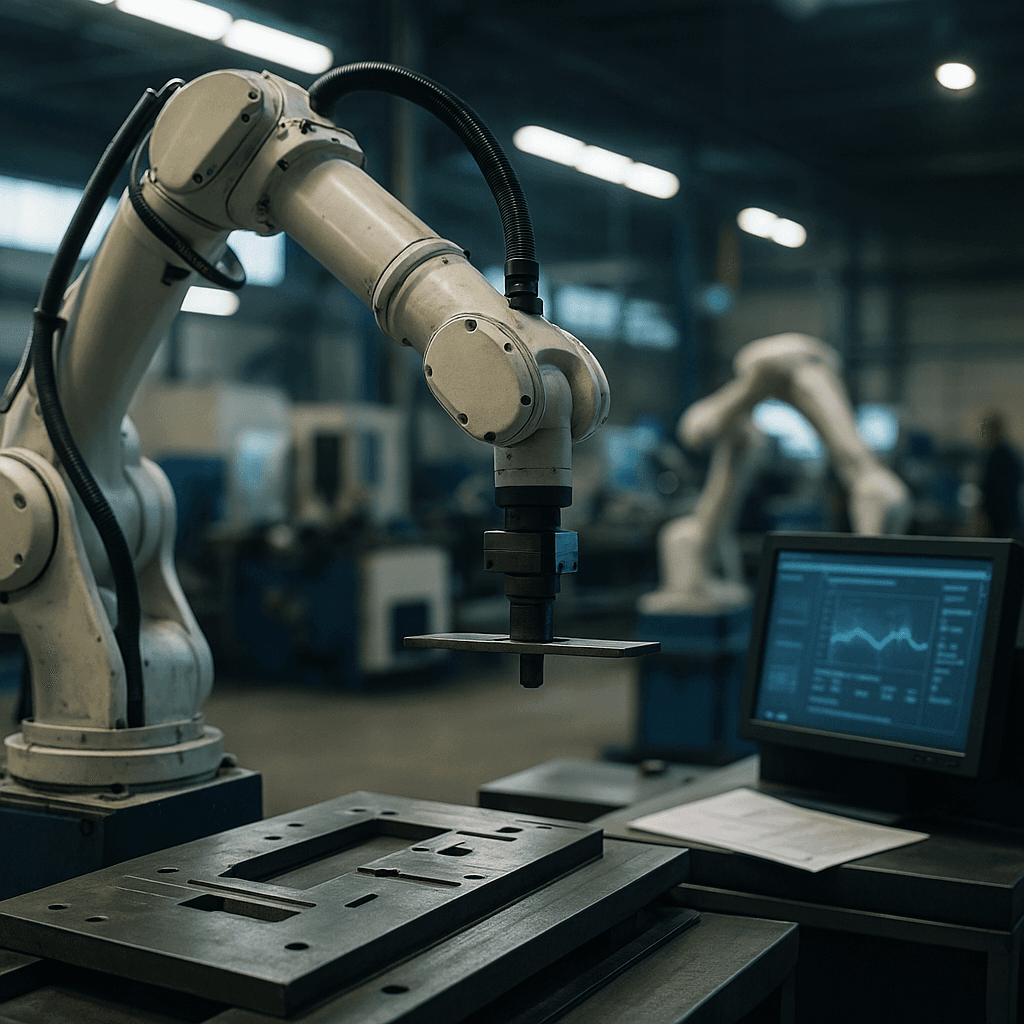
For decades, industrial robot datasheets have quoted cycle time, repeatability and payload — but never a comparable electricity figure. ABB Robotics is now leading an ISO working group drafting the first international Technical Specification that would put a standardized kWh number on that spec line — and it is on track to publish in August 2026.
The standard, in plain terms
The formal designation is ISO/DTS 25213, "Robotics — Test methods for measuring the energy consumption of robots — 6-Axis articulated industrial robots". It sits under ISO/TC 299, the parent technical committee for robotics standardization. Hosting duties belong to the Swedish Institute for Standardization (SIS), Sweden's national ISO member body, and the working group includes experts from 11 other countries — coverage names participants from China, Japan, Germany, Denmark, Mexico, the United States, Korea, France and the United Kingdom.
The draft took roughly 18 months to reach final-text stage and was registered for FDIS approval in February 2026, with publication targeted for August 2026. Scope is explicit: 6-axis articulated industrial robots in typical applications. Service, medical, SCARA, autonomous mobile and DELTA robots sit outside this TS.
Why "average power" on a brochure does not work
Gianluca Brotto, Head of Sustainability at ABB Robotics, has framed the gap bluntly in coverage of the working group: refrigerators, televisions, washing machines and electric motors all have established methods for comparing energy use — robots do not. The reason is that a robot's measured draw depends on size, payload, path, environment and task. Two cells running the same nameplate machine can pull materially different power because their duty cycles differ. Modern Machine Shop reports that those are exactly the parameters the TS aims to normalize, and names Emma Brimdyr, a Global R&D Sustainability Specialist at ABB Robotics, alongside Brotto on the working group.
What changes inside procurement
Once a uniform method exists, kWh-per-cycle becomes a comparable, contractable spec — sitting next to cycle time and repeatability on the line that buyers actually evaluate. That has two operational consequences. First, integrators can drop a measured energy figure into a TCO model rather than a vendor-blessed approximation. Second, fleet owners filing under the EU's Corporate Sustainability Reporting Directive, or answering customers' Scope 3 questionnaires, finally get a defensible number rather than an estimate.
The scale across which that metric would apply is not small. The International Federation of Robotics puts the global installed base of industrial robots at more than 4 million units, a figure cited alongside the standardization effort.
Where this bites first: paint, weld, foundry
The applications where measured kWh will move procurement first are the ones where electricity is already a meaningful share of variable cost: paint booths, arc and spot welding cells, and foundry handling. ABB's own internal studies, referenced in the IFR press release, attribute more than 70% of a robot's lifecycle carbon footprint to electricity consumed during the operational use phase. In energy-intensive cells that ratio dominates not just the sustainability case but the operating line.
OEM exposure
Coverage of the working group flags an uncomfortable point for ABB's competitors. FANUC, KUKA, Yaskawa and Universal Robots have not publicly announced parallel transparency programs. When ISO/DTS 25213 lands and integrators begin requesting kWh-per-cycle figures in tender documents, OEMs without internally validated numbers will be measured first under someone else's method — or excluded from comparison sheets entirely. The losses, if they come, will not look like a recall or a quality problem; they will look like missing RFP points.
The regulatory tailwind
This does not arrive in a vacuum. Large manufacturers are already under pressure from EU CSRD disclosures and customer-driven Scope 3 reporting to produce auditable energy data for capital equipment. A standardized kWh-per-cycle figure is exactly the input those reports need, and absent it, fleet owners have been forced to model assumptions. Trade coverage has framed the standard as a procurement and disclosure unlock rather than a sustainability gesture.
What to watch
Three milestones matter from here. First, publication of ISO/DTS 25213 in August 2026 — the open text will reveal the specific test conditions (idle, motion, peak draw, payload-loaded cycles) that public coverage has not yet detailed. Second, whether the other major OEMs publish kWh-per-cycle figures voluntarily ahead of buyer demand. Third, whether large integrators in automotive, white goods and electronics tender writing embed the metric in standard RFP language. That last move is what converts a published standard into a procurement requirement.
The next robot RFP that lands on a plant manager's desk will have a kWh column — and it will not be empty.