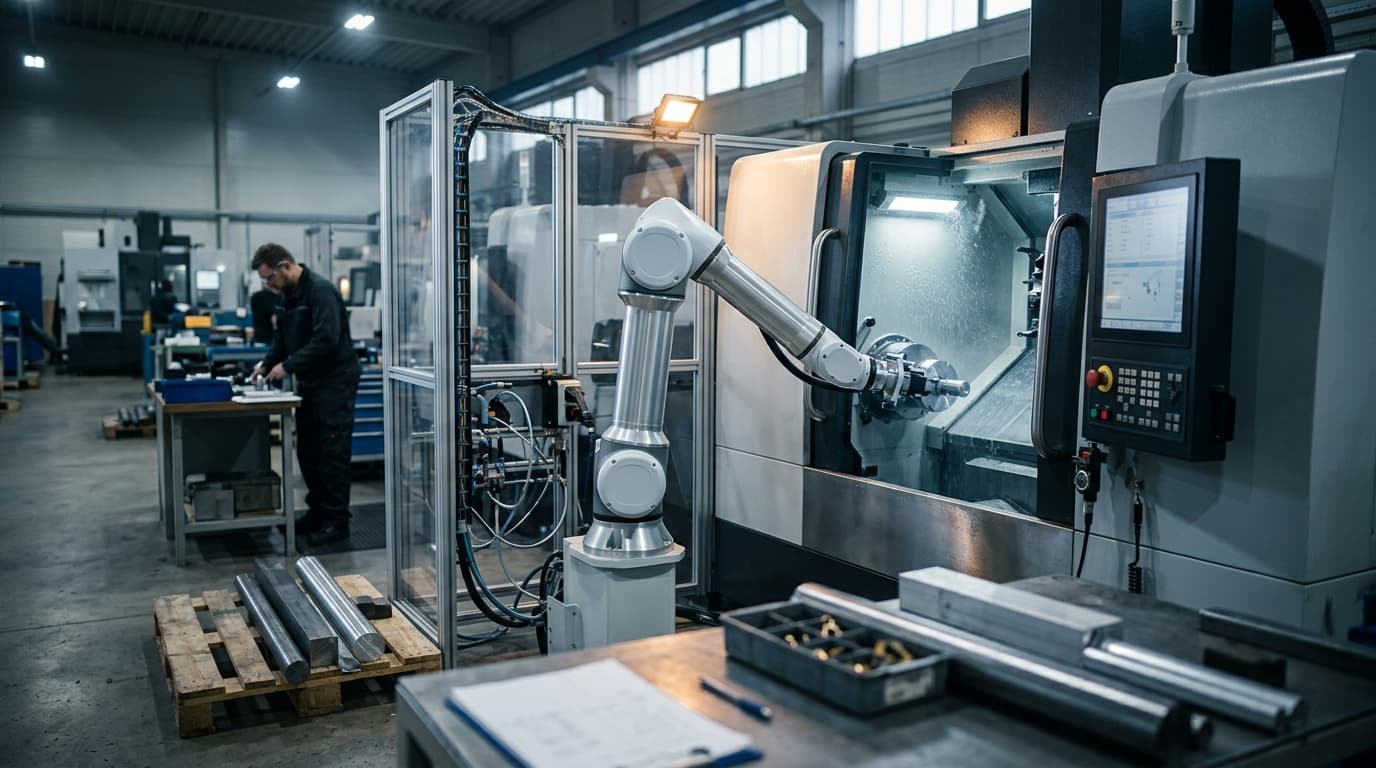
Mind Robotics closed a $400 million funding round on May 13, 2026, led by Kleiner Perkins, valuing the Rivian spinout at roughly $3.4 billion and pushing its total raised past $1 billion in under 18 months. The capital — disclosed in the company's primary announcement and confirmed by TechCrunch and Reuters — is earmarked for scaling deployment of a foundation-model-driven industrial robotics platform aimed at dexterous manufacturing work. The strategic question for the floor is not whether the round closes a technology gap. It is whether this wave of capital — combined with parallel scaling at Path Robotics and AGIBOT — finally compresses the price of a deployed robot cell to the point that a Tier 3 contract shop can amortize it against a single operator's wage.
The Funding Stack
Mind Robotics was founded in 2025 by Rivian CEO RJ Scaringe and has now stacked three rounds in roughly twelve months: a $115 million seed in late 2025, a $500 million Series A in March 2026, and this $400 million extension. New investors in the latest round include Meritech Capital, Redpoint, SV Angel, Incharge, A-Star, and Garuda Ventures. They join an existing cap table that already reads like a federation of strategic interest in industrial AI: Accel, Andreessen Horowitz, Eclipse, Prysm, Bain Capital Ventures, Greenoaks, and the venture arms of Volkswagen and Salesforce.
The company's positioning is full-stack — foundation models, purpose-built robots, and the deployment infrastructure to push both into customer plants. That last layer is where the money actually goes. Building the model is a research problem; getting a working cell behind a fence at a $20-million-revenue machine shop in Ohio is a field-engineering problem, and field engineering is where industrial robotics has historically bled margin and timelines.
Why The Capital Wave Matters
Mind Robotics is not raising into a quiet market. Path Robotics has now raised more than $300 million since 2018, including $100 million in the past twelve months led by Matter Venture Partners and Drive Capital. In April 2026, Path launched Rove, a mobile quadruped welder, with Saronic and shipbuilder HII among early adopters. HII has publicly tied the partnership to a 14% throughput gain on initial work, with another 15% targeted as the program expands.
On the supply side, China's AGIBOT has declared 2026 its "Deployment Year One." The Robot Report confirmed its 10,000th humanoid unit rolled off the line in March 2026. AGIBOT's service network now spans 17 countries, including SIR Spa in Italy, a Singtel-anchored Robotics-as-a-Service program in Singapore, Genting Malaysia, and a Hyperscale Data facility in Michigan. The company made its U.S. market debut at CES 2026. Three vendors raising and shipping simultaneously means three sets of price curves bending at once — and that matters more to a small shop than any single product announcement.
What A Cell Actually Costs In 2026
The numbers behind the headline are unsentimental. Standard Bots' 2026 cost guide places a fully deployed industrial robot cell at $150,000–$500,000, with palletizing systems toward the top of that band at $175,000–$500,000-plus, and full cobot solutions including installation and training at $40,000–$150,000. The low-end deployed cell starts around $60,000–$80,000.
Hardware floor is lower still. EVS International's 2026 pricing teardown puts 6-axis arms at $25,000–$180,000 for the arm alone, with Chinese tier-1 light-payload arms starting around $15,000–$20,000. The arm itself is only 30–40% of a finished cell's total cost; the rest is end-of-arm tooling, vision, safety perimeter, controls integration, and the deployment engineer's hours.
For job-shop economics, the most relevant sub-segment is CNC machine tending. GrabaRobot's 2026 tending guide brackets installed tending cells at $60,000–$150,000, with in-machine tending systems at $15,000–$50,000 and payback windows of 6–18 months. Multi-machine tending — one arm feeding two or three CNC spindles — frequently pays back in under nine months.
The Wage Line
Here is the threshold the headline points at. A skilled U.S. CNC machinist runs $55,000–$75,000 per year before burden. Three operators across two shifts represent roughly $360,000 in annual labor exposure on a single set of machines. The same analysis finds that one operator running four automated spindles can replace four operators running four manual ones, cutting per-part labor cost by 60–75%.
That is the math behind the editorial framing. If a deployed cell can land under roughly $90,000 — comfortably inside the bottom of the cobot and CNC-tending bands — a Tier 3 shop owner can amortize it against one loaded operator wage over the first year and still have margin to absorb integration overrun. Mind Robotics has not publicly disclosed a per-cell price target, and the "under $90K" line is this publication's extrapolation from current vendor pricing, not a Mind Robotics commitment. But the funding round buys exactly the deployment infrastructure that would pull the average sale price toward that line.
The Friction Tier 3 Still Eats
Cell list price is the easy number. The hard one is integration. High-mix, low-volume shops — the spine of U.S. Tier 3 contract manufacturing — face the longest paybacks because reprogramming, regripping, and reconfiguration eat directly into the labor savings the cell was supposed to produce. An Eclipse-cited industry report in April 2026 concluded that most manufacturers adopting automation never realize meaningful ROI — and the failure mode is almost always the integration layer, not the robot itself.
This is the gap the foundation-model thesis aims at. If the cell learns a new part family from demonstration rather than reprogramming, the high-mix penalty drops. If the same arm can switch between weld, tend, and pack tasks via a software update, the second and third use cases get effectively subsidized by the first. Whether Mind Robotics' platform actually delivers that flexibility in production environments is the open question the next twelve months will answer — and it is what the new capital is being spent to prove.
The Service-Network Effect
The other lever is field service. Historically, the bottleneck on small-shop deployment has not been the robot — it has been the integrator. AGIBOT's Robotics-as-a-Service network, anchored by Singtel in Singapore and partners across 17 countries, externalizes the deployment-engineer cost and turns the cell into a monthly line item. Path Robotics' mobile Rove platform takes a different swing at the same problem: a quadruped welder that walks up to the work instead of waiting for the work to be fixtured into a stationary cell.
Cobot installations are projected to exceed 80,000 units globally in 2026, about 14% of total industrial robot installations and growing 30%-plus annually. Most cobots pay back within one to three years. The market is voting on the form factor that fits Tier 3 economics — lower payload, easier safety perimeter, and a price tag inside the wage line.
What To Watch
Three signals will tell operators whether the under-$90K threshold is real or theoretical by year-end. First, Mind Robotics' first publicly named manufacturing customers and the per-site economics they disclose. Second, IMTS 2026 floor pricing — the show is where machine-tending cell pricing is set on the record, and any vendor competing for Mind Robotics' attention will price aggressively. Third, the North American robot order trajectory: orders grew 6.6% in 2025 on the strength of mid-market adoption, and any acceleration in 2026 will be the cleanest indicator that the price-versus-wage equation has actually moved.
The Mind Robotics round does not, by itself, deliver a $90,000 cell to a job shop in Erie. But it underwrites the deployment muscle that closes the gap between a $60,000–$80,000 hardware low-end and a turnkey, supported system a single-operator shop can actually run. For Tier 3, that is the difference between a robotics line item that pencils and one that doesn't.
Related reading
Sources
-
Mind Robotics Announces $400M in New Funding to Expand Industrial Robotics Deployment — BusinessWire
-
Rivian spinoff Mind Robotics raises another $400M — TechCrunch
-
Rivian spinout Mind Robotics valued at $3.4 billion in new funding round — Reuters via Yahoo Finance
-
Year One of Deployment: How AgiBot is Building a Global Robot Empire — Aparobot
-
AGIBOT Makes Its U.S. Market Debut at CES 2026 — PR Newswire
-
Robots for manufacturers: 2026 guide to cost, ROI, and use cases — Standard Bots
-
How Much Does an Industrial Robot Cost? Guide (2026) — EVS Int'l
-
CNC Machine Tending Robot 2026: $60K–$150K Lights-Out Setup — GrabaRobot
-
How Is CNC Automation Reshaping Manufacturing Productivity in 2026? — CompanionLink
-
Most manufacturers adopt automation, but few achieve meaningful ROI — Robotics & Automation News