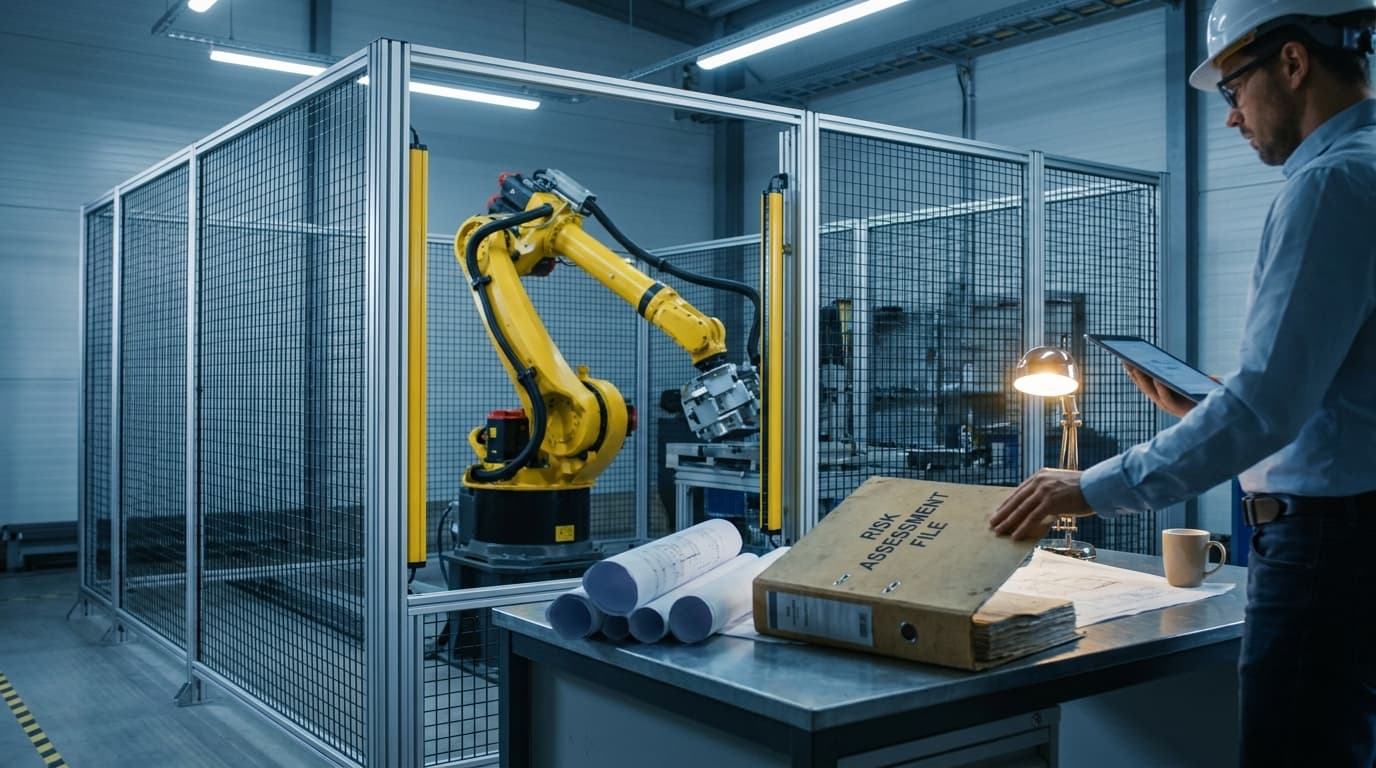
The ANSI R15.06 2025 requirements apply to new robot installations, not retroactively to cells you already run. The revision moves the unit of risk assessment from the robot system to the robot application, folds ISO/TS 15066 into Part 2, adds a mandatory cybersecurity threat assessment, and replaces blanket PL d with per-function performance levels.
That is the honest headline for a plant engineer. Nothing on your floor became illegal on a date in 2025. What did happen is that several documents in your risk assessment binder now describe a framework that no longer exists, and a handful of physical items moved from good practice to requirement for the next cell you buy. The useful question is not "am I compliant" but "which of my files are out of date, and which line items belong in next year's capex."
What published, and when
ISO 10218-1:2025 and ISO 10218-2:2025 both published on 5 February 2025. Part 1 is edition 3, 95 pages, and it replaces the now withdrawn ISO 10218-1:2011; it treats the industrial robot as partially completed machinery, which is to say a component the integrator finishes. Part 2 is edition 2, 223 pages, and its scope covers design, integration, commissioning, operation, maintenance, decommissioning and disposal of robot applications and robot cells.
The US national adoption followed in stages. ANSI/A3 R15.06-2025 Parts 1 and 2 were approved on 21 August 2025, revising ANSI/RIA R15.06-2012. A genuinely new Part 3, ANSI/A3 R15.06-3-2025, Use of Industrial Robot Cells, was approved on 7 October 2025, and the complete 403 page three-part set published on 29 October 2025.
If you want one number that tells you how much new obligation exists, use page count. Part 1 went from roughly 50 pages to 95. Part 2 went from roughly 72 to 223. ANSI/A3 R15.06 Parts 1 and 2 together went from 162 pages to 374. That is not editorial padding. It is scope: subject areas that were previously spread across technical reports, or absent, are now inside the normative documents.
Buy Part 3 first
Parts 1 and 2 are addressed to the robot builder and the integrator respectively. If you operate cells rather than build them, most of Part 1 is background and much of Part 2 tells you what your integrator owes you at handover.
Part 3 is the one written for you. It was developed by US and Canadian experts precisely because the ISO documents do not address user requirements: what the company that owns the cell is responsible for once the integrator has driven away, over the operating life of the equipment. There is no ISO equivalent. For a plant with installed robots and no plans to buy a new cell this year, Part 3 is the purchase that generates work you can act on.
Change 1: the robot system becomes the robot application
This is the change with the widest downstream effect and the least visible cost. The unit of risk assessment is no longer the robot system, meaning the robot, its end effector and its sensors. It is the robot application, defined to include the workpiece, the task program and the machinery supporting the task. A single robot cell can contain several applications.
Read that against your own file. If your assessment covers "the weld cell" as one object, the new boundary asks you to account for the part you are welding, the program that runs it, and the positioner, conveyor or fixture that supports it. The practical consequence is that a program change or a new part number becomes a more clearly identified reason to revisit the assessment, rather than a production event that happens outside the safety file entirely. Most shops running high-mix work will find this is where the real labour sits.
Change 2: has ISO/TS 15066:2016 been withdrawn?
No. As checked on September 28, 2026, ISO lists ISO/TS 15066:2016 as published and current, with revision planned. The ISO catalogue record shows its 2022 confirmation and the June 26, 2025 decision to revise it; ISO/AWI 15066-1 is under development. Record the edition, catalogue status and date checked in your assessment file. A planned revision does not mean the existing document has been withdrawn.
The collaborative robot content that lived in ISO/TS 15066:2016 is now largely absorbed into ISO 10218-2:2025, covering hand guided control, speed and separation monitoring, and power and force limiting, with a normative annex on separation distance and an informative annex on body-region contact limits.
For the application file, the term "collaborative robot" is dropped in favour of "collaborative application" and "collaborative task." The same robot can run a collaborative application or a non-collaborative one depending on how the safeguarding is designed. If your documentation says "we have a cobot, so the cell is inherently safe," that sentence no longer maps to the standard's vocabulary and it never described a safety argument to begin with. What you have is an application, and its designation depends on the task and the safeguarding, not on the part number of the arm.
Change 3: monitored standstill is more than a rename
"Safety-rated monitored stop" is now "monitored standstill." If it were only a rename it would be a find-and-replace exercise. It is not. Monitored standstill is elevated to an independent safety function and is no longer confined to collaborative operation. It applies wherever a stop category 2 condition holds position with drive power active and unintended motion must be prevented.

On an existing floor, that describes more stations than most engineers expect: pallet load positions where the robot holds still while a human indexes a fixture, muted light curtain zones, hand-load stations where the arm is powered and stationary while an operator reaches in. If those points were treated as an incidental behaviour of the controller rather than as a safety function with validation records, the new edition says otherwise.
Change 4: cybersecurity moves from nowhere to a shall
ISO 10218-1:2025 introduces a cybersecurity threat assessment as a requirement, not as an informative note. Where identified threats create safety risks, measures must prevent unauthorized access to hardware, software, configuration data and programs. The reference chain runs from ISO 10218-1 to IEC TS 63074:2023 to IEC 62443, which is to say it lands you in the industrial control system security framework rather than in IT policy.
For a plant, the scope is narrower and more answerable than the acronyms suggest. Who can reach the teach pendant network. Who holds the controller passwords, and whether that is a person or a sticky note. Whether the safety configuration can be modified from the general plant network. Whether anyone has written any of this down. On most installed cells the honest answer to the last question is no, and producing that document is a day of work rather than a capital project.
Change 5: functional safety gets granular
The old approach was effectively a blanket: PL d with Category 3 architecture. The 2025 edition replaces that with a required performance level determined per safety function, taken either from default tables in the annexes or from a documented risk assessment. That is a real trade. The annex tables are cheaper to document and will be right for most cells. Deriving your own PLr can justify a lower level on a specific function, but you pay for it in documentation that has to survive review.
Alongside this sits a new two-class robot classification. Class I covers very low hazard robots with reduced control requirements, typically PL b. Class II covers the large majority of industrial robots at the conventional higher requirement. Classification turns on total mass per manipulator, maximum force per manipulator and maximum speed. If you run small, light arms on secondary operations, Class I is worth checking against the criteria before you spend on control architecture you do not need.
Change 6: normal stop, and the end of the e-stop as a load button
The revision requires a dedicated normal stop function for planned workflow stopping, with an explicit prohibition on using emergency stop devices as normal stop devices.

This is short because it is blunt. Walk your floor and count the stations where the operator hits the e-stop to load a part, because that was the button within reach and it worked. Every one of those is now a named finding. It is also, on most cells, the cheapest thing on this list to fix: a stop device, a rung of logic, and a retrained operator.
The re-document list
These are the files to reopen on a cell you already own. None of them require a purchase order.
-
The risk assessment boundary and task list, redrawn to the robot application: workpiece, task program and supporting machinery inside the line.
-
The collaborative designation, restated as an application and task rather than as a property of the robot.
-
The stop function inventory: every stop on the cell, its category, and whether an emergency stop device is doing a normal stop's job.
-
Monitored standstill validation records for every station where the arm holds position with drives live and a person is near.
-
The cybersecurity threat assessment, including controller access, pendant network reachability and who can change the safety configuration.
-
End effector notes: edges, energy absorbing materials, manual release without power, and tool changer mis-combination, all of which are now explicit subject areas.
-
The restart method, specifically how unexpected restart is prevented and how the safeguarded space is verified clear before motion resumes.
-
Additional axes: base lifts, seventh-axis tracks and positioners, which the revision treats explicitly rather than leaving to the integrator's judgement.
What pulls an old cell into the new edition
Not a date. Events. A modification to the cell, a new part or program, a changed layout, changed personnel access, or a new end effector are the triggers that put an installed application back on the assessment bench, and when they do, the current edition is the one a reasonable engineer works from. Framing it this way is more useful than a transition calendar, because it tells your engineering change process what to watch for.
What stays grandfathered, and the limits of that word
R15.06 is a voluntary consensus standard written forward, for new installations. The historical bridging document for installed equipment is RIA TR R15.506-2014, Applicability of ANSI/RIA R15.06-2012 for Existing Industrial Robot Applications, and it is keyed to the 2012 edition. Before you rely on a bridging document for the 2025 set, confirm with A3 whether a 2025-edition companion exists; as of this writing the 2014 report is what the repositories list.
Now the limit. "Grandfathered" describes the standard, not your exposure. There is no OSHA standard specific to robots. Enforcement runs through 29 CFR 1910.212 machine guarding, 1910.147 lockout tagout, Subpart S electrical, and Section 5(a)(1) of the OSH Act, the General Duty Clause. Under the General Duty Clause, a current consensus standard is exactly what an inspector points to when arguing that a hazard was recognized in the industry. The standard is voluntary; the argument that you should have known is not. Add to that your customer audits and your insurer, neither of which observes a transition period, and the practical answer is that the paperwork above is worth doing whether or not anyone requires it of you.
Budgeting: paperwork versus hardware
Separate the list into two buckets before you take it to a capital meeting.
Paperwork only. The application boundary rewrite, the collaborative terminology, the stop inventory, the cybersecurity threat assessment, end effector and tool changer notes, and the additional axes documentation. This is engineering hours plus the cost of the standards themselves. The Robot Report put the ISO documents at $244; the three-part ANSI/A3 set is a separate purchase.
Can require hardware or firmware. Per-function PLr evidence where the existing architecture cannot demonstrate the level. Monitored standstill validation where the function was never treated as a safety function. Restart verification where nothing physically confirms the safeguarded space is clear. A dedicated normal stop device where operators are using the e-stop. Network segmentation for the controller. Scope each of these per station, not per cell, and you will usually find the count is smaller than the anxiety.
The Monday morning checklist
-
Buy ANSI/A3 R15.06-3-2025, Use of Industrial Robot Cells. Assign an owner.
-
List every robot application in the plant, using the new boundary. Expect the count to exceed your cell count.
-
Walk the floor and mark every station where an operator stops the cell with an emergency stop device for routine work.
-
Mark every station where the arm holds position with drives live and a person is within reach. Those are your monitored standstill functions.
-
Ask IT and controls jointly: who can reach the controller, who holds the passwords, can the safety configuration change from the plant network.
-
Check your light arms against the Class I criteria (mass, force and speed per manipulator) before assuming Class II control requirements.
-
Add the five triggers (modification, new part or program, layout change, access change, new end effector) to your engineering change checklist.
-
Fix the terminology in the risk assessment file: application, not system; collaborative application, not collaborative robot; monitored standstill, not safety-rated monitored stop. Do not record ISO/TS 15066 as withdrawn.
If you export, or buy cells from EU integrators
The European timeline is separate and firmer. The EU Machinery Regulation applies from January 2027, and the requested transition period for the superseded EN ISO 10218:2011 is 24 months, pending European Commission approval and listing in the Official Journal. If you ship machinery into the EU, or you are specifying a cell from a European integrator, that pending listing is worth tracking, because it sets when the old harmonized standard stops carrying presumption of conformity.
One last note on citations. If you are printing clause numbers into an internal procedure, confirm them against the purchased standard rather than against vendor summaries. The revision guides circulating online are useful for orientation and have been broadly accurate on substance, but clause numbering is the kind of detail that should come from the document you paid for.
Related reading
-
[Which Industrial AI Demos at IMTS Are Ready for a Plant Floor?](/article/which-industrial-ai-demos-at-imts-are-ready-for-a-plant-floor)
-
How to Answer a 30% Price-Down Letter Without Losing the Program
Sources
-
ISO 10218-1:2025, Robotics, safety requirements, Part 1: Industrial robots (ISO catalogue record)
-
ISO 10218-2:2025, Robotics, safety requirements, Part 2: Industrial robot applications and robot cells (ISO catalogue record)
-
[ISO/TS 15066:2016, Robots and robotic devices, Collaborative robots](https://committee.iso.org/standard/62996.html) (ISO catalogue record, current status)
-
A3 releases full three-part national safety standard for industrial robots (The Robot Report)
-
ISO 10218 industrial robot safety standard receives major overhaul (The Robot Report)
-
Updated ISO 10218: answers to frequently asked questions (A3)
-
ISO 10218-2:2025 Revision Guide (Safetics Insight)
-
New standards for industrial robots EN ISO 10218-1 and -2 (IBF Solutions)
-
Robotics: Standards (OSHA) and OSHA Technical Manual, Section IV, Chapter 4