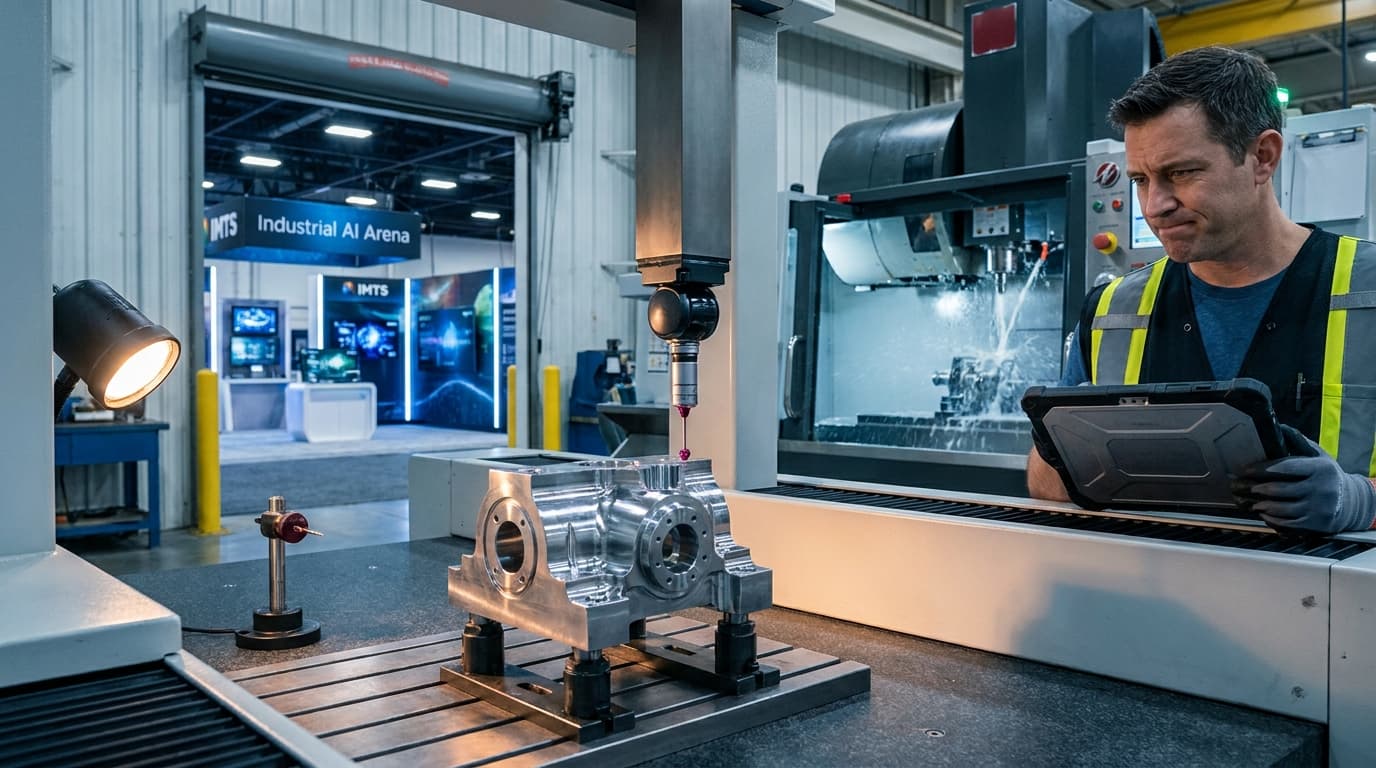
The Industrial AI Arena at IMTS 2026 is not a wonder cabinet. It is a screening venue. Thirty-two exhibitors plus Sandia National Laboratories, all on Level 3 of the North Building at McCormick Place, is a compressed way to disqualify vendors you would otherwise spend two quarters evaluating one video call at a time. Nothing on the industrial AI IMTS 2026 show floor is going to fail because the model was bad. It will fail because your controls do not emit the data the model needs, because nobody at the plant owns retraining after a tooling change, or because it writes to a system your IT group will not open.
So walk in with the opposite posture from the one a trade show floor is engineered to produce. You are not there to be impressed. You are there to run the same five questions against every demo and leave with the four or five vendors that survived them. Each question below is meant to be asked standing up, in the booth, while the machine is still cycling behind the sales engineer.
What is new at IMTS 2026?
IMTS 2026 runs Sept. 14–19, 2026 at McCormick Place in Chicago. The show guide lists 11 industry sectors including this year's addition, the Industrial AI Arena, in the North Building, Level 3. (Some IMTS and press materials still describe 10 technology sectors, written before the Arena was added — treat any bare sector count with suspicion.) IMTS's own description of the Arena's scope is broad: quality and inspection, process optimization, downtime reduction, cybersecurity, ergonomics, safety, and demand forecasting.
-
Arena roster: 32 exhibitors plus Sandia National Laboratories. IMTS names Atomic Industries, Ignizia, C-Infinity and Purchaser.ai among them, alongside embedded-AI technology from FANUC, Autodesk, Hexagon, Heidenhain, High QA, Keyence, Mazak, Okuma, Siemens, Standard Bots and Universal Robots.
-
IMTS Industrial AI Conference: Wednesday, Sept. 16, 10:00 a.m.–4:45 p.m., South Building Room S401-ABC. $450 advance, $500 onsite from Sept. 1 — the fee includes conference sessions, six-day exhibit hall access and lunch. IMTS bills it as "a one-day, practitioner-focused program delivering reality-based AI for the factory floor," with a step-by-step methodology for identifying high-value opportunities and assessing data readiness, plus case studies in metalworking, semiconductors and robotics.
-
Who built it: the conference was developed with Dr. Jay Lee of the A. James Clark School of Engineering at the University of Maryland. His featured case study covers monitoring multiple CNC machines with low-cost edge AI devices using a predictive, traceable stream-of-quality methodology.
-
Scale: nine conferences with 69 sessions in the main IMTS Conference; the show expects 89,000-plus registrants, 1,800-plus exhibitors and 1.2 million sq. ft. of exhibit space. For calibration, IMTS 2024 finished at 89,020 registrants and 1,737 exhibitors.
Ryan Kelly, AMT's vice president of technology, frames the value as access: "IMTS 2026 gives manufacturers direct access to AI experts who understand industrial processes." That is the right frame — expert access, not product discovery. The products will find you.
Do most manufacturing AI projects actually fail?
Enough of them stall that you should assume yours will unless you can name why it won't. Rockwell Automation's 11th annual State of Smart Manufacturing report (published May 19, 2026; 1,560 respondents across 17 countries, companies from $100M to $30B-plus in revenue) puts 34% of operations in the AI-augmented column today, on a path past 50% by 2030. But 18% of respondents remain in pilot mode, and the number that should govern your booth conversations is this one: of all the data manufacturers collect, only 43% is being used effectively.
The cautionary analogue comes from outside the plant. MIT Media Lab's Project NANDA "GenAI Divide" study found roughly 95% of enterprise generative-AI pilots delivered little to no measurable P&L impact, and attributed the failures to a learning and integration gap rather than to model quality. Scope caveat, stated plainly: that study looked at enterprise generative AI, not plant-floor machine learning, so do not carry the 95% into your capital request as a manufacturing statistic. Carry the diagnosis instead. The same study found that buying from specialized vendors succeeded about 67% of the time, roughly three times the rate of internal builds — which is an argument for walking the Arena rather than staffing a data science team.
If you run a 120-person shop and feel late, you are not. Census Bureau BTOS data through May 3, 2026 shows 19.8% of U.S. firms using AI in any business function — 37% at firms with 250-plus employees, 32% at 100–249, and under 20% below 20 employees. That release does not break out manufacturing, so it is a floor-level baseline, not a sector number.
Jay Lee's framing names the three barriers directly: identifying usable data, selecting the right AI tools, and deciding whether intelligence runs at the edge or in the cloud. The five questions below are those barriers turned into things you can say out loud in a booth.
Question 1: What data does it need, and do you already have it?
Ask for the required tag list before the demo ends. Not "we integrate with most systems" — the list. Sample rate. Sensor placement. How many months of history it needs before it is useful. How many labeled defect examples for a vision or quality model, and who does the labeling.

Then the connectivity question: does it read MTConnect or OPC UA off the control as-is, or does it need a custom driver and PLC tag access? If the answer involves adding vibration sensors, current transducers or a gateway per cell, the real project is a retrofit. That quote belongs on the capex line, not the software line, and it changes the payback math before you have run a single inference. A vendor who can hand you the tag list in the booth has deployed before. A vendor who says "we'll scope that in the assessment" is selling you the assessment.
Question 2: Who owns the model after go-live, and who retrains it?
Models drift because plants change. Name the triggers out loud and make the vendor answer each one: a tooling change, a new material lot, a rebuilt spindle, a fixture revision, a second shift running different feeds and speeds.
Then ask four follow-ups. What is the retraining cadence? Who performs it — your people, their people, or an automated pipeline? What does it cost, and is it inside the subscription or billed as professional services? And the one that separates demos from deployments: what does accuracy look like in month six, and can anyone at my plant tell that it has drifted before an operator stops trusting the alarms? If the answer to the last one is "we monitor that on our end," ask what report you get and how often.
Question 3: Where does it run, and what does it touch?
Edge versus cloud is a plant-network question, not a philosophical one. Does the cell need outbound internet? What is the latency budget for an in-cycle decision — an adaptive feed override is not the same problem as an overnight maintenance recommendation. What happens to the cell when the link drops: does the model degrade gracefully, hold last-known state, or does the line stop?

Then integration. Is this read-only from the historian, or does it write to the MES, generate work orders, or push values to the control? Read-only is a pilot. Write access is an IT and safety project with a change-control process attached. Ask which layer of the stack the product sits in and who owns the interface when it breaks at 2 a.m.
Security belongs in the same conversation. Rockwell's survey found 46% of respondents had at least one cyber incident in the past year. Ask who owns vendor remote access, how it is granted, how it is logged, and — the question almost nobody asks in a booth — how it is revoked when their support engineer changes jobs.
Question 4: What does the reference customer's uptime look like?
Ask for the plant contact, not the logo slide. A vendor that has real deployments can produce a maintenance manager who will take a 20-minute call. Then run that call properly:
-
How long from kickoff to production use — not first data, production use?
-
What is the false-positive rate, expressed as alarms per operator per shift?
-
What do operators do when the model is wrong, and does anyone log it?
-
Does the champion who bought it still work there? If not, did the system survive them?
-
What broke, and how fast did the vendor fix it?
The question about the departed champion does more work than it looks like. A system that only functions while its internal sponsor is around is a person, not a product.
Question 5: What is the ROI, and measured against what baseline?
Booth ROI claims are usually measured against the customer's worst year. Hold them against a public benchmark instead. DOE's Federal Energy Management Program O&M best practices, published via PNNL, estimate that a functioning [predictive maintenance program saves 8%–12% over a preventive-maintenance-only program](https://www.pnnl.gov/projects/om-best-practices/maintenance-approaches), and that preventive maintenance saves 12%–18% over reactive maintenance.
That gives you a specific and slightly rude question: which baseline did your case study measure from? If a vendor claims 30% maintenance cost reduction, they are almost certainly measuring a plant that was running to failure — in which case most of the savings came from having a maintenance program at all, and the software collected credit for the discipline. If you already run preventive maintenance on schedule, 8%–12% is the honest number to model, and you should size the deal against that, not against the slide.
Then the commercial terms, in the booth, before the follow-up meeting: pilot cost; per-machine or per-seat pricing quoted at 40 machines, not at three; exit terms; and who owns the process data and the trained model if you leave. That last clause is where the leverage sits for the next five years.
How should a plant team work the floor?
Hall hours split by building: North and South run 10 a.m.–6 p.m. Central, East and West run 9 a.m.–5 p.m. Plan the Arena around the North Building schedule.
Wednesday, Sept. 16 is the pinch point. The Industrial AI Conference occupies the full day in S401-ABC, and it competes directly with ELEVATE in the afternoon, the all-day Industrial Laser Conference from the Laser Institute of America, and EBITDA Growth Systems from 9–11 a.m. If you are sending two people, split them; if you are sending one, note that Sept. 15 also carries the Job Shops Workshop (1–4:30 p.m.), the Investor Summit, the AM+ Workshop on aerospace and defense, and LATAM Day. Register before Sept. 1 and the conference is $450 instead of $500 — a $50 step that is trivial per head and annoying at eight.
One distinction worth carrying between buildings: embedded AI at the machine-builder booths — FANUC, Mazak, Okuma, Siemens, Hexagon, Keyence — is a fundamentally different purchase from a standalone platform in the Arena. One arrives with the machine, commissioned and supported by the OEM that already owns your service relationship. The other arrives with an integration project, a tag list, and a second vendor in the room when something goes wrong. Both can be right. They are not interchangeable, and they should not be evaluated on the same form.
Mike Cicco, president and CEO of FANUC America and AMT board chairman, describes the demand side accurately: "Production demands and workforce constraints are pushing manufacturers to take a closer look at technologies like AI, digital twins, additive, and advanced automation." Pressure is a reason to look. It is not a reason to sign at the show.
The one-page scorecard
Print this, put it on a clipboard, and fill one out per booth. A vendor you cannot complete a row for is a vendor you have not evaluated.
-
Data required vs. data you have — tag list, sample rate, months of history, labeled examples, and whether it reads MTConnect/OPC UA natively.
-
Model owner and retrain trigger — who retrains, on what cadence, at what cost, and how drift becomes visible to your team.
-
Systems touched and write access — historian, MES, work orders, control; edge or cloud; behavior when the link drops.
-
Reference plant contacted — name, title, phone call completed, time-to-production and alarms-per-shift recorded.
-
Benchmark and baseline — their claim, the baseline they measured from, and the DOE 8%–12% comparison.
-
Exit terms — data ownership, model ownership, notice period, and per-machine price at full fleet scale.
One more piece of context for the capital committee. AMT's USMTO series shows June 2026 manufacturing technology orders at $672.7M, up 15.6% over May and 56.8% over June 2025, with first-half 2026 orders at $3.44B — up 36.0% year over year and the strongest half-year since USMTO collection began in 1998. Aerospace led first-half demand, and power generation and distribution orders ran 14% above automotive. But units ordered in H1 came to 11,243, down 2.6% versus the second half of 2025. Dollars are rising faster than machine count, which means shops are buying more capable, more instrumented equipment rather than simply buying more of it.
That is the whole reason to run the checklist. Budget exists this year, and the machines arriving on your floor already emit more data than the last generation did. That combination is what makes buying a demo expensive in 2026 — not because the money is scarce, but because it is available enough to spend on something that never leaves pilot.
Related reading
-
The Strongest Machine-Tool Half in 28 Years — and Aerospace, Not Detroit, Is Signing the POs
-
How to Answer a 30% Price-Down Letter Without Losing the Program
Sources
-
IMTS Industrial AI Conference — date, hours, room, pricing, audience and program framing.
-
IMTS 2026 Spotlights the Technologies Powering Manufacturing's Next Leap (AMT/IMTS) — Arena exhibitor count, named exhibitors, show scale, Cicco quote.
-
IMTS Announces 2026 Conferences Lineup — nine-conference schedule and Jay Lee's three barriers.
-
Attractions at IMTS 2026 — Industrial AI Arena scope.
-
IMTS 2026 Show: Dates, Sectors and Conferences (Fabricating & Metalworking) — 11-sector list and per-building hours.
-
IMTS 2026 preview: Industrial AI, automation take center stage (Design World).
-
IMTS 2026 puts industrial AI and automation on the shop floor (MarketScale) — Ryan Kelly quote.
-
2026 State of Smart Manufacturing (Rockwell Automation).
-
MIT report: 95% of generative AI pilots at companies are failing (Fortune via Yahoo Finance).
-
Large Firms With at Least 20 Employees Biggest AI Users (U.S. Census Bureau, BTOS).
-
O&M Best Practices: Maintenance Approaches (PNNL / DOE FEMP).
-
Machine Tool Demand is Booming in 2026 — USMTO Report, June 2026 (American Machinist).
-
IMTS Turnout (Cutting Tool Engineering) — IMTS 2024 actuals.