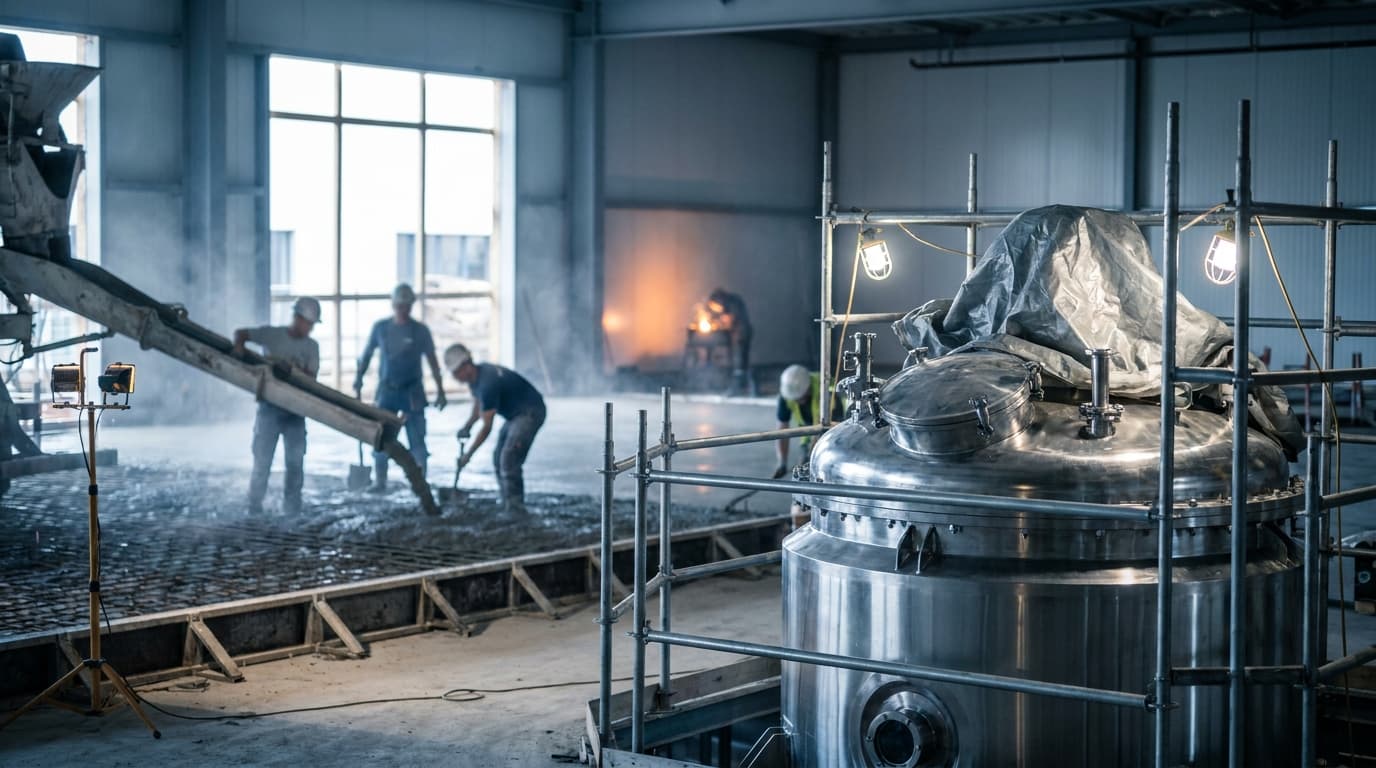
The defining feature of the new pharmaceutical tariff regime is a calendar problem. On July 31, 2026, a 100% ad valorem duty begins biting the largest branded drugmakers selling into the United States. The industry's answer to that duty is a wave of domestic plant construction now totaling more than $480 billion in pledges. The trouble is that a greenfield pharmaceutical facility takes roughly three to five years to move from approved concept to first commercial batch. No amount of pledged capital changes the fact that concrete cannot cure, lines cannot be qualified, and batches cannot be released before the deadline arrives. For the next several years, this is not a construction story. It is a compliance, contracting, and capex-timing story.
The order itself
On April 2, 2026, the White House issued a Section 232 national-security proclamation titled Adjusting Imports of Pharmaceuticals and Pharmaceutical Ingredients into the United States. The legal vehicle matters: Section 232 frames imported drugs and their key inputs as a national-security and supply-chain vulnerability rather than an ordinary trade dispute, which is the rationale the administration laid out in its accompanying fact sheet.
The headline rate is 100% ad valorem, and it lands on patented and branded pharmaceutical products together with key inputs, including active pharmaceutical ingredients (APIs). Critically, generic pharmaceuticals and their associated ingredients are not subject to the Section 232 tariff at this time. That carve-out is the single most important scoping line in the order, and it shapes everything downstream: the duty targets the high-margin branded book, not the commodity generic supply that dominates U.S. prescription volume.
The rate ladder
The 100% figure is a ceiling, not a flat tax. The proclamation builds a ladder, and where a company lands on it depends on geography and on the deals it is willing to sign. As the legal analysis from Ropes & Gray details, the structure runs as follows:
-
15% allied-country rate. Products from the European Union, Japan, Korea, and Switzerland/Liechtenstein face 15% rather than the full 100%.
-
0% through January 20, 2029. Companies that sign both a most-favored-nation (MFN) pricing agreement with the Department of Health and Human Services and an onshoring agreement with the Department of Commerce pay nothing through that date. The linkage between the tariff and MFN drug pricing is the lever explained by Clinical Leader - the off-ramp is as much a pricing concession as a manufacturing one.
-
20% rising to 100%. Companies with a Secretary-approved plan to onshore production pay 20% - but that rate escalates to the full 100% four years after the proclamation, roughly April 2030. The discount is a runway, not a destination.
Read together, the ladder turns a tariff schedule into a negotiating table. A firm's effective rate is a function of which agreements it executes, and each off-ramp carries an embedded cliff edge - January 20, 2029 for the deal track, ~April 2030 for the plan track.
Two deadlines, one design
The effective dates are staggered by design. Companies named in Annex III - the large manufacturers - face the July 31, 2026 start. Everyone else gets until September 29, 2026. The sequencing concentrates the immediate pressure on exactly the firms with the biggest branded import exposure and the deepest pockets to either pay or negotiate, while giving smaller players a roughly two-month reprieve. Membership in Annex III is therefore not a footnote; it determines who is first to the July 31 cliff.
The $480B reshoring wave
The industry response has been loud and large. According to Think Global Health, 14 firms have pledged more than $480 billion over the next four to ten years, spanning roughly 22 new manufacturing sites and about 44,000 new jobs. The named companies read like a roster of the global branded industry: Eli Lilly plus AbbVie, AstraZeneca, Bristol Myers Squibb, Gilead, GSK, Johnson & Johnson, Merck, Novartis, Novo Nordisk, Pfizer, Roche, and Sanofi.
Eli Lilly is the anchor case. As pharmaphorum reported, Lilly unveiled a roughly $27 billion program in late February 2026 built around four new U.S. plants - three for small-molecule API production and one extending its injectables capacity - lifting its total planned U.S. capex above $50 billion. Trade-press coverage from Pharma Manufacturing framed the spend explicitly against tariff pressure, reading the capex as much as a political signal as an operational one.
Why the math doesn't close in time
Here is where the pledges collide with physics and validation science. A greenfield pharmaceutical facility typically takes about three to five years from concept approval to first batch, according to a build-timeline breakdown from IntuitionLabs: roughly 6 to 12 months of design, 12 to 24 months of construction, and 12 to 18 months of commissioning, qualification, and validation (CQV). Installing a single new sterile line on its own has historically taken two to three years. Sterile injectables - precisely the capacity Lilly's fourth plant addresses - are the slowest of all.
The timelines in the pledges confirm the gap. Per Think Global Health, even early groundbreakings are slated for 2026 to 2027 "at the earliest," a characterization attributed to Repligen's CEO. Stack a 2026-2027 groundbreaking on top of a three-to-five-year build, and meaningful new domestic capacity does not arrive until roughly 2028 to 2030. The July 31, 2026 cliff sits years ahead of the first qualified batch. The $480 billion is real, but on the deadline's clock it is a forward commitment, not present-tense relief.
The supply base can't be repointed by July 31
Even setting aside construction time, the upstream chemistry is concentrated offshore in ways that cannot be rerouted in a single summer. U.S. Pharmacopeia's Quality Matters analysis documents how geographically concentrated API manufacturing capacity remains. Brookings quantifies the exposure: China controlled roughly 80% of global generic API supply by 2023, and India - itself a major API source - depends on China for roughly 70% of its own API and bulk-drug imports. The two largest alternative supply nodes are therefore either Chinese or China-dependent. A tariff effective July 31 cannot conjure a domestically rooted ingredient base that does not yet exist.
The compliance and contracting reality
Because the plants can't open in time, the near-term action moves into legal and compliance functions. Affected firms face a three-way near-term choice: pay the tariff, sign an MFN-pricing-plus-onshoring deal with HHS and Commerce for 0% through January 2029, or accept the 20%-rising-to-100% onshoring-plan track. Each path generates obligations. The 0% route ties a manufacturer to MFN pricing commitments with HHS and a Commerce onshoring agreement; the 20% route requires a Secretary-approved onshoring plan. Both create documentation, audit, and milestone-tracking exposure - plan approvals to secure, agreement terms to satisfy, and effective dates to manage against Annex III status. The compliance organization, not the construction crew, owns the next 18 months.
Capex against the cliff edges
The balance-sheet logic is a trade between front-loaded spend and tariff avoidance, with hard dates baked into every option. A firm signing the deal track buys a 0% rate but inherits the January 20, 2029 expiry; a firm on the plan track buys a 20% rate but watches it escalate toward 100% by roughly April 2030. Either way, the pledged capex must convert into qualified, batch-releasing capacity before those edges arrive, or the cost-avoidance case unwinds. The capital is being deployed not merely to build plants but to outrun two specific calendar dates.
What to watch next
The signal worth tracking is who signs versus who pays. Watch which firms execute MFN-plus-onshoring deals for the 0% rate and which absorb the tariff or take the 20% plan track; watch the composition of Annex III, since membership sets the July 31 versus September 29 line; watch for legal challenges to the scope of Section 232 as applied to pharmaceuticals; and watch the 2026-2027 groundbreaking milestones that will reveal whether the pledged sites are moving on schedule. The plants will eventually matter. Until they open, the story lives in contracts and customs entries.
Related reading
Sources
-
Fact Sheet: Tariffs on Patented Pharmaceutical Products - The White House
-
Tracking Pharma's Progress on U.S. Onshoring Efforts to Avoid Tariffs - Think Global Health
-
Lilly unveils $27bn reshoring drive around four new plants - pharmaphorum
-
Editor's (re)View: Eli Lilly's $27B investment in US manufacturing - Pharma Manufacturing
-
Global manufacturing capacity for APIs remains concentrated - U.S. Pharmacopeia (Quality Matters)
-
[US drug supply chain exposure to China - Brookings](https://www.brookings.edu/articles/us-drug-supply-chain-exposure-to-china/)
-
Pharmaceutical Plant Development: From Concept to Commissioning - IntuitionLabs
-
U.S. Pharma Tariffs And MFN Become Law After April 2 Update - Clinical Leader