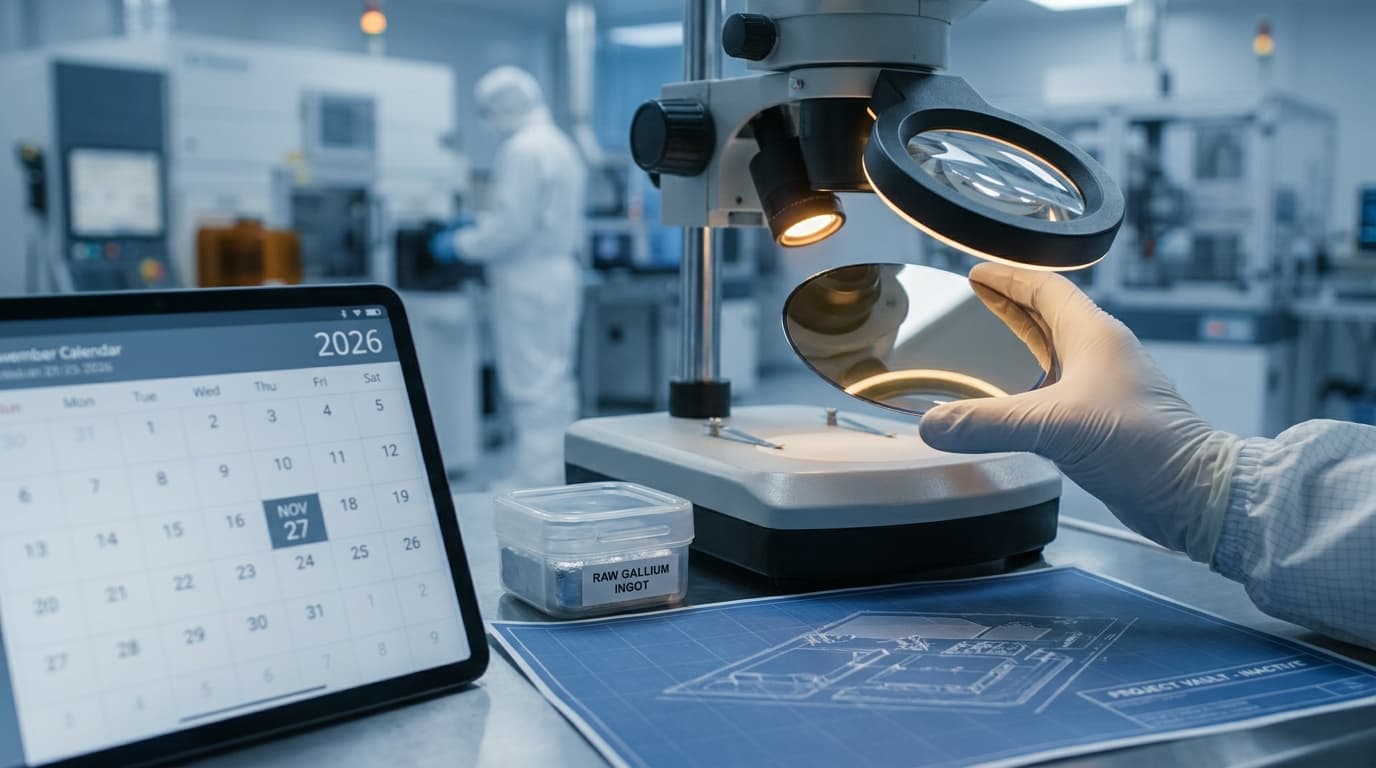
Put the date on the calendar: November 27, 2026. That is when China's one-year suspension of its export ban on gallium, germanium, antimony and superhard materials lapses by default — and unless Beijing affirmatively renews it, the controls snap back on their own. The reprieve that took effect on November 9, 2025 was never a rollback. It is a truce with a clock, and the clock is now measured in weeks and months, not years.
The distinction matters more than the headline relief suggested. When China's Ministry of Commerce (MOFCOM) suspended Article 2 of Announcement No. 46 (2024) — the December 3, 2024 outright ban on U.S.-bound exports of these materials — it also paused the broader October 9, 2025 global control expansion. But it left the underlying legal machinery fully intact. This is a pause button, not a delete key, and the difference is the whole story for anyone building a semiconductor or defense bill of materials over the next 18 months.
The architecture that stayed intact
To read the leverage correctly, separate three layers that the coverage tends to collapse into one.
First, the base: China has required export licenses on gallium and germanium since 2023. That licensing regime is the foundation, and it never went away. Second, the U.S.-specific escalation: the December 3, 2024 ban under Announcement No. 46, which cut off American buyers entirely. That is the piece MOFCOM suspended — Article 2 — effective November 9, 2025 through November 27, 2026. Third, and critically, the April 4, 2025 Announcement No. 18, which put seven medium and heavy rare earths — samarium, gadolinium, terbium, dysprosium, lutetium, scandium and yttrium — under license requirements. Announcement 18 was not suspended. It continues to require licenses today.
So what actually happened in November 2025 is narrow: one article of one announcement was paused, in exchange for Washington delaying its Export Administration Regulations 'Affiliates Rule,' following the late-October 2025 Trump–Xi meeting in South Korea. The suspension of the gallium, germanium and antimony ban reopened a specific channel, but the surrounding licensing apparatus — 2023 base, April 2025 rare-earth list — remains legally operative. As the Foundation for Defense of Democracies framed it, Beijing paused some curbs while retaining the levers of control.
And this is not the first cycle. The December 2024 ban was itself the escalation; the November 2025 suspension is the second turn of a suspend-and-reinstate wheel. Each cycle demonstrates that the leverage is retained, not surrendered — the tap can be reopened and closed again on Beijing's timeline.
The chokepoint, quantified
Why does a single article of a single Chinese announcement re-price global supply chains? Because of where these materials come from. According to the U.S. Geological Survey, China accounts for roughly 99% of world primary low-purity gallium production and about 98% of refined gallium. Total world gallium output in 2024 was only about 760 tonnes — of which China produced roughly 750 tonnes. This is not a large, liquid commodity market with many suppliers and fungible substitutes. It is a thin, concentrated stream controlled almost entirely by one country.
The economics explain the concentration — and why it is so hard to break. Primary gallium is not mined directly. It is recovered as a byproduct of aluminum (bauxite/alumina) and zinc refining. Standing up recovery capacity outside China requires capital investment and multi-year lead times that the pre-2023 price simply never justified. When gallium was cheap and freely available, no Western refiner had a business case to build recovery circuits. The controls created the incentive, but incentives do not compress the physics or the construction schedule of a refinery.
Washington's answer, itemized
The U.S. response has been real and substantial — but it is a stockpiling-and-financing play, not a production play. Three pieces stand out.
Project Vault. Announced February 2, 2026, the EXIM Board approved a Direct Loan of up to $10 billion — more than double EXIM's largest-ever financing — plus roughly $2 billion in private investment, to build the U.S. Strategic Critical Minerals Reserve. The public-private reserve is designed to cover all 60 minerals on the USGS 2025 Critical Minerals List. Participants read like a cross-section of the industrial economy: GM, Stellantis, Boeing and Google as offtakers, with Hartree Partners, Mercuria Americas and Traxys among the suppliers and traders.
Section 232. On January 15, 2026, President Trump issued Proclamation 11001 after Commerce found that imports of processed critical minerals and derivative products threaten national security. Notably, there were no immediate tariffs. Instead, the administration ordered negotiations with a 180-day report due around July 13, 2026. The record itself is the alarming part: the U.S. is fully import-dependent for 12 critical minerals and more than 50% reliant on 29 others, with processed critical minerals 'embedded across defense and commercial supply chains.'
The financing stack. The State Department cites more than $30 billion in letters of interest, investments, loans and other support for critical-minerals projects over the prior six months. EXIM alone has issued $14.8 billion in letters of interest under the current administration. Gallium-specific support includes the TRACE-Ga (Technology for Recovery and Advanced Critical-material Extraction – Gallium) project and seven LOIs worth more than $2.2 billion tied to a Pentagon-backed gallium refinery in Western Australia, enabling up to $5 billion in total investment.
Why the buildout loses the race
Here is the mismatch that no press release resolves. Every instrument above — the $10 billion loan, the reserve, the $30 billion stack — is either finance or inventory. None of it is operating refining capacity. As the Bipartisan Policy Center notes, America's deepest vulnerability is not raw material access but the absence of commercial-scale midstream processing and refining for materials like gallium and germanium. A stockpile can bridge a gap; it cannot manufacture new supply. A loan can fund a refinery; it cannot make that refinery reach commercial output before the concrete cures.
The timelines do not intersect. Midstream refining capacity is built on a horizon measured in years — permitting, engineering, byproduct-circuit integration, qualification. The snap-back deadline is measured in weeks and months. The Western Australia refinery LOIs and TRACE-Ga are the right kind of investment, but they are early-stage. On November 27, 2026, if China lets the suspension lapse, the U.S. will still have no commercial-scale domestic gallium or germanium refinery running at capacity. The reserve will hold whatever it managed to buy during the truce, and then it will draw down against a closed tap.
The operator story: what re-prices, and why
For operators, the abstraction of export policy becomes concrete in the bill of materials. Gallium and germanium are not commodity fillers; they are functional feedstocks for compound semiconductors and electro-optical/infrared systems that have no drop-in silicon substitute.
Gallium feeds gallium-nitride (GaN) RF and power electronics. As the technical literature on gallium-based field-effect transistors documents, these devices operate across roughly 2–18 GHz, tolerate temperatures above 200°C, and deliver on the order of 40–50% efficiency gains over silicon in electronic-warfare and radar applications. Germanium feeds electro-optical/infrared optics and fiber. The downstream defense exposure is specific: systems including the AN/FPS-117 radar, AEGIS and Patriot depend on these material chains.
That is the transmission mechanism. A snap-back does not merely raise a spot price on an exotic metal; it re-prices semiconductor and defense bills of materials at the component level, before any U.S. refinery reaches capacity to absorb the shock. Operators exposed to GaN RF/power devices or germanium optics should be pricing that November event into procurement and contract terms now, not treating the current suspension as a return to normal.
What to watch
-
Renewal or lapse: Whether China affirmatively extends the suspension or lets it expire by default on November 27, 2026. Default is snap-back; silence is not neutral.
-
The Section 232 report (~July 13, 2026): The 180-day negotiation outcome will signal whether the U.S. moves to tariffs on processed critical minerals or secures alternative-supply commitments.
-
Project Vault drawdowns: First reserve purchases and offtake activity — how much material actually gets stockpiled during the open window.
-
Refining milestones: Any concrete construction or commissioning progress on TRACE-Ga or the Western Australia gallium refinery, the only line items that address the actual bottleneck.
The asymmetry
Strip away the announcements and the shape of the problem is stark: on one side, a policy timeline you can put on a calendar — a suspension with an expiration date, a negotiation with a due date, a reserve with an approved loan. On the other, a physical buildout you cannot accelerate — refining capacity that takes years to stand up against a deadline that arrives in months. Money and stockpiles are moving fast. Molecules are not. Until a U.S. refinery is actually turning bauxite and zinc residues into gallium at commercial scale, the leverage stays where it has been since 2023, and the November snap-back remains the single most consequential date on the critical-minerals calendar.
Related reading
-
The Pentagon's Additive Budget Jumped 83% to $3.3B — and Velo3D's $9.8M DLA Contract Is the Tell
-
[The Pentagon Guaranteed $110 a Kilo for 10 Years: Inside MP Materials' $1.25B Texas 'Magnet Independence' Bet Against China's 90% Grip](/article/mp-materials-10x-texas-magnet-plant-pentagon-price-floor-china)
Sources
-
China suspends ban on exports of gallium, germanium, antimony to US — CNBC
-
China Pauses Some Rare Earth Export Curbs While Retaining Levers of Control — FDD
-
Beyond Rare Earths: China's Growing Threat to Gallium Supply Chains — CSIS
-
EXIM Approves Project Vault Loan to Launch America's Strategic Critical Minerals Reserve — EXIM.gov
-
Week in Review: Project Vault and the U.S. Strategic Critical Mineral Reserve — EXIM.gov
-
[Trump Administration Announces Results of Critical Minerals Investigation Under Section 232 — Covington & Burling](https://www.cov.com/en/news-and-insights/insights/2026/01/trump-administration-announces-results-of-critical-minerals-investigation-under-section-232-and-directs-us-officials-to-initiate-negotiations)
-
2026 Critical Minerals Ministerial — U.S. Department of State
-
Progress in Gallium Oxide Field-Effect Transistors for High-Power and RF Applications — PMC/NIH