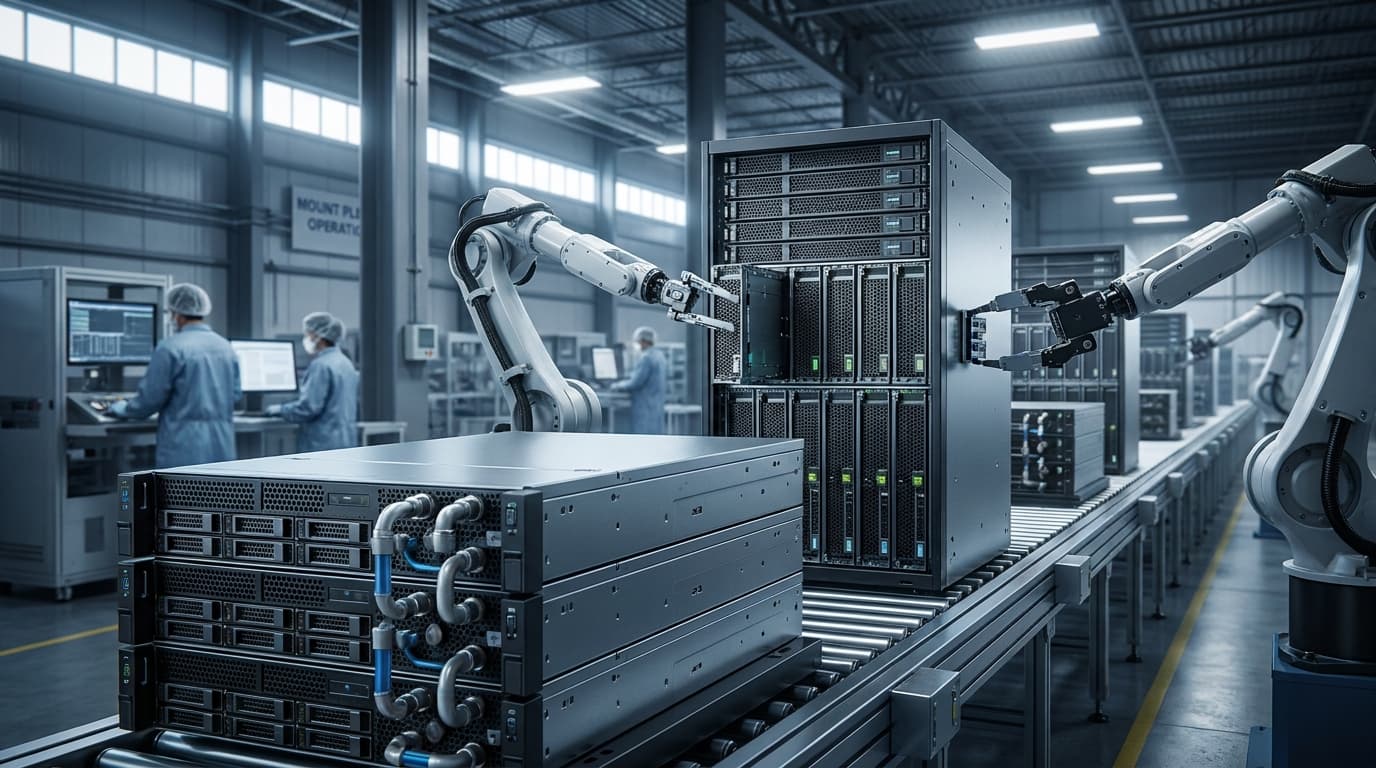
The most consequential thing happening on Foxconn's Mount Pleasant campus is not the one the state of Wisconsin is still measuring. The 2017 LCD-fab thesis — the one that produced the incentive package, the eminent-domain fights, and the running national punchline — is functionally dead. What replaced it, with very little fanfare and a great deal of capital, is a downstream AI-server integration operation that has become structurally important to the way at least two U.S. hyperscalers source rack-scale compute.
In November 2025, Foxconn announced a $569 million expansion of the Mount Pleasant site explicitly framed around AI and data-server demand, projecting 1,374 new jobs over four years. Under the modified state contract, Foxconn now pledges 2,616 jobs and $1.2 billion in capital investment by the end of 2029 — a far cry from the original Wisconn Valley promises, but, unlike those promises, attached to a product line with visible end-customer demand.
From fab promise to rack integrator
The repositioning did not start in 2025. It started in 2020, when Foxconn began assembling components for Google's data-center servers at Mount Pleasant — at the time, the only U.S. site capable of surface-mount assembly for Google's hardware. That contract gave the campus a baseline of EMS work: SMT lines, board-level assembly, the unglamorous core of contract manufacturing.
What changed in late 2025 was the customer profile and the scale. On November 20, 2025, OpenAI and Foxconn announced a partnership to co-design and build multiple generations of AI servers, racks, networking equipment, cooling systems and power infrastructure in the United States. The structure is worth reading carefully: the deal includes no purchase commitments. OpenAI gets early access and option-to-buy on the resulting hardware. Foxconn gets a design partner and a credible anchor narrative for U.S. capacity.
That posture is consistent with what Hon Hai has been telling investors. At the company's May 14, 2026 investor briefing, Foxconn guided that AI server shipments will more than double year-over-year in 2026, with cloud and networking products already accounting for roughly 50% of group revenue in Q1 2026. April 2026 revenue grew about 30% year-over-year, driven primarily by rack-scale AI assembly for hyperscalers deploying Nvidia GB200/Blackwell systems. Foxconn is among the principal chassis and rack ODMs for the GB200 NVL72 platform.
What is actually being built in Mount Pleasant
The Wisconsin site is not where every Foxconn AI server originates — most of that volume still ships from Asia and Mexico — but the work it now houses is recognizable to anyone who has walked an EMS floor: SMT lines for server boards, rack-scale integration for Nvidia GB200-class systems, liquid-cooling loop test capacity (called out specifically in the November 2025 expansion announcement), and networking and power subassembly work for hyperscaler customers.
The labor profile this requires is not the cleanroom semiconductor operator the original LCD-fab thesis promised. It is high-mix EMS work: surface-mount assembly, rack integration, liquid-cooling loop verification, burn-in. That maps directly onto the existing Midwest EMS labor base in Wisconsin, Illinois, Ohio and Minnesota — a quieter but more durable industrial story than the one originally sold to the state.
The cluster nobody planned
Foxconn's pivot has, almost incidentally, produced a hyperscaler-anchored mega-site. In January 2026, Mount Pleasant approved Microsoft's plans for 15 additional data centers, with taxable value above $13 billion, on the former Foxconn footprint. Microsoft is also tapping previously unused Foxconn-allocated power capacity — turning what looked like a stranded infrastructure subsidy into a hyperscaler power buffer.
That juxtaposition matters. Mount Pleasant now hosts the integrator (Foxconn), an adjacent end-user buildout (Microsoft), and grid capacity that was originally provisioned for a fab that never ran at scale. Whether by design or by accident, the village has aggregated the kind of compute, power and assembly density that hyperscalers normally have to assemble across multiple states.
The peer set is not following Foxconn into the Midwest
This is the part that should interest U.S. industrial readers most. The Tier-1 U.S.-listed EMS peers are visibly chasing the same AI-infrastructure demand — but they are not chasing it into the Midwest.
-
Jabil has committed $500 million to a new Southeast U.S. facility, operational mid-2026, targeting hyperscaler and AI cloud infrastructure.
-
Flex is on track for roughly $6.5 billion in data-center revenue in 2026 — about 35% year-over-year growth — anchored on NVIDIA and LG partnerships.
-
Celestica is expanding U.S. capacity through 2027, tied to Google TPU rack systems.
None of these EMS peers has publicly identified a Midwest site comparable to Foxconn's Wisconsin pivot. The capex is real, but the geography is concentrated in the Southeast, where the labor market, utility costs and incentive landscape have historically favored greenfield EMS investment. Foxconn's Wisconsin position therefore looks less like the leading edge of a Midwest reshoring wave and more like a single-anchor exception — durable, but unreplicated.
What this changes for operators and investors
Three implications are worth taking seriously.
First, the U.S. EMS supply base for AI hardware is bifurcating geographically. Foxconn's Mount Pleasant operation is the only Midwest mega-anchor for hyperscaler integration; the rest of the Tier-1 EMS expansion is happening in the Southeast. That has real consequences for logistics, labor sourcing, and the regional spillover work — board houses, cable assemblers, sheet-metal shops, liquid-cooling component suppliers — that orbits any large rack integrator.
Second, the labor demand is structurally different from what was originally underwritten. SMT operators, rack integrators and liquid-cooling QA technicians are not the same hires as semiconductor cleanroom staff. The training pipelines, the wage bands and the supplier-tier skills profile all shift. Wisconsin technical colleges and the regional EMS labor base are inheriting a workload they were better suited for than the one the original incentive package presupposed.
Third, the state-incentive arithmetic has been reset. The modified 2024 contract that produced the 2,616-job and $1.2 billion-by-2029 commitments is a much more conservative instrument than the original Wisconn Valley deal. If Foxconn hits those numbers on the back of AI-server demand, Wisconsin will end up with something closer to a normal large EMS site — valuable, but not transformative in the way the 2017 announcement promised.
Open questions
Several things remain genuinely unclear. How much of Foxconn's AI-server output is actually U.S.-built versus assembled in Mexico or Asia is not broken out cleanly in Hon Hai's segment reporting. Whether the OpenAI partnership generates meaningful Wisconsin volume — or remains a design-and-readiness exercise that ships its production volume offshore — will only be visible in the 2026 and 2027 capex and hiring trail. The hyperscaler concentration risk that Mount Pleasant now embodies is real: a campus whose economics depend on three or four end customers is a campus whose economics can move quickly.
But the headline change is settled. The Mount Pleasant site is no longer a stranded promise. It is a working AI-server integrator inside a hyperscaler cluster, and the financial trail is now in Foxconn's data-center segment guidance rather than in Wisconsin's incentive paperwork. For a project that spent most of a decade as shorthand for industrial-policy failure, that is a quieter and more interesting outcome than anyone was expecting.
Related reading
-
Intel's Ohio Slip to 2030 Forces Commerce to Convert Its Biggest CHIPS Bet into Equity
-
GLP-1 Capex Is Quietly Outpacing the EV Buildout — and Lilly and Novo Are Driving It
Sources
-
OpenAI taps iPhone assembler Foxconn to manufacture AI hardware in US — CNBC (Nov 20, 2025)
-
Foxconn to spend $569M expanding Wisconsin factory — Manufacturing Dive
-
Foxconn to build Google servers at controversial Wisconsin plant — DCD
-
Jabil's US$500M Manufacturing Expansion for AI Data Centres — Data Centre Magazine
-
Celestica Expands AI Infrastructure Portfolio — Yahoo Finance