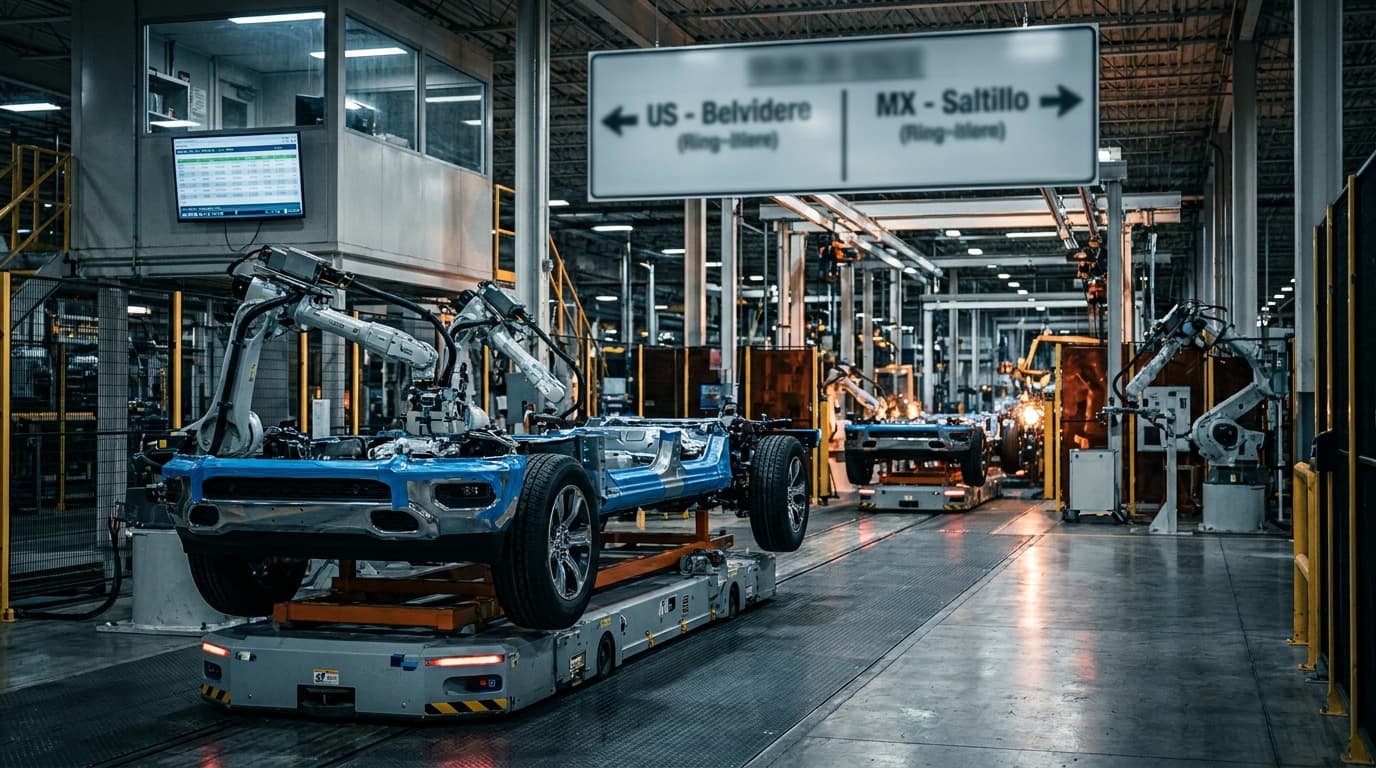
The 2026 round of Stellantis-UAW conflict is being miscategorized in most coverage as a sequel to the 2023 Stand Up Strike — a wage fight with picket lines. It is not. The strike authorization votes Shawn Fain is now sequencing across Stellantis facilities are about where the next generation of Ram pickups, Jeep crossovers, and HEMI V8s get assembled. That is a fundamentally different bargaining problem, with a different cast of interested parties, and a different set of operators who stand to lose money if it goes badly.
The trigger: a $13 billion promise, then a Belvidere slip
In October 2025, Stellantis announced what it called the largest single US manufacturing commitment in company history: $13 billion over four years spread across Illinois, Michigan, Indiana, and Ohio. The package included reopening the idled Belvidere Assembly plant for the next Jeep Cherokee and Compass (roughly 3,300 jobs, with about 1,500 UAW members recalled), a $400 million Toledo Assembly investment to add an all-new Ram midsize truck alongside Wrangler and Gladiator (about 900 jobs), the next-generation Dodge Durango at Detroit Assembly Complex, and a $100 million-plus Kokomo investment for the new GMET4 EVO four-cylinder engine starting in 2026.
Three months later, the timeline began to move. Per Detroit News reporting on January 28, 2026, and subsequent Reuters coverage, the UAW now puts Belvidere's reopen at roughly June 2028 — a slip of about a year from the original 2027 target. UAW Local 1268, which represents Belvidere workers, has continued to organize publicly around the delay.
Running in parallel, Stellantis has been expanding its Saltillo, Coahuila complex in Mexico. Saltillo currently assembles the Ram 1500, the 6.4-liter HEMI BGE V8, and the twin-turbo 3.0-liter Hurricane I6. Autoblog reports Stellantis is targeting 100,000-plus HEMI V8 engines for 2026, with much of that volume currently routing through the Saltillo line. MoparInsiders separately reports that HEMI expansion is no longer location-locked to Saltillo — a notable detail given that the union now has a live argument that V8 work could plausibly be allocated north of the border.
The UAW has framed this gap — US commitments slipping right, Mexican capacity ramping on schedule — through its Keep the Promise campaign. That framing is the reason the 2026 disputes do not look like 2023.
The strike-vote sequence so far
The first 2026 Stellantis strike authorization vote was held at the Los Angeles Parts Distribution Center, where, per the UAW, members overwhelmingly approved a walkout if US investment commitments are not honored. The union has explicitly tied authorization to investment compliance, not wage scales.
Bloomberg reported on May 1, 2026 that a second vote was scheduled May 7–8 at Sterling Heights Assembly — Local 1700, roughly 6,000 workers, the plant that builds the Ram 1500 — over a skilled-trades outsourcing dispute. That vote was called off after Stellantis agreed to let the union bid on the work in question. The Sterling Heights episode matters less for what happened than for what it signaled: Fain is prepared to authorize strikes plant-by-plant, on plant-specific operational issues, and use each vote to reinforce the broader allocation argument. The UAW has also documented company-side counter-pressure, publishing robocalls from Stellantis urging members to vote no.
CBS Detroit's local coverage captures the on-the-ground stakes: the dispute is being absorbed in southeast Michigan and northern Illinois as a US-jobs question, not a pay question.
What is actually moving south
Per Mexico News Daily and Automotive Logistics, Stellantis's expansion of Mexican operations under the Dare Forward plan is broader than HEMI volume. Reporting on planned Ram pickup production in Mexico has been the most politically combustible piece of the footprint shift, because the Ram 1500 is the program around which Sterling Heights Local 1700's leverage is built. Whether or not specific Ram variants ultimately move, the credible threat of allocation flexibility is itself the negotiating weapon — and the union understands that.
This is also not a Stellantis-only story. Mexico Business News documents a broader industry pattern of OEMs reworking the US-Mexico production split. Stellantis is the OEM where labor leverage has crystallized first.
The under-reported angle: Tier 1 sunk capex
This is the part of the 2026 cycle that is not yet in the mainstream business press, and operators close to the negotiations are watching it carefully. The argument is straightforward: when an OEM announces a vehicle program tied to a specific assembly plant, Tier 1 suppliers — body, driveline, transmission, casting, seating — commit tooling capital against that location. Belvidere Jeep Cherokee and Compass, Toledo midsize Ram, Detroit Durango: each carried Tier 1 sourcing decisions made on the original timeline. A Belvidere slip from 2027 to 2028, or worse a quiet allocation change, does not simply hurt UAW members. It strands supplier capex.
Procurement Magazine's supplier-side analysis of the $13B announcement is the closest published proxy for this view — it reads the Stellantis package primarily as a Tier 1 sourcing event, not just an OEM capex story. BorgWarner's Q3 2025 earnings call contains the kind of program-timing language that suppliers use when they have meaningful exposure to OEM allocation decisions, though the call stops well short of naming Stellantis programs specifically.
To be clear about what is and is not in evidence: there is no public reporting confirming that Magna, BorgWarner, or American Axle are formally coordinating with the UAW on production-location commitments. That coalition, if it exists, is operating quietly through the normal channels — sourcing reviews, program-timing conversations, and back-channel pressure on OEM purchasing. What can be said with confidence is that the structural incentive for such a coalition is now sharper than it has been in any prior cycle, because OEM allocation flexibility has become the live variable in a way that wage scales were in 2019 and 2023.
The leverage math has changed
In 2019 (GM strike) and 2023 (Stand Up Strike), the negotiating geometry was OEM versus union, with suppliers as collateral exposure. If 2026 plays out the way the current strike-authorization sequence suggests, the geometry becomes OEM versus union plus a supplier base with sunk Midwest tooling that depreciates faster if work moves to Saltillo. That is a different leverage equation, and it explains why Fain is sequencing votes around plant-specific operational disputes — each vote keeps the allocation question live without forcing a single all-or-nothing economic action.
What operators should watch
-
Belvidere retooling start date. The original timeline implied retooling kickoff materially earlier than where it now sits. A confirmed retooling start in 2026 would substantially defuse Fain's headline argument; continued slippage into 2027 sharpens it.
-
Saltillo HEMI volume disclosures. The 100,000-plus 2026 target is the most concrete production number in play. Watch the next Stellantis 6-K and any supplemental operating data for actual versus planned volumes — and for any indication that HEMI work is being multi-sourced back into the US, which would be the company's most credible de-escalation move.
-
Q2 2026 Tier 1 earnings calls. Listen specifically for Magna, BorgWarner, and American Axle commentary on program-timing risk and capacity utilization at Midwest plants tied to Stellantis programs. Even guarded language here is informative.
-
Which UAW local gets the next authorization vote. The sequencing tells you Fain's read of where leverage is strongest. A vote at a Toledo or Detroit local would escalate the allocation argument materially; a vote at another parts distribution center would suggest the union is still building the political case.
The counter-move risk
The supplier-coalition thesis has a clean Stellantis counter-move: route around the US Tier 1 base by sourcing more aggressively from Mexican Tier 1s — Nemak on castings, Metalsa on frames, and the broader Coahuila-Nuevo León supplier cluster that already feeds Saltillo. The cross-OEM context in Mexico Business News's reporting suggests this capacity exists and is being built out industry-wide. A material shift in Stellantis's Tier 1 sourcing mix toward Mexican suppliers would be the clearest signal that the OEM has decided to break the implicit Midwest coalition rather than negotiate with it.
The original Toledo and Belvidere commitments are also still publicly tied together — WTOL's local Toledo reporting bundles them as a single allocation promise. That bundling is a feature, not a bug, for the union: if either commitment slips, both communities have a reason to escalate, and so does the supplier base that tooled for the original program map.
This is no longer a wage cycle. It is a production-location cycle, and the operators with the most money at risk are not in Auburn Hills or Detroit — they are in the Tier 1 plants whose IRR models were built on US allocations that the OEM is now visibly free to reconsider.
Related reading
Sources
-
Stellantis to Invest $13 Billion to Grow in the United States — Stellantis press release, October 2025.
-
Stellantis set to delay Belvidere plant reopening, UAW official says — Detroit News, January 28, 2026.
-
Stellantis pushes back Belvidere assembly plant reopening to 2028, UAW says — Reuters via Yahoo Finance.
-
Stellantis: Keep the Promise! — UAW campaign site.
-
First Stellantis strike authorization vote at LA Parts Center — UAW press release.
-
UAW video exposes Stellantis robocalls urging no vote — UAW.
-
UAW Schedules Strike Authorization Vote at Stellantis Ram Truck Plant — Bloomberg, May 1, 2026.
-
UAW, Stellantis announce commitment to Toledo plant, reopening of Belvidere — WTOL 11.
-
UAW 1268 shares update on Belvidere Stellantis plant — WIFR, March 30, 2026.
-
Report: Stellantis Planning Mexican Production for Ram Pickups — The Truth About Cars.
-
Stellantis planning major expansion of its Mexican operations — Mexico News Daily.
-
Stellantis adds models to Mexico production in Dare Forward plan — Automotive Logistics.
-
HEMI Is Back: Stellantis Targets 100,000+ V8 Engines for 2026 — Autoblog.
-
Stellantis Working On Expanding HEMI V8 Production — MoparInsiders.
-
Stellantis: $13bn US Plan Set to Reshape Sourcing — Procurement Magazine.
-
BorgWarner (BWA) Q3 2025 Earnings Call Transcript — Motley Fool.
-
Tension between UAW and Stellantis causes fear that some U.S. auto jobs could vanish — CBS Detroit.
-
Mexico Auto Sector Shifts as Stellantis, GM Rework Operations — Mexico Business News.