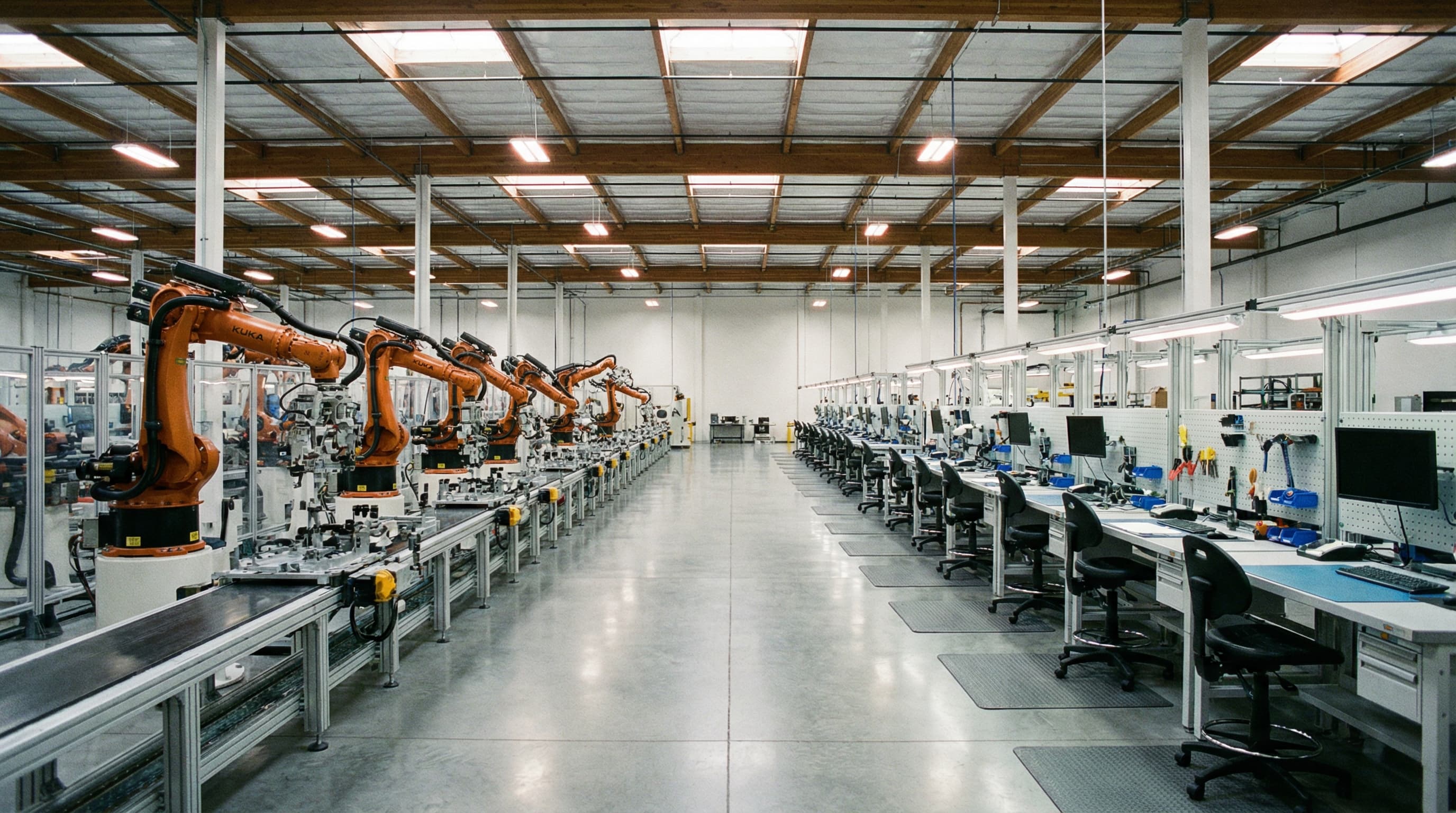
Output Is Up. Headcount Is Down. That's Not a Contradiction.
U.S. industrial production posted its fourth consecutive month of gains in February 2026, with manufacturing output rising 0.7% in January and 0.2% in February. Q4 2025 delivered the best quarterly reading since 2022. High-tech equipment production surged 8.6% year-over-year, driven largely by semiconductor reshoring and AI infrastructure buildout.
Meanwhile, manufacturing lost 12,000 jobs in February. That follows 90,000 jobs lost across all of 2025, the third straight year of decline. The BLS diffusion index for manufacturing fell to 45.1, meaning more subsectors are cutting than adding. The ISM Employment Index has now sat below 50 for 13 consecutive months.
Factories are producing more. They are hiring less. And the gap between those two lines is the most important chart in American manufacturing right now.
The ISM Numbers Tell the Story
ISM's Manufacturing PMI hit 52.4% in February, marking two straight months of expansion after a long contraction stretch. The production index has been in expansion territory for four consecutive months. Orders are coming in.
But the employment index at 48.8% tells the other half. Susan Spence, ISM's committee chair, put it plainly: "These panelists are telling us we don't know, even after Supreme Court, what other tariffs are gonna be lobbed. And so our customers are ordering in very small increments."
Forty-five percent of ISM panelists said their priority is managing existing headcounts, not expanding them. When your order book is growing in small, unpredictable increments, you run overtime before you hire. You cross-train existing operators before you onboard new ones. You invest in automation that gives you flex capacity without fixed labor cost.
That's rational behavior for a plant manager working with a six-month planning horizon that keeps getting shorter.
Capacity Utilization: Room to Run Without Hiring
Manufacturing capacity utilization sits at 75.6%, a full 2.6 percentage points below the long-run average going back to 1972. That slack matters. It means the average factory has roughly 24% of its theoretical capacity sitting unused.
When utilization is this low, output gains don't require new hires. They require better scheduling, fewer changeovers, longer production runs, and smarter deployment of the workforce already on the floor. A facility running at 75% doesn't need a second shift. It needs the first shift running closer to plan.
This is partly why the production-employment divergence isn't as alarming as the headline numbers suggest. Factories aren't replacing workers with robots overnight. They're squeezing more throughput out of existing capacity with existing people. The automation investment is real, but it's layered on top of basic operational improvement that should have been happening for years.
The Tariff Freeze Is Real
Teresa Fort, an economist at Dartmouth who studies trade and manufacturing, described the tariff dynamic in terms that any purchasing manager would recognize: "There is no way for a firm to plan with any kind of confidence of what are its costs gonna be, how long is it going to last."
That uncertainty hits hiring harder than production. A manufacturer can adjust material sourcing in weeks. Shifting suppliers, renegotiating contracts, passing through cost increases -- these are painful but executable. Hiring is a different commitment. Training a CNC operator takes 6-12 months. Onboarding a maintenance technician for a complex automation line can take longer. The 400-person labor gap at TSMC Phoenix is a case study in how hard it is to build a skilled manufacturing workforce, even with virtually unlimited capital.
No plant manager is going to commit to that timeline and cost when the tariff environment could change their product economics in a single executive order. So they hold. They run lean. They authorize overtime and tolerate the burnout it creates, because overtime is variable cost and headcount is fixed.
Fort added context on the downstream effects that rarely make headlines: "Maybe it helps steel a little bit, but all the sectors that are downstream from steel are hurt because now they have a crucial input that is more expensive." The tariff math creates winners and losers within manufacturing, not just between manufacturing and other sectors.
Where the Jobs Actually Went
Jason Miller, a supply chain economist at Michigan State, offered the longer view: "Our manufacturing payrolls have never recovered from the global financial crisis of 2008, 2009. We lost over 25% of our manufacturing during that recession."
That context matters. The current decline isn't a sudden collapse. It's the continuation of a structural trend that accelerated through COVID, paused briefly during the 2021-2022 recovery, and resumed as automation investment caught up with pandemic-era labor scarcity.
The BLS data shows roughly 12.6 million total manufacturing employees as of January 2026. Nearly 500,000 positions remain open. The gap isn't that manufacturers don't want to hire. It's that the people they want to hire don't exist in the quantities or locations needed.
Assembly Magazine reported that hiring priorities are shifting from traditional machine operators toward digitally fluent technicians who can program, maintain, and troubleshoot automated systems. That's a different labor pool. The 55-year-old CNC lathe operator retiring next year and the 24-year-old robotics technician replacing him are not interchangeable, and the pipeline producing the latter is thin.
Automation Spending Tells You Where This Goes
The global industrial robotics market is projected to hit $65.1 billion in 2026, with robot shipments expected to grow 7% or more after a flat 2025. AI in process manufacturing is forecast to reach $12.97 billion by year-end. Eighty-five percent of manufacturers say they plan to prioritize digital transformation over the next 12 months.
Those numbers translate to shop floor reality in a specific way. Rockwell Automation's Q1 orders were down 8%, reflecting the near-term hesitation that tariff uncertainty creates. But the company's backlog and forward pipeline suggest the spending is deferred, not canceled. When the uncertainty window closes -- or manufacturers simply accept it as the new normal -- the automation capex will land.
And when it does, it will not create the same job-per-output-unit ratio that the old capacity did. A new palletizing cell replaces three to four material handlers. A vision inspection system replaces two quality inspectors per shift. An automated guided vehicle fleet replaces a forklift team. Each of these investments adds output capacity without adding headcount. That's the point.
The Two-Speed Reality
American manufacturing is not in decline. Output says otherwise. It is not booming, either. Employment says otherwise.
What's happening is a structural reconfiguration. Factories are producing more per worker, investing in automation that smooths labor volatility, and holding off on permanent hires until the policy environment stabilizes. The 75.6% capacity utilization number means there's room to keep growing output without adding people, at least for another few quarters.
The question is what happens when utilization pushes toward 80% and the slack runs out. At that point, manufacturers either hire, invest in the next round of automation, or cap their growth. Reshoring projects already face 8-month waits for basic utility infrastructure. Adding workforce on top of that bottleneck makes the planning horizon even more uncertain.
For plant managers, the play right now is clear: run what you have harder, invest in flexibility, and don't lock in fixed costs you can't unwind if the next tariff announcement changes your bill of materials overnight. Whether that's good long-term industrial strategy is a different question. But it's rational. And the data says that's exactly what's happening.
Frequently Asked Questions
Why is manufacturing employment falling while industrial production is rising?
Factories are producing more per worker through a combination of automation investment, operational improvements, and low capacity utilization (75.6%) that allows output gains without new hires. Tariff uncertainty is also freezing hiring decisions, as manufacturers run overtime rather than commit to permanent headcount.
What does the ISM Manufacturing PMI at 52.4% mean?
A PMI reading above 50 indicates the manufacturing sector is expanding. February 2026's reading of 52.4% marked the second consecutive month of expansion after a prolonged contraction. However, the employment subindex at 48.8% shows that hiring is still contracting even as overall activity grows.
How are tariffs affecting manufacturing hiring decisions?
Policy uncertainty is causing customers to order in small increments, making it difficult for manufacturers to forecast demand. Training a skilled manufacturing worker takes 6-12 months, and managers are unwilling to make that commitment when tariff changes could alter their cost structure overnight. The result is more overtime and temporary labor rather than permanent hires.
How many manufacturing jobs are open in the U.S. right now?
Nearly 500,000 manufacturing positions remain unfilled nationwide as of early 2026, despite the sector losing 90,000 jobs in 2025. The gap reflects a skills mismatch: manufacturers increasingly need digitally fluent technicians who can operate and maintain automated systems, while the retiring workforce skews toward traditional machine operation skills.
Is automation replacing manufacturing jobs?
Automation is changing the composition of manufacturing jobs more than eliminating them outright. The global industrial robotics market is projected at $65.1 billion in 2026, and 85% of manufacturers plan to prioritize digital transformation. Each automation investment adds output capacity without proportional headcount, shifting demand from manual operators to technicians who can program and maintain automated systems.