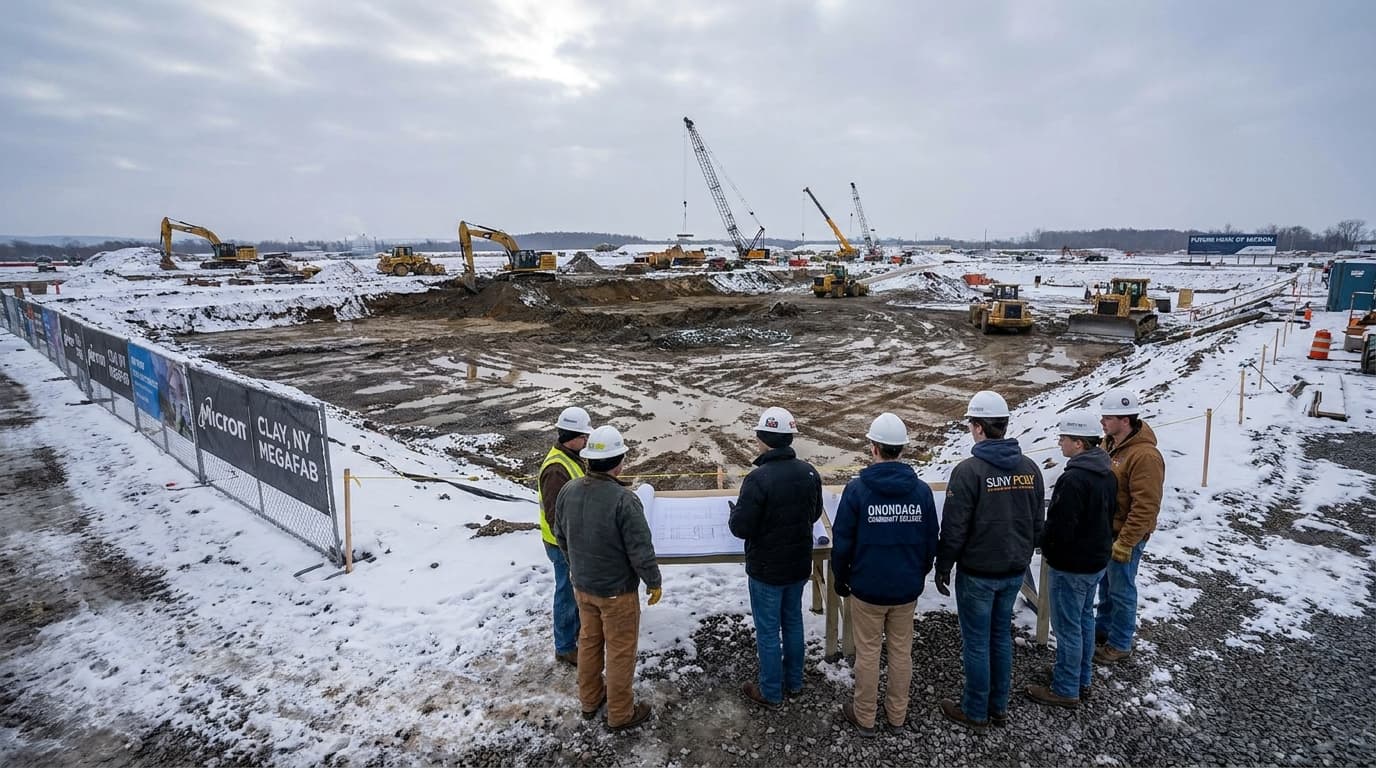
On January 16, 2026, Gov. Kathy Hochul and Micron CEO Sanjay Mehrotra stood on a frozen patch of the 1,377-acre White Pine Commerce Park in Clay, N.Y., and ceremonially broke ground on what Micron describes as the largest private investment in New York State history: a four-fab memory complex with a 20-year buildout and a roughly $100 billion price tag. The ceremony, which moved indoors to Syracuse University's National Veterans Resource Center, was the political headline. The harder problem starts the moment the bulldozers leave.
Micron's own projections peg full buildout at roughly 9,000 direct Micron jobs and ~50,000 total state jobs once indirect and induced employment is counted. The supply side of that math, in Onondaga County, is currently producing technicians in dozens per cohort.
What actually broke ground
The Jan. 16 event marked the formal start of construction on the Clay megafab campus, with Fab 1 as the lead structure in a sequenced four-fab plan. Engineering News-Record had earlier documented the slip of construction start into 2026 — a reminder that 'broke ground' in megafab parlance covers a long arc from site prep to tool move-in, with subsequent fabs phased in over roughly two decades. Construction Dive's coverage framed Clay as the largest greenfield semiconductor project in U.S. history by announced dollar value.
The site itself is owned by the Onondaga County Industrial Development Agency, and the four-fab vision sits inside Micron's broader ~$125 billion U.S. expansion plan. Tool move-in for Fab 1 is the operational milestone that matters most for workforce planners; that's the point at which clean-room-qualified technicians must exist in real numbers, not in press releases.
The CHIPS money trail — and the quiet rebalance toward Boise
Micron's federal envelope was sized in late 2024. The Commerce Department awarded up to $6.165 billion in direct CHIPS Act funding across the company's Idaho and New York projects, with the original allocation tilted heavily toward Clay.
That tilt narrowed in 2025. According to reporting on the amended CHIPS agreement, Micron redirected roughly $1.2 billion of its New York allocation toward its Boise ID2 fab. Clay's federal share fell from approximately $4.6 billion to $3.4 billion; Idaho's rose to roughly $2.75 billion. The company's June 2025 8-K filing is the primary SEC disclosure for the amended terms.
Officially, the reallocation reflects Boise's earlier readiness and accelerates ID2 production. Read alongside the New York schedule slip, it also tells industry watchers something useful: the federal piece of the capital stack is willing to move when ramp risk concentrates in one geography. Community-investment optics still favor Central New York — Micron has committed $500 million for the NY region versus $75 million for Idaho — but the production-capacity dollars followed the readier site.
The workforce supply side is real — and small
Central New York is not standing still on technician training. The state and Micron have stood up a formal workforce partnership through NY CREATES. In October 2025, Onondaga Community College unveiled a $15 million cleanroom simulator, a facility designed to give associate-degree students hands-on time in protocols that mirror actual fab floor work. A Micron executive at the unveiling framed the demand bluntly: roughly half of the jobs at full buildout are technician roles, not engineers.
Upstate, SUNY Poly's Semiconductor Processing to Packaging Research, Education, and Training Center received an additional $4 million in funding and is projected to train up to 150 students per year at capacity. And the inaugural OCC–Advance 2 Apprenticeship Semiconductor Technician Bootcamp, which ran from late February through mid-May, graduated 11 technicians.
Stack those numbers together honestly: a flagship bootcamp graduating in the single digits per cohort, a SUNY Poly training center aiming for roughly 150 students per year at full capacity, and a community college cleanroom that just opened its doors. Against ~9,000 direct Micron roles phased in over a 20-year buildout — half of them technicians — the supply curve is in the right shape but the wrong order of magnitude. McKinsey's industry-wide analysis projects the U.S. semiconductor technician gap persisting and worsening through approximately 2028 absent step-change scale-up in training throughput.
The relocation risk hiding in the timeline
When fabs miss their local-hiring ratios, the slack gets filled in one of two ways: internal transfers from existing sites or H-1B and contractor flows. TSMC's Arizona project is the case study most industry analysts cite for the first failure mode; Intel's Ohio One project illustrates the second risk — schedule slippage compounding workforce-pipeline maturity problems.
Micron has not publicly framed Clay as a relocation play; its New York expansion materials remain anchored to local hiring and community investment. But the structural pressure is visible in the numbers: tool move-in for Fab 1 lands in the late-decade window that McKinsey identifies as the tightest technician squeeze, and the 2025 CHIPS reallocation already established that capital can move when one site readies faster than another. Onondaga's pipeline does not need to match 9,000 in year one — it needs to credibly trend toward several hundred qualified technicians per year by the time Fab 1 needs them.
What success looks like — and what failure looks like
Success, from a Central New York standpoint, is OCC's cleanroom simulator and SUNY Poly's STPC scaling from inaugural cohorts to multi-hundred annual throughput over the next 24 months, with bootcamp graduate counts moving from 11 to triple digits per cycle. Failure isn't a dramatic announcement; it's the quieter outcome where Fab 1 tool move-in arrives and the marginal technician hire ends up being an internal transfer from Boise or Manassas because the local pipeline didn't ramp in time. Local coverage of the groundbreaking captured the political mood; the workforce-pipeline disclosures over the next four quarters will reveal whether the underlying capacity is catching up to it.
For operators and investors watching the broader U.S. memory landscape, the read-through is straightforward. Micron's New York commitment is real, the campus is now physically underway, and the CHIPS Act envelope still tilts the project's federal economics toward viability. The constraint that determines whether Clay scales to four fabs on the announced timeline isn't permitting, financing, or even EUV tool delivery. It's how many qualified technicians Onondaga County can put through a cleanroom door per year — and that number, today, is small.
Related reading
-
Wolfspeed's Mohawk Valley SiC Fab Is Ramping Just as the Market It Was Built For Cools
-
Intel's Ohio Slip to 2030 Forces Commerce to Convert Its Biggest CHIPS Bet into Equity